Executive Overview
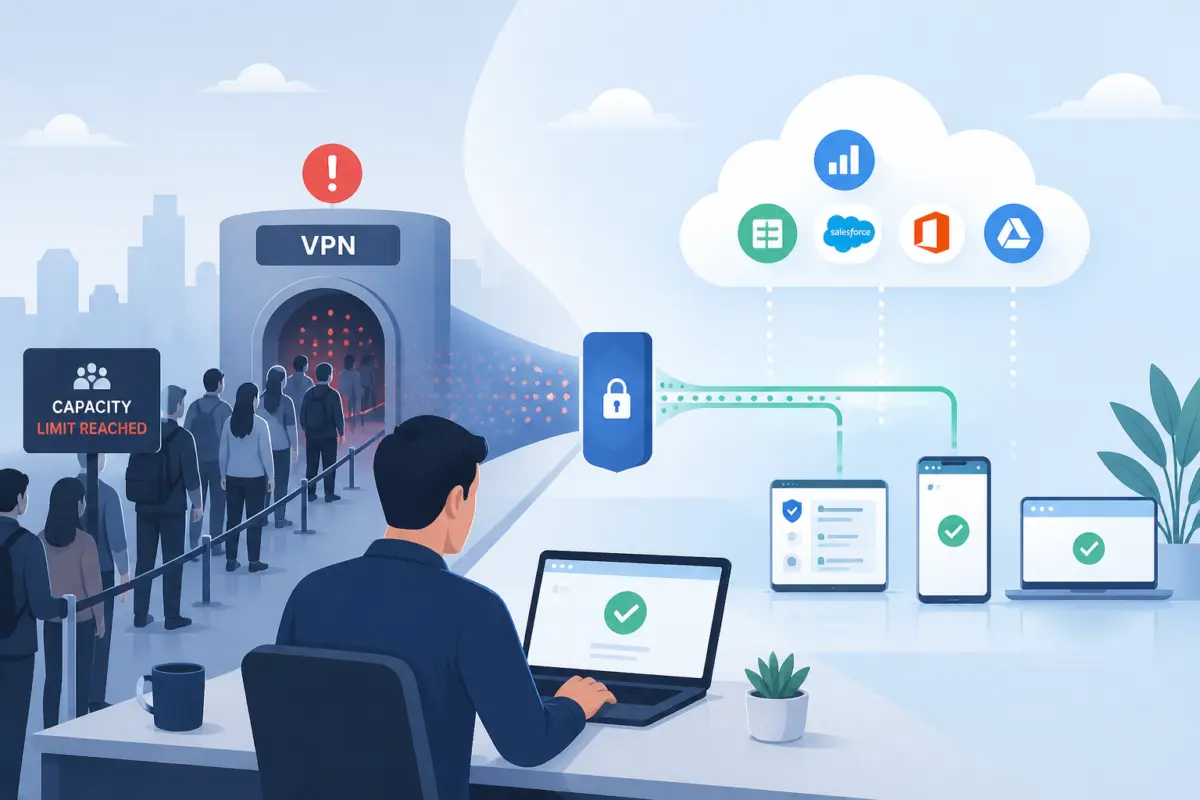
In an era defined by decentralized operations, rapid workforce expansion, unexpected merger integrations, and sudden remote work mandates, corporate Virtual Private Networks (VPNs) are increasingly pushed past their operational limits. Traditionally regarded as the gold standard for secure remote access, conventional VPN architecture is fundamentally bottlenecked by the concept of the perimeter: it grants full network access by default, channeling all remote traffic through a centralized gateway. When organizational growth or surge demands overwhelm these gateways, enterprises face severe disruptions.
The immediate corporate reaction is often to throw more bandwidth at the problem or purchase additional VPN licenses. However, seasoned IT and cybersecurity leaders recognize that the solution does not lie in discovering how many additional tunnels a gateway can accept. Rather, it begins with analyzing which applications employees actually need to perform their daily duties.
By decoupling application sessions from the traditional VPN tunnel—leveraging application publishing, desktop virtualization, and browser-based access tools—organizations can maintain business continuity without compromising security. This architectural shift aligns cleanly with the National Institute of Standards and Technology (NIST) principle of protecting individual resources rather than entire network segments. This comprehensive report examines how modern enterprises audit their remote infrastructure, implement alternative delivery platforms, navigate deployment models, and execute phased migrations to future-proof their digital workplaces.
Detailed Chronology: The Evolution of Remote Access Pressures
To understand why traditional VPNs are buckling under modern workloads, it is helpful to trace the timeline of how remote access infrastructure has been tested over the past decade.
Phase One: The Perimeter-Based Baseline
For decades, corporate networks operated under a castle-and-moat security model. Employees connected to the office network via physical Ethernet cables or, when traveling, through rudimentary VPN clients. Because remote workforces were typically small—consisting of traveling executives or occasional telecommuters—gateway hardware was sized for fractional utilization. Concurrent-session ceilings and bandwidth limits rarely intersected with real-world constraints.
Phase Two: The Shift Toward Universal Mobility
As cloud adoption accelerated and mobile devices permeated the workplace, the volume of remote connections steadily climbed. Enterprises began expanding their VPN gateways, layering on multi-factor authentication (MFA), and optimizing bandwidth. However, the fundamental architecture remained unchanged: every remote worker received a virtual IP address and full visibility into corporate network segments, vastly expanding the enterprise attack surface.
Phase Three: The Scalability Crisis and Modern Breaking Points
Recent years have introduced unprecedented volatility into workforce planning. Sudden global shifts to remote work, aggressive corporate mergers, and rapid contractor onboarding have caused user counts to skyrocket overnight. Organizations suddenly found their existing VPN infrastructure operating at 150% to 200% capacity.
During peak hours, authentication servers became choking points, and connection limits began rejecting new sessions while prematurely dropping established ones. Single-gateway configurations buckled under the strain of routing millions of packets through a solitary network chokepoint. It became glaringly obvious that linear scaling of legacy VPN architectures was no longer economically or technically viable, forcing IT leaders to look toward application-centric alternatives.
Supporting Context & Metrics: Auditing and Diagnosing VPN Bottlenecks
Before deploying any alternative remote access solution, an enterprise must diagnose where its existing capacity is evaporating. A superficial glance at daily bandwidth averages is entirely insufficient; organizations must conduct rigorous, data-driven audits during peak operational hours.
Deconstructing the Gateway Bottleneck
The first crucial step is separating the gateway’s concurrent-session ceiling from its raw bandwidth and authentication capacity. Many IT teams mistake a bandwidth shortage for a session limit issue, or vice versa.
- Connection Limits: A gateway can reject new sessions due to hardware seat maximums even when substantial bandwidth remains available. This abruptly locks out logging employees during critical morning hours.
- Authentication Choke Points: When thousands of employees attempt simultaneous logins during peak periods, identity providers (IdPs) and authentication servers become severely constrained, resulting in login timeouts.
- Bandwidth Saturation: Routing all traffic—including video conferencing, web browsing, and heavy file transfers—through a single gateway creates an artificial bottleneck that compromises performance for everyone.
The Three-Question Diagnostic Audit
An effective VPN usage audit relies on gateway logs and application traffic measurements captured during the busiest login window of the week. IT teams should answer three foundational questions:
- Which specific applications account for the vast majority of daily traffic volume?
- Which user groups experience the highest frequency of dropped connections or authentication delays?
- Which workloads require full network access versus those that only require interaction with a single software program?
The applications that surface at the top of this audit become the primary candidates for removal from the VPN tunnel. By establishing baseline measurements of their current traffic load, administrators can later verify whether transitioning these applications to an alternative delivery platform has successfully relieved gateway pressure.
Official Standards, Platforms, and Technical Approaches
Once the audit is complete, organizations must evaluate the technical mechanisms available for moving workloads outside the VPN.
1. Application Publishing vs. Full Network Access
Application publishing delivers specific software programs to remote users while the actual execution happens on centralized servers. Users interact strictly with the application window, maintaining zero visibility into the underlying network segments. This drastically reduces the attack surface.
When evaluating these platforms, administrators must compare bandwidth usage under identical workloads. Assumptions that a published application automatically consumes fewer resources than a full virtual desktop can be misleading; rigorous testing must include peripheral operations like printing and file transfers. Platforms such as TSplus support this model across both on-premises and cloud infrastructures, offering flexible subscription and perpetual licensing models. However, organizations accustomed to larger enterprise stacks must carefully audit integration requirements, as smaller platforms may feature fewer built-in third-party connectors than market giants like Citrix.
2. HTML5 Browser Access and Clientless Delivery
To eliminate client deployment delays and onboarding friction, many organizations are migrating users to HTML5 browser-based delivery models. Employees authenticate directly through standard web browsers (such as Chrome, Edge, or Safari) utilizing existing enterprise credentials, completely bypassing the need to install dedicated client software on personal or contractor devices.
However, "clientless" does not mean universal compatibility. Modern browser delivery architectures come with strict limitations. For instance, platforms utilizing Microsoft’s Windows App requirements mandate supported desktop browsers that are no more than 12 months old, while frequently excluding mobile browsers entirely. IT teams must verify endpoint readiness before declaring browser access a universal fix.
3. Choosing Between On-Premises, Cloud, and Hybrid Delivery
The underlying infrastructure supporting these alternative delivery methods must be selected based on organizational scale, compliance mandates, and operational maturity:
- On-Premises Infrastructure: Keeps hosted software and sensitive data physically within corporate data centers, granting IT teams direct, granular control over hardware, security policies, and network configurations.
- Cloud-Hosted Solutions: Platforms like Microsoft Azure Virtual Desktop provide elastic scaling, accommodating sudden workforce spikes through automated provisioning of full desktops and individual applications. However, organizations remain responsible for properly sizing session host virtual machines and managing cloud expenditure.
- Hybrid Strategies: Combines in-house security controls with cloud scalability by routing overflow demand to the cloud during peak hours. Crucially, hybrid architectures require thorough pre-testing to ensure that internal database and authentication dependencies remain reachable from the cloud under heavy loads.
Matching Licensing Models to Workforce Scaling
Licensing barriers can stall remote expansion just as quickly as hardware limitations. Traditional VPN contracts often charge per user or per device, meaning a sudden doubling of remote staff instantly doubles software licensing costs. Furthermore, administrative approval delays can block access even when gateway capacity is readily available.
Organizations should evaluate payment terms separately from seat counts, analyzing whether subscriptions utilize named-user or concurrent-user models. Multi-year total cost of ownership (TCO) analyses consistently reveal dramatic differences between software vendors, making it vital to match licensing metrics against expected headcount fluctuations rather than list prices alone.
Future Outlook: Phased Migration and Long-Term Resilience
Transitioning away from a legacy VPN dependency cannot be accomplished overnight. A reckless "rip-and-replace" strategy risks catastrophic business interruption. Instead, forward-thinking enterprises are adopting structured, phased migration blueprints.
The Phased Migration Blueprint
- Compatibility Assessment and Staging: Essential business applications are tested thoroughly in staging environments before any end-users are migrated.
- Departmental Piloting: Rather than cutting over the entire company, IT rolls out the alternative delivery platform to a single department. This pilot group is selected based on measured peak sessions and application traffic volume.
- Baseline Validation: Launch times and task completions must match or exceed established performance baselines. Crucially, administrators must conduct successful print and export tests. For cloud-hosted pilots like Azure Virtual Desktop, network latency up to 150 milliseconds is generally acceptable for non-video workloads, but teams must record exact application response times under peak concurrency and secure formal sign-off from application owners.
- Targeted Training: Browser-based tools and virtualized desktops operate differently than traditional installed clients. Brief training sessions and clear, concise documentation drastically reduce the volume of helpdesk support tickets during the first fortnight of deployment.
- Decommissioning and Rollback Readiness: Before retiring VPN access for the pilot group, administrators must cross-reference peak gateway traffic logs with the original audit data to confirm tangible pressure reduction. A designated rollback owner must be assigned to every migration phase in the event that an unhandled database or authentication dependency surfaces.
Conclusion
The era of routing all enterprise traffic through a monolithic, capacity-constrained VPN gateway is rapidly drawing to a close. By auditing actual usage, publishing individual applications in alignment with NIST guidelines, leveraging HTML5 browser access, and adopting flexible hybrid architectures, organizations can build a resilient, scalable remote access strategy. Transitioning away from legacy VPN tunnels is no longer merely an exercise in IT optimization—it is a fundamental prerequisite for modern enterprise agility, security, and uninterrupted business continuity.