Executive Overview
Every software engineering team, at some point in its lifecycle, inevitably confronts a deceptively simple yet profoundly challenging question: How much testing is enough?
For decades, the standard response across the software development industry has defaulted to a philosophy of accumulation: more automated tests, exhaustive regression suites, expanded test environments, and a relentless push to cover every conceivable edge case across an ever-growing matrix of devices and operating systems. However, as modern applications evolve into intricate webs of microservices, third-party APIs, and cloud-native infrastructure—all while release cycles accelerate from quarterly updates to continuous deployment—this traditional approach has hit a brick wall.
Testing everything, even with the augmenting power of artificial intelligence, is no longer a realistic strategy. Modern software teams are under unprecedented pressure to ship faster while simultaneously maintaining uncompromising standards of quality, security, and reliability. The core bottleneck is not a lack of commitment or engineering discipline; rather, it is the simple economic reality that time, computational power, and human attention are finite resources.
In this high-stakes environment, clinging to the outdated goal of 100% test coverage is a recipe for burnout and diminished returns. The question that forward-thinking engineering organizations must ask is shifting from "How much testing is enough?" to "What should we test first?"
The answer to that question lies in the strategic adoption of risk-based testing. By shifting the focus from exhaustive execution to intelligent prioritization based on business and operational impact, development and QA teams can maximize their effectiveness, protect their users, and deliver reliable software without sacrificing speed.
Detailed Chronology: The Evolution of Software Testing Paradigms
To understand how the software industry arrived at the current crossroads of testing overload, it is instructive to examine the chronological evolution of quality assurance practices over the past several decades.
The Era of Waterfall and Exhaustive Verification (1990s – Early 2000s)
During the height of the Waterfall development era, testing was treated as a distinct, downstream phase that occurred only after all code had been written. Release cycles spanned months or even years. Because software updates were infrequent and expensive to deploy, the QA strategy focused heavily on exhaustive, manual verification. Teams had the luxury of time—sometimes weeks or months—to run through massive test scripts, attempting to validate every single requirement and code path.
The Agile Revolution and the Rise of Automation (Mid 2000s – 2010s)
As the software industry transitioned to Agile methodologies, release cadences compressed from years to weeks or even days. Manual testing could no longer keep pace with the velocity of code changes. This catalyzed a massive boom in test automation. Frameworks for unit testing, integration testing, and UI automation proliferated. The prevailing mantra became "automate everything."
While this era drastically improved feedback loops, it also sowed the seeds for modern maintenance fatigue. Organizations accumulated sprawling suites of automated tests that were expensive to maintain, prone to flakiness, and disconnected from the actual business risk of the features they were validating.
The Cloud-Native Complexity Crisis (Present Day)
Today, applications are no longer monolithic entities running on predictable local servers. They are distributed, cloud-native ecosystems comprising dozens of microservices, third-party authentication providers, payment gateways, and asynchronous event queues. Code is pushed to production multiple times a day through continuous integration and continuous deployment (CI/CD) pipelines.
In this hyper-connected, fast-paced landscape, the traditional model of writing more and more tests has broken down. Teams find themselves drowning in CI/CD pipeline queues, waiting hours for test suites to run, only to experience production incidents caused by edge cases that no one thought to script. The industry has reached an inflection point: exhaustive testing is mathematically and operationally impossible, forcing a transition toward risk-prioritized engineering.
Supporting Context & Metrics: The Anatomy of Risk in Modern Engineering
To successfully pivot from a coverage-centric mindset to a risk-based strategy, organizations must first deconstruct what risk actually means in the context of software delivery.
Not Every Bug Carries the Same Weight
One of the most pervasive operational anti-patterns in software engineering is treating every defect as a high-severity emergency. In reality, bugs exist on a wide spectrum of consequence. A typographical error on an internal administrative settings page is an aesthetic nuisance. Conversely, a failure in a user authentication flow, a broken checkout pipeline, or an infrastructure outage affecting a core customer-facing workflow can instantly transform into an existential business crisis, resulting in immediate revenue loss, regulatory non-compliance, and severe reputational damage.
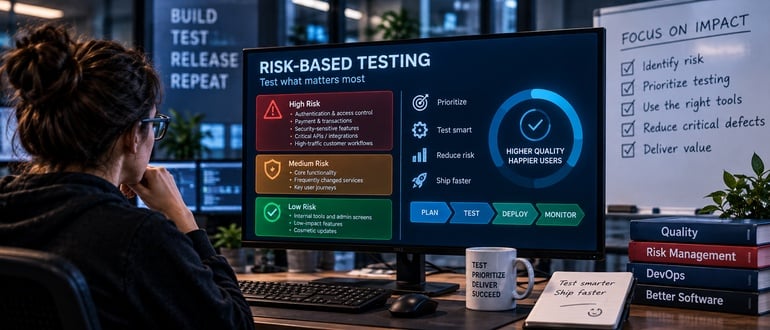
Risk-based testing acknowledges this asymmetry. Instead of spreading testing effort evenly across an entire application codebase, engineering teams allocate their finite QA resources proportionally to the areas where failures would induce the greatest business, operational, or customer-facing impact.
Typically, high-risk components include:
- Core Revenue Pathways: Payment processing, subscription management, and checkout flows.
- Security and Authentication: Identity management, access control lists, and data encryption mechanisms.
- Data Integrity Layers: Database migration scripts, transactional logic, and multi-tenant data isolation.
- Mission-Critical Integrations: Third-party APIs and services upon which core application functionality depends.
Conversely, lower-risk functionality—such as auxiliary reporting dashboards, secondary UI styling elements, or legacy internal tools—still warrants verification, but it does not demand the same depth of exploratory and automated scrutiny as core revenue drivers.
Aligning with Mature DevOps Principles
Interestingly, this risk-first mentality is already deeply embedded in other disciplines within modern DevOps organizations.
Consider how other technical verticals operate:
- Security Teams: They do not attempt to patch every theoretical vulnerability with equal urgency. Instead, they prioritize vulnerabilities based on CVSS scores, exploitability in the wild, and potential data exposure.
- Site Reliability Engineers (SREs): They focus their observability, alerting, and redundancy efforts on mitigating the specific failure modes most likely to cause catastrophic system outages, rather than trying to prevent every minor transient network hiccup.
- Infrastructure Teams: They evaluate the "blast radius" of a configuration change before pushing updates to production, applying rigorous change management only where the risk warrants it.
Testing, as a critical pillar of the software delivery lifecycle, must follow this exact same governing principle. Instead of asking the anxious question, "What haven’t we tested yet?" mature engineering teams are learning to ask: What is the blast radius if this component fails? And what is the probability of that failure occurring?
Official Industry Frameworks and Structured Prioritization
Transitioning to a risk-based testing methodology does not mean relying on gut feelings or ad hoc decisions made in the heat of a sprint planning meeting. The software engineering discipline has established several robust, structured frameworks designed to help organizations systematically evaluate risk and translate those insights into concrete testing priorities.
1. Product Risk Management (PRisMA)
PRisMA is a systematic framework used to identify, analyze, and manage product risks throughout the entire software development lifecycle. By mapping functional requirements against business risk categories (such as safety, financial impact, legal compliance, and user adoption), teams can visually categorize features into risk grids. This ensures that testing efforts are front-loaded and concentrated on high-impact areas.
2. Rapid Risk Assessment (RRA)
Derived from agile and lean principles, RRA enables cross-functional teams to quickly assess the risks introduced by new user stories or architectural changes. By evaluating technical complexity alongside business impact, teams can determine on the fly whether a new feature requires intensive exploratory testing, targeted automated regression, or minimal verification.
3. Quality Functional Deployment (QFD)
QFD is a structured method that translates customer needs and expectations directly into technical requirements and quality measures. By anchoring testing priorities in real-world user value, QFD ensures that engineering teams do not waste valuable cycles testing obscure internal code paths that have little to no bearing on the end-user experience.
4. Cost of Exposure
This economic model estimates the financial and operational impact of potential defects reaching production. By calculating the cost of failure (including remediation time, customer churn, and brand damage) and comparing it against the cost of testing, organizations can make data-driven decisions about where to deploy their QA resources for maximum return on investment.
Regardless of which specific framework an organization chooses to implement, the key to success is consistency. Having a repeatable, collaborative process for evaluating risk before every major release cycle transforms testing from a bureaucratic hurdle into a strategic competitive advantage.
Future Outlook: The Role of AI and Human Judgment in Quality Assurance
As we look toward the future of software engineering, the landscape of quality assurance will continue to be reshaped by technological advancements, most notably the maturation of artificial intelligence and machine learning.
The Augmentation of Testing Through AI
Artificial intelligence is rapidly becoming an indispensable co-pilot for QA and engineering teams. Modern AI tools are increasingly capable of analyzing commit histories, identifying newly modified code paths, suggesting targeted test coverage, and flagging brittle components that may require closer human inspection.
Furthermore, AI-driven visual regression tools and self-healing test scripts are alleviating the immense maintenance burden associated with traditional UI automation suites. By handling the tedious, repetitive aspects of test maintenance, AI frees up human testers to focus on complex, high-value exploratory testing.
The Unreplaceable Value of Human Judgment
Despite these powerful technological leaps, AI cannot—and should not—make autonomous risk prioritization decisions in a vacuum.
Understanding nuanced customer expectations, anticipating shifting business priorities, and weighing the real-world operational impact of a software failure still requires sophisticated human judgment. Artificial intelligence excels at pattern recognition and execution speed, but humans are uniquely equipped to evaluate strategic business risk, empathy for the end-user, and contextual trade-offs.
Shifting the Metric: From Coverage to Confidence
Ultimately, the future of software quality is not about achieving arbitrary coverage metrics. Code coverage percentages and total test execution counts will always hold some diagnostic value, but they are fundamentally vanity metrics if they fail to capture the scenarios most likely to cause production incidents.
A development team can boast an impressive 95% code coverage metric while simultaneously missing the critical user journey vulnerability that triggers a catastrophic outage. Conversely, another team might execute far fewer automated tests overall, yet consistently deliver bulletproof, highly reliable software because every test they run is laser-focused on mitigating real-world business risks.
As software systems grow increasingly complex and the demand for rapid delivery accelerates, exhaustive testing will recede further into the realm of technical impossibility. The organizations that consistently release high-quality, resilient software will not be the ones running the highest volume of tests. Instead, they will be the industry leaders who make the smartest, most disciplined decisions about where testing delivers the absolute highest value.
For modern engineering teams operating under relentless pressure to ship faster, ultimate success will no longer be measured by the sheer volume of tests executed, but by how effectively those targeted tests reduce risk before software ever touches production.