After navigating more than six billion miles of deep space across an arduous eight-year interplanetary voyage, the joint European-Japanese BepiColombo mission has entered the final, most delicate stretch of its journey to Mercury. On Thursday, the spacecraft successfully executed one of the most hazardous operations ever attempted in the inner Solar System: the structural separation and jettisoning of its Mercury Transfer Module (MTM).
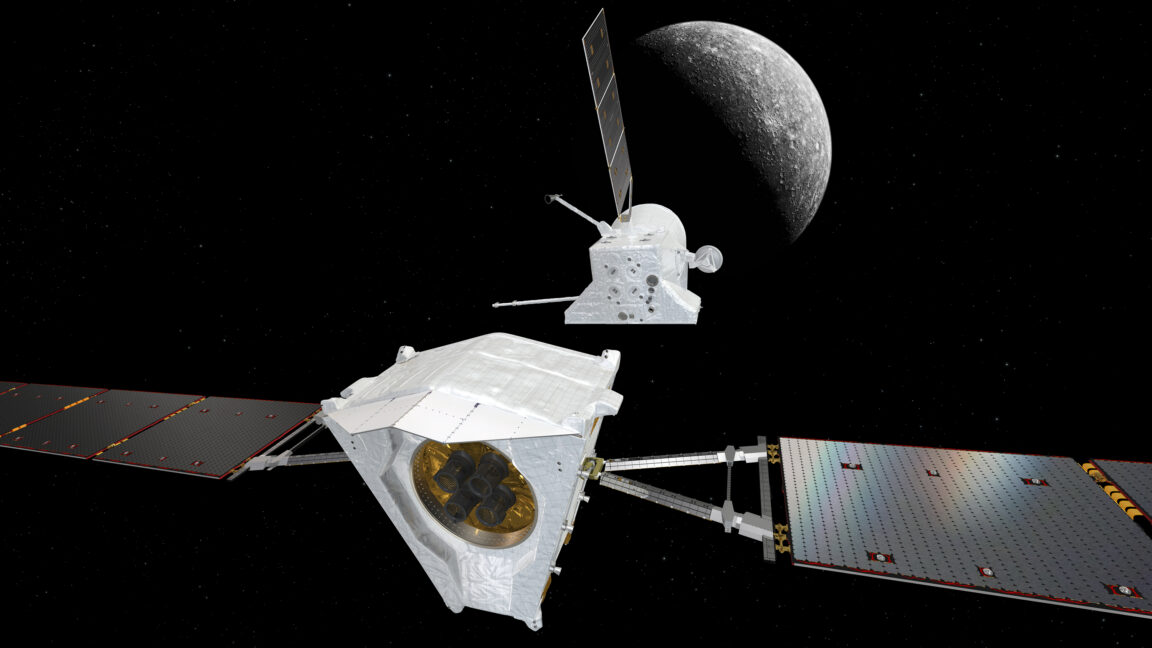
Carrying a price tag of nearly $2 billion and led primarily by the European Space Agency (ESA) with vital contributions from the Japan Aerospace Exploration Agency (JAXA) and NASA, BepiColombo represents an unprecedented milestone in planetary exploration. Unlike previous missions that merely sailed past the Solar System’s innermost world, BepiColombo is designed to split into two independent science orbiters once it arrives. This dual-spacecraft architecture will simultaneously examine Mercury’s hyper-dense core, ancient cratered surface, tenuous exosphere, and volatile-rich polar regions.
The successful discarding of the heavy-ion propulsion module—which served as the spacecraft’s structural backbone and power plant throughout its long cruise—marks a pivotal transition. Operating just 39 million miles from the Sun, where intense solar radiation and crushing thermal loads push engineering limits, the mission team successfully decoupled the systems. With telemetry confirming stable power margins and positive solar array charging, BepiColombo remains firmly on target to achieve orbital insertion on November 21, opening a groundbreaking new chapter in our understanding of planetary origins.
Detailed Chronology: An Eight-Year Odyssey Through the Inner Solar System
The trajectory that brought BepiColombo to the threshold of Mercury is a triumph of modern orbital mechanics and deep-space navigation. Launched in October 2018 aboard an Ariane 5 rocket from Europe’s Spaceport in Kourou, French Guiana, the spacecraft could not take a direct route. Because Mercury orbits so close to the Sun, any probe attempting to reach it from Earth faces a massive gravitational acceleration well. To match speeds with the fleet-footed planet and slip safely into orbit, a spacecraft must shed or gain an immense amount of energy—known technically as delta-v. In fact, reaching and orbiting Mercury demands more propulsive energy than sending a probe to fly by Pluto.
To navigate this energy barrier without consuming impossible amounts of chemical propellant, mission planners designed a complex choreography of planetary flybys. BepiColombo utilized a historic sequence of nine gravity assists—swinging past Earth once, Venus twice, and Mercury itself six times. These flybys acted as cosmic brake pedals and accelerators, gradually shifting the spacecraft’s orbital inclination and spiraling it closer to the Sun.
However, the path was far from smooth. In 2024, the spacecraft’s cutting-edge ion thrusters suffered a partial power degradation. To compensate for the loss of continuous thrust, mission engineers were forced to extend the cruise phase by an entire year, redesigning trajectory corrections on the fly. Despite these setbacks, the spacecraft accumulated over 6 billion miles of transit before reaching the critical deployment milestone this week.
Thursday’s separation event occurred at a distance of roughly 39 million miles (63 million kilometers) from the Sun—less than half the distance between Earth and our star. Preprogrammed commands triggered four heavy-duty springs that forcefully pushed the Mercury Transfer Module away from the dual-orbiter stack. For the mission operations team, this momentary silence was tense. But within hours, data downlinked to ESA’s European Space Operations Centre (ESOC) in Darmstadt, Germany, verified that the Mercury Planetary Orbiter’s (MPO) solar arrays had successfully deployed, caught the sunlight, and begun recharging the onboard batteries.
Supporting Context & Metrics: Architecture of a Dual Orbiter
What sets BepiColombo apart from its historical predecessors—NASA’s Mariner 10 (which executed three flybys in the 1970s) and MESSENGER (which orbited from 2011 to 2015)—is its unique multi-component design.
During its long interplanetary cruise, the spacecraft was configured as a unified stack composed of three distinct segments:
The Mercury Transfer Module (MTM): Built by ESA, this unit housed the four gridded ion thrusters, power-generation systems, and chemical propellant tanks required for the eight-year cruise. It has now been permanently discarded.
The Mercury Planetary Orbiter (MPO): Also built by Europe, this robust, thermally shielded spacecraft is equipped with high-resolution cameras, spectrometers, and radar instruments designed to map Mercury’s surface geology and mineral composition.
The Mercury Magnetospheric Orbiter (Mio / MTM): Provided by JAXA, this spin-stabilized spacecraft will occupy a higher, elliptical orbit. Its primary instruments are dedicated to studying Mercury’s surprisingly active magnetic field, solar wind interactions, and exospheric plasma dynamics.
Mission Parameter
Specification / Detail
Total Program Cost
Nearly $2 Billion
Total Distance Traveled
> 6 Billion Miles (> 10 Billion Kilometers)
Launch Date
October 20, 2018
Planned Orbital Insertion
November 21, 2026
Gravity Assists Used
9 Total (1 Earth, 2 Venus, 6 Mercury)
Current Distance from Sun
~39 Million Miles (~63 Million Kilometers)
Operating in the vicinity of Mercury presents severe engineering hurdles. Temperatures on the sunlit side of the planet soar past 800 degrees Fahrenheit (430 degrees Celsius), while the shadowed side plunges to cryogenic lows of -290°F (-180°C). Furthermore, the spacecraft must contend with intense, unfiltered solar radiation and thermal reflection bouncing directly off Mercury’s barren crust. To survive this punishing environment, the European and Japanese orbiters feature specialized multi-layer insulation blankets, ceramic-coated louvers, and titanium shields.
Official Statements and Expert Perspectives
The complexity of discarding the transfer module so close to the Sun cannot be overstated. Ignacio Tanco, head of inner Solar System mission operations at ESA, emphasized the extreme nature of the maneuver during a press briefing following the separation event.
"This is equivalent to launching a new spacecraft," Tanco told reporters, noting the considerable risk inherent in the operation. "Letting go of the transfer module required the rest of the spacecraft to take over power generation, propulsion, pointing, and thermal control—all while flying perilously close to the Sun. This is something that we could only verify after separation had occurred, utilizing several brand-new sensors and mechanisms within our attitude control system."
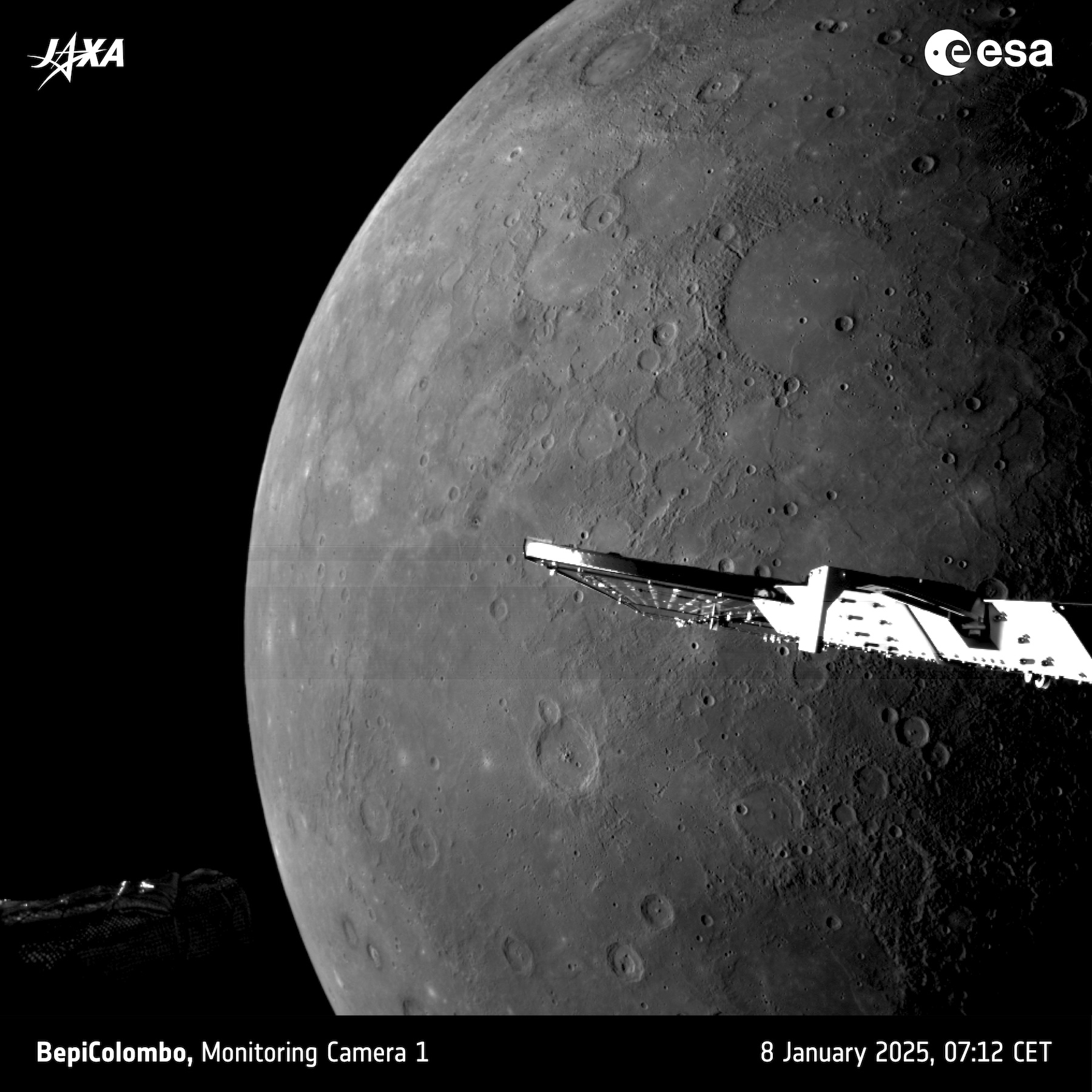
Tanco also highlighted a secondary benefit of the jettison: many of the mission’s primary science instruments, including its highest-resolution cameras, were physically obscured by the bulky propulsion module during the cruise phase. “It is only now, upon the release of the transfer module, that these instruments will see first light,” he added.
Elsa Montagnon, BepiColombo’s spacecraft operations manager at ESA, expressed immense relief and satisfaction as telemetry data confirmed the health of the remaining stack.
"The solar arrays were shielded and did not see direct sunlight during the cruise phase," Montagnon explained. "We now have direct confirmation that power margins are fully positive, that the solar arrays are generating nominal power, and that the batteries depleted during separation are actively recharging. This is all stellar news for the team."
Santa Martinez, ESA’s mission manager for BepiColombo, underscored the broader philosophical and scientific motivations driving the decades-long endeavor.
"It’s a remarkably ambitious mission," Martinez said. "Mercury is notoriously difficult to reach and operate around because of the extreme environment so close to the Sun. But what makes this mission truly unique is that for the first time in space exploration history, we are bringing two independent spacecraft to orbit this mysterious body simultaneously. This is going to provide humanity with unprecedented, multi-perspective views of Mercury and open an entirely new chapter in our understanding of how our Solar System formed."
Future Outlook: Unlocking the Secrets of the Innermost Planet
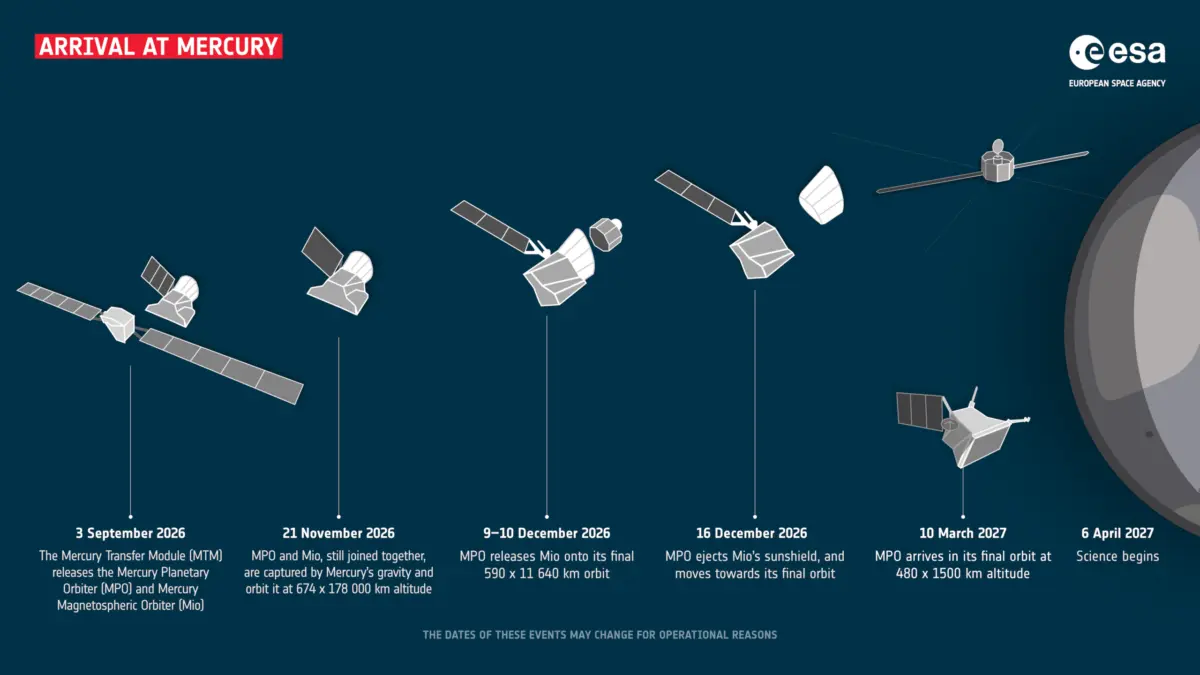
With the transfer module successfully cleared from its path, BepiColombo is now on a direct trajectory for orbital capture on November 21. Over the weeks following arrival, the stacked European and Japanese orbiters will perform final braking maneuvers before decoupling from one another in December.
While the MPO settles into a low polar orbit to map the planet’s topography and mineralogy, Mio will rise into its designated higher orbit to measure energetic particles and magnetic fluctuations. Routine, synchronized scientific operations are slated to begin in April, once all instruments have completed calibration and checkout in the harsh Mercurian environment.
Geraint Jones, ESA’s project scientist for BepiColombo, noted that the mission aims to resolve lingering mysteries left behind by NASA’s MESSENGER spacecraft, which exhausted its fuel supply and impacted the planet’s surface in 2015.
"There is a massive amount left to be learned," Jones observed. "We need to map the entire planet in high resolution and answer specific questions raised by MESSENGER’s pioneering work—such as the nature of the volatile-rich water ice hiding inside permanently shadowed polar craters."
By analyzing Mercury’s disproportionately massive iron core, its unexpected intrinsic magnetic field, and the ways solar wind strips material from its airless surface, scientists hope to piece together a comprehensive history of terrestrial planet formation. As BepiColombo prepares for its final orbital insertion, humanity stands on the precipice of decoding the evolution of the Solar System’s most extreme rocky world.