Executive Overview
The artificial intelligence boom was built on a foundational truth: large language models needed massive oceans of text scraped from the internet to learn language, reason, and converse. But as the frontier of technology pivots from the digital screen to the physical world, the robotics industry faces a starkly different reality. There is no internet equivalent for the physical world. Robots cannot simply scrape YouTube or Wikipedia to learn how to fold a fitted sheet, delicately handle a glass beaker, or navigate a cluttered warehouse floor. They require high-fidelity, real-world teleoperation data—and capturing that data is notoriously messy, expensive, and unglamorous.
Enter XDOF, an ambitious startup aiming to solve the ultimate bottleneck of physical AI. Less than three months after emerging from stealth and announcing a $70 million Series A funding round, XDOF is already locked in late-stage negotiations for a massive Series B round. According to multiple sources close to the transaction, the new financing values the startup at an eye-watering $1.2 billion, with venture capital powerhouse 8VC leading the charge.
The velocity of XDOF’s growth has caught even Silicon Valley veterans by surprise. Initially, the company had no immediate plans to return to the fundraising market so soon after its summer capital injection, which featured heavyweights like Thrive Capital, Andreessen Horowitz, Lux Capital, and Spark Capital. However, a hyper-accelerated revenue trajectory—with annualized figures rapidly approaching the $50 million milestone—prompted aggressive inbound interest from top-tier venture capitalists eager to secure a stake in the infrastructure layer of physical robotics.
While terms remain fluid and the deal has not yet been finalized, the valuation underscores a surging investor thesis: XDOF is positioning itself as the Scale AI or Mercor of the physical world. By acting as an outsourced data-supply chain for frontier AI labs and robotics companies, XDOF is building the foundational data pipelines, collection tools, and annotation systems that are vital to bringing general-purpose robots out of the laboratory and into everyday life.
Detailed Chronology: From UC Berkeley Research to Silicon Valley Unicorn Status
The origins of XDOF trace back to an academic frustration. While pursuing his Ph.D. at the University of California, Berkeley, researcher Philipp Wu found himself hamstrung by a persistent barrier in his studies on how robots learn from large datasets: the utter scarcity of large-scale, high-quality physical data.
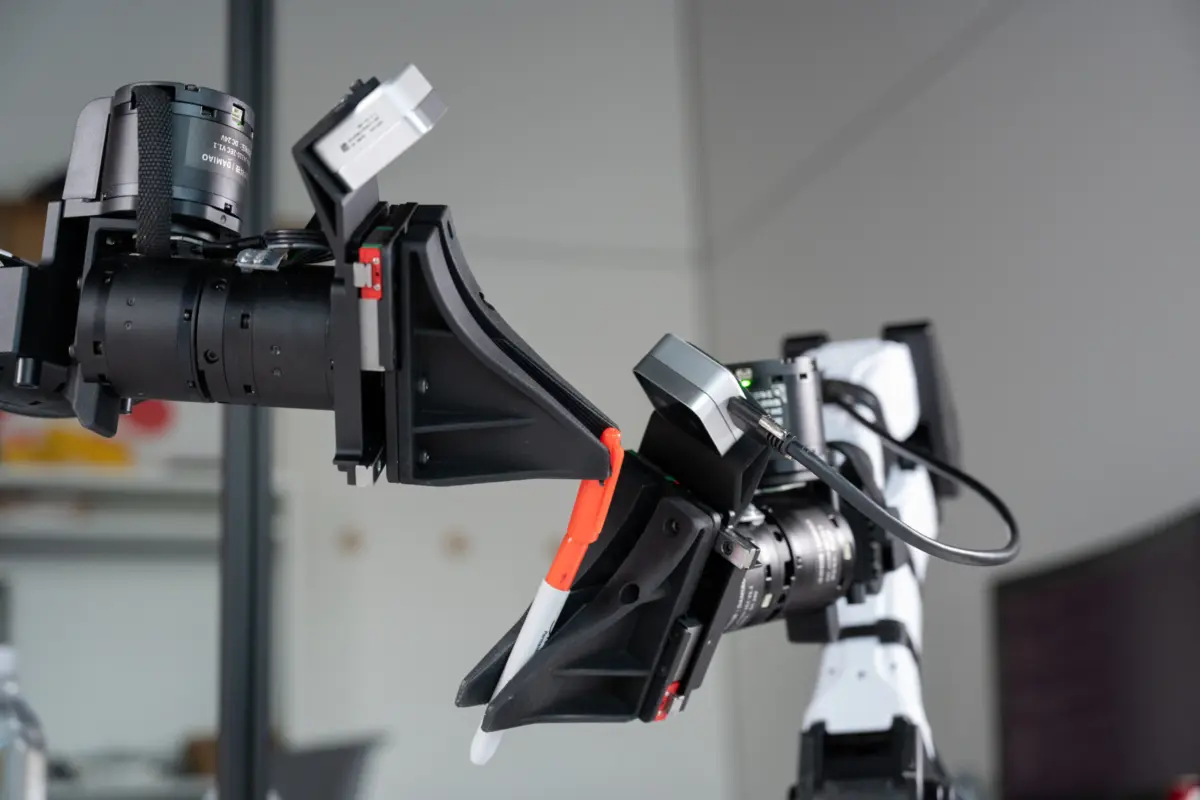
Recognizing that academic labs could not single-handedly bridge the data deficit required to train versatile robotic systems, Wu teamed up with fellow researcher Fred Shentu. Together, they set out to democratize and streamline the data collection process. Their collaboration birthed GELLO, an innovative, low-cost teleoperation system designed to let human operators remotely control robotic arms with high precision. By mapping human physical movements directly to robotic hardware, GELLO generated the precise training data researchers desperately needed.
The project culminated in an influential academic paper that sent ripples through the robotics community. It demonstrated that robust, adaptable robot behaviors could be taught effectively if researchers had access to repeatable, high-frequency teleoperation logs.
Capitalizing on this academic breakthrough, Wu and Shentu officially founded XDOF in 2024, stepping out of stealth to commercialize their discoveries. The market response was immediate. In June, TechCrunch reported the company’s $70 million Series A round. Backed by a premier syndicate of investors who recognized the parallels between early LLM data labeling and modern physical robotics, XDOF quickly onboarded roughly 20 initial customers, including several premier frontier AI labs.
Now, barely a quarter after that initial reveal, XDOF is hurtling toward unicorn status. Its rapid evolution from a university research project into a billion-dollar enterprise highlights the desperate, high-stakes race among tech giants to solve the physical embodiment problem.
Supporting Context & Metrics: The Mechanics of Physical Data Collection
To understand why XDOF commands a $1.2 billion valuation despite its youth, one must examine the operational realities of training general-purpose robots. While software startups can spin up cloud servers to scrape petabytes of text and imagery overnight, physical AI requires tangible, real-world interaction.
The Outsourced Data-Supply Chain
Frontier AI labs and robotics manufacturers often lack the specialized infrastructure, internal bandwidth, or logistical capability to capture training data at scale. XDOF bridges this gap by acting as an end-to-end data-supply chain. The startup designs and deploys the data pipelines, collection tools, and sophisticated annotation systems necessary to transform raw physical movements into structured machine learning datasets.
A Global Workforce of Teleoperators and Sensors
Capturing human dexterity and spatial awareness is fundamentally labor-intensive. To solve this, XDOF is aggressively building out a global workforce of human data collectors. This network operates on two distinct fronts:
- Remote Teleoperators: Individuals who sit at control stations leveraging systems like GELLO to steer robots through complex, unstructured tasks remotely.
- Egocentric Operators: Human workers who wear sophisticated body sensors, motion-capture suits, and head-mounted cameras to record everyday physical tasks from a first-person perspective.
By recording mundane yet complex human activities—such as folding clothes, sorting inventory, assembling mechanical parts, and flattening cardboard boxes—XDOF translates human intuition into actionable training data for artificial intelligence models.
Historic Data Releases and Partnerships
In a move that cements its academic and industry leadership, XDOF has partnered with the UC Berkeley AI Research (BAIR) lab. Together, they are preparing to release ABC, which the partners believe will be the largest and most comprehensive collection of high-quality robot training data ever assembled. This open-and-proprietary dataset strategy allows XDOF to cement its ecosystem lock-in while continuously refining its commercial offerings.
Market Landscape and Competition
XDOF is not operating in a vacuum, though it currently enjoys a first-mover advantage in specialized physical data pipelines. Competitor Mecka AI is also pursuing real-world data collection, while traditional human-data labeling platforms like Scale AI and Micro1 are expanding their horizons beyond large language models to capture the lucrative physical AI market. Nevertheless, XDOF’s deep-rooted academic pedigree and specialized focus on hardware-software integration give it a formidable moat.
Official Statements and Industry Insights
Neither XDOF nor 8VC has responded to requests for comment regarding the late-stage Series B negotiations, reflecting the confidential and dynamic nature of the transaction. However, statements from company leadership during previous funding cycles illuminate the strategic vision driving the startup forward.
Reflecting on the foundational challenges of his academic days, co-founder and CEO Philipp Wu noted in a prior interview:
"As a PhD student studying how robots learn from large datasets, one big impediment to our research was the lack of large-scale data to work with."
Investors intimately familiar with the robotics landscape echo this sentiment, frequently drawing parallels between XDOF’s positioning and the explosive trajectory of text-based data labeling pioneers. Just as Scale AI provided the foundational annotations that unlocked the generative AI revolution, investors view XDOF as the indispensable tollbooth through which all physical AI developers must pass.
Without clean, structured, and scaled teleoperation data, humanoid robots and general-purpose robotic arms remain expensive toys confined to controlled laboratory environments. By providing the grease for the wheels of physical automation, XDOF has positioned itself as an essential partner to the companies building the future of physical labor.
Future Outlook: The Road Ahead for XDOF and Physical AI
As XDOF finalizes its blockbuster $1.2 billion Series B round led by 8VC, the startup faces both immense opportunities and formidable scaling challenges.
Scaling Human Operations Globally
The immediate test for XDOF will be executing its ambitious plan to hire, train, and manage thousands of data collectors worldwide. Scaling a human-in-the-loop operation across multiple continents introduces complex logistical, quality control, and labor management hurdles. Ensuring that data collected in diverse international environments remains uniform and high-quality will be paramount as enterprise clients demand higher fidelity datasets.
Deepening Enterprise Integration
With an annualized revenue run rate approaching $50 million just months after emerging from stealth, XDOF has proven that there is immediate, robust enterprise demand for its services. Moving forward, the startup must deepen its integrations with premier AI labs and humanoid robotics manufacturers. As these robot makers transition from pilot programs to commercial deployments in factories, warehouses, and eventually consumer homes, their demand for edge-case data and continuous learning pipelines will multiply exponentially.
The Macroeconomic Horizon
The broader tech ecosystem is watching XDOF’s capitalization closely. A $1.2 billion valuation for a company less than a year out of stealth signals that venture capital appetite for physical AI infrastructure remains insatiable. If XDOF can successfully execute its data collection roadmap, cement its partnership ecosystem around the ABC dataset, and maintain its explosive revenue growth, it will not only solidify its status as a foundational pillar of robotics—it may well redefine how the machines of tomorrow learn to interact with our world.