









FLORIDA — In what legal experts are calling a watershed moment for modern copyright enforcement, Spanish-language media powerhouse TelevisaUnivision (TU) is aggressively expanding the boundaries of U.S. intellectual property law. Following a succession of default judgments against major pirate IPTV operators, the broadcaster has petitioned a federal court in Florida for a staggering $32.7 million in statutory damages.
More importantly, TU is urging the court to issue a permanent injunction featuring unprecedented "self-expanding" mechanisms. If granted by U.S. District Judge Kathleen Williams, the order would grant rightsholders the unilateral authority to continuously add new domains, IP addresses, digital services, and even unidentified corporate entities to a massive enforcement blocklist without ever having to return to court for judicial approval.
This aggressive legal maneuver signals a dramatic evolution in how media corporations tackle digital piracy in the United States, importing dynamic site-blocking frameworks long utilized in Europe and tailoring them for the American legal ecosystem.
Executive Overview
The legal battle commenced in July when TelevisaUnivision secured a sweeping preliminary injunction targeting five prominent pirate IPTV services: Thunder TV, Sunset TV, Tele Latino, Pop TV, and Kaelus TV. Within weeks, the scope of the injunction ballooned exponentially, eventually ensnaring hundreds of domains and over a hundred online intermediaries as the defendants repeatedly failed to appear in court or mount a defense.
On September 4, capitalizing on the defendants’ default, TU filed a comprehensive motion asking Judge Williams to enter a final default judgment. The core of the filing centers on two distinct elements:

- A $32.7 Million Financial Penalty: Comprising $26.7 million for willful copyright infringement (calculated at the statutory maximum of $150,000 per registered work) and $6 million for willful trademark counterfeiting ($2 million per defendant group).
- An Unprecedented Self-Expanding Injunction: A permanent injunction that not only locks down nearly 600 domain names and 121 digital intermediaries but also establishes a self-updating enforcement loop, enabling TU to target mirror sites, successor applications, and newly discovered John Doe entities autonomously.
While collecting millions in damages from elusive, foreign-based digital operators remains an uphill battle, the true prize for TelevisaUnivision lies in the crippling operational chokehold the permanent injunction would place on the global infrastructure supporting digital piracy.
Detailed Chronology: From Preliminary Sweep to Permanent Siege
The Genesis: July’s Broad Preliminary Order
The groundwork for this sprawling litigation was laid in the middle of summer, when TelevisaUnivision hauled five major IPTV providers into a federal court in Florida. The initial complaint targeted Thunder TV, Sunset TV, Tele Latino, Pop TV, and Kaelus TV—services that collectively streamed unauthorized copyrighted broadcasts and proprietary trademarks to vast global audiences.
Because none of the named defendants showed up to contest the allegations, the court entered initial preliminary relief. Crucially, the early injunction granted TU a rare power: the ability to dynamically supplement the court order with newly discovered domains and affiliated pirate platforms without filing new motions or requesting judicial review. Within weeks of securing this preliminary win, TU utilized the clause twice, rapidly swelling the enforcement net to capture additional rogue brands such as XuperTV, Tarjeta Roja, Pirlo TV, and Roja Directa.
The September 4 Default Motion
With the defendants universally failing to answer the complaints, the litigation crossed into its decisive default phase on September 4. TU formally requested that Judge Williams enter a default judgment against the six named individuals and entities operating Thunder TV, Sunset TV, and Tele Latino. (The operators of Pop TV and Kaelus TV, who have successfully cloaked their identities behind privacy services, remain designated as unidentified John Doe defendants).
In addition to demanding financial redress, the proposed permanent order codifies and supercharges the dynamic site-blocking mechanics tested during the preliminary phase.
[Initial Complaint: 5 IPTV Services]
       │
       ▼ (July Preliminary Injunction)
[Dynamic Additions: XuperTV, Tarjeta Roja, Pirlo TV, etc.]
       │
       ▼ (September 4 Default Motion)
[Permanent Injunction: ~600 Domains & 121 Intermediaries + Self-Expanding Powers]
Supporting Context & Metrics: The Scale of the Crackdown
The numbers associated with TelevisaUnivision’s legal filings are staggering, illustrating the vast, industrialized nature of modern IPTV piracy networks and the complex web of global tech companies unwittingly or wittingly supporting them.
Nearly 600 Domains and the Hydra Effect
The updated Schedule A attached to the legal paperwork catalogs nearly 600 unique domain names.
- Thunder TV and Tele Latino alone account for more than 90 domains each.
- XuperTV, which TU characterizes as a "white label" service constructed on the exact same Magis TV infrastructure used by Tele Latino, adds over 110 domains to the mix.
Faced with a game of digital whack-a-mole, pirate operators frequently spin up mirror applications and successor services—a phenomenon known as the "Hydra effect." TU’s legal filing targets this directly. According to a supplemental court declaration, the operators of Thunder TV recently abandoned direct distribution of TU content through their primary app, instead launching a mirror application called Black Eye. Users can access Black Eye utilizing the exact same login credentials originally purchased for Thunder TV.
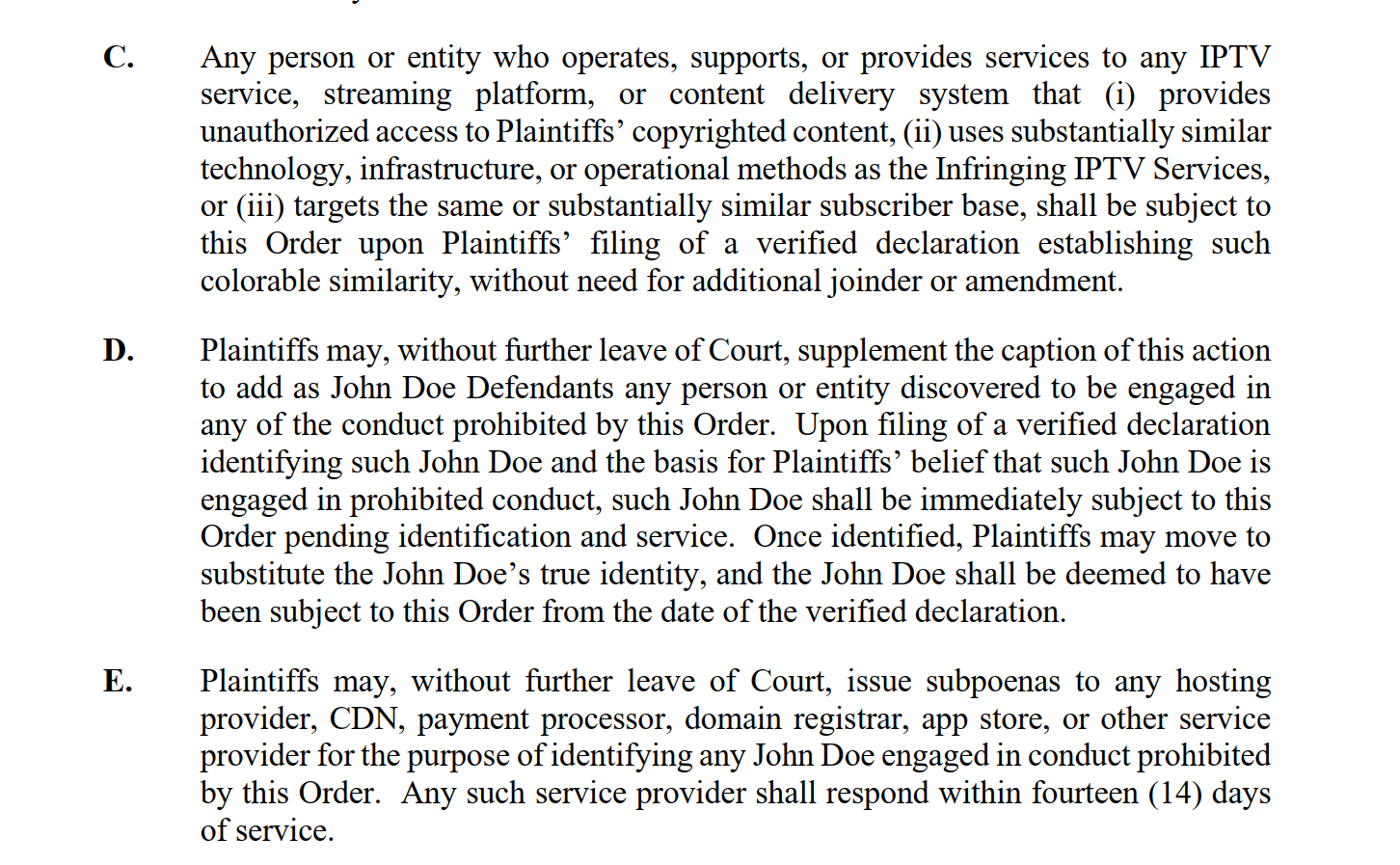
To combat this, the proposed permanent order introduces a "colorable similarity" carveout. Under this provision, any service that unauthorizedly accesses TU’s content, utilizes substantially similar underlying technology, targets the same subscriber base, or acts as a successor to the banned platforms can be legally ordered to comply with the injunction automatically.
The Intermediary Web: 121 Enablers
The proposed injunction casts an exceptionally wide net over digital intermediaries, listing 121 distinct companies required to assist in blocking, restricting, or unmasking the pirates:
- Domain Registrars & Hosting Providers: 51 domain registrars and 58 web hosting/CDN providers. This includes major U.S.-based institutions like GoDaddy and NameCheap, alongside international players such as Russia’s REGTIME-SU, Vietnam’s Mat Bao, Peru’s NIC.PE, Iran’s Aria Shatel, the Dutch Registrar.eu, and even a Romanian state-owned research institute, ICI Bucuresti.
- SaaS and Cloud Platforms: Popular productivity, web-building, and code-hosting platforms—including GitHub, Vercel, Canva, Wix, Squarespace, and Automattic (the corporate entity behind WordPress.com)—are explicitly cited for their links to various pirate domains or promotional pages.
- Streaming Hardware & Software: Technology hardware giants and application distribution frameworks are also commanded to act. Roku and the creators of the AFTVnews Downloader app are ordered to scrub pirate applications from their systems and actively block the numerical short codes utilized by end-users to sideload the illicit software.
Technical Missteps and Targeted Subpoenas
While the scope of the intermediary list is breathtaking, it is not without technical flaws. Independent digital rights observers have pointed out that the injunction mistakenly includes regional Internet registries like Europe’s RIPE NCC and the Asia-Pacific’s APNIC under the banner of "web host / hosting provider." Because these registries merely allocate blocks of IP address space rather than hosting content or directly routing user traffic, they lack the technical capability to block end-user access to specific IPs.
Conversely, content delivery network giant Cloudflare faces a targeted, highly specific demand. For roughly 90 IP addresses tied to the pirate domains, Cloudflare is ordered to unmask its proxy shields by producing the true origin servers behind them, alongside the legal names and email addresses of the account holders.
Financial Penalties: $32.7 Million on Paper
While the enforcement mechanisms of the injunction form the operational backbone of TU’s strategy, the statutory damages requested by the broadcaster represent a formidable financial deterrent.
┌────────────────────────────────────────────────────────┐
│               TOTAL DEMAND: $32.7 MILLION              │
├──────────────────────────┬─────────────────────────────┤
│ Copyright Infringement   │ $26.7 Million               │
│ (Max $150k per work)     │                             │
├──────────────────────────┼─────────────────────────────┤
│ Trademark Counterfeiting │ $6.0 Million                │
│ ($2M per defendant group)│                             │
└──────────────────────────┴─────────────────────────────┘- Copyright Claims: TU seeks $26.7 million for willful copyright infringement, pushing for the statutory maximum of $150,000 for each registered work compromised by the defendants.
- Trademark Claims: An additional $6 million is demanded for willful trademark counterfeiting, calculated at $2 million per defendant group.
The Reality of Foreign Defendants and Default Judgments
Media industry analysts are quick to note that collecting tens of millions of dollars from anonymous, overseas IPTV operators is statistically improbable. Most defendants operate from jurisdictions with little regard for U.S. copyright judgments, and their financial assets are heavily obscured or entirely offshore.
TelevisaUnivision is undoubtedly aware of this financial reality. Rather than expecting a multi-million-dollar check to clear, the immense damages award serves a dual strategic purpose. First, it underscores the severity of the infringement before the court, justifying the imposition of the draconian permanent injunction. Second, it legally establishes liability, paving the way for sweeping administrative shutdowns, domain seizures, and infrastructural blockades that cut off the pirates’ revenue pipelines at the root.

This multi-million-dollar default strategy has become a preferred playbook for major media conglomerates combatting IP theft in U.S. courts. Earlier this year, Amazon and Netflix secured an $18.75 million default judgment against a Dallas-based IPTV operator in March, while major Hollywood studios successfully clinched a $9 million default judgment against a Pennsylvania streaming ring in June. TU’s action simply pushes the financial and operational stakes to an unprecedented new high.
Future Outlook: Setting a Dangerous Precedent or the Future of IP Law?
As the motion sits pending before U.S. District Judge Kathleen Williams, the digital rights community and legal scholars are watching closely. The core debate rests on whether American jurisprudence should adopt European-style dynamic site-blocking models—orders that effectively bypass traditional judicial gatekeeping to empower private corporations to continuously update enforcement blocklists.
If Judge Williams approves the self-expanding permanent injunction in its current form, it will establish a powerful and controversial legal precedent in the United States. Rightsholders across the music, film, and broadcasting sectors will undoubtedly cite the TelevisaUnivision ruling in future copyright battles, attempting to secure similar automated powers to combat online piracy without returning to court every time a pirate domain mutates.
Conversely, civil liberties advocates and internet infrastructure providers have expressed cautious concern over the breadth of such orders. Allowing a private entity to unilaterally expand the scope of a court-mandated censorship and blocking list—without judicial oversight for subsequent additions—raises critical questions regarding due process, potential over-blocking of legitimate third-party websites, and the burden placed on global intermediaries.
For now, the legal world waits to see whether Judge Williams will permit TelevisaUnivision to wield this self-expanding legal sword, or if the court will trim back the most expansive provisions of the proposed order to preserve traditional judicial oversight. Regardless of the immediate outcome, the case has fundamentally redefined the modern battle lines between global broadcasters and digital copyright infringement.