Executive Overview
As organizations worldwide grapple with the integration of generative artificial intelligence into software development lifecycles (SDLC), leadership teams are largely trapped in a false dichotomy. They face a frustrating binary: implement draconian bans on AI tools—only to watch developers bypass restrictions using shadow IT—or adopt a laissez-faire approach, leaving code reviews to catch vulnerabilities by chance.
The Debian Project, one of the bedrock institutions of the open-source Linux ecosystem, has spent the better part of a fortnight confronting this exact paradigm. Through a high-stakes, public General Resolution that concluded at the end of August, Debian developers debated eight distinct proposals to determine the project’s official stance on artificial intelligence and generative code.
Rather than succumbing to reactionary bans or offering an uncritical endorsement, the community charted a middle course. The resulting policy neither prohibits nor mandates AI tools, instead focusing on strict human accountability, data protection, and behavioral guardrails.
For enterprise DevOps teams, platform engineers, and open-source maintainers alike, Debian’s resolution offers a fascinating blueprint. By regulating behavior around tools rather than attempting to police the tools themselves, the project has provided an instructive case study. However, as industry experts point out, this model also exposes a harsh underlying reality: establishing policy language is effortless, but scaling human review capacity in a resource-constrained environment remains an uphill battle.
Detailed Chronology: The Road to Debian’s General Resolution
The debate over generative AI within the Debian ecosystem was not born in a vacuum. For months, maintainers observed a steady influx of AI-assisted pull requests, bug triage notes, and build scripts. While some contributors welcomed the velocity boost offered by Large Language Models (LLMs), others raised urgent alarms regarding code quality, licensing ambiguities, and the potential for cascading security risks.
Recognizing that informal consensus was no longer sufficient, the project initiated a formal General Resolution process.
The Ballot and the Process
Running officially from August 15 through August 28, the General Resolution presented the Debian developer community with eight competing proposals. These options spanned the ideological spectrum:
- The Prohibitionist Approach: An outright ban on generative AI contributions, which would have required an amendment to Debian’s foundational Social Contract.
- The Laissez-Faire Approach: A hands-off stance treating AI assistants merely as another local utility, no different from an advanced auto-complete or a compiler extension.
- Compromise Frameworks: Various middle-ground policies focusing on disclosure requirements, attribution transparency, and behavioral guardrails.
To determine the outcome, Debian utilized the Condorcet voting method—a preference-ranking system that ensures the chosen option enjoys the broadest possible consensus across the electorate. Out of roughly 1,000 eligible Debian developers worldwide, just over 130 cast their ballots.
Defeating the Supermajority
For the proposed outright ban to succeed, it required a stringent three-to-one supermajority because it sought to alter the Debian Social Contract—the core ideological covenant governing the project since its inception.
The ban fell far short of this threshold. Instead, the community coalesced around a nuanced, pragmatic policy. Project Secretary Kurt Roeckx formally announced the outcome as the voting window closed, cementing a policy framework that explicitly sidesteps both total prohibition and unbridled acceptance.
Supporting Context & Metrics: The Mechanics of the New Policy
The policy that emerged victorious is notable primarily for what it omits. It does not mandate that contributors disclose whether an LLM was used to draft a changelog, debug a complex build script, or triage a cumbersome bug report. While disclosure is culturally encouraged, it is not a legalistic prerequisite for submission.
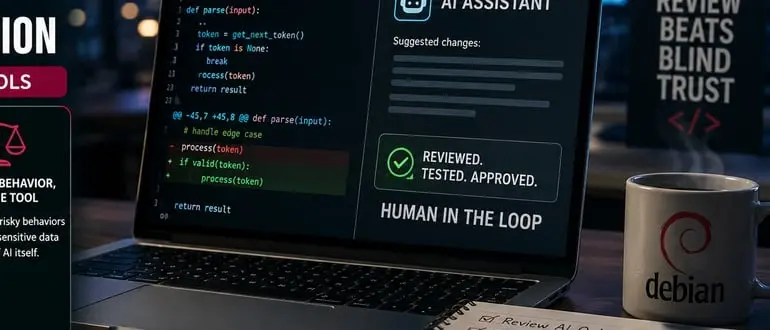
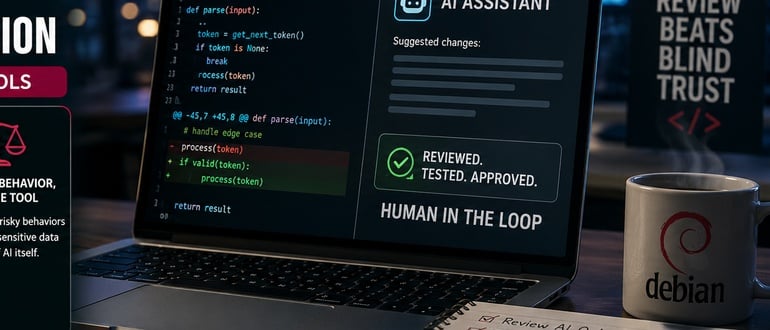
Instead, the policy shifts the entire burden of responsibility onto the human in the loop.
The Core Mandate: Absolute Human Accountability
Under the new guidelines, contributors are strictly required to thoroughly review, test, and validate any model output before it is integrated into the official Debian package archive. "Blindly accepting or uploading AI-generated material without appropriate human review" constitutes an immediate violation of standard Debian protocol. The origin of the code—whether synthesized by a neural network or typed by hand—is legally and procedurally secondary to the requirement that a human developer stands behind its integrity.
Three Pillars of Guardrails
To operationalize this principle safely, the policy introduces three specific constraints:
- Information Protection and Confidentiality: Sensitive materials—including private communications, embargoed security vulnerabilities, cryptographic keys, and internal credentials—cannot be transmitted to third-party AI services without explicit, high-level authorization.
- Bulk Automated Contributions: Mass-scale operations, such as automated bug filings or sweeping multi-package patch runs, require prior community discussion and a designated human who takes direct accountability for the results.
- Licensing Neutrality: Debian explicitly chose to bypass the unresolved legal debates surrounding the copyrightability of AI-generated works. Existing project licensing rules apply to AI-touched contributions identically to human-crafted code.
The Shadow of Credential Leaks
The strict regulation regarding credentials and confidential data is not born of theoretical paranoia. Software supply chain security metrics underscore the urgency of these precautions.
According to threat intelligence researchers tracking developer ecosystems, 28.65 million hardcoded secrets were leaked in public GitHub commits globally. Most alarmingly, leaked AI-service API keys and credentials surged by 81% year-over-year. For a project of Debian’s scale and critical infrastructure importance, pasting an embargoed zero-day vulnerability or an unpatched security bug into a third-party LLM interface represents an operational catastrophe waiting to happen.
Official Statements & Expert Perspectives
While the community has spoken, industry analysts are already dissecting the practical implications of Debian’s resolution.
Mitch Ashley, Vice President and practice lead for Software Lifecycle Engineering and AI-Native Software Engineering at The Futurum Group, highlights a structural paradox embedded within the new policy. While placing the obligation on the human reviewer is conceptually correct, reviewers are precisely the resource that volunteer-driven open-source projects lack most acutely.
"Debian put the obligation on the reviewer, which is the right place for it, but this is the component that runs out of capacity first," Ashley observes.
"Review was already scarce in a volunteer project where roughly 130 of a thousand developers voted. AI-assisted contributions do not arrive at volunteer reviewer speed. Every organization borrowing this model inherits the same arithmetic. Policy language is free, but reviewer hours are not."
Ashley’s observation cuts to the heart of modern software engineering. Banning LLMs is often an exercise in futility because organizations cannot reliably detect subtle AI assistance, particularly as code-generation tools become natively baked into modern Integrated Development Environments (IDEs). Conversely, relying on self-reporting through mandatory disclosure assumes high compliance rates that rarely materialize in practice.
Debian’s framework bypasses these enforcement headaches by focusing on outcomes rather than intents. It declares that contributors own their submissions completely, regardless of the tools used to draft them. However, as Ashley notes, declaring that humans must review code does not magically manufacture the hours required to conduct those reviews.
Future Outlook: What Enterprises Can Learn from Debian
As the dust settles on the Debian General Resolution, the ripple effects will likely extend far beyond the Linux distribution ecosystem. Enterprise DevOps and platform engineering teams wrestling with internal AI governance policies should take note.
Shifting Focus from Tools to Behaviors
Most corporate AI policies obsess over tracking how code is written, asking invasive questions like, "Did you use an LLM for this function?" Debian’s resolution suggests a more mature, enforceable inquiry:
- Did a human comprehensively review and test this code before deployment?
- Did any proprietary intellectual property or sensitive credentials leave the corporate perimeter during the generation process?
By regulating behavior around the tool rather than the tool itself, organizations create policies that are actually enforceable.
Unresolved Horizons
To be sure, Debian’s vote does not solve every open question surrounding artificial intelligence in software development. The legal status of AI-assisted code remains an international quagmire, and Debian’s decision to punt on copyright ambiguity simply pushes that legal gray area downstream to downstream distributors, enterprise users, and commercial vendors wrapping Debian packages.
Yet, as a governance model, the axiom of "trust the review process, restrict the specific behaviors that cause harm" provides a remarkably pragmatic foundation. It is an honest starting point—one that acknowledges the limitations of detection while doubling down on accountability. As the debate over generative AI continues to repeat itself across every tier of the technology sector, Debian’s pragmatic compromise may well serve as the gold standard for open-source and enterprise governance alike.