In a landmark legal development that could redefine how foreign media conglomerates combat intellectual property theft across borders, Chinese streaming powerhouse Tencent has cleared a major hurdle in a Florida federal court. U.S. District Judge David Leibowitz ruled that the high-traffic, Chinese-language pirate streaming platform Olevod is subject to U.S. jurisdiction, keeping alive a massive copyright infringement lawsuit that could carry staggering financial penalties.
Olevod, operating through the domains olevod.com and olevod.tv, has long catered to the global Chinese diaspora, offering a robust catalog of movies and television series without authorization. While Western anti-piracy coalitions such as the Alliance for Creativity and Entertainment (ACE) and the Motion Picture Association (MPA) have historically trained their crosshairs on English-language pirate networks, Chinese streaming giants are increasingly taking matters into their own hands.
Tencent’s legal action targets more than 150 of its crown-jewel properties—some boasting upwards of 30 billion streams globally. The lawsuit alleges that Olevod operates as a sophisticated commercial enterprise, generating revenue through targeted advertising and paid VIP subscriptions.
Initially, Olevod mounted an aggressive defense, claiming to be operated by a Spanish entity with zero physical presence, employees, or servers in the United States. A magistrate judge initially recommended dismissing the case for lack of personal jurisdiction, arguing that mere accessibility of a website does not automatically subject a foreign operator to Florida courts. However, in a decisive reversal, Judge Leibowitz rejected that recommendation. Armed with fresh traffic data and proof of commercial transactions involving U.S. residents, the court established that Olevod actively does business within the state.
This pivotal ruling does not yet determine liability or damages, but it establishes a powerful legal precedent. For Chinese rightsholders seeking to protect their intellectual property abroad, the message is clear: operating a foreign-hosted website that monetizes U.S. traffic opens the door wide to American courts. Olevod now faces an October 2 deadline to formally answer the complaint, leaving the future of the platform hanging in the balance as the litigation enters its next phase.
Detailed Chronology: From Subpoenas to Federal Court Showdown
The path to the recent federal court ruling is a multi-year narrative of escalating pressure, shifting legal strategies, and cross-border jurisdictional maneuvering. While Olevod managed to fly beneath the radar of traditional Western anti-piracy watchdogs, its prolonged operations eventually drew the ire of one of Asia’s most formidable entertainment conglomerates.
Phase 1: Operating in the Shadows
For years, Olevod served as a stable, highly accessible destination for Chinese-speaking audiences living outside mainland China. Interestingly, the platform strategically blocked visitors originating from mainland China. Industry analysts note this was likely a tactical measure to dodge immediate crackdowns from domestic Chinese authorities and local rightsholders who enforce stringent copyright laws within the country.
Despite escaping inclusion in the United States Trade Representative’s (USTR) annual lists of key foreign piracy threats, Olevod was not entirely invisible to international enforcement. The site previously surfaced in batches of Digital Millennium Copyright Act (DMCA) subpoenas secured by ACE and found its way onto Australia’s expanding copyright piracy blocklist, curated by heavyweights like Netflix and Disney. Nevertheless, these measures failed to disrupt the platform’s core operations or its steady influx of users.
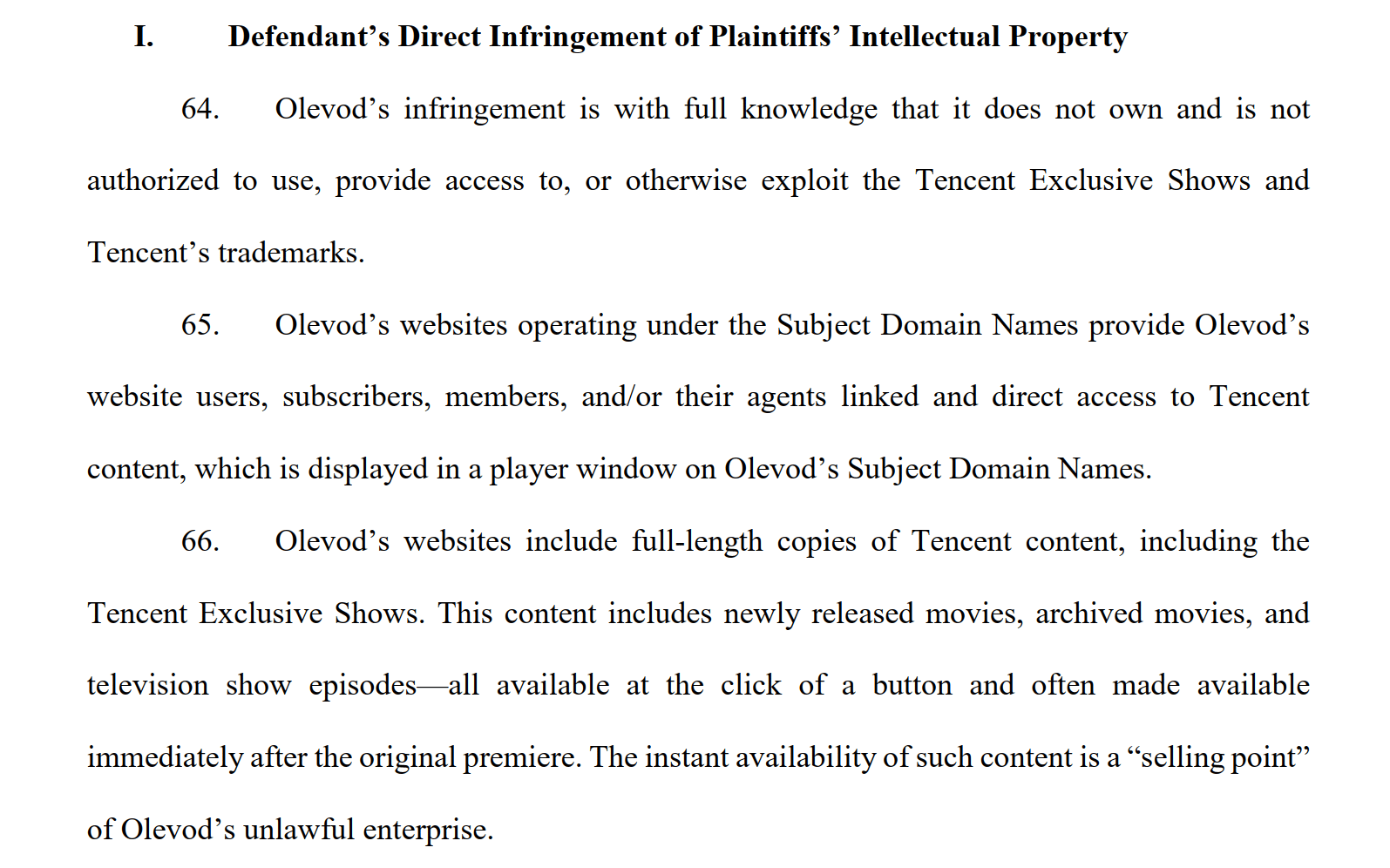
Frustrated by rampant unauthorized distribution, Tencent escalated the dispute from digital notices to the physical courtroom in October 2023. Filing a comprehensive copyright and trademark infringement complaint in the U.S. District Court for the Southern District of Florida, Tencent took direct aim at the corporate machinery behind olevod.com and olevod.tv.
The complaint meticulously cataloged more than 150 proprietary shows and films, emphasizing that Olevod routinely made premiere-ready content available to the public within moments of its official release. To compound matters, Tencent highlighted that the pirate site’s web pages surrounded its copyrighted content with advertisements for high-risk or illicit industries, including online gambling, adult services, and counterfeit academic diplomas.
Phase 3: The Jurisdictional Tug-of-War (January – June 2024)
Anticipating severe legal and financial fallout, Olevod retained Florida-based counsel to challenge the lawsuit at its inception. In January 2024, the defense filed a motion to dismiss the action, arguing a complete lack of personal jurisdiction.
The corporate entity behind the site identified itself as Jiayi Network Technology SL, a Spanish company with no American footprint. According to the defense:
The company maintained no offices, employees, or formal contracts within the United States.
The physical servers hosting the platform were located in Germany and France.
Subscription pricing was denominated exclusively in Euros and Chinese Yuan, with financial transactions processed via Alipay and WeChat Pay rather than traditional U.S. banking channels.
Tencent countered this narrative by introducing compelling digital evidence. The Chinese tech giant demonstrated that Olevod actively accepted U.S. dollars via PayPal, aggressively sold digital advertising space targeted at American consumers, and utilized network routing infrastructure linked to a mail drop in Destin, Florida.
In June 2024, Magistrate Judge Panayotta Augustin-Birch recommended granting Olevod’s motion to dismiss. She reasoned that while Tencent successfully proved Floridians could access the website, it failed to provide definitive proof that a Florida resident had actually streamed a copyrighted Tencent title on the platform. The magistrate warned that establishing jurisdiction solely on website accessibility would expose any entity with a globally accessible website to lawsuits anywhere in the world.
Phase 4: The Judicial Reversal (September 2024)
Tencent refused to back down. Bolstered by updated analytics, the company presented fresh traffic data procured from Semrush. The metrics revealed that in June alone, olevod.com pulled in 123,400 visits from the state of Florida, cementing the region as the platform’s fourth-largest U.S. user base.
Confronted with this empirical evidence of local engagement, District Judge David Leibowitz rejected the magistrate’s recommendation. Ruling that Olevod’s ad sales and premium subscription models constituted active commercial transactions with Florida residents, the judge drew a direct parallel to precedent-setting counterfeit merchandise cases. The court affirmed that digital piracy operations of this scale cannot hide behind foreign incorporation documents when they actively harvest revenue from U.S. soil.
Supporting Context & Metrics: The Anatomy of a High-Stakes Lawsuit
The scale of the litigation between Tencent and Olevod is underscored by striking quantitative metrics and complex legal demands that illustrate the lucrative nature of modern digital piracy.
Scale of Infringement and Financial Exposure
Tencent’s copyright complaint is staggering in its arithmetic scope. The filing explicitly details 670 registered episodes of television shows and films. Under U.S. copyright law, statutory damages can reach up to $150,000 for each willful infringement.
Theoretical Maximum Damages: Multiplied across the 670 registered episodes, Tencent’s potential statutory damages ceiling eclipses $100 million.
Global Audience Reach: Several of the exclusive Tencent titles hosted on Olevod have historically accumulated up to 30 billion aggregate streams worldwide, demonstrating the immense commercial value of the stolen intellectual property.
Florida Traffic Impact: Semrush analytics data submitted to the court revealed that Olevod attracted more than 123,000 visits from Florida users within a single month, proving that the platform maintains a vibrant, active consumer base inside the court’s geographic footprint.
The Proposed Injunction and Digital Disruption
Recognizing that pirate operators rarely possess the liquid capital to satisfy nine-figure judgments, Tencent crafted its legal remedy to cripple the infrastructure of Olevod entirely. Beyond financial compensation, the streaming titan requested a broad, sweeping injunction.
If granted, the court order would compel:
Internet Service Providers (ISPs) to block domestic routing to Olevod domains.
Hosting Providers and Cloud Services to terminate server contracts.
Domain Name System (DNS) Resolvers to remove resolution records.
Virtual Private Network (VPN) Providers to restrict routing paths.
Financial Institutions, Banks, and Payment Processors—including alternative processors—to freeze accounts and block transaction flows linked to the enterprise.
Such an injunction, if enforced globally or successfully propagated across U.S. network boundaries, would effectively render the platform digitally invisible to Western consumers.
Official Statements & Legal Arguments
The legal memoranda filed by both parties reveal sharply contrasting philosophies regarding digital sovereignty, global commerce, and the reach of American intellectual property law.
Olevod’s Defense: The "Foreign Entity" Shield
Throughout the proceedings, Jiayi Network Technology SL leaned heavily on its lack of physical nexus to the United States. Maintaining that it was merely a passive foreign publisher, the defense argued:
"The company behind the site identified itself as Jiayi Network Technology SL, which is a Spanish company without a U.S. connection. The site’s servers are in Germany and France… its prices are in yuan and euros, with most payments running through Alipay and WeChat Pay. The site has no employees, offices or contracts in the United States."
The defense sought to frame the platform as an international enterprise operating entirely outside the legislative oversight of American federal courts, asserting that mere web accessibility does not equal purposeful availment of a specific forum state’s laws.
Tencent’s Counter-Strategy: Digital Presence as Commercial Conduct
Tencent systematically dismantled the defense’s geographic isolation argument by spotlighting active commercial engagement. By pointing to PayPal transactions in U.S. dollars, targeted digital advertising banners visible to American viewers, and localized IP usage, Tencent successfully characterized Olevod not as an idle informational repository, but as an active commercial vendor.
The Court’s Ruling: Piercing the Digital Border
District Judge David Leibowitz formalized this perspective in his written opinion, explicitly equating digital piracy infrastructure to physical trafficking in counterfeit goods:
"The core of Tencent’s claims is that Jiayi traffics in pirated Tencent content. And the record shows Jiayi has built a business doing just that in Florida—both by selling ad space visible to Florida residents and by selling premium subscriptions to U.S. consumers, including Florida residents."
Judge Leibowitz further emphasized that the intangible, digital nature of streaming media does not grant immunity when compared to physical commerce:
"That pirate streams are digital and designer bags physical does not matter… Olevod is not a hobbyist running a one-man business from home, but a sophisticated company running interactive websites."
Future Outlook: A New Playbook for Chinese Rightsholders?
The implications of the Olevod litigation extend far beyond a single copyright dispute, potentially establishing a definitive playbook for Chinese entertainment conglomerates seeking legal recourse in Western courts.
The Shadow of iQIYI v. Aiyifan TV
Tencent is not blazing this trail entirely alone. In a closely parallel action last year, rival Chinese streaming platform iQIYI filed a similar copyright infringement lawsuit against the pirate streaming site Aiyifan TV in the exact same Florida federal court, utilizing the same legal representation.
Unlike Olevod, the anonymous operators of Aiyifan TV chose not to mount a defense, leading the court to enter a default judgment within months. However, when iQIYI subsequently moved for a staggering $196.55 million in damages alongside a sweeping domain-transfer injunction, the presiding judge exercised caution. The court granted liability but criticized the rightsholder for pulling per-work damages figures seemingly "out of thin air," leaving the final financial award pending further evidentiary proof.
What Lies Ahead for Olevod
For Olevod, the immediate future remains precarious. Having lost the preliminary jurisdictional battle, the company faces an October 2 deadline to file its formal answer to Tencent’s substantive allegations of copyright and trademark infringement.
Legal experts note that Olevod now stands at a strategic crossroads:
Continue the Fight: Commit substantial financial resources to contest the merits of Tencent’s copyright claims in Florida federal court.
Default and Disappear: Follow the trajectory of Aiyifan TV—abandoning the court battle, absorbing a default judgment, and potentially pivoting its operational domains to evade enforcement.
At the time of publication, both olevod.com and olevod.tv remain active and operational, serving video content to users worldwide.
Broader Industry Ramifications
For the broader entertainment and anti-piracy landscape, Judge Leibowitz’s ruling dismantles the traditional shield utilized by foreign-hosted piracy sites. By proving that ad-supported streaming and digital subscription models targeting U.S. consumers establish sufficient minimum contacts, Chinese rightsholders have gained a potent legal weapon.
If this jurisdictional standard holds through subsequent appellate scrutiny, it signals that foreign pirate platforms can no longer rely on Spanish incorporation, German servers, or European payment gateways to insulate themselves from multi-million-dollar lawsuits in the United States. As Asian streaming giants increasingly flex their legal muscles on the global stage, the digital grey market for unauthorized content is facing an unprecedented wave of cross-border accountability.