Executive Overview
Deep in the heart of San Francisco’s bustling South of Market (SoMa) district, an unmarked office space sits in near-total silence. On a typical afternoon, the cavernous room is nearly empty, lacking both corporate decor and the standard trappings of a modern tech headquarters. There is no sign on the door, no reception desk, and just a single human occupant tapping away on a laptop.
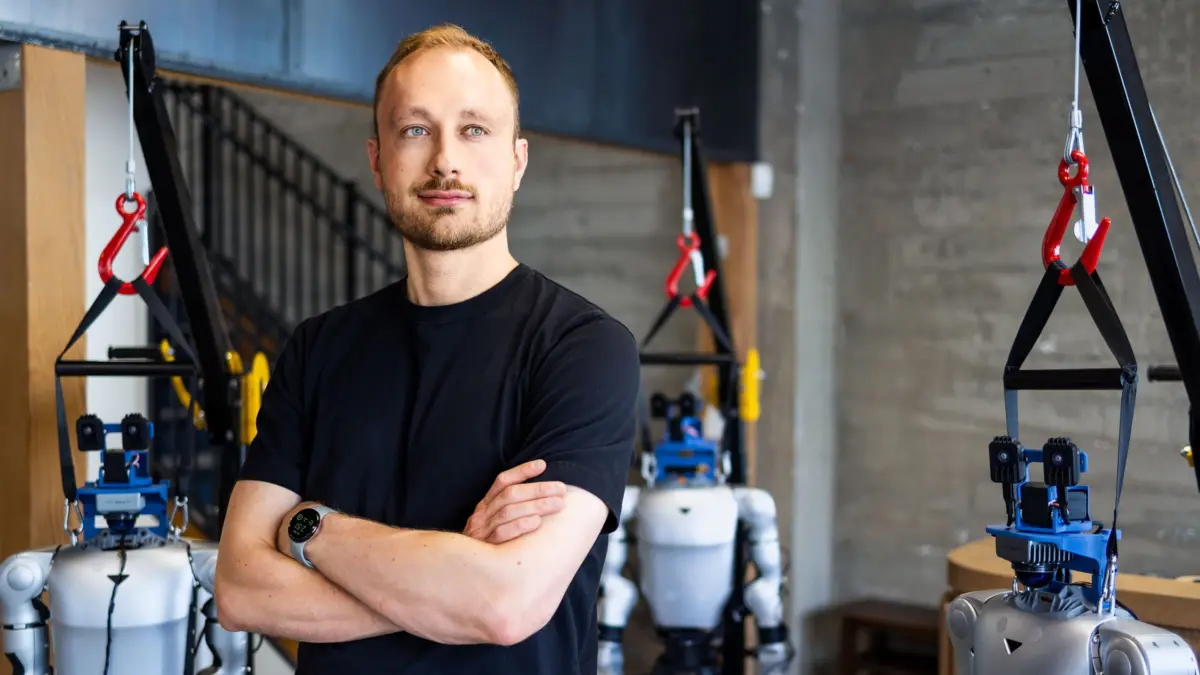
Yet, this stark, unpolished workspace is far from vacant. Suspended down the center of the wide-open room, hanging from heavy-duty industrial racks like marionettes waiting for a puppeteer, are dozens of humanoid robots. Imported directly from hardware manufacturers in China, these gleaming metallic and plastic frames vary wildly in size, shape, and articulation. They are the physical vessels for an invisible, revolutionary intelligence—and they represent the next great frontier in artificial intelligence.
This is the stealth-mode startup of Danijar Hafner, a 31-year-old prodigy and former Google DeepMind researcher who has quietly positioned himself at the bleeding edge of robotics and reinforcement learning. While Hafner remains tight-lipped about the exact commercial applications of his new venture, he describes it as the culmination of a decade-long obsessive pursuit: teaching artificial intelligence how to safely navigate, reason within, and adapt to environments it has never encountered during training.
For decades, the robotics industry has chased the holy grail of general-purpose utility—machines that can seamlessly integrate into human spaces like homes, hospitals, and chaotic offices. Yet, traditional robotics has continuously stumbled over a fundamental hurdle: fragility in the face of the unknown. A robot programmed to walk across a pristine laboratory floor will invariably stumble the moment it encounters a misplaced rug, an irregular staircase, or an unfamiliar room layout.
Hafner’s approach sidesteps this traditional trial-and-error paradigm entirely. By leveraging advanced model-based reinforcement learning and sophisticated "world models"—AI systems that emulate physical reality—Hafner’s software allows agents to imagine, simulate, and predict the consequences of their actions before they ever take a physical step. Having conquered virtual battlegrounds from Atari to Minecraft, Hafner is now translating those digital algorithms into physical muscle and bone. If he succeeds, his startup won’t just build better robots; it will fundamentally rewrite how machines learn to live alongside humans.
Detailed Chronology: From Rural Germany to the Pinnacle of AI Research
To understand the scope of Danijar Hafner’s current ambitions, one must trace a trajectory that spans from a quiet, rural town in northeastern Germany to the elite inner sanctums of global tech giants.
The Early Spark
Hafner grew up far removed from the hyper-accelerated tech hubs of Silicon Valley. Raised in a small German village where both of his parents worked as classical musicians, his childhood was steeped in the structure of melodies and harmonies. Yet, a young Hafner found himself drawn to a different kind of architecture: code.
Taught the basics of computer programming by a tech-savvy neighbor, Hafner quickly dove down the digital rabbit hole. By the time he reached high school, the advent of accessible online courses allowed him to immerse himself in the nascent field of artificial intelligence.
"I was always fascinated with how thinking works," Hafner recalls. While philosophy and biology offered theoretical frameworks, artificial intelligence provided a tangible, computational canvas on which to emulate cognition.
Entering the Big Leagues
Hafner’s talent was too potent to remain confined to rural Germany. In 2015, while cutting his teeth as a second-year engineering undergraduate at the prestigious Hasso Plattner Institute in Potsdam, he managed to secure a coveted role as a student researcher at Google Brain.
That foot in the door unlocked an extraordinary career trajectory. Over the ensuing years, Hafner completed roughly a dozen internships and research positions across Google Brain and Google DeepMind (which later merged under the unified DeepMind banner), spanning research hubs in the United Kingdom, Canada, and the United States. During this tenure, he collaborated directly with some of the most legendary figures in computer science. He worked alongside Geoffrey Hinton, widely hailed as one of the "godfathers of AI" and a foundational pioneer of deep learning, as well as Ashish Vaswani, co-author of the seminal 2017 research paper "Attention Is All You Need," which introduced the transformer architecture that underpins virtually all modern large language models.
The Turning Point: Leaving the Mothership
Despite the prestige, resources, and intellectual capital available at Google DeepMind, Hafner reached an inflection point in the fall of 2025. Driven by a desire to bring his theoretical breakthroughs out of the cloud and into the physical world, he made the bold decision to leave the tech titan behind.
He stepped away to found his own stealth startup in San Francisco—a gamble that traded the infinite compute and security of Google for the high-stakes, high-reward ambiguity of early-stage entrepreneurship. Armed with a handful of imported humanoid robots and a proven mathematical framework, Hafner is now building the foundation for what he hopes will be a paradigm-shifting commercial enterprise.
Supporting Context & Metrics: Decoding the "Dreamer" Architecture
The secret sauce behind Hafner’s robotics venture is not necessarily superior hardware, but rather a profoundly efficient approach to machine learning known as model-based reinforcement learning.
The Illusion of Reality: World Models
Traditional reinforcement learning relies on trial and error in the real world. To teach a robot to walk, engineers historically had to let it fall down tens of thousands of times—breaking parts, burning out motors, and wasting immense amounts of time and energy.
Hafner bypasses this bottleneck by developing world models. A world model is an internal neural network constructed by the AI to emulate the physics, rules, and dynamics of the real world. Instead of stumbling around a physical room, Hafner’s AI "agents" are dropped into this internal simulation.
Within the world model, the agent learns how to act, testing strategies and predicting future outcomes. In essence, the AI learns to "dream" or "imagine" scenarios. It projects what will happen if it lifts a foot, turns a corner, or pushes an object. By processing these imagined trajectories, the agent accumulates vast amounts of experience entirely in its mind before executing a single physical movement. This dramatically accelerates the learning process, allowing agents to execute massively complicated, multi-step tasks without hazardous real-world trial and error.
A Proven Track Record Across Virtual Horizons
Before tackling the messy physics of humanoid robotics, Hafner systematically proved the validity of his architecture across increasingly complex virtual environments, marked by a series of high-profile algorithmic breakthroughs:
- PlaNet (2018–2019): Hafner’s first major breakthrough was a model-based agent that demonstrated the ability to execute complex actions by planning ahead using a learned environment model, proving that compact latent dynamics could rival pixel-based processing.
- Dreamer 2: Pushing the boundaries further, Dreamer 2 became the first model-based agent to achieve human-level performance across the notoriously difficult Atari 2600 game suite, relying purely on its internal "dreams" to strategize gameplay.
- Dreamer 3: Raising the stakes, Dreamer 3 achieved a landmark feat in reinforcement learning by successfully solving the elusive Minecraft Diamond challenge. Operating from raw visual pixels, the agent independently figured out how to gather resources, craft tools, and mine diamonds without human intervention or prior rules.
- Dreamer 4: Continuing the evolution, Dreamer 4 pushed autonomy even further by learning to mine diamonds directly from an offline dataset of recorded gameplay videos, mastering the game without ever actively interacting with or playing it in real time.
- DayDreamer: Marking the crucial bridge between digital and physical, the DayDreamer project applied the Dreamer algorithm directly to physical robots. It enabled robotic systems to operate autonomously in novel environments and recover from real-world disruptions—such as being aggressively pushed over by human researchers—without requiring custom retraining loops.
Official Statements and Industry Perspective
Hafner’s meteoric rise within the artificial intelligence community has not gone unnoticed. Among his peers and mentors at Google, his technical capabilities are spoken of with a mixture of awe and reverence.
Timothy Lillicrap, a distinguished researcher at Google DeepMind and a former manager and co-author of Hafner, offers a striking assessment of the young scientist’s prowess:
“I get to interact with a lot of really smart people in research at Google, and he easily sits in the top half of 1%,” Lillicrap notes. “In many cases he would build, single-handedly, things it would take entire teams of engineers to build.”
This rare combination of high-level theoretical vision and relentless, hands-on engineering execution is precisely what has allowed Hafner to leap from academic papers to founding a high-stakes hardware-software startup.
When pressed about the ultimate destination of his current stealth venture, Hafner remains characteristically circumspect. He is guarded with product roadmaps and reluctant to overpromise timelines. Yet, his final hint leaves little doubt about the magnitude of his ambitions.
Reflecting on his departure from Google DeepMind and the formation of his new company, Hafner offers a single, guiding motivation:
"I was interested in solving a problem that would change the world."
Future Outlook: The Road Ahead for Embodied AI
As Hafner’s startup prepares to emerge from stealth mode, the broader tech and robotics landscape stands at a fascinating crossroads. The integration of large language models (LLMs) and vision-language-action (VLA) models has given robots an unprecedented ability to understand human language and intent. However, translating high-level commands ("clean this room" or "bring me a glass of water") into physical actions within unstructured human spaces remains the industry’s ultimate bottleneck.
This is precisely where Hafner’s world-model paradigm could prove revolutionary. If an embodied AI agent can use model-based reinforcement learning to dynamically simulate its physical surroundings on the fly, it will no longer be paralyzed by unpredictable environments. A robot entering a cluttered home for the first time won’t need a pre-mapped blueprint; it will instantly construct a mental physics model of the space, predict the consequences of its movements, and navigate safely.
Challenges, of course, remain immense. Supply chains for humanoid hardware, the high costs of actuators and sensors, power consumption constraints, and safety regulations in human-centric spaces are formidable hurdles for any startup. Furthermore, scaling simulation-to-reality transfer for bipedal locomotion is notoriously punishing.
Yet, if history is any indicator—from his early breakthroughs with PlaNet to solving Minecraft and pushing DayDreamer into physical hardware—Danijar Hafner has a habit of quietly solving problems that the rest of the industry considers intractable.
Back in the quiet SoMa office, amidst the hanging frames of silent humanoids, the future of artificial intelligence is taking shape. It is an intelligence that does not merely calculate pixels on a screen, but one that dreams, imagines, and prepares to step out into our world.