Executive Overview
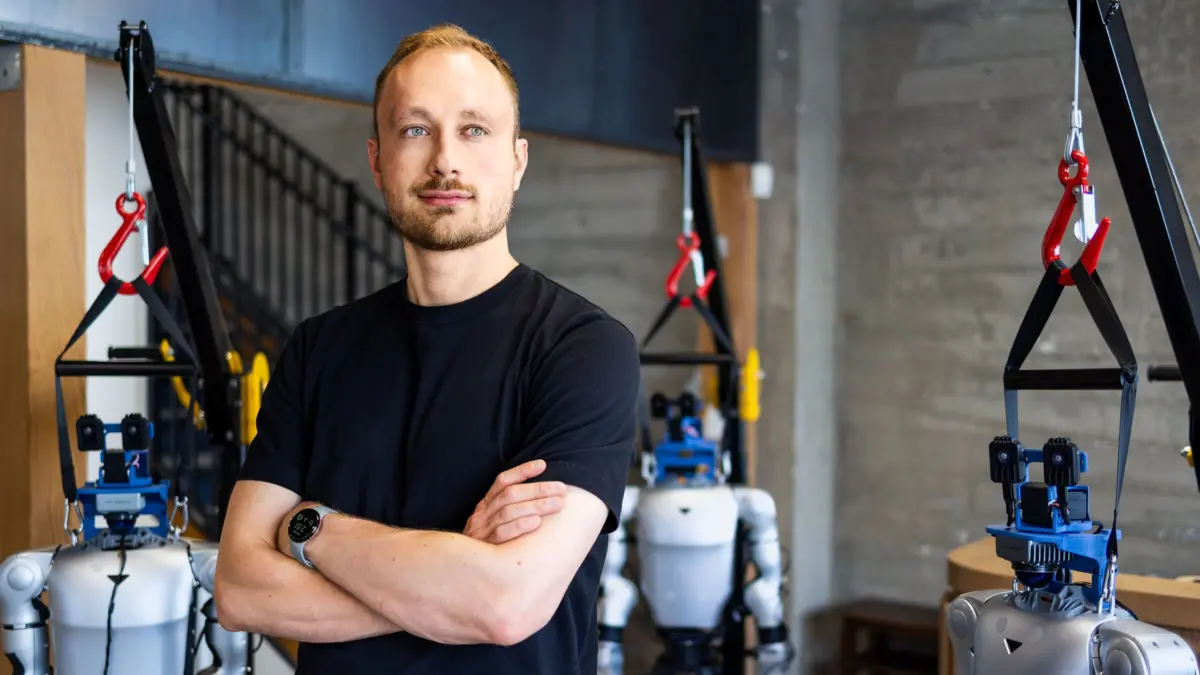
In a sparsely furnished, largely echoing office situated in the heart of San Francisco’s South of Market (SoMa) district, the physical future of artificial intelligence is quietly taking shape. There is no sleek corporate signage on the door; the startup operating inside remains strictly in stealth mode. The workspace is devoid of traditional trappings—no rows of ergonomic desks, no bustling administrative staff, and barely any furniture. Instead, what dominates the room is a stark, avant-garde array of humanoid robots. Suspended from overhead racks running down the center of the wide-open floor plan, these machines hang like marionettes, varying in shape, size, and mechanical design.
This nascent enterprise belongs to 31-year-old Danijar Hafner, a researcher whose pedigree reads like a who’s who of modern AI history. Having recently departed from Google DeepMind in the fall of 2025 to launch this venture, Hafner is pursuing a vision that bridges the chasm between virtual intelligence and physical reality. While he remains tight-lipped about the precise commercial applications of his new startup, the hardware hanging from his ceiling offers a glaring hint: these humanoid units, imported directly from the rapidly advancing robotics ecosystem in China, are the physical vessels for his life’s work.
Hafner’s core mission is as ambitious as it is fundamental to the next era of automation: enabling artificial intelligence to seamlessly navigate and adapt to completely novel environments it has never encountered during its training phase. For decades, the robotics industry has struggled with the "unseen scenario" problem. If a robot is deployed into a human home, it must effortlessly interpret unfamiliar floor plans, unorthodox furniture placements, and erratic human behaviors. Traditional reinforcement learning requires grueling, real-world trial-and-error processes that are slow, dangerous, and computationally prohibitive.
Hafner bypasses this bottleneck entirely through a paradigm known as model-based reinforcement learning. By developing advanced "world models"—AI systems engineered to simulate physical reality—his agents learn how to act within internal mental simulations. They effectively "dream" or "imagine" future outcomes, allowing them to formulate complex strategies and react to unprecedented physical disruptions in the real world (IRL) without ever having practiced them beforehand. As the tech industry races to commercialize humanoid general-purpose labor, Hafner’s approach could represent the missing intellectual link that finally brings robots out of controlled laboratory environments and into everyday human spaces.
Detailed Chronology: From Rural Germany to the Pinnacle of AI Research
To understand the scale of Danijar Hafner’s current ambitions, one must trace a trajectory defined by relentless curiosity, precocious achievement, and deep immersion within the crucible of modern machine learning research.
Formative Years and Early Fascination
Hafner’s journey began far away from the venture-capital-fueled corridors of San Francisco. He grew up in a quiet, rural town in northeastern Germany, the son of two classical musicians. Surrounded by art and structured performance, young Hafner found himself drawn instead to the systematic logic of computation. Lacking immediate local mentors in computer science, he taught himself how to program with the help of a tech-savvy neighbor.
By the time he reached high school, his focus had narrowed toward artificial intelligence, catalyzed by the advent of online coursework.
“I was always fascinated with how thinking works,” Hafner reflects.
While others viewed computers as tools for calculation or communication, Hafner saw them as blank canvases capable of emulating cognitive processes. AI offered a rigorous, mathematical medium through which the mechanics of thought could be reconstructed and understood.
The Google Brain and DeepMind Crucible
Hafner’s academic aptitude quickly transitioned into high-impact professional output. In 2015, while cutting his teeth as a second-year undergraduate engineering student at the Hasso Plattner Institute in Potsdam, Germany, he secured a coveted student researcher role at Google Brain.
That initial internship opened the floodgates. Over the subsequent years, Hafner completed a dozen distinct internships and research positions across Google’s global footprint, spanning Google Brain and Google DeepMind operations in the United Kingdom, Canada, and the United States. In an industry where most researchers specialize narrowly, Hafner collaborated directly with legendary figures who shaped the foundational infrastructure of contemporary AI:
- Geoffrey Hinton: Widely acknowledged as one of the founding "godfathers" of deep learning, whose pioneering work on backpropagation and neural networks catalyzed the modern AI boom.
- Ashish Vaswani: Coauthor of the seminal 2017 research paper "Attention Is All You Need," which introduced the transformer architecture—the structural backbone powering every major large language model (LLM) in existence today, including OpenAI’s GPT series and Google’s Gemini.
Working alongside these titans allowed Hafner to absorb structural paradigms at the bleeding edge of the field, setting the stage for his own radical departures from traditional methodologies.
Supporting Context & Metrics: Decoding World Models and the "Dreamer" Legacy
While many of his peers at Google focused on scaling up massive language models or tweaking transformer weights, Hafner’s intellectual obsession lay in reinforcement learning and the mechanics of planning. Traditional deep reinforcement learning agents require millions of interactions with an environment to learn basic tasks. In robotics, this means thousands of broken actuators, burned-out motors, and hours of tedious human supervision.
The Mechanics of Model-Based Reinforcement Learning
Hafner’s solution centers on model-based reinforcement learning (MBRL). Instead of forcing an agent to learn purely by reacting to raw sensory data in real time, Hafner’s systems build an internal, predictive model of how the world works—a "world model."
- Simulation: The AI agent treats this internal model as a sandbox simulation of reality.
- Imagination ("Dreaming"): The agent explores various trajectories, predicting future states, rewards, and consequences entirely within its mental model.
- Execution: By "imagining" the consequences of its actions before taking them, the agent can execute hyper-complex, multi-step tasks in the physical world without requiring extensive real-world trial-and-error training.
The Evolution of the "Dreamer" Series
Hafner systematically proved the validity of this world-model approach by deploying his algorithms against increasingly complex virtual battlegrounds, ranging from standard physics simulations to classic video games:
- PlaNet (2018–2019): Hafner’s early breakthrough, introducing a latent dynamics model that enabled agents to execute long-term planning purely from image pixels.
- Dreamer 2: Marking a major milestone, Dreamer 2 became the first-ever model-based agent to achieve human-level performance on the notoriously challenging Atari 2600 benchmark suite, operating entirely inside learned world models.
- Dreamer 3: Raising the bar higher, Dreamer 3 achieved what was previously considered a holy grail for reinforcement learning agents: solving the Minecraft "Diamond" challenge. Without human demonstrations, the agent successfully learned to explore, survive, gather resources, and mine diamonds entirely on its own accord.
- Dreamer 4: Pushing the paradigm into offline learning, Dreamer 4 demonstrated the ability to learn how to mine diamonds purely by consuming an offline dataset of recorded gameplay videos, eliminating the need for active interactive engagement with the game environment during training.
Crossing the Virtual-Physical Divide: DayDreamer
Having conquered virtual domains, Hafner turned his attention to hardware. Through his DayDreamer project, he successfully ported the Dreamer algorithm directly onto physical robotic platforms.
Using DayDreamer, robots were able to operate autonomously in novel environments, rapidly adapting to structural changes and physical disruptions—such as being unexpectedly shoved or knocked over by human operators—without requiring any prior task-specific fine-tuning. This seamless transfer from simulated imagination to physical execution established the theoretical foundation for his post-Google endeavors.
Official Statements and Industry Perspective
Within the insular, high-stakes ecosystem of Google DeepMind, exceptional talent is commonplace. Yet, Hafner’s output and technical independence earned him rare, unreserved praise from senior leadership and veteran collaborators.
Timothy Lillicrap, a distinguished researcher at Google DeepMind and one of Hafner’s former managers and co-authors, offers a striking assessment of Hafner’s capabilities:
“I get to interact with a lot of really smart people in research at Google, and he easily sits in the top half of 1%,” Lillicrap notes.
Elaborating on Hafner’s prodigious engineering speed, Lillicrap adds: “In many cases he would build, single-handedly, things it would take entire teams of engineers to build.”
This rare combination of deep theoretical insight—capable of authoring mathematically dense reinforcement learning papers—and fierce engineering autonomy is what allowed Hafner to leap from student researcher to independent founder before the age of 32.
Future Outlook: The Stealth Startup and the Quest to Change the World
As the tech industry transitions from the digital era of chatbots and generative text into the physical era of robotics and spatial computing, the race for general-purpose physical intelligence has accelerated dramatically. Venture capital firms are pouring billions of dollars into humanoid robotics hardware startups, betting that universal labor units will soon populate warehouses, hospitals, and homes.
However, hardware is only half the battle. Without robust cognitive architectures capable of navigating chaotic, unstructured human spaces without constant remote oversight, expensive humanoid hardware risks becoming an expensive, inert novelty. This is precisely the vacuum that Danijar Hafner’s new San Francisco venture is poised to fill.
Having officially departed Google DeepMind in the fall of 2025, Hafner is currently operating under a veil of calculated secrecy. The sparse SoMa office—punctuated by hanging humanoid frames waiting for their cognitive software to awaken—hints at an imminent commercial unveiling. While he remains coy about the exact product roadmap, his underlying motivation remains transparently grandiose.
“I was interested in solving a problem,” Hafner hints, offering a glimpse into his overarching ambition, “that would change the world.”
If world models can successfully teach autonomous machines how to "dream" their way through physical uncertainty, Danijar Hafner may well provide the spark that transitions humanoid robotics from science fiction laboratories into the messy, unpredictable reality of everyday human life.