Executive Overview
On the bustling outskirts of Shanghai, a paradigm shift in consumer technology and industrial automation is unfolding not behind the closed doors of a sterile laboratory, but in the vibrant, chaotic, and joyous atmosphere of a public festival. On a national holiday, families flood the Intelligent Manufacturing & Robotics Global Co-Innovation Center, an expansive R&D hub that houses over 100 companies dedicated to the research, development, and commercialization of advanced robotics.
Here, children squeal with delight as they unbox mini robotic dogs capable of executing intricate handstands, while adults gather around temporary arenas to watch remote-controlled quadrupeds engage in water-bead battles. Further into the complex, humanoid robots don blinged-out tops to perform traditional drunken boxing, execute flawless front flips, and command squads of robotic lions in synchronized routines.
This is no ordinary trade show. It is part of a calculated, large-scale public relations and cultural integration campaign orchestrated by China’s robotics sector to normalize the presence of intelligent machines in everyday life. As embodied artificial intelligence—the integration of sophisticated AI algorithms into physical, moving systems—takes center stage in China’s latest five-year plan, the nation is racing not only to build the world’s most capable hardware, but also to win the hearts and minds of its citizens. With nearly 90% of the world’s bipedal and two-armed robotic shipments originating from Chinese factories last year, the country is transforming from a manufacturing powerhouse into a living laboratory where humans and humanoids co-exist, play, and work side by side.
Detailed Chronology: A Day Inside the Shanghai R&D Hub
Morning: The Arrival of Curious Families
The morning sun beats down on the sprawling courtyard of the Intelligent Manufacturing & Robotics Global Co-Innovation Center as the gates open to a throng of eager visitors. Taking advantage of a public holiday, parents and children stream into the facility, driven by a growing curiosity about the machines dominating national headlines.
Within minutes of entry, the air fills with the electronic whirs of servos and the delighted shouts of children. Near the main entrance, an 11-year-old boy becomes the center of attention, hoisting a newly purchased mini robotic dog. As the mechanical pet attempts a clumsy handstand, a crowd of onlookers gathers, cameras and smartphones instantly raised to capture the moment. This immediate commercial availability of interactive, affordable robotics sets the tone for the day: robotics in China are no longer confined to industrial assembly lines or sci-fi cinema; they are consumer products.

Midday: Interactive Demos and Competitive Sparks
As the morning transitions into afternoon, the focus shifts from casual spectating to active engagement. The R&D hub, which normally hums with the quiet intensity of engineers testing specialized bots designed for heavy logistics and sewage-pipe inspection, transforms into an interactive playground.
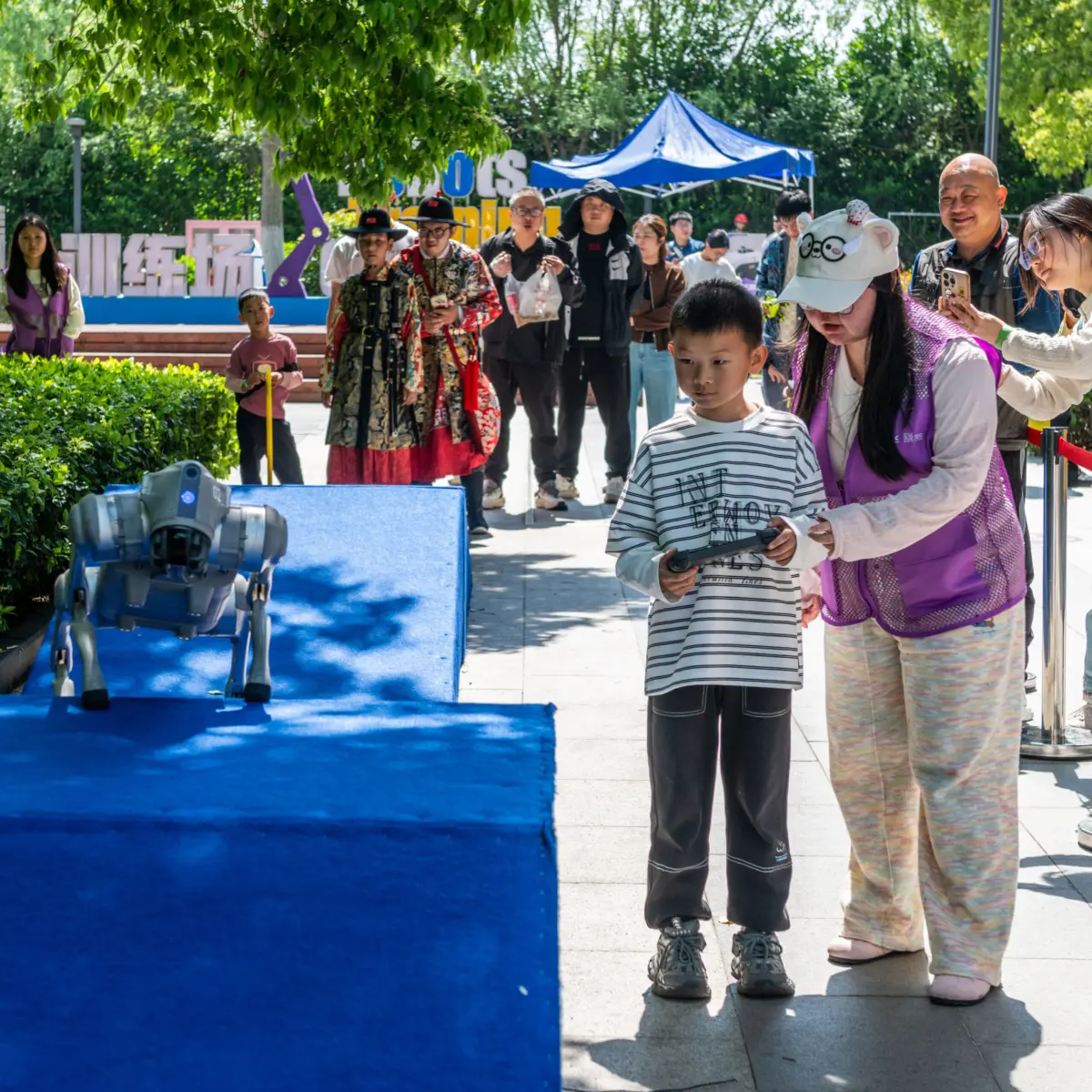
Meters away from retail booths, roboticists turn educators. Two staff members stand beside a flight of custom-built stairs, patiently guiding children through the process of programming and commanding a quadrupedal robot to ascend step by step. The children grapple with the nuances of weight distribution and balance, gaining a visceral understanding of robotic engineering.
Nearby, the atmosphere intensifies around a makeshift fighting ring. Two remote-controlled combat robots face off, firing harmless water beads at each other as boys and girls cheer themselves hoarse. The controllers—mostly children—wield joysticks with competitive ferocity. After a tense exchange of tactical maneuvers and saturated projectiles, a supervising staffer declares the duel a draw, diffusing the tension into shared laughter.
Further along the exhibition floor, the practical applications of robotics are put on display. At the DexForce booth, product managers demonstrate a humanoid model adept at brewing coffee, while a pair of multi-articulated robotic arms tirelessly attempts to fold a basket of freshly laundered T-shirts. These demonstrations highlight a core mission: showcasing machines engineered to liberate humanity from physical toil and mundane chores.
Afternoon: The Spectacle in the Main Tent
As afternoon peaks, the gravitational pull of the festival’s main tent draws the vast majority of attendees into a massive, cavernous hall. The centerpiece of the afternoon is a live cultural and technological showcase featuring some of China’s most advanced humanoid robots.

The music swells, and a humanoid robot adorned with flashy accessories steps onto the stage. To the absolute astonishment of the audience, the machine initiates a complex sequence of martial arts movements, perfectly mimicking the swaying, unpredictable stances of traditional "drunken boxing." Moments later, a second humanoid leaps forward, executing a clean, high-velocity front flip that sends the crowd into raptures of applause.
Lined up neatly beside the stage, a squad of smaller robotic lions—traditional symbols of prosperity and good fortune in Chinese culture—await their cue, their mechanical eyes blinking in unison. The audience, utterly captivated, begins to chant in a unified rhythm: "More, more, more." The boundary between ancient cultural tradition and cutting-edge cybernetics blurs, illustrating how deeply robotics are being woven into the fabric of modern Chinese identity.
Supporting Context & Metrics: The Global Robotics Landscape
The festive scenes in Shanghai are symptoms of a much larger, highly strategic national initiative. China’s ascent to the pinnacle of global robotics is underpinned by sweeping economic policies and staggering manufacturing metrics.
The Rise of Embodied AI
Embedding artificial intelligence into physical systems—collectively termed "embodied AI"—was enshrined as a foundational technological pillar in China’s latest five-year plan. Policymakers in Beijing recognize that the true economic value of AI will not be unlocked solely through software agents or large language models operating in digital spaces, but through machines capable of interacting with, manipulating, and navigating the physical world.
This strategic vision has translated into overwhelming market dominance. According to recent industry shipping data, nearly 90% of the more than 13,000 two-armed, two-legged humanoid robots delivered globally last year were manufactured in China.

| Metric / Indicator | Data Point / Status | Strategic Implication |
|---|---|---|
| Global Market Share (Humanoids) | ~90% of global shipments (2025/2026 data) | Absolute manufacturing and supply chain supremacy |
| Total Global Humanoid Shipments | >13,000 units delivered annually | Rapid scaling from prototype to commercial deployment |
| Core National Policy Driver | Embodied AI in the National Five-Year Plan | State-backed funding, land grants, and R&D prioritization |
| Public Integration Sites | Shanghai R&D hubs, Beijing marathons, national malls | Cultivating domestic consumer demand and cultural acceptance |
Overcoming Global Skepticism
While Chinese firms surge ahead, the global robotics community remains deeply fractured over the utility and form factor of humanoid machines. Western roboticists and venture capitalists have long pointed out that humanoids face severe developmental bottlenecks:
- The Balance Problem: Bipedal locomotion requires immense computational power and dynamic stabilization, making robots prone to high-profile, costly falls.
- Mass and Safety: Heavy metallic limbs pose inherent safety hazards when operating in close proximity to untrained humans.
- Economic Viability: Astronomical price tags and notoriously short battery lives severely restrict commercial and domestic appeal.
- Form Factor Debate: Many engineers argue that wheels, tracks, or quadrupedal designs are vastly superior and more energy-efficient for the vast majority of utilitarian tasks, dismissing the humanoid shape as an anthropomorphic vanity project.
Despite these legitimate engineering reservations, Chinese enterprises are betting that the cultural resonance and ultimate versatility of a human-shaped machine outweigh the initial hurdles. By inundating the public sphere with working models—not just in Shanghai, but via bipedal robots running half-marathons in Beijing and performing in shopping malls across multiple provinces—Chinese firms are gathering invaluable real-world telemetry while simultaneously engineering social license for automation.
Official Statements and Industry Insights
The philosophy driving these public-facing exhibitions is rooted in the belief that familiarity breeds adoption. Industry leaders argue that overcoming psychological barriers is just as important as solving engineering equations.
"Humanoid robots can free people from physical work and mundane chores. But to get society ready for that transition, people need to touch them, see them, and interact with them without fear."
— Yang Duan, Product Manager at DexForce
Yang’s sentiment echoes throughout the Shanghai innovation center. For decades, industrial robots operated behind safety cages in automotive plants, hidden away from the general populace. By bringing humanoids, quadrupeds, and robotic pets out of the laboratory and into carnivals, shopping complexes, and public parks, companies are reframing robots from intimidating harbingers of technological unemployment into approachable companions and helpers.

Furthermore, engineering teams emphasize that public feedback loops—observing how a child reacts to a stumbling quadruped or how a crowd responds to a robot doing a martial arts routine—provide qualitative data that computer simulations simply cannot replicate.
Future Outlook: The Road Ahead for Embodied AI
As the sun sets over the Shanghai R&D hub and the crowds slowly disperse, the broader implications of the day’s events come into sharp focus. The robot carnival was far more than a holiday diversion; it was a preview of an inevitable demographic and technological future.
Facing a rapidly aging population and a shrinking workforce, China views advanced robotics not as a luxury, but as an existential economic necessity. The convergence of cheap domestic manufacturing supply chains, aggressive state subsidies, and a culturally receptive populace creates an environment where humanoid robotics can iterate and commercialize at a velocity unseen anywhere else in the world.
In the coming years, the boundary between exhibition and reality will continue to dissolve. The children who spent their holiday cheering for drunken-boxing humanoids and programming stair-climbing quadrupeds will grow up in a world where bipedal assistants are as commonplace as smartphones and electric vehicles. While engineering challenges regarding power density, durability, and cost remain formidable, China’s masterclass in public engagement ensures that when the technology is finally ready for prime time, the society will be ready to welcome it with open arms.