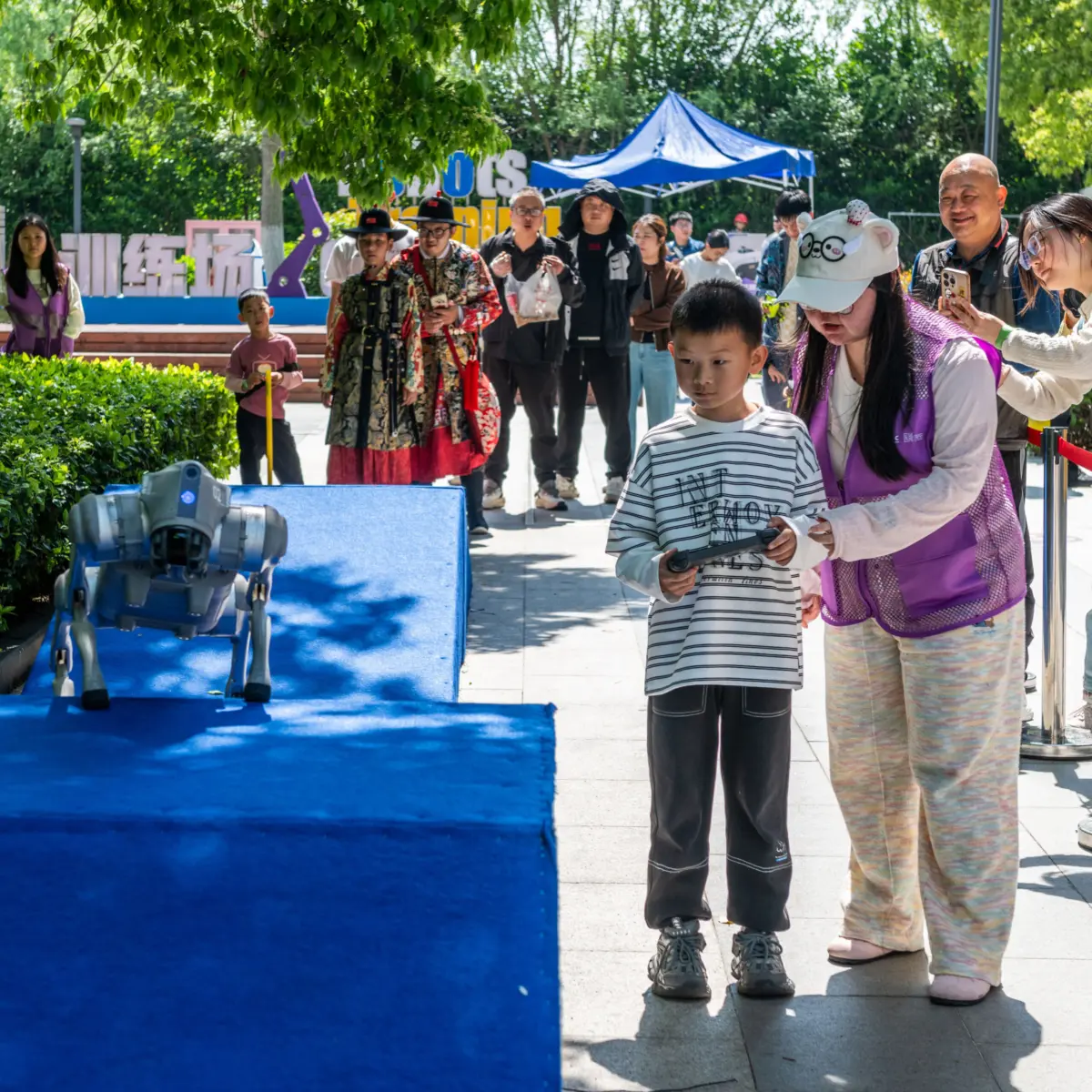
SHANGHAI — “Look, it is trying to do a handstand!”
An 11-year-old boy shouts these words with uncontainable excitement, watching his newly acquired mini robotic dog attempt a series of erratic, acrobatic stunts. The toy pet, purchased moments earlier by his mother at a sprawling robotics “carnival” on the outskirts of Shanghai, is the center of attention as he forces it to repeat the trick for passing strangers. On this vibrant public holiday, families are pouring into the industrial R&D hub in droves, eager to witness firsthand the rapid convergence of everyday entertainment and advanced engineering.
Welcome to the cutting edge of China’s consumer robotics revolution, where humanoid machines and quadrupedal pets are transitioning rapidly from sterile industrial laboratories into the public consciousness.
Executive Overview
Humanoid and specialized robots are having a profound cultural moment in China. Far from being confined to factory floors or high-security defense compounds, advanced bipedal and quadrupedal machines are increasingly embedded in the fabric of daily public life. This shift is not accidental; it is a foundational pillar of China’s national strategy to dominate the emerging landscape of “embodied AI”—the integration of artificial intelligence into physical, dynamic systems.
Embedment of robotics into the physical economy formed a core priority in the nation’s latest five-year economic plan. Supported by robust government subsidies, localized supply chains, and aggressive R&D funding, Chinese firms have emerged as undisputed global leaders in the production of humanoid and multi-limbed machines. Industry metrics indicate that nearly 90% of the more than 13,000 two-armed, two-legged robots delivered globally last year were manufactured within China.
Yet, beyond the macroeconomic data and strategic policy papers lies a more visceral reality: a massive, coordinated public relations and cultural integration campaign. From martial-arts-performing humanoids in Shanghai to bipedal robots running half-marathons in Beijing, China is normalizing the presence of humanoids through sheer spectacle. By welcoming families, children, and skeptics into immersive carnivals and interactive showcases, the robotics industry is actively courting hearts and minds, transforming cold mechanical engineering into a beloved form of public entertainment.
Detailed Chronology: A Day at the Shanghai Robotics Hub
The Intelligent Manufacturing & Robotics Global Co-Innovation Center, located on the suburban fringe of Shanghai, usually functions as a powerhouse of heavy R&D. The sprawling complex houses more than 100 enterprises dedicated to researching, developing, manufacturing, and marketing industrial automation, specialized municipal inspection bots, and heavy-duty logistics carriers.

On this particular holiday, however, the heavy-machinery atmosphere yields to the vibrant chaos of a high-tech theme park.
Morning: Hands-On Engineering for the Next Generation
As morning sunlight floods the open courtyards of the innovation hub, families stream through the gates. The atmosphere is less academic conference and more science-fiction county fair.
Meters away from the bustling stalls where parents queue to purchase mini robotic dogs, two young engineers from a participating startup are running an impromptu workshop. They guide a group of fascinated children through the fundamentals of quadrupedal mobility, showing them how to program a four-legged bot to navigate a custom-built staircase.
Further along the main concourse, the playful mood shifts to fierce competition. A tense crowd surrounds a temporary ring where two remote-controlled combat robots are locked in a duel. The machines aggressively fire plastic water beads at each other’s armored chassis, kicking up clouds of mist as young spectators scream encouragement from the sidelines. After a frantic three-minute exchange that leaves both machines leaking coolant and missing armor plating, a weary staff member steps into the ring to declare the match a hard-fought draw.
Afternoon: Practical Utility Meets Theatrical Flamboyance
By midday, the focus shifts from toys and combat games to practical automation and high-end theatrical performance.
Inside the main exhibition hall, DexForce—one of China’s most prominent emerging robotics firms—draws heavy crowds with a humanoid model engineered specifically for service applications. The bipedal unit methodically heats water, grinds coffee beans, and pours a latte with practiced precision. Just a few booths down, a pair of multi-axis robotic arms struggles gamely, yet efficiently, with a mountain of laundry, attempting to fold a basket of cotton T-shirts.
"These machines are designed to free people from physical work and mundane chores," explains Yang Duan, a product manager at DexForce, gesturing toward the coffee-making humanoid. "When people see a robot making a drink or folding clothes, the technology stops feeling intimidating. It starts feeling like a natural extension of our homes."

Evening: The Grand Showcase and the Cultural Climax
As evening approaches, the energy culminates inside the festival’s main tent. The space is packed to capacity, the air thick with anticipation.
When the house lights dim, the headliner takes the stage: a full-sized humanoid robot adorned in a gleaming, jewel-encrusted top and traditional theatrical garb. To the pounding rhythm of traditional drums, the machine executes a flawless rendition of "drunken boxing," a complex and notoriously fluid martial arts style. Its joints articulate with uncanny smoothness, mimicking human unsteadiness before snapping into razor-sharp defensive postures.
Not to be outdone, a second humanoid leaps forward, executing a clean front flip that draws gasps and thunderous applause from the spellbound audience. Along the perimeter of the stage, a squad of diminutive robotic lions bobs up and down in synchronization, waiting for their turn in the grand finale.
The audience, utterly captivated, begins to chant in unison: "More, more, more!"
Supporting Context & Metrics: The Global Robotics Landscape
While the festive atmosphere in Shanghai paints a picture of effortless technological adoption, the broader global robotics industry has historically faced significant headwinds. Understanding the significance of China’s public push requires examining the structural challenges that have slowed humanoid development elsewhere.
The Engineering Hurdles of Humanoid Design
For decades, roboticists across the United States, Europe, and Japan have wrestled with the immense engineering paradox of the humanoid form. Building a machine with two legs and two arms mimics human anatomy, but it imposes severe mechanical penalties:
- The Balance Problem: Bipedal locomotion requires continuous, high-speed computational adjustments to maintain center-of-gravity equilibrium. A slight miscalculation can result in catastrophic, expensive falls.
- Mass and Momentum: To house the actuators, power supplies, and processors necessary for fluid movement, humanoids are heavy. Their sheer physical heft introduces serious safety hazards when operating in close proximity to untrained humans.
- Power Constraints: High-torque electric motors draw immense amounts of electrical current. Consequently, most humanoids suffer from severely limited battery lives, often tethered to power cords or restricted to operational windows of under an hour.
- Form-Factor Skepticism: Many prominent roboticists and industrial designers argue that the humanoid shape is fundamentally inefficient. They contend that wheeled bases, tracked systems, or specialized multi-limbed configurations are vastly superior for practical tasks, dismissing humanoids as anthropomorphic vanity projects designed more for marketing than utility.
China’s Strategic Dominance in Embodied AI
Despite these global skepticisms, Chinese enterprises have doubled down on the humanoid form, driven by coordinated state policy and an unmatched manufacturing ecosystem.

+--------------------------------------------------------------------------+
|                 GLOBAL HUMANOID ROBOT SHIPMENTS (ESTIMATE)               |
|                                                                          |
|   China-Manufactured Units:  [████████████████████████████████] ~90%     |
|   Rest of World:             [████] ~10%                                 |
+--------------------------------------------------------------------------+
According to recent industry market analyses, nearly 90% of the more than 13,000 two-armed, two-legged robots delivered worldwide last year originated from Chinese production lines. This dominance is underpinned by several strategic advantages:
- Supply Chain Integration: China commands the manufacturing infrastructure for high-precision harmonic reducers, brushless DC motors, and advanced actuators—the core hardware components that make fluid robotic motion possible.
- State-Level Backing: The inclusion of "Embodied AI" in national economic planning guarantees non-dilutive funding, municipal testbeds, and streamlined regulatory pathways for robotics startups.
- Aggressive Public Normalization: Unlike Western firms that often unveil robots in controlled, sterile laboratory environments, Chinese companies deploy their creations directly into the public sphere—shopping malls, tourist attractions, and public carnivals.
This cultural saturation strategy is evident nationwide. In Beijing, bipedal robots have been successfully integrated into public fitness events, running segments of half-marathons alongside human athletes. In Hangzhou and Shenzhen, humanoid receptionists greet hotel guests and guide airport passengers. The PR campaign is working: by reframing advanced technology as accessible, entertaining, and deeply woven into daily recreation, public skepticism is rapidly melting away.
Official Statements and Industry Perspectives
The rapid commercialization and public deployment of humanoids have sparked intense debate among industry insiders regarding the future trajectory of automation.
"When you look at the history of consumer technology, form follows adoption. People said the personal computer was unnecessary, and they said smartphones were toys. Humanoids are crossing that exact psychological threshold today through entertainment and direct interaction."
— Dr. Li Wei, Senior Robotics Researcher, Shanghai Academy of Artificial Intelligence
Industry leaders emphasize that public-facing showcases are not mere marketing ploys, but essential data-gathering exercises. Every interaction between a curious child and an autonomous quadruped, or a crowd watching a bipedal robot perform martial arts, provides engineers with invaluable telemetry regarding human-robot interaction (HRI) dynamics, safety thresholds, and user interface preferences.
"These machines can free people from physical work and mundane chores. But before society trusts a robot to clean a kitchen or care for an elderly relative, society has to feel comfortable simply sharing space with it. That is what events like this carnival achieve."
— Yang Duan, Product Manager, DexForce
Furthermore, proponents of embodied AI argue that the physical constraints of humanoid design are rapidly being overcome by breakthroughs in neural network training. By utilizing reinforcement learning algorithms trained in virtual simulation environments before deployment in physical hardware, modern humanoids are learning to recover from falls, adapt to uneven terrain, and manipulate delicate objects with unprecedented dexterity.

Future Outlook: What Lies Ahead for Embodied AI?
As the sun sets over the Shanghai robotics innovation hub, packing crates are assembled, and the energetic shouts of children fade into the hum of server racks and charging bays. Yet, the ripples of the day’s events extend far beyond the perimeter fence.
The trajectory of China’s robotics sector over the next five years will likely serve as the global barometer for the mass adoption of embodied AI. Several key trends are poised to define this evolution:
- Cost Reduction through Scale: As manufacturing volumes climb toward hundreds of thousands of units annually, economies of scale are expected to drive down the notoriously high price tags of humanoid hardware, opening up consumer markets previously restricted to industrial enterprises.
- Regulatory and Safety Frameworks: With humanoids increasingly sharing public spaces—sidewalks, malls, parks, and marathons—governments will face mounting pressure to establish rigorous safety certification standards, balancing rapid innovation with public liability.
- The Convergence of Generative AI and Physical Actuators: The integration of large language models (LLMs) and vision-language-action (VLA) models into bipedal chassis will soon transform today’s pre-programmed performers into genuinely autonomous agents capable of understanding natural language commands and adapting dynamically to unstructured real-world environments.
For now, however, the immediate victory for China’s robotics engineers is cultural. As long as audiences continue to chant “More, more, more” while metallic actors bow and flip on stage, the psychological barrier between humans and their robotic future is dissolving—one high-kick, coffee pour, and handstand at a time.
Reporting by You Xiaoying in Shanghai and London.