Executive Overview
What began as an aggressive, unprecedented legal offensive against the internet’s most exclusive private BitTorrent communities has suddenly devolved into a bizarre legal farce. For months, a federal copyright lawsuit filed in the Northern District of Illinois has captured the attention of the digital rights community, legal scholars, and online privacy advocates. The plaintiff—identifying himself as an independent filmmaker named Matthew Schneider—launched a sweeping crusade against ten unnamed "John Doe" defendants, accusing them of running a coordinated piracy ring that allegedly distributed his copyrighted motion pictures without authorization.
The lawsuit targeted some of the most secure, invite-only private torrent trackers operating on the global web: PassThePopcorn, BroadcasTheNet, KaraGarga, HDBits, Beyond-HD, and Bibliotik. For elite private trackers, which routinely shield their operations behind rigorous vetting processes, strict invite structures, and encrypted networks, facing an open federal lawsuit was already a watershed moment.
However, during a pivotal telephonic hearing before U.S. Magistrate Judge Andrea R. Wood, the foundations of the lawsuit catastrophically fractured. Defense attorneys representing the anonymous defendants dropped a bombshell revelation: they had successfully contacted the real Matthew Schneider—an Ontario, Canada-based filmmaker associated with Dirtbag Films—who confirmed under oath that he has nothing to do with the federal lawsuit bearing his name.
As a result, a case that initially threatened the operational security of premier private BitTorrent networks has transformed into a high-stakes investigation of potential identity theft, fabricated investigative reports, phantom corporate entities, and possible severe judicial sanctions. This in-depth report explores the chronology of the litigation, the mounting evidence of widespread fabrication, the shocking courtroom showdown, and the profound implications this case holds for copyright enforcement in the digital age.
Detailed Chronology of the Litigation
Phase 1: The Initial Subpoena Offensive
The legal saga began quietly in September of last year when a pro se plaintiff—appearing without formal legal representation—filed a petition for a Digital Millennium Copyright Act (DMCA) subpoena in a California federal court. Acting through Cloudflare, the petitioner, identifying as Matthew Schneider, sought to unmask the operators and contributors behind several prominent private trackers. The initial targets included PassThePopcorn, BroadcasTheNet, KaraGarga, HDBits, and Beyond-HD.
From the outset, technical and legal experts expressed skepticism. Multiple digital researchers and community sources pointed out glaring anomalies in the evidentiary filings. Specifically, numerous "infringing URLs" submitted by the plaintiff did not point to functional torrent landing pages, utilized URL structures entirely alien to the targeted architectures, and referenced content that could not actually be found within the repositories of the accused trackers.
Despite these glaring discrepancies, the docket remained quiet for months. Then, in December, the litigation escalated dramatically. The individual identifying as Schneider abandoned the narrow DMCA discovery route and filed a full-scale federal copyright infringement lawsuit in the U.S. District Court for the Northern District of Illinois.
Phase 2: Consolidation and the "Piracy Enterprise" Theory
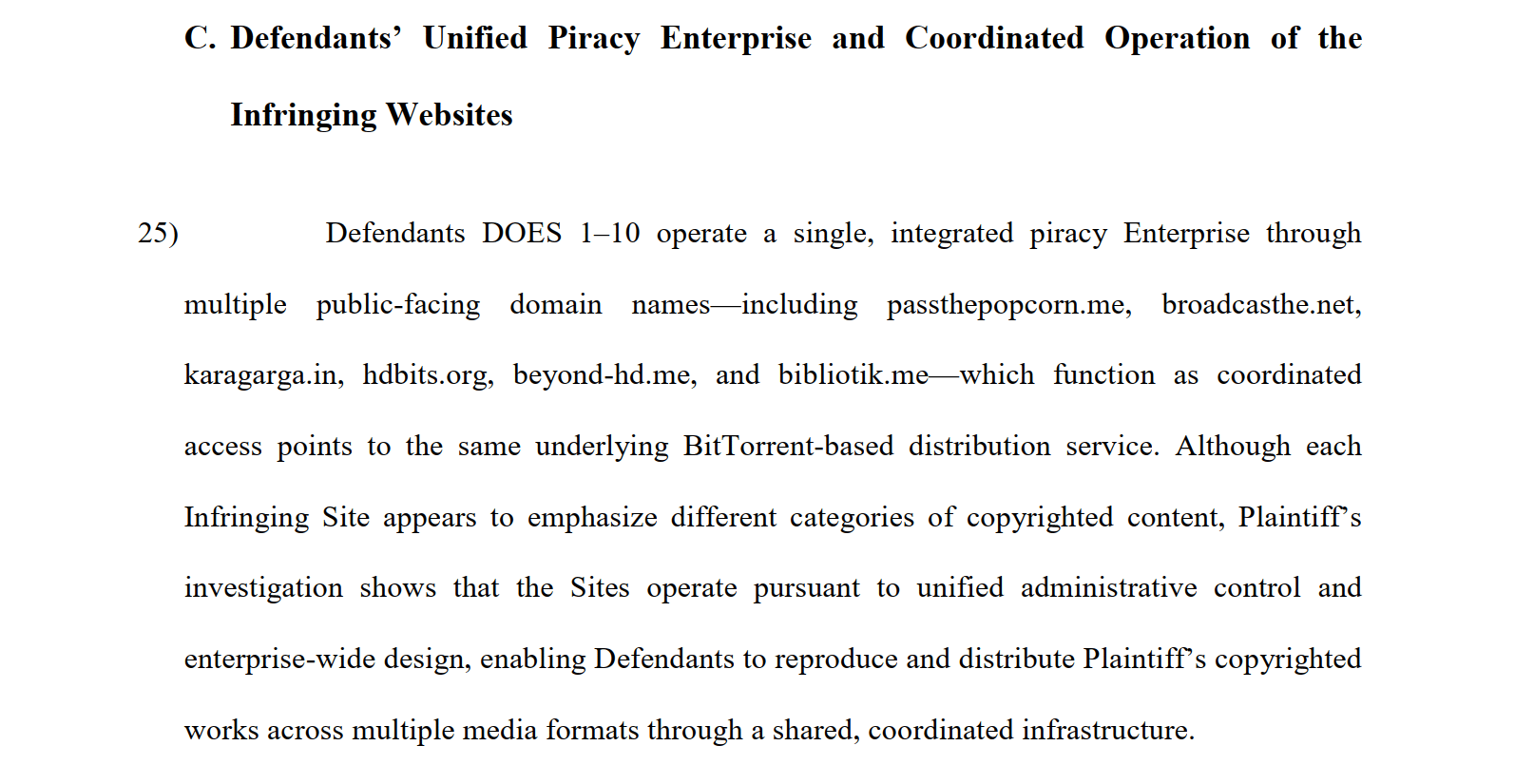
In his Illinois complaint, the plaintiff doubled down on his assertions, naming ten unnamed "John Doe" defendants. Rather than treating the targeted platforms as isolated entities, the complaint framed PassThePopcorn.me, BroadcasTheNet, KaraGarga.in, HDBits.org, Beyond-HD.me, and Bibliotik.me as a unified, coordinated "piracy Enterprise."
The pro se complaint alleged that these six distinct platforms operated merely as "coordinated access points to the same underlying BitTorrent-based distribution service." By consolidating the trackers under a single racketeering and copyright infringement umbrella, the plaintiff attempted to cast an expansive legal net designed to compel disclosures from major web infrastructure and financial service providers.
Phase 3: The Discovery Battles and Subpoena Objections
By February, Judge Wood permitted the plaintiff to issue sweeping third-party subpoenas to seven major corporations: Reddit, GoDaddy, Cloudflare, PayPal, Stripe, Namecheap, and X Corp (formerly Twitter). The plaintiff demanded comprehensive identifying information, financial logs, and communication records for the Doe defendants.
This aggressive discovery push immediately triggered resistance. Defense attorneys representing several Doe defendants mobilized, filing formal motions to quash the subpoenas. Consequently, by May, the court placed all seven subpoenas in abeyance pending the resolution of these motions.
It was during this phase that the defense filings began dismantling the plaintiff’s evidentiary foundation piece by piece.
Supporting Context & Metrics: Fabricated Evidence and Phantom Investigators
As defense counsel dug deeper into the plaintiff’s evidentiary submissions, they uncovered a labyrinth of inconsistencies, red flags, and suspected fraud.
The Phantom Investigative Agency
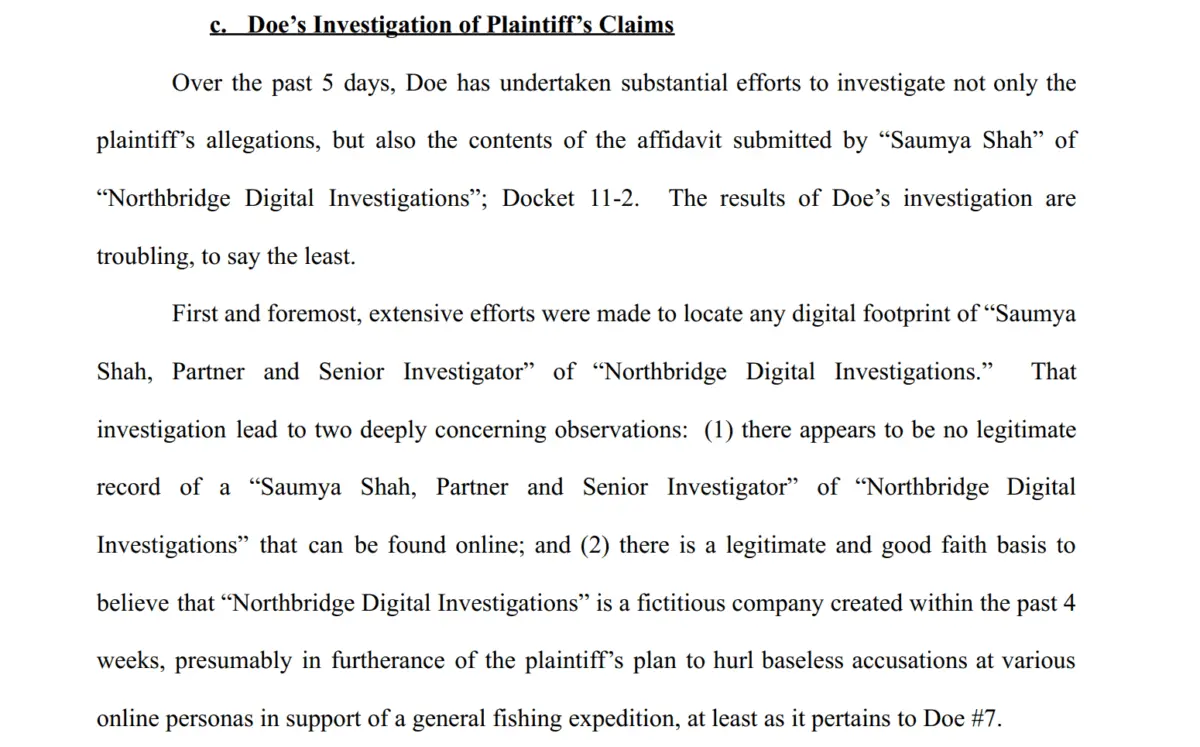
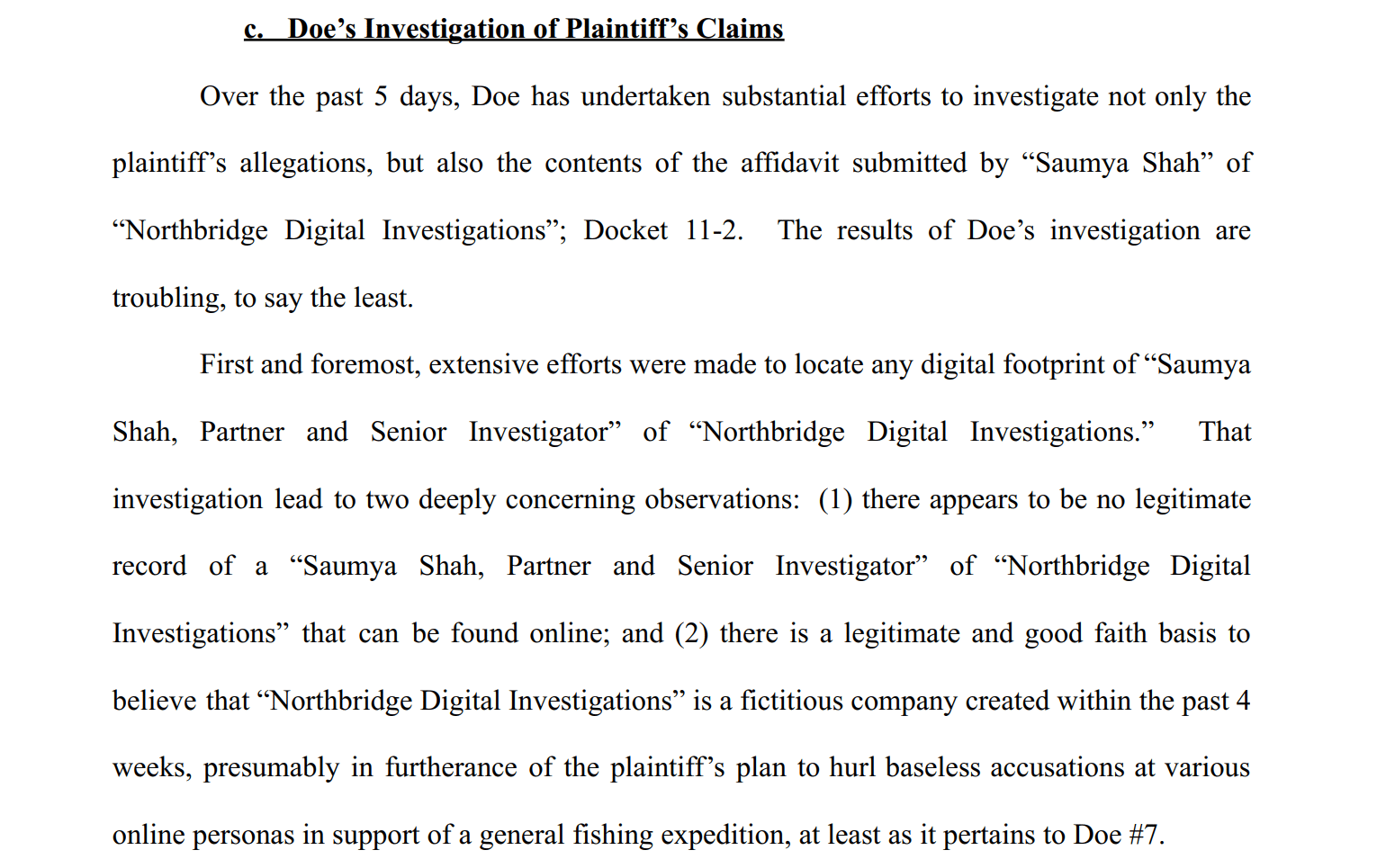
In support of his discovery motions, the plaintiff submitted a sworn declaration purportedly authored by "Saumya Shah, Partner and Senior Investigator" at a UK-based corporate entity known as "Northbridge Digital Investigations."
When defense counsel and independent researchers—including journalists from TorrentFreak—scrutinized these credentials, the house of cards collapsed:
- Corporate Registry Check: A search of the UK Companies House registry revealed zero corporate registrations for "Northbridge Digital Investigations."
- Investigative Footprint: Saumya Shah possessed no verifiable digital footprint, professional history, or industry credentials anywhere online.
- The Response: When challenged regarding these discrepancies, the plaintiff stubbornly insisted that his copyright infringement claims against "Doe 7" remained valid, entirely dodging questions regarding the existence of Saumya Shah or Northbridge Digital Investigations.
Dubious Evidentiary Exhibits
Further compounding suspicions, Doe 7’s legal team analyzed the approximately 130 URLs submitted as foundational evidence of infringement. The analysis revealed:
- Cross-contamination of URLs belonging to unrelated, public pirate indexing sites.
- WHOIS ownership lookups targeting at least ten additional private tracker domains that were not even named as defendants in the original complaint.
- A complete lack of verifiable cryptographic hashes or verifiable torrent seeding logs linking the accused private swarms directly to the plaintiff’s master files.
Official Statements and the Courtroom Showdown
The trajectory of the litigation changed overnight during a telephonic hearing presided over by Judge Andrea R. Wood. Prior to the proceedings, defense counsel Erin Russell (representing Doe 1) and Haley Finch (representing other Does) took the extraordinary step of contacting the judge’s chambers directly. Recognizing the gravity of their claims, the attorneys informed the court that they had developed definitive proof that the litigant styling himself as "Matthew Schneider" was an impostor.
Unmasking the Real Matthew Schneider
Russell and Finch conducted extensive open-source intelligence and network research, tracing the filmmaker’s catalog to a genuine Canadian independent film production company named Dirtbag Films.
Utilizing personal professional networks—Finch is a Canadian attorney with direct connections to the independent film community—the defense teams successfully reached the real Matthew Schneider. The legitimate filmmaker executed a formal, signed legal declaration confirming his true identity, verifying that he resides in Ontario, Canada, and explicitly stating that he has never filed, authorized, or participated in the federal lawsuit playing out in Illinois.
The Hearing and the Plaintiff’s Defiance
During the telephonic hearing, Judge Wood confronted the plaintiff directly with the defense’s findings. When asked to respond to the explosive revelation that he was an apparent impostor, the plaintiff offered a dismissive defense. He argued that the revelation should not delay ongoing court rulings and concluded the exchange by stubbornly asserting:
"I’m Matthew Schneider."
Judge Wood acted swiftly to secure the integrity of the judicial process. She declined to rule on the pending motions to quash or proceed anonymously, and she formally denied the plaintiff’s motion to strike Doe 7’s filings.
Crucially, Judge Wood signaled that if the impersonation allegations hold true, the plaintiff faces severe judicial sanctions, contempt citations, and immediate dismissal of the action. She ordered the defense to formally file a motion supported by the declaration of the authentic Canadian Matthew Schneider and scheduled a mandatory in-person evidentiary hearing to resolve the identity crisis once and for all.
Furthermore, the court issued strict protective parameters: the plaintiff was explicitly barred from seeking any further personal identifying information regarding the Doe defendants, and all parties were prohibited from filing identifying materials onto the public docket.
Future Outlook: Implications for Digital Copyright Enforcement
The collapse of this lawsuit marks a watershed moment in the intersection of copyright litigation and digital piracy enforcement.
1. The Vulnerability of Pro Se Litigants in Copyright Actions
Federal courts traditionally afford a degree of procedural leniency to pro se litigants navigating complex statutory frameworks. However, this case exposes the extreme vulnerabilities and risks associated with allowing unrepresented individuals to leverage federal subpoena powers against privacy-centric online communities. Without rigorous initial vetting by licensed officers of the court, bad actors can exploit the federal judiciary to wage personal vendettas, harvest data, or execute harassment campaigns under the guise of intellectual property protection.
2. The Legal Fallout for the Plaintiff
If the upcoming in-person evidentiary hearing confirms that an impostor hijacked the identity of Canadian filmmaker Matthew Schneider, the legal consequences will be severe. Beyond the immediate dismissal of the lawsuit with prejudice, the plaintiff faces referral for criminal fraud, perjury charges stemming from false sworn declarations, and substantial monetary sanctions to compensate the defense teams for legal fees incurred in unmasking the fraud.
3. Protection for Private Trackers
For the operators and users of PassThePopcorn, BroadcasTheNet, KaraGarga, HDBits, Beyond-HD, and Bibliotik, the development is a monumental relief. Private trackers rely on absolute discretion and isolation from the public internet to maintain their operational security. While this lawsuit initially appeared to pose an existential threat to these networks, the exposure of fraudulent practices has inadvertently reinforced the resilience of these communities against bad-faith legal maneuvers.
Post-Publication Developments
In a final twist highlighting the volatile nature of the proceeding, court officials ordered the case files sealed shortly after initial reports went public. While this administrative lock-down temporarily limits public access to the docket, it guarantees that the forthcoming in-person showdown before Judge Wood will be one of the most closely watched intellectual property hearings of the year.