Executive Overview
The intersection of artificial intelligence and copyright law has given rise to some of the most complex, high-stakes litigation of the digital age. Over the past two years, rightsholders ranging from independent authors to major academic publishers have launched aggressive legal assaults against the architects of modern generative AI models. At the heart of these disputes lies a fundamental conflict: the insatiable data demands of large language models (LLMs) versus the exclusive reproduction and distribution rights granted by copyright law.
Among the corporations squarely in the legal crosshairs is Meta Platforms. Alongside rivals like OpenAI and Google, Meta has faced a barrage of class-action and individual lawsuits accusing the tech giant of harvesting pirated text, proprietary articles, and copyrighted books to train its Llama family of AI models. While courts have begun parsing the nuanced boundaries of what constitutes "fair use" during the actual training phase of an AI model, ancillary legal battles continue to rage over the methods used to acquire these massive training corpora.
In the case of Meta, the spotlight has turned sharply toward its utilization of peer-to-peer networks—specifically, the BitTorrent protocol and notorious "shadow libraries" like Anna’s Archive. Facing claims that it illegally distributed copyrighted works by "seeding" files back into the BitTorrent network while downloading them, Meta mounted an unorthodox defense: it argued that uploading data is an unavoidable, "part-and-parcel" mechanic of the protocol, rendering it a technical necessity for bulk data acquisition.
Desperate to dismantle this defense, opposing publishers attempted to subpoena Meta’s fierce market rivals, OpenAI and Anthropic, demanding their internal torrent logs and configuration files. They hoped to prove that competing AI labs successfully downloaded shadow library data without contributing to its illegal redistribution. However, a federal magistrate judge recently slammed the brakes on that strategy, shielding the rival AI developers while simultaneously tightening the noose on Meta’s own internal server data. This comprehensive report breaks down the anatomy of the subpoenas, the court’s rulings, and what this legal chess match means for the future of AI training practices.
Detailed Chronology of the Legal Battle
The Genesis: Llama, Shadow Libraries, and the Torrent Connection
The seeds of this specific legal controversy were planted when authors such as Richard Kadrey and Sarah Silverman filed a landmark class-action lawsuit against Meta. The complaint alleged that Meta utilized unauthorized copies of copyrighted books—sourced from illicit shadow libraries via BitTorrent—to train its foundational Llama language models. During the acquisition process, Meta’s systems allegedly operated as active nodes in the peer-to-peer swarm, not only downloading (leeching) files but also uploading (seeding) fragments of those copyrighted books to other peers across the network.
The "Fair Use" Split and Meta’s New Defense
Last summer, U.S. District Judge Vince Chhabria handed down a mixed ruling that defined the trajectory of the litigation. He determined that the actual algorithmic training process—whereby an AI digests text to identify patterns and weights—constituted fair use. However, the claims regarding the unauthorized distribution of copyrighted material via BitTorrent survived, remaining as the critical, active frontier of the case.
Faced with liability for sharing copyrighted files over BitTorrent, Meta introduced a supplemental legal defense early this year. The company argued that any uploading of pirated books that occurred concurrently with their downloads was an unavoidable consequence of using the BitTorrent protocol. Meta characterized BitTorrent as "a more efficient and reliable means of obtaining the datasets" and insisted that, in the case of massive repositories like Anna’s Archive, it was the only viable mechanism for bulk acquisition. Because peer-to-peer networks function by design through reciprocal uploading, Meta claimed the distribution was merely an "inherent characteristic" of the technology rather than an intentional act of copyright infringement.
Expanding the Suit and the Hunt for Precedent
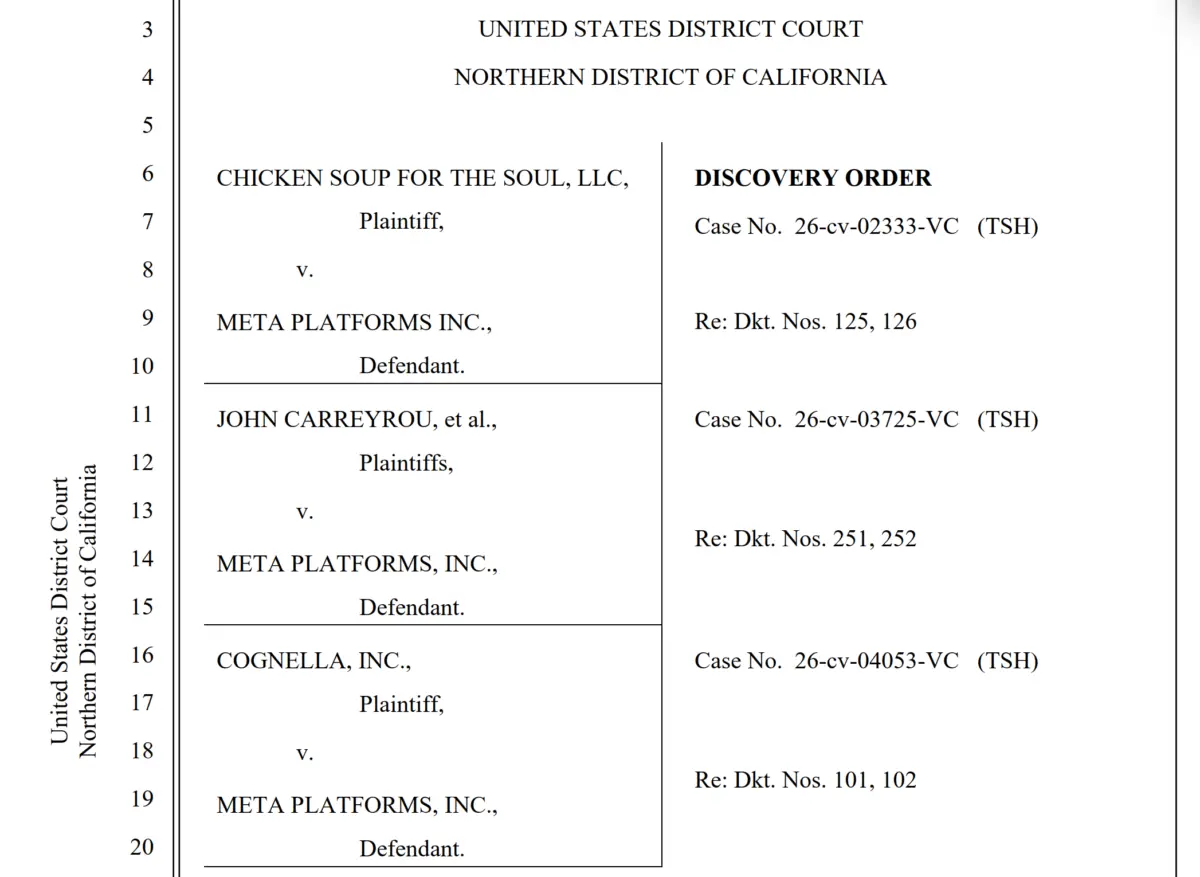
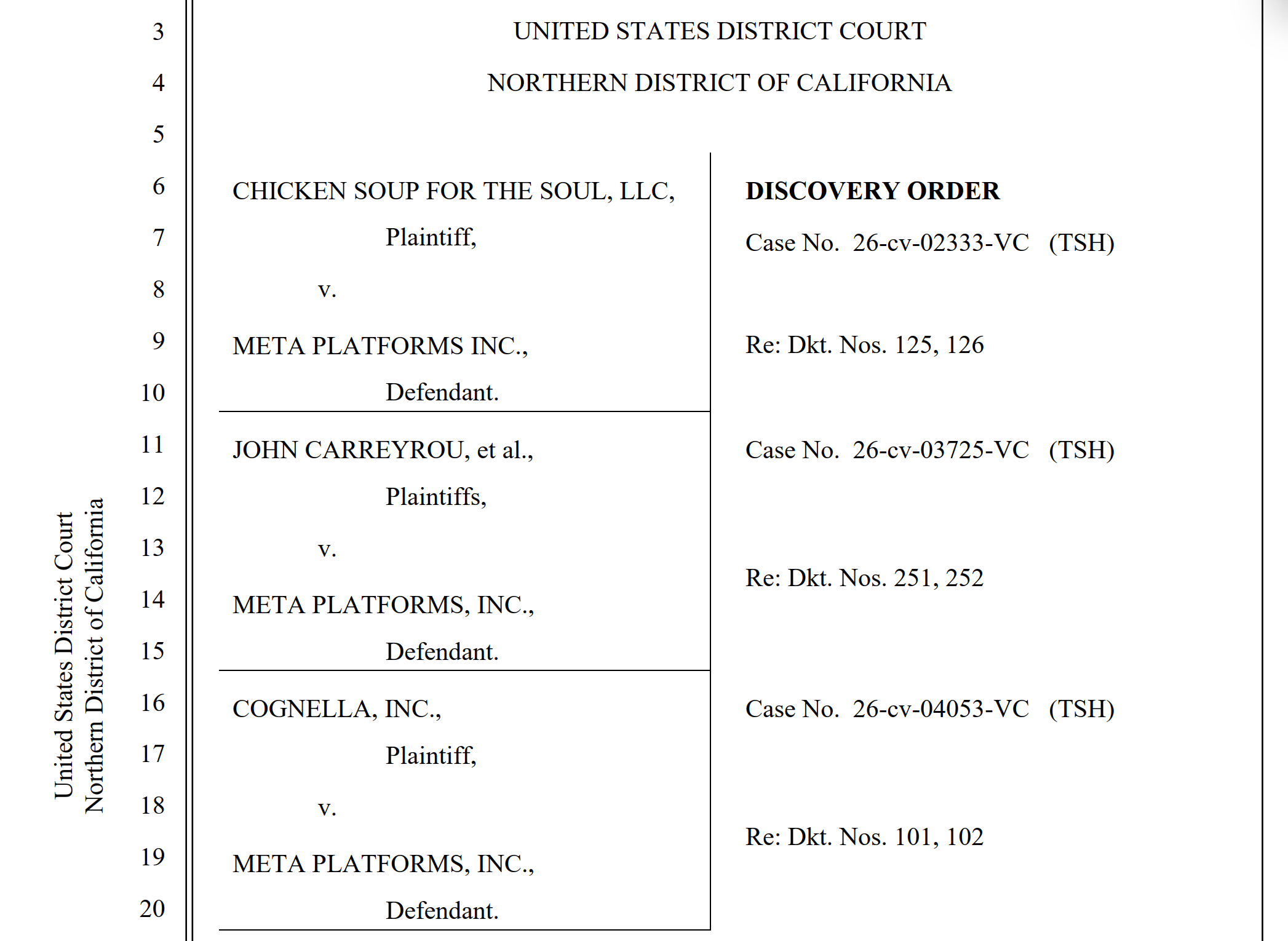
Meta’s novel defense is currently being stress-tested across three related lawsuits spearheaded by high-profile plaintiffs: Chicken Soup for the Soul, academic publisher Cognella, and Cambronne Inc., a firm representing journalist John Carreyrou. All three cases have been consolidated under Judge Chhabria, zeroing in on Meta’s shadow library torrenting activities.

Recognizing the vulnerability of Meta’s "necessity" argument, the publishers decided to look outward rather than waiting solely for Meta to produce its technical documentation. In August, the plaintiffs served sweeping subpoenas upon OpenAI and Anthropic—Meta’s primary competitors in the generative AI space.
The subpoenas demanded the exact identities, software versions, and configuration files of every torrent client OpenAI and Anthropic had utilized since 2019, alongside any internal records documenting efforts to suppress data uploading (seeding). The publishers’ logic was razor-sharp: if OpenAI or Anthropic successfully acquired similar training datasets via BitTorrent while actively configuring their clients to block uploading, Meta’s claim of technical necessity would collapse. It would prove that seeding was not an immutable law of the protocol, but rather a choice Meta deliberately declined to make—especially given prior discoveries showing a Meta engineer had previously written a script to prevent seeding while leaving leeching intact.
Supporting Context & Metrics: The Mechanics of BitTorrent and AI Data Harvesting
To understand the legal arguments, one must examine the fundamental duality of the BitTorrent protocol. Unlike traditional client-server architectures where a single host distributes a file to multiple downloaders, BitTorrent operates on a decentralized peer-to-peer (P2P) model.
- Leeching: The act of downloading data fragments (pieces) of a file from other users in the network swarm.
- Seeding: The reciprocal act of uploading those downloaded pieces to other users who are still seeking them.
By design, BitTorrent rewards participation; clients that actively upload speed up their own download rates through a tit-for-tat incentive mechanism. However, nearly all modern torrent clients feature configuration settings, command-line flags, or advanced parameters that allow users to throttle, limit, or completely disable the upload bandwidth (effectively operating in "read-only" or "leech-only" mode).
The Shadow Library Ecosystem
The datasets in question often originate from "shadow libraries"—massive, underground digital repositories such as Anna’s Archive, Library Genesis (LibGen), and Z-Library. These platforms host millions of copyrighted books, academic papers, and articles free of charge, entirely bypassing publisher licensing fees and copyright controls.
Because these repositories frequently operate outside the traditional web infrastructure and face constant takedown notices, their vast archives are often bundled into massive torrent swarms. For AI developers seeking to ingest petabytes of text data quickly, these peer-to-peer networks represent an enticing, albeit legally perilous, shortcut.
Official Statements and Arguments
The legal briefs submitted by both sides highlight a fierce debate over technical relevance, standard industry practices, and the boundaries of legal discovery.
The Plaintiffs’ Perspective
The publishers argued vigorously that the operational habits of Meta’s competitors directly undermined Meta’s core defense. In their court filings, they asserted:
"If OpenAI torrented but configured its clients to suppress uploading, then the redistribution Meta calls an ‘inherent characteristic’ of protocol was a setting Meta declined to change."
By refusing to disable seeding, the plaintiffs argue, Meta crossed the line from passive data collection into active copyright distribution.
The AI Rivals Push Back
OpenAI and Anthropic fiercely resisted the subpoenas, filing motions to quash the requests. They argued that their internal technical practices had zero bearing on Meta’s legal liability. Anthropic’s legal counsel emphasized the proprietary and variable nature of torrent software:
"Clients are not interchangeable, they differ in their default upload settings, in whether those defaults can be reconfigured, and in their capacity to suppress uploading during and after a download. What Anthropic’s client allowed shows nothing about what Meta’s did."
OpenAI echoed these sentiments, pointing out that the plaintiffs had failed to establish any baseline evidence proving that OpenAI utilized identical torrent clients, operated under the same technical constraints, or "built comparable corpora to Meta."
The Court’s Ruling
U.S. Magistrate Judge Thomas Hixson ultimately sided with OpenAI and Anthropic, issuing an order blocking the subpoenas. Judge Hixson reasoned that casting a wide net over rival AI companies was an inefficient and overly broad investigative path when direct evidence was available elsewhere:
"To the extent Meta’s fair use defense hinges on the assertion that its use of BitTorrent was the only way BitTorrent can be used, that assertion can be tested by examining the BitTorrent client itself… Any user of a torrent client would be relevant in that sense. Why can’t Plaintiffs’ expert use the torrent clients to show how torrent clients can be used?"
Furthermore, Judge Hixson noted that if the plaintiffs wished to prove whether shadow library data could only be acquired in bulk via torrents, they should gather that evidence directly from the shadow libraries themselves rather than dragging third-party competitors into the fray.
Future Outlook: The Turn Toward Meta’s Own Servers
While the doors to OpenAI’s and Anthropic’s digital records remain closed, the publishers have secured a major breakthrough regarding Meta’s internal infrastructure.
In a parallel ruling stemming from the core class-action lawsuit filed by Richard Kadrey, Judge Hixson granted a motion compelling Meta to hand over the command history files for every server, virtual machine, and AWS instance it used during its torrenting operations. Command histories provide an immutable, step-by-step log of every command entered by system operators—including how torrent clients were deployed, configured, and whether upload limits were manipulated.
This order serves as a direct rebuke to Meta’s earlier foot-dragging. Following admissions earlier this year that Meta had withheld relevant documents past discovery deadlines, federal judges have progressively tightened the screws on the tech giant.
What Lies Ahead
The implications of these rulings will ripple across the broader landscape of AI litigation:
- Expert Witness Reports: Plaintiffs’ technical experts are currently combing through Meta’s newly surrendered server logs and command histories. Their opening reports, due later this month, are expected to provide the definitive technical narrative of how Meta downloaded and shared copyrighted texts.
- The Death of the "Necessity" Defense: If the server logs reveal that Meta engineers actively chose to leave seeding enabled—or worse, had the technical capability to disable it but failed to do so for the sake of swarm health—Meta’s "part-and-parcel" fair use defense will likely disintegrate before Judge Chhabria.
- Precedent for Future Discovery: By drawing a firm line against subpoenaing third-party competitors, the court has established a boundary protecting non-parties from becoming collateral damage in sprawling copyright wars, forcing litigants to focus strictly on the defendant’s own digital footprint.
As generative AI models continue to evolve, the legal frameworks governing their ingestion of human knowledge are being forged in real-time. Whether Meta’s torrenting practices are ultimately judged as an unavoidable technical necessity or willful copyright infringement will soon be decided—not by what its competitors did in the shadows, but by the cold, hard command logs etched into Meta’s own servers.