Executive Overview
In the ongoing high-stakes battle between global entertainment giants and digital piracy networks, rightsholders are increasingly utilizing aggressive, streamlined legal mechanisms to unmask anonymous operators. Under United States copyright law, content creators and distributors are granted a powerful shortcut: the ability to identify alleged copyright infringers without initiating a full-blown civil lawsuit. This is achieved through the deployment of Digital Millennium Copyright Act (DMCA) subpoenas. These legal documents, typically signed off by a court clerk without the need for extensive judicial oversight, compel third-party service providers to surrender the private, identifying data of anonymous accounts.
Over recent years, this legal instrument has evolved into a formidable Open Source Intelligence (OSINT) tool. Leading the charge in its utilization is the Alliance for Creativity and Entertainment (ACE), supported by the Motion Picture Association (MPA). In a decisive escalation of this strategy, the MPA filed two major new subpoena applications in federal courts across California.
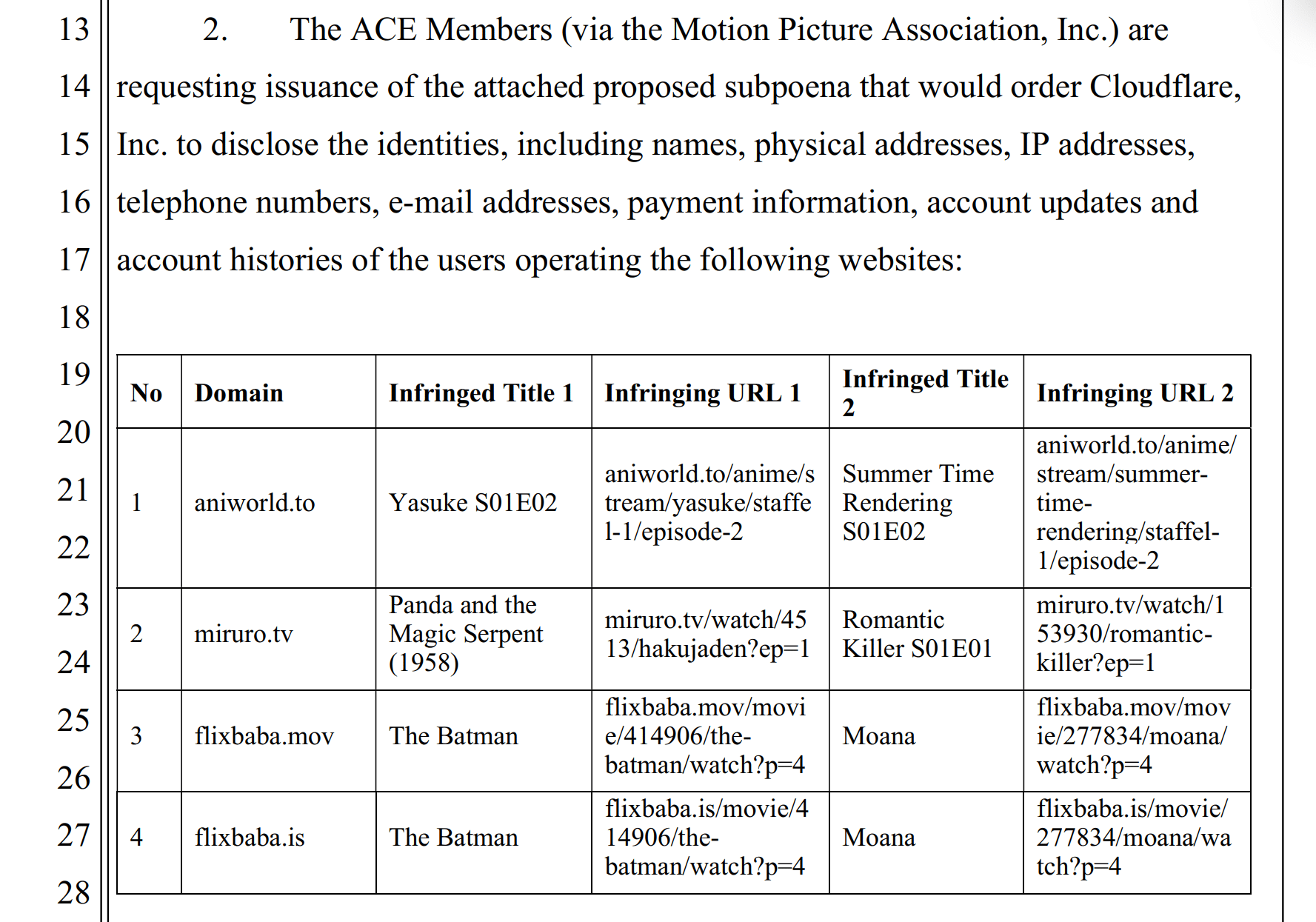
The first sweeping legal action targets internet infrastructure and content delivery giant Cloudflare, demanding the identification data of individuals operating a sprawling network of nearly 50 high-traffic pirate streaming domains. Among them are massive international giants such as the anime streaming titan Miruro and the German-language television hub Aniworld.to. The second subpoena zeroes in on Discord, targeting specific users and servers accused of distributing unauthorized, pirated copies of blockbuster films and popular television series.
This dual-pronged offensive underscores Hollywood’s evolving tactic: cutting off pirate infrastructure at the network edge via reverse-proxy providers while aggressively pursuing the administrators lurking inside encrypted, community-driven chat platforms.
Detailed Chronology: The Anatomy of the New Subpoena Filings
The legal maneuvers unfolded early this week within California’s federal court system, reflecting meticulous preparation by the legal teams representing the MPA and its high-profile roster of member studios—including The Walt Disney Company, Netflix, Warner Bros. Discovery, Universal Studios, Paramount Pictures, and European football governing body UEFA.

Phase 1: The Cloudflare Infrastructure Sweep (Central District of California)
Filed in the U.S. District Court for the Central District of California, the first subpoena targets Cloudflare, a vital cog in modern web infrastructure that provides security, DDoS protection, and reverse-proxy services to millions of websites worldwide. By sitting between visitors and a website’s origin server, Cloudflare often shields the true identities and physical locations of site operators.
The MPA’s application encompasses 49 distinct domain names that allegedly facilitate widespread copyright infringement. For every listed domain, ACE is demanding that Cloudflare surrender a comprehensive dossier of user data. This includes:
- Full legal names
- Physical addresses
- IP addresses
- Telephone numbers
- Email addresses
- Payment details and billing histories
- Comprehensive account creation and access logs
While intellectual property investigators acknowledge that pirate operators frequently register infrastructure using false identities or privacy-masked burner accounts, the acquisition of Cloudflare’s internal logs can provide critical digital breadcrumbs. Even a single billing discrepancy or unmasked IP address can crack an otherwise anonymous operation wide open.
Phase 2: Unmasking the Discord Administrators (Northern District of California)
Simultaneously, a second legal filing was submitted to the U.S. District Court for the Northern District of California, this time targeting the popular gamer-centric communication platform Discord.
On behalf of ACE, the MPA requested user identification logs tied to specific numeric identifiers representing two Discord servers and two distinct user accounts. According to the court documents, these digital enclaves were utilized to distribute direct links to unauthorized, high-definition copies of major cinematic and episodic releases, including Disney’s Wreck-It Ralph, Martin Scorsese’s Shutter Island, Amazon’s animated superhero hit Invincible, and the dramatic series The Pitt.
While the initial legal paperwork is heavily redacted regarding usernames—listing only raw numeric server, account, and channel IDs—forensic analysis of Discord’s platform architecture yields telling temporal data. Every ID generated on Discord is embedded with a precise creation timestamp:
- The First Server: Metadata reveals that the user account, communication channel, and primary server structure were all generated in rapid succession within a half-hour window in September 2025. This ephemeral hub remained active until it was abruptly pulled offline earlier this month.
- The Second Server: This infrastructure is notably older, tracing its genesis back to September 2020. However, the specific user account flagged alongside it for allegedly pushing infringing material was registered much more recently, in November of the previous year. This discrepancy indicates that the current administrators likely assumed control of—or infiltrated—a pre-existing community hub to repurpose it for mass piracy distribution.
Crucially, by the time the legal filings were made public, both targeted Discord servers had already vanished from the platform. Whether Discord’s trust-and-safety teams acted on parallel DMCA takedown notices or the panicked operators deleted their servers to evade detection remains unconfirmed. However, correspondence between the MPA and Discord explicitly demanded the removal of these communities, characterizing their sole operational purpose as acting as bridgeheads to external pirate streaming portals.
Supporting Context & Metrics: The Scale of the Targeted Ecosystem
To fully comprehend the gravity of the MPA’s Cloudflare subpoena, one must examine the staggering traffic metrics associated with the 49 targeted domains. Far from minor, fly-by-night copycats, the list reads like a global directory of mainstream streaming piracy.
The Heavyweights: Miruro and Aniworld
According to web analytics data from Similarweb cited in the legal filings, two particular networks tower above the rest in terms of global reach:
- Miruro (.to / .tv): Crowned as the undisputed leader of the targeted anime networks, Miruro pulls in staggering visitor metrics. Its
.todomain alone commands approximately 45 million monthly visits, while its.tvvariant adds another 37 million visits per month, making it a massive global destination for unauthorized Japanese animation streaming. - Aniworld.to: Dominating the European market, this German-language anime and television streaming portal draws an estimated 23 million visits every month, with the overwhelming majority of its traffic originating from Germany and German-speaking regions.
A Global Tour of Piracy Brands
Beyond the anime giants, the remaining 47 domains represent a cross-section of global copyright infringement, encompassing multiple linguistic and regional niches:

- Classic Clones: Numerous domains trade aggressively on the legacy name recognition of defunct giants like 123movies, Fmovies, and SolarMovie, deploying rapid-fire mirror networks to bypass ISP blocking orders.
- Regional Hubs: The list features Spanish-language Pelisflix mirrors, the Chinese-language Gimy network (
gimy.tv,gimy.now,gimyv.com), and various Hindi-language download portals. - Live Sports Streaming: Notably, the filing takes aim at StreamEast branded sports portals (
thestreameast.fun,streameasti.is, and related variants) which routinely broadcast live matches illicitly—directly infringing upon the broadcast rights of ACE member UEFA and major American sports leagues.
Comparing Subpoena Strategies: Targeted Precision vs. Wide Nets
Legal analysts have noted a distinct tactical shift in how rightsholders deploy DMCA subpoenas. For instance, this targeted approach contrasts sharply with massive, scattershot subpoenas seen in other high-profile intellectual property disputes—such as Take-Two Interactive’s sprawling hunt for Grand Theft Auto VI leakers, which demanded user data across thousands of accounts spanning multiple servers.
In contrast, the MPA’s current Discord action is surgical, focusing strictly on the specific orchestrators and administrators who built and maintained the pirate distribution channels, rather than casting a wide net over everyday end-users who merely consumed the content.
Official Statements and Legal Mechanics
The legal foundation of these actions rests squarely upon 5 U.S.C. § 512(h) of the Digital Millennium Copyright Act. This statutory provision allows copyright owners to file a simple application for a subpoena with any federal district court clerk. Once issued, the subpoena legally obligates service providers—whether they are cloud hosting networks like Cloudflare or chat service providers like Discord—to disclose all identifying information in their possession regarding the accused parties.
While the MPA has remained tight-lipped regarding ongoing investigative leads, statements embedded within the formal legal filings emphasize the systemic threat posed by these platforms. The MPA stressed to Discord that the infrastructure in question served no legitimate communicative or social function, functioning instead as malicious conduits designed explicitly to siphon users away from licensed digital storefronts and toward illicit monetization schemes funded by advertising and user donations.
Representatives for Cloudflare and Discord have not yet publicly commented on the specifics of these latest filings. Historically, both technology companies comply with legally binding U.S. court orders while balancing user privacy advocacy where jurisdiction and warrants permit. However, because DMCA subpoenas bypass standard judicial balancing tests—requiring only a verified copyright takedown notice and a formal administrative request—the legal hurdles for the MPA to secure the data are comparatively low.
Future Outlook: The Escalating War on Decentralized Piracy
The dual-pronged legal offensive against Cloudflare and Discord signals a broader, more aggressive phase in the entertainment industry’s anti-piracy crusade. As traditional web hosting companies and domain registrars implement stricter abuse policies, illicit operators have increasingly decentralized their operations. They now hide behind reverse-proxy networks like Cloudflare to obscure server origins while building tightly knit, encrypted communities on platforms like Discord and Telegram to cultivate loyal user bases and distribute magnet links or streaming paths.
By weaponizing the DMCA subpoena process against both infrastructure providers and chat platform administrators, the MPA and ACE are demonstrating that digital anonymity is shrinking. Even if operators utilize pseudonyms, fake registration details, and ephemeral chat channels, the digital footprints left behind during server creation, billing transactions, and traffic routing provide federal investigators with viable threads to pull.
As these subpoena requests await formal signature by federal court clerks, the outcome will likely set a critical precedent for how far rightsholders can penetrate platform-as-a-service (PaaS) and content delivery networks. If successful, the unmasking of the individuals behind networks like Miruro and Aniworld—alongside the Discord server administrators—will likely trigger a wave of civil lawsuits, financial settlements, and potentially criminal referrals. For digital pirates operating in the shadows, the message from Hollywood is unequivocal: the shield of online anonymity is wearing thin, and the legal net is closing in.