Executive Overview
As artificial intelligence transitions from an assistive typing aid into an autonomous agent capable of executing shell commands, modifying complex codebases across multiple files, and interacting directly with network pathways, the modern integrated development environment (IDE) has undergone a fundamental transformation. It is no longer merely a text editor; it is a live runtime environment possessing direct access to corporate intellectual property, internal network paths, and production codebases.
For many enterprise backend engineering teams—particularly those operating within massive Java, Kotlin, and Spring ecosystems anchored by JetBrains IDEs—this shift introduces unprecedented productivity alongside severe security vectors. When an autonomous coding agent can execute system-level commands, the central enterprise concern is no longer just about code quality or syntax completion. The critical question is what happens if the AI agent inadvertently interacts with unauthorized files, breaches sensitive network routes, or exposes hardcoded credentials.
Addressing these critical security challenges head-on, GitHub has rolled out a powerful new set of enterprise-managed sandbox policies for GitHub Copilot in JetBrains environments, currently available in public preview. This release marks a major leap forward in AI governance. By allowing IT and security administrators to centrally define, enforce, and verify strict boundaries around what sandboxed Copilot sessions can and cannot do, GitHub is bridging the gap between rapid software development velocity and rigorous enterprise security compliance.
Rather than relying on slow-moving, general-purpose Mobile Device Management (MDM) platforms or trusting developers to configure their own local environments, organizations can now lock down Copilot’s capabilities directly through the plugin’s managed settings. Combined with a robust new policy diagnostics tool, multi-file editing capabilities, and deep IDE context integration via the Copilot CLI, this update fundamentally alters how platform engineering and security teams govern generative AI at scale.
Detailed Chronology: The Evolution of Copilot Governance
The introduction of enterprise-managed sandbox policies for JetBrains is not an isolated update; it represents the culmination of a deliberate, methodical strategy by GitHub to secure its AI toolchain across every developer touchpoint. Over the past several months, GitHub has systematically closed governance gaps as Copilot has evolved from a simple code completion tool into a multi-modal, agentic coding partner.
Summer 2024: Laying the Groundwork
The foundation for these recent controls was laid in June, when GitHub introduced local and cloud sandboxes for the Copilot Command Line Interface (CLI) into public preview. These initial tools gave individual developers a mechanism to restrict what an AI agent could reach on their local machine using straightforward commands like /sandbox enable, or alternatively, to offload heavier, potentially risky computational tasks to ephemeral, isolated cloud-based Linux environments.
While these early tools empowered developers to protect their own local machines, enterprise security teams required centralized, top-down enforcement mechanisms. Prior to GitHub’s latest release, enforcing these boundaries meant routing policy changes through corporate MDM systems like Microsoft Intune or specialized endpoint management tools. Because MDM solutions are designed to manage entire operating systems rather than specific application plugins, they are notoriously broad, inflexible, and slow to deploy. A single policy adjustment could take days or weeks to clear bureaucratic approval chains and propagate across thousands of developer workstations.
August 2024: Expanding Plugin and Telemetry Governance
Recognizing the limitations of operating-system-layer management, GitHub shifted its strategy toward application-native governance. In August, the company introduced managed settings specifically for JetBrains IDEs, empowering administrators to govern third-party plugins, establish Model Context Protocol (MCP) server allowlists, and route telemetry data directly from within the plugin architecture.
This move established a vital architectural precedent: rather than pushing policies down from the OS layer, GitHub embedded administrative controls directly into the Copilot plugin channel. This allowed platform teams to adjust security perimeters in an afternoon rather than submitting cumbersome device management change requests.
September 2024: Bringing Granular Sandboxes to JetBrains
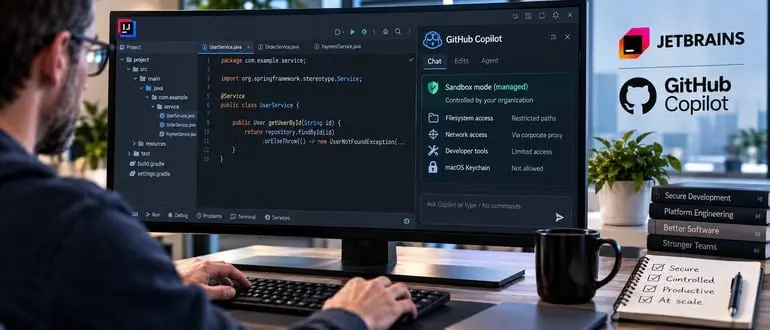
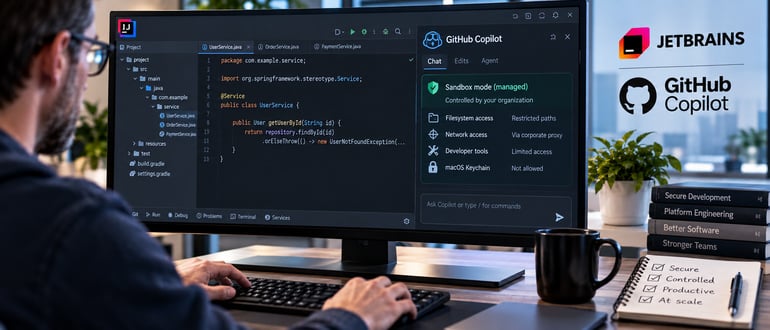
Building directly upon the managed settings framework established in August, GitHub’s latest September release brings enterprise-managed sandbox policies directly to Copilot in JetBrains. Now, administrators can centrally dictate the operational boundaries of AI agents running inside enterprise backend environments. Once an administrator locks a specific sandbox policy at the enterprise or organization level, the setting automatically populates within the developer’s JetBrains plugin interface, clearly marked with a (managed) tag. Local developers are entirely locked out from overriding these configurations, ensuring absolute compliance across the entire engineering organization.
Supporting Context & Metrics: Why IDE Runtimes Demand Rigorous Oversight
To fully grasp the significance of GitHub’s new sandbox policies, one must examine the unique architectural reality of enterprise backend development. Environments powered by JetBrains—such as IntelliJ IDEA, PyCharm, and WebStorm—frequently manage massive, enterprise-scale monorepos containing millions of lines of code. These repositories are often interconnected with complex microservices, internal package registries, database schemas, and cloud deployment pipelines.
When a developer invokes an autonomous AI agent within such an environment, the agent requires contextual awareness to be truly effective. However, granting an AI model the ability to read codebases, execute terminal commands, and query external APIs creates a vast attack surface.
The Security Dilemma of Agentic AI
According to insights from industry analysts, the transition of the IDE from a passive writing tool to an active runtime environment necessitates a complete reassessment of enterprise threat modeling.
- Credential Exfiltration Risks: Developers frequently store API keys, database credentials, and cloud provider tokens within local environment variables, configuration files, or operating system keychains (such as the macOS Keychain). If an autonomous AI agent experiences a hallucination or is manipulated via indirect prompt injection, it could inadvertently read these secrets and transmit them across the network.
- Unauthorized Network Access: Without strict network path restrictions, an AI coding assistant could theoretically query unauthorized internal endpoints, staging environments, or external third-party servers, leaking proprietary code or internal architecture details.
- Filesystem Modifications: Unchecked agents executing shell commands could modify critical system files, overwrite production configuration templates, or delete essential project assets.
Granular Controls Now Available to Administrators
The public preview of enterprise-managed sandbox policies for JetBrains gives IT and platform teams direct authority over the following parameters:
- Sandbox Activation: Administrators can mandate whether sandboxing must run for all Copilot sessions, eliminating the risk of developers turning off local security features for convenience.
- Filesystem Boundaries: Security teams can define precisely which directory paths a sandboxed Copilot session is permitted to read from or write to, protecting sensitive directories.
- Network Path Restrictions: Admins can whitelist or blacklist specific network destinations, preventing unauthorized data exfiltration or communication with unapproved external APIs.
- Proxy Routing: Corporate traffic can be forced through designated enterprise proxies, ensuring all AI-related network activity complies with organizational auditing standards.
- Developer Tool Access: Restrictions can be placed on whether Copilot can interact with underlying developer utilities and command-line execution environments.
- macOS Keychain Protection: On macOS systems, administrators can explicitly control whether Copilot is granted access to the operating system’s Keychain, safeguarding stored credentials and cryptographic secrets.
Accompanying Feature Enhancements
Beyond sandbox governance, the latest update introduces several powerful functional enhancements designed to improve developer productivity while maintaining strict oversight:
- Policy Diagnostics Tool: Recognizing that a security policy is only as good as its verification, GitHub has introduced a dedicated diagnostics utility. This tool enables administrators to verify whether their managed settings are actively being detected, loaded, and enforced on individual developer workstations.
- Cross-File Next-Edit Suggestions: Copilot’s predictive editing has evolved beyond single-file boundaries. Suggestions can now seamlessly jump across multiple files, a critical capability for refactoring tasks and architectural updates that touch multiple layers of an enterprise application.
- Project-Wide Chat Context: Copilot Chat can now ingest comprehensive, project-wide context automatically, removing the tedious requirement for developers to manually attach relevant files one by one.
- CLI-to-IDE Integration (
/idecommand): The Copilot CLI now features a/idecommand that links a terminal session directly with the active JetBrains context. This ensures that command-line agent sessions possess full awareness of the exact code selections, warnings, and diagnostics currently visible within the IDE. - OpenTelemetry Democratization: OpenTelemetry settings for Copilot Chat—previously restricted to enterprise-managed configurations—are now available to all users, facilitating broader telemetry tracking and performance monitoring.
Official Statements & Industry Perspectives
The release of enterprise sandbox policies has struck a chord with industry analysts and software lifecycle engineering experts who have long warned about the governance vacuum surrounding generative AI adoption.
Mitch Ashley, Vice President and Practice Lead for CIO & Technology Buyers and Software Lifecycle Engineering at The Futurum Group, offered a penetrating analysis of what this release means for modern enterprise security architectures.
"Once an agent can execute commands, edit across files, and reach the network on its own, the IDE isn’t just an editor anymore—it’s a runtime that needs the same access controls as any other system touching production code," Ashley stated.
"Building sandbox policy into the tool itself, rather than leaving it entirely to device management, is what lets security teams actually verify what’s enforced instead of assuming it. That verification piece is the part most organizations still skip."
Ashley’s emphasis on verification underscores a foundational shift in enterprise risk management. For years, organizations operated under a "trust-but-verify" model—or worse, a "configure-and-hope" model—where IT teams pushed configuration files out to workstations and assumed they were functioning correctly.
With autonomous AI agents executing shell commands and making independent modifications to codebases, blind trust is no longer viable. The inclusion of the policy diagnostics tool within GitHub’s latest release represents an institutional acknowledgment that governance must be verifiable, transparent, and continuous. Organizations utilizing Copilot’s advanced agentic features—such as automated autopilot modes and bypass-approval workflows—now possess the tooling necessary to definitively prove that their security boundaries are actively holding the line.
Future Outlook: The Trajectory of Agentic AI Governance
As we look toward the future of software engineering, the release of managed sandbox policies for JetBrains highlights a broader, undeniable trend: Agentic AI features are shipping significantly faster than the traditional security controls designed to govern them.
Throughout the summer of 2024, GitHub demonstrated a clear pattern of reactive yet rapid iteration. From managed plugin lists in July, to MCP server allowlists and telemetry routing in August, and now comprehensive sandbox policies in September, GitHub has consistently closed governance gaps one specialized surface area at a time. This iterative playbook is expected to continue as AI coding assistants acquire even deeper system-level autonomies.
Recommendations for Enterprise Platform & Engineering Teams
For organizations running JetBrains IDEs at enterprise scale, the practical implications of this release are immediate and actionable:
- Abandon Outdated Management Paradigms: Platform teams should avoid treating this release as a routine plugin update to be skimmed past or delegated entirely to slow-moving MDM administrators.
- Deploy Policy Diagnostics First: Before enabling any of Copilot’s more advanced, autonomous features—such as multi-file editing, CLI integrations, or agentic autopilot modes—engineering leadership must mandate running the policy diagnostics tool to verify baseline enforcement.
- Establish Cross-Departmental Ownership: Security, platform engineering, and development leads must collaborate to explicitly define organizational boundaries for filesystem access, network paths, and macOS Keychain interactions.
- Audit and Verify Continuously: Move away from static configuration files. Utilize GitHub’s native verification tools to continuously audit that intended restrictions are actively landing and holding on developer endpoints.
The tools required to secure the AI-driven development lifecycle are now fully available within the GitHub ecosystem. Whether enterprise organizations choose to proactively implement these rigorous safeguards before an incident occurs, or reactively scramble after a security breach, remains entirely up to them. What is certain, however, is that the era of unfettered, unmonitored AI autonomy within the enterprise IDE has officially come to an end.