In a legal push that could establish a sweeping precedent for digital copyright enforcement in the United States, major Spanish-language media conglomerate TelevisaUnivision (TU) is aggressively pursuing a permanent, self-expanding injunction against a vast network of pirate IPTV services. Filed in a federal court in Florida under the oversight of Judge Kathleen Williams, TU’s latest motion marks an escalation in modern anti-piracy litigation, moving far beyond traditional courtroom battles.
The media giant is seeking a staggering $32.7 million in statutory damages alongside an exceptionally broad permanent injunction. If approved, this order would grant the broadcaster unilateral authority to continuously add new domains, IP addresses, and even un-served "John Doe" defendants to the enforcement list without requiring subsequent judicial approval. This legal strategy mirrors the "dynamic site blocking" mechanisms long utilized across Europe, yet it adapts them uniquely to the American legal framework.
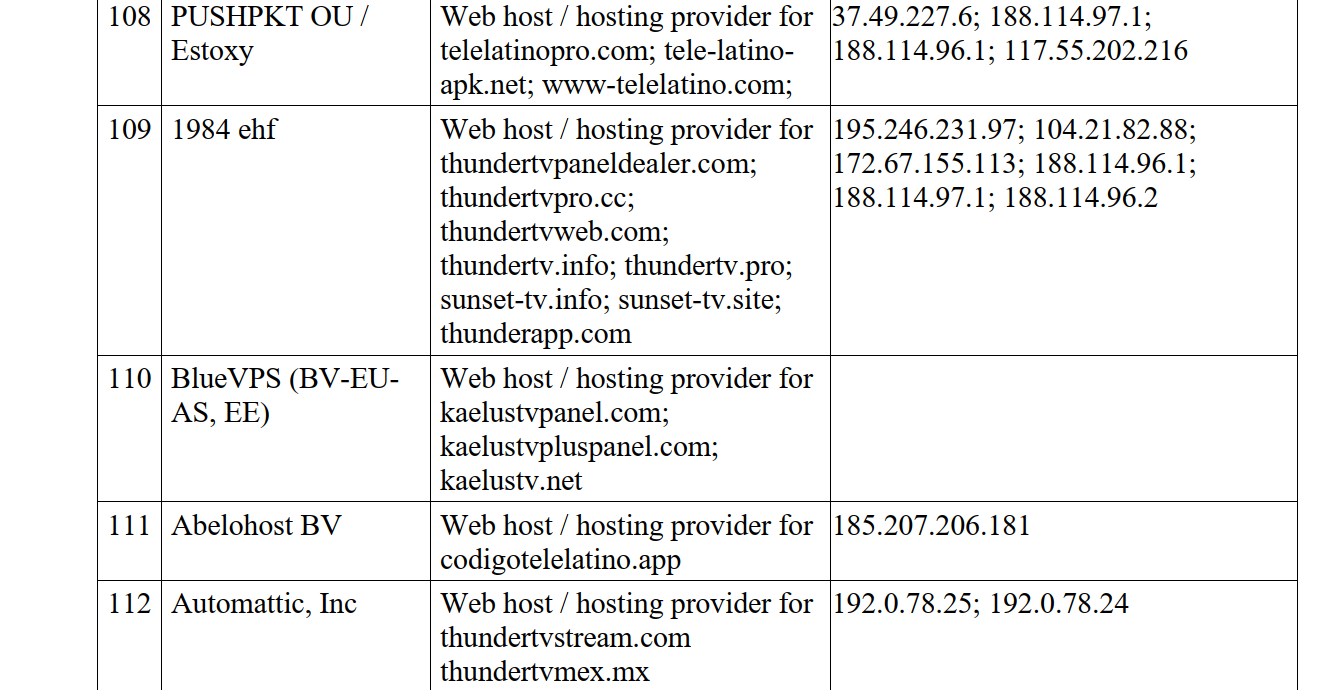
The case initially began as a targeted lawsuit against five prominent pirate IPTV services. However, due to the defendants’ systematic failure to appear in court, it has rapidly snowballed into an expansive dragnet encompassing nearly 600 unique domains and a staggering 121 internet intermediaries globally. From multinational domain registrars and content delivery networks (CDNs) to mainstream software providers, cloud services, and app stores, the scope of entities swept into the litigation highlights the sheer complexity of modern digital piracy ecosystems.
While the multi-million dollar damage figure serves as a potent paper deterrent against foreign-based actors who are unlikely to pay, the true core of TU’s strategy lies in structural disruption. By legally binding a massive network of technical intermediaries to cut off access, unmask proxy operators, and scrub distribution channels, TelevisaUnivision is attempting to construct an automated shield against digital infringement. As Judge Williams weighs the constitutionality and practicality of these unprecedented self-expanding provisions, the legal community watches closely to see how far U.S. federal courts are willing to go in handing enforcement keys directly to rightsholders.
Detailed Chronology: From Five IPTVs to a Global Dragnet
The legal offensive being waged by TelevisaUnivision did not materialize overnight; rather, it represents a calculated, step-by-step escalation designed to choke off illicit streaming operations at every possible layer of their technical infrastructure.

The Initial Spark and Default
The litigation commenced earlier this year when TelevisaUnivision filed a federal complaint targeting five primary pirate IPTV services: Thunder TV, Sunset TV, Tele Latino, Pop TV, and Kaelus TV. These platforms had built lucrative business models by streaming proprietary Spanish-language television content, movies, and live sports broadcasts without authorization or compensation to the copyright holders.
From the outset, the defendants adopted a classic evasive posture common in illicit streaming operations—they simply failed to appear in court. The operators behind Pop TV and Kaelus TV remained deeply anonymous, shielded behind privacy services and pseudonymous John Doe placeholders, while the entities behind Thunder TV, Sunset TV, and Tele Latino willfully ignored judicial summons. This total default by the defendants created an open procedural pathway for TU to move for default judgments, shifting the focus of the litigation from proving liability to designing an airtight, preventative remedy.
The Summer Preliminary Injunction
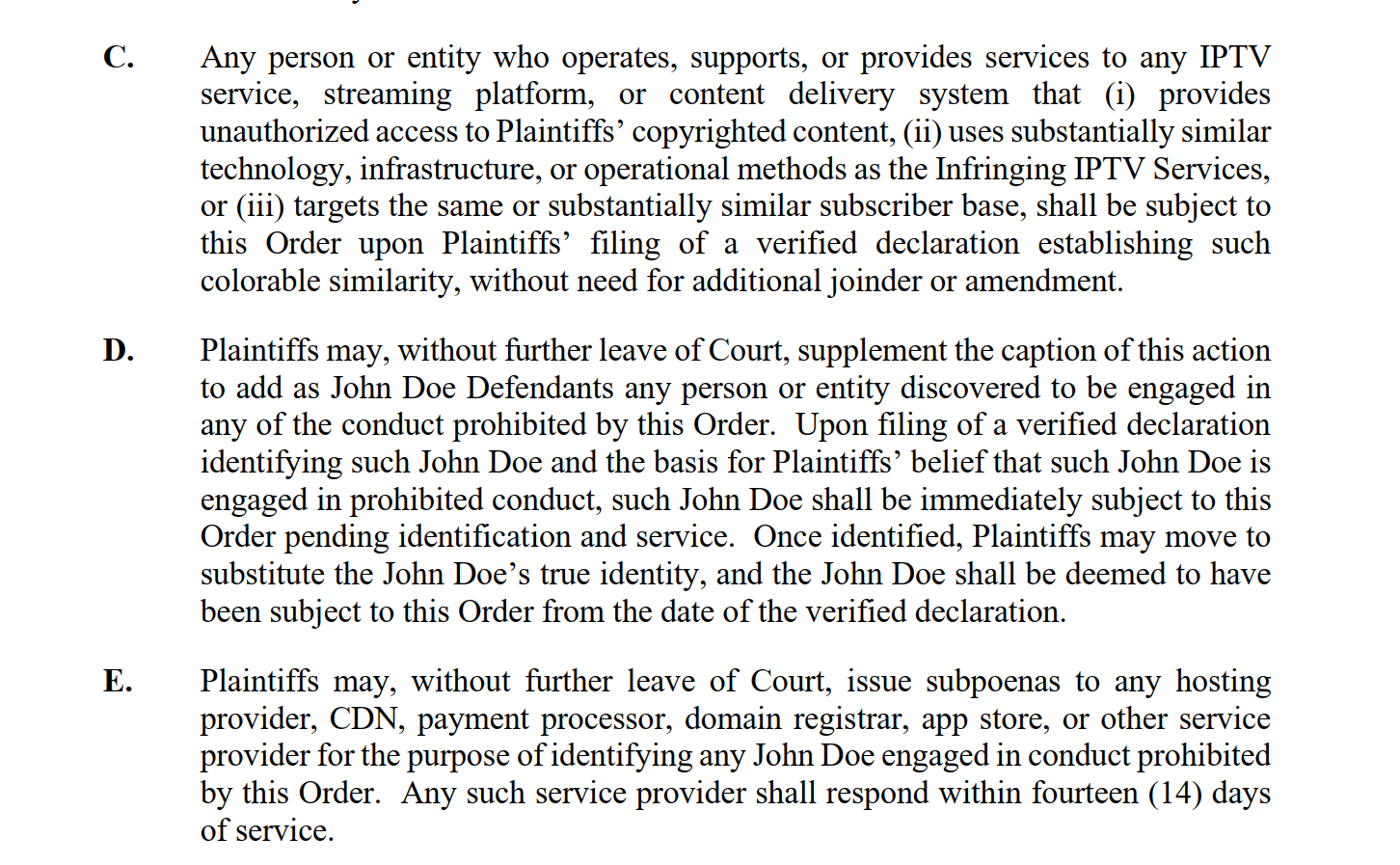
Recognizing the rapid "whack-a-mole" nature of pirate networks—where operators seamlessly spin up new domains the moment old ones are taken offline—TU petitioned for, and successfully secured, a preliminary injunction in July. Crucially, this preliminary order contained a dynamic mechanism that allowed the broadcaster to unilaterally add new domains and IP addresses to the blocking schedules without returning to the judge for formal modification.
The utility of this power became evident almost immediately. Before the preliminary injunction was even a month old, TelevisaUnivision had invoked its self-expanding capabilities twice, sweeping in additional pirate brands, mirror sites, and secondary domains. By September, the initial footprint of five IPTV services had ballooned into a sprawling index of nearly 600 unique domains and infrastructure endpoints.
The September 4 Default Judgment Motion
The culmination of this procedural trajectory occurred on September 4, when TU filed a comprehensive motion for default judgment before Judge Kathleen Williams. Asking for a headline figure of $32.7 million in combined copyright and trademark damages, the filing simultaneously pushed for a permanent injunction that preserves and aggressively expands upon the dynamic powers granted in the summer.
According to supplementary court declarations, this evolution is a direct necessity. For instance, investigators discovered that the operators of Thunder TV had seemingly abandoned their primary branding after initial legal pressures, only to stand up a nearly identical mirror application dubbed "Black Eye." This successor service allowed users to log in using their pre-existing Thunder TV credentials to access the exact same pirated feeds. To combat this slippery evasion tactic, TU’s proposed permanent order introduces sophisticated carveouts designed to capture successor entities, alter-ego services, and anyone utilizing "substantially similar technology" to target the same subscriber base.
Supporting Context & Metrics: The Scale of Modern IPTV Piracy
The numbers accompanying TelevisaUnivision’s legal filings paint a vivid picture of the industrial scale of contemporary digital piracy. Far from being operated out of a single basement server, modern IPTV empires rely on global content distribution networks, multi-tiered white-label infrastructure, and a dizzying array of technological intermediaries.
Breaking Down the Numbers: 600 Domains and 121 Intermediaries
The proposed permanent injunction references nearly 600 unique domain names. Brands such as Thunder TV and Tele Latino alone account for over 90 domains each, reflecting a redundant architecture designed to survive piecemeal takedowns. Another notable player, XuperTV, was identified by TU as a white-label service built directly upon the underlying Magis TV infrastructure, contributing upwards of 110 domains to the blocking schedule.
More striking than the domain count is the sheer breadth of the intermediary list. The legal paperwork targets 121 distinct intermediaries, categorized into:
- 51 Domain Registrars: Ranging from popular U.S.-based entities like NameCheap and GoDaddy to international registrars such as Russia’s REGTIME-SU, Vietnam’s Mat Bao, Peru’s NIC.PE, the Dutch Registrar.eu, Iran’s Aria Shatel, and even the Romanian state research institute ICI Bucuresti.
- 58 Hosting and Content Delivery Network (CDN) Providers: Platforms providing server space and traffic acceleration.
- 5 Parts Distribution & Payment Channels: Facilitating subscription fees and financial transactions.
- 5 App Distribution Platforms: Gateways through which users install unauthorized streaming software onto consumer hardware.
The Intermediary Dragnet: Software, Clouds, and Registries
The net cast by TU captures household technology brands alongside obscure offshore hosts. Platforms such as GitHub, Vercel, Canva, Wix, Squarespace, and Automattic (the corporate force behind WordPress.com) have all been linked in court documents to specific pirate domains or promotional pages.
Furthermore, the injunction takes aim at hardware ecosystems and software installation tools. Roku and the developers behind the AFTVnews Downloader app have been ordered to scrub pirate applications from their stores and actively block the numerical short codes traditionally used by consumers to sideload unauthorized IPTV apps onto smart TVs and streaming sticks.
In a few instances, however, the broad nature of the legal demand has highlighted the technical complexities—and occasional overreaches—inherent in mass-injunction drafting. The proposed order lists RIPE NCC and APNIC, the regional Internet registries responsible for allocating IP address space in Europe and the Asia-Pacific regions, respectively. Mischaracterized in the filings as "web hosts," these registries allocate blocks of IP numbers to local internet service providers but possess no technical ability to block traffic or censor specific web content, illustrating the friction that occurs when broad copyright enforcement meets the rigid architecture of the global internet.
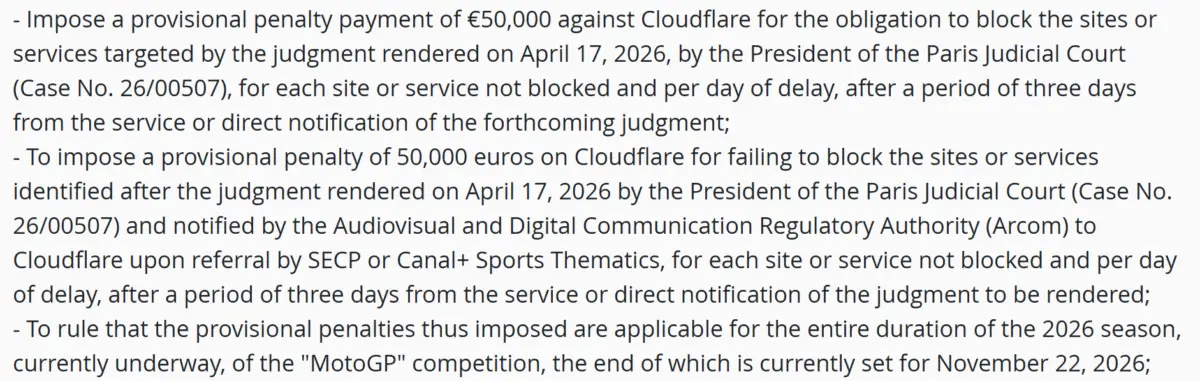
Cloudflare, meanwhile, faces dedicated, highly specific demands. For approximately 90 IP addresses tied to the pirate operations, Cloudflare is ordered to unmask its proxy layers by revealing the true origin servers behind its network, alongside the authentic names and email addresses of the account holders.
Official Statements and Legal Strategy
While the corporate entities behind the pirate IPTV networks have maintained radio silence—failing entirely to retain legal counsel or present a defense in a U.S. court—TelevisaUnivision’s legal strategy is laid bare within its extensive court filings and public motions.
The Rationale for Self-Expanding Powers
The core of TU’s legal argument hinges on the inadequacy of traditional, static injunctions in the face of agile cybercrime syndicates. Historically, a copyright holder winning an infringement suit could secure an order compelling specific parties to halt infringement on specific, pre-listed URLs. However, as soon as that order was signed, pirate operators could simply register a new domain name, spin up a mirror server, and resume operations unhindered, forcing rightsholders to initiate entirely new lawsuits or repeatedly petition judges for amendments.

By pushing for a "self-expanding" permanent injunction, TelevisaUnivision is asserting that judicial efficiency and effective property protection require shifting administrative burdens away from the courts and onto the infrastructure gatekeepers. Under TU’s proposed framework, once a service is legally determined to be infringing, the rightsholder is empowered to act as both investigator and enforcer of the perimeter—updating schedules, adding mirror domains, and notifying intermediaries of newly discovered touchpoints without judicial oversight.
The Calculus of Multi-Million Dollar Judgments
The $32.7 million damage request is divided into two distinct statutory categories:
- $26.7 Million for Willful Copyright Infringement: Calculated at the statutory maximum of $150,000 for each instance of willful infringement across the broadcaster’s registered works.
- $6 Million for Willful Trademark Counterfeiting: Calculated at $2 million per defendant group for unauthorized commercial appropriation of TU’s protected brand identities.
Industry legal analysts widely acknowledge that collecting tens of millions of dollars from anonymous, foreign-based operators residing in permissive jurisdictions is an absolute statistical improbراءة—a near impossibility. TU is under no illusion that it will recoup this capital from the primary defendants. Instead, the multi-million dollar figure functions primarily as a legal instrument fulfilling two vital purposes:
- Deterrence on Paper: Establishing a severe judicial precedent that signals the exorbitant financial risks associated with large-scale digital piracy of protected broadcast assets.
- Justification for Drastic Relief: Demonstrating to federal judges that because monetary damages are uncollectible from evasive international defendants, equitable relief—specifically, a massive, structural, self-expanding injunction—is the only viable remedy capable of protecting intellectual property.
This strategy mirrors broader trends across the media landscape. Earlier this year, tech giants Amazon and Netflix secured an $18.75 million judgment against a Dallas-based IPTV operator, while major Hollywood studios successfully obtained a $9 million default judgment against a Pennsylvania streaming operation in June. Yet, while domestic defendants may occasionally face tangible asset seizures, foreign syndicates operate largely insulated from domestic financial recovery, leaving structural network disruption as the sole effective weapon for rightsholders.
Future Outlook: Implications for U.S. Copyright Law and Global Piracy
As Judge Kathleen Williams reviews the motion for default judgment and the accompanying proposed permanent injunction, the case stands as a pivotal watershed moment for American digital copyright jurisprudence. The outcome will likely reverberate far beyond the specific Spanish-language content libraries of TelevisaUnivision, setting a critical benchmark for how U.S. courts handle the collision between digital privacy, intermediary liability, and international intellectual property enforcement.
The Balancing Act: Judicial Oversight vs. Private Enforcement
The central question facing the federal court is one of institutional boundaries: Can—and should—a court delegate ongoing enforcement and expansion powers directly to a private corporation?
Critics of dynamic and self-expanding injunctions argue that bypassing judicial review removes essential checks and balances. Allowing a rightsholder to unilaterally expand the scope of a court order—adding new defendants, new domains, and new third-party intermediaries without a judge evaluating the merits of each newly captured entity—creates a tangible risk of over-blocking. Legitimate websites, shared hosting environments, and unrelated businesses frequently share IP spaces or technical configurations with bad actors; without judicial scrutiny, automated or aggressive expansion lists could inadvertently stifle lawful speech and commerce.
Conversely, proponents of the TelevisaUnivision model argue that the traditional U.S. judicial process is fundamentally too slow and cumbersome to combat real-time internet piracy. By the time a rightsholder files paperwork, schedules a hearing, and secures a judicial modification to an injunction, a pirate network has already migrated across a dozen new domains and domain extensions. For copyright enforcement to remain relevant in an era of automated, cloud-based streaming infrastructure, legal remedies must evolve to match the speed and agility of the infringement itself.
A New Standard for Intermediaries
Regardless of how Judge Williams rules on the most expansive self-expanding provisions, the sheer breadth of the intermediary list targeted in this litigation signals a permanent shift in expectations for tech platforms, cloud providers, and registrars. Intermediaries can no longer safely adopt a passive stance toward illicit streaming traffic hosted on their networks or registered through their portals.
If the proposed permanent injunction is approved in full, companies ranging from major cloud infrastructure providers like Cloudflare down to boutique domain registrars and software tools will find themselves legally mandated to act as active participants in copyright enforcement. For global pirate networks relying on decentralized, multi-jurisdictional infrastructure, the walls are steadily closing in—not through direct apprehension of elusive operators, but through the systematic dismantling of the digital plumbing that keeps their streams alive.