BRUSSELS — The European Union’s ongoing battle against live-streaming piracy has reached a critical juncture. For years, major sports leagues, broadcasting conglomerates, and intellectual property rightsholders have lobbied Brussels for urgent, decisive, and harmonized legislation to stem the financial bleeding caused by unauthorized pirate streams.
While the European Commission took a step forward in 2023 by publishing a targeted, non-binding recommendation encouraging member states to streamline the takedown of illegal live broadcasts, the results have been patchy. While certain countries—most notably Italy with its contentious "Piracy Shield" system—have dramatically escalated enforcement, other EU nations have enacted little to no meaningful action.
Now, a newly released, comprehensive study commissioned by the European Parliament’s Committee on Legal Affairs (JURI) argues that the EU’s fragmented, voluntary approach is fundamentally broken. Titled “Countering online piracy of sports and broadcast in the EU” and authored by Professor Giovanni Maria Riccio of the University of Salerno, the report calls for a radical paradigm shift: transitioning away from soft guidance and toward a binding EU-wide Regulation.
At the center of Professor Riccio’s proposal is a controversial mechanism: a mandatory 30-minute takedown window for internet intermediaries, modeled closely after Italy’s aggressive administrative framework. Yet, the report also wades directly into a minefield of digital rights concerns, openly acknowledging the severe collateral damage—known as overblocking—that plagues such blunt instruments.
Executive Overview
The landscape of live-event broadcasting is defined by high stakes, fleeting windows of economic value, and shifting consumer habits. For sports rights-holders, the value of a live football match, Formula 1 race, or Olympic event diminishes the moment the final whistle blows or the checkered flag drops. Consequently, piracy of live broadcasts operates on a hyper-accelerated timeline that traditional copyright enforcement mechanisms, which often take days or weeks to process, cannot match.
To bridge this gap, the JURI-commissioned study lays out a blueprint for a pan-European enforcement apparatus. Its core recommendations include:
- A Binding EU Regulation: Replacing voluntary member-state guidance with hard EU law to eradicate legal fragmentation across borders.
- The 30-Minute Takedown Window: Forcing internet intermediaries to disable access to unauthorized live streams within half an hour of notification.
- Expanded Intermediary Scope: Extending liability and cooperation duties far beyond traditional Internet Service Providers (ISPs) to include Content Delivery Networks (CDNs), Virtual Private Network (VPN) providers, dedicated server hosts, and third-party Domain Name System (DNS) resolvers like Google and OpenDNS.
- National Administrative Oversight: Requiring every EU member state to establish an independent regulatory authority modeled after Italy’s Communications Authority (AGCOM).
- Addressing Root Economic Causes: Acknowledging that punitive enforcement alone cannot succeed without fundamentally overhauling the prohibitive cost and fragmented availability of legal streaming alternatives.
While entertainment conglomerates and sports federations have welcomed the study as a long-overdue reality check, digital rights advocates, civil liberties groups, and technical experts have sounded alarms. By proposing the widespread adoption of Italy’s Piracy Shield model, the report champions a system that has repeatedly been shown to cause massive collateral damage, inadvertently censoring human rights organizations, cloud hosting environments, and innocent web infrastructure.
Detailed Chronology: From Soft Guidance to Hard Regulation
To understand how the European legislative debate arrived at this contentious crossroads, it is necessary to examine the timeline of anti-piracy policy evolution within the European Union over the past decade.
1. The Era of Voluntary Frameworks (2018–2022)
Historically, EU enforcement relied on the antiquated frameworks of the Electronic Commerce Directive and the Copyright Directive. Rightsholders continually argued that these rules were designed for static web pages and text-based files, rendering them entirely impotent against dynamic, rapidly shifting IP addresses and stream-ripping operations used by modern pirate rings. As major sports rights values soared into the billions of euros, political pressure on the European Commission intensified.
2. The 2023 Recommendation and the Italian Vanguard
Responding to sustained industry pressure, the European Commission issued a targeted recommendation in May 2023. It "encouraged" member states to implement proactive measures ensuring the prompt removal of live-content piracy. However, because the text was non-binding, it carried no legal teeth.
Seizing on the mandate, Italy forged ahead, operationalizing its infamous Piracy Shield system. Operated by the Italian communications regulator AGCOM, the platform allows rightsholders to upload evidence of illegal streaming domains and IP addresses, triggering automated, near-instantaneous blocks across Italian ISPs and DNS providers. While lauded by sports federations for dropping thousands of pirate streams within minutes, it immediately drew sharp criticism from tech experts and civil rights lawyers for its lack of judicial oversight and frequent overblocking incidents.

3. The 2024–2025 JURI Intervention
Recognizing that Europe was fracturing into a patchwork of strict enforcement zones and safe havens, the European Parliament’s JURI Committee commissioned Professor Riccio to evaluate the efficacy of current laws. Released to the public, the Riccio report concludes that the current environment is fundamentally unviable.
"The current EU response to live-content piracy remains fragmented and not fully adapted to the speed and technical complexity of live broadcasts," the report states. "Existing rules provide useful tools, but they do not yet ensure consistent and timely enforcement across Member States."
The study now serves as a key foundational document as the European Commission reviews the broader implementation of the Copyright in the Digital Single Market Directive, setting the stage for high-stakes legislative battles in the European Parliament.
Supporting Context & Metrics: The Technical Reality of Intermediary Liability
A critical contribution of the new JURI study is its insistence that targeting traditional ISPs alone is no longer sufficient to combat sophisticated modern piracy networks.
Expanding the Net to the Infrastructure Layer
Modern pirate operations utilize complex, multi-tiered hosting architectures. When a domain is blocked by an ISP, operators instantly migrate to new IP addresses, utilize Cloudflare or alternative CDNs to obfuscate origin servers, or route traffic through decentralized DNS resolvers and VPN tunnels.
Consequently, the study argues that the personal scope of anti-piracy regulations must extend to the entire technical chain of internet distribution. Professor Riccio writes:
"It would likewise be desirable for the personal scope of application to extend to the entire chain of intermediaries technically involved in the distribution of unauthorised content — including providers of content delivery networks, VPN services, dedicated servers and DNS resolution systems."
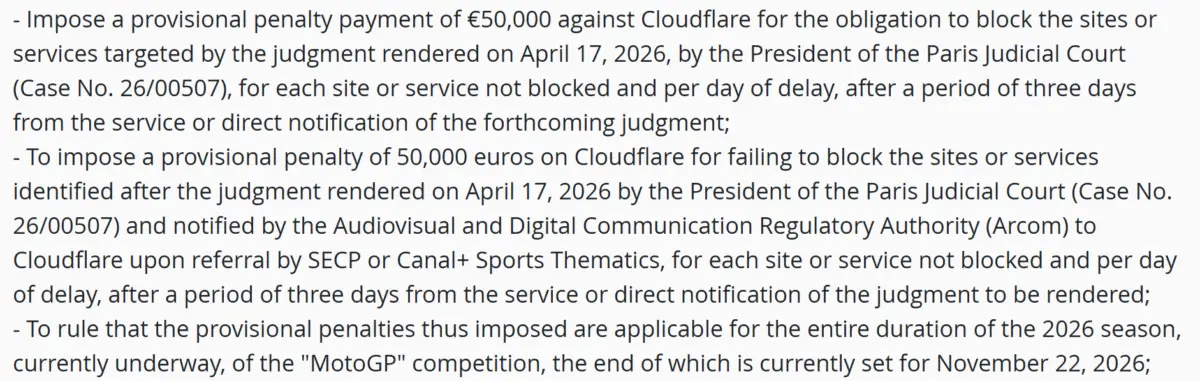
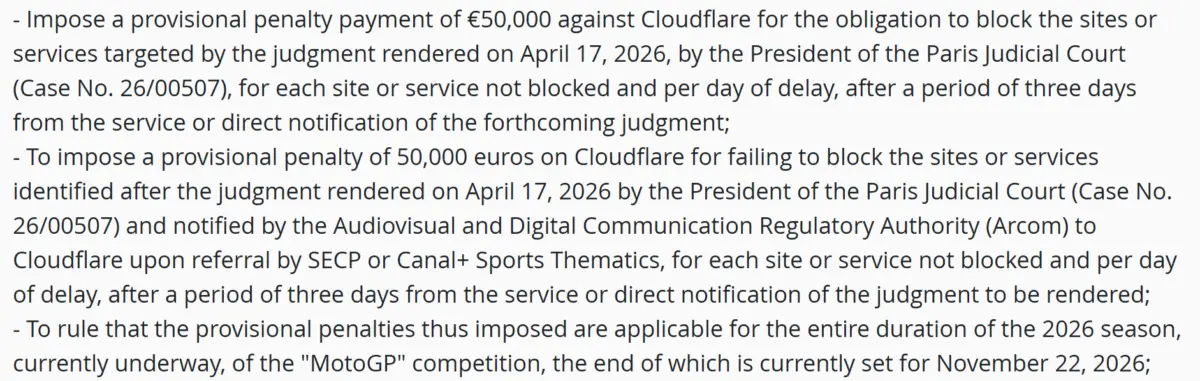
This recommendation aligns with recent judicial trends across Europe. For instance, the Paris Judicial Court made waves by issuing simultaneous, sweeping site-blocking orders that compelled not only standard telecom operators, but also independent DNS resolvers and commercial VPN providers, to actively block access to designated pirate domains.
The AGCOM Blueprint: Exporting the Italian Model
To manage this vast web of technical intermediaries, the study suggests that every single EU member state should replicate Italy’s AGCOM framework. Rather than forcing rightsholders to initiate costly, protracted civil lawsuits for every single match or event, an independent administrative authority would maintain a centralized database, issuing automated, binding blocklists that intermediaries must execute within a strict 30-minute window.
The Elephant in the Room: Overblocking and Collateral Damage
Despite leaning heavily into the Italian model, the JURI study does not shy away from the darker side of automated site-blocking technology. In an intellectual paradox, the report openly warns that IP and DNS blocking remain "inherently blunt instruments."
By design, IP addresses are rarely permanently tethered to a single piece of content or a single website. In the era of cloud computing, shared hosting, and Content Delivery Networks, thousands of distinct, entirely legal websites often share the exact same IP address or cloud infrastructure. When a broad IP block is executed, the collateral damage is instantaneous.

Empirical Evidence of Collateral Damage
To illustrate the dangers of aggressive blocking, the study cites damning empirical research:
- The OONI Study in Spain: Research from the Open Observatory of Network Interference documented the fallout of sweeping judicial blocking orders issued on behalf of Spanish football league LaLiga. During match broadcasts, more than 554,000 domains were blocked at least once. Among the victims of this collateral damage were critical digital infrastructure endpoints like Amazon S3, alongside websites operated by global humanitarian and human rights organizations, including Amnesty International, UNICEF, the UNHCR, the ACLU, and even the Australian Senate.
- The CEPS Report: Earlier this year, a study by the Centre for European Policy Studies (CEPS) severely criticized EU-level site-blocking mechanisms, going so far as to call for an outright ban on IP-based blocking and arguing that rightsholders should be held financially liable for collateral economic damage caused by wrongful takedowns.
Even while acknowledging these profound warnings, the JURI study paradoxically recommends forging ahead with the Piracy Shield approach across the entire European Union. To reconcile this contradiction, the report suggests implementing procedural safeguards—such as limiting blocks strictly to the exact duration of the live event, maintaining administrative oversight, and adhering to proportionality principles established by the Court of Justice of the European Union (CJEU). Whether these theoretical safeguards would be enough to prevent widespread overblocking in practice remains a fiercely contested debate.
The Demand-Side Equation: Addressing the Root Drivers of Piracy
Significantly, the JURI report avoids falling into the trap of viewing technical enforcement as a silver bullet. It openly concedes that no amount of state-mandated blocking or administrative censorship will eradicate piracy if the legal marketplace remains fundamentally broken.
For years, consumer advocates have pointed out that piracy is frequently a service problem rather than purely a moral failing. The study echoes this sentiment, identifying fragmented, prohibitively expensive legal offerings as the primary engine driving users toward unauthorized streams.
Fans attempting to watch their favorite sports leagues legally often find themselves trapped in a Byzantine maze of hurdles:
- Subscription Saturation: Consumers are forced to purchase multiple, competing streaming packages across different platforms just to follow a single sport or competition.
- Geoblocking Barriers: Artificial territorial restrictions prevent fans from accessing international broadcasts even when domestic options are unavailable or inadequate.
- User Experience Degradation: Intrusive advertising, unstable proprietary apps, and poor video bitrates on official platforms frequently compare unfavorably to the seamless, aggregated interfaces provided by high-end illegal IPTV providers.
To effectively combat piracy, the study urges the European Commission and media conglomerates to look inward, calling for more attractive, accessible, and competitively priced legal options that address the demand side of the equation.
Future Outlook: A Politically Charged Crossroads
As it stands, Professor Riccio’s report is officially advisory—a third-party academic study commissioned by a European Parliament committee rather than an immediate piece of draft legislation.
However, its release lands at a pivotal moment. The European Commission is actively navigating its ongoing review of the Copyright in the Digital Single Market Directive. In the halls of Brussels, the battle lines are already sharply drawn:
- The Pro-Enforcement Lobby: Sports federations, major TV networks, and copyright-heavy industries are mobilizing behind the study, demanding that the EU adopt binding regulations, establish national AGCOM equivalents, and enforce the 30-minute takedown timer to protect multi-billion-dollar investments.
- The Digital Rights & Tech Coalition: Big tech companies, open-internet advocates, civil liberties groups, and major infrastructure providers like Google and Cloudflare are pushing back fiercely. They warn that mandating rapid-fire, automated blocking systems across DNS providers, CDNs, and VPNs will inevitably undermine network stability, stifle innovation, and institutionalize systemic overblocking that violates fundamental freedom of expression and due process rights.
Whether the European Union will yield to rightsholders and institutionalize a pan-European "Piracy Shield," or whether resistance from civil society and technical experts will force a more cautious, measured approach, will define the future of the digital landscape in Europe for years to come.