Executive Overview
The landscape of digital photography is undergoing a profound shift. As camera sales experience a historic post-pandemic resurgence, a new generation of visual creators is entering the market. However, these aspiring photographers face a steep hurdle: the transition from shooting simple JPEGs to mastering the complexities of RAW image processing. Traditionally, this transition has been gatekept by steep subscription fees and intimidating, highly technical software suites designed exclusively for seasoned professionals.
In a strategic bid to disrupt this paradigm, Aftershoot—a company widely recognized for its enterprise-level, AI-driven post-production tools for professional photographers—has launched Photon. Debuting as a completely free RAW image editor for macOS and Windows, Photon attempts to solve the industry’s accessibility crisis.
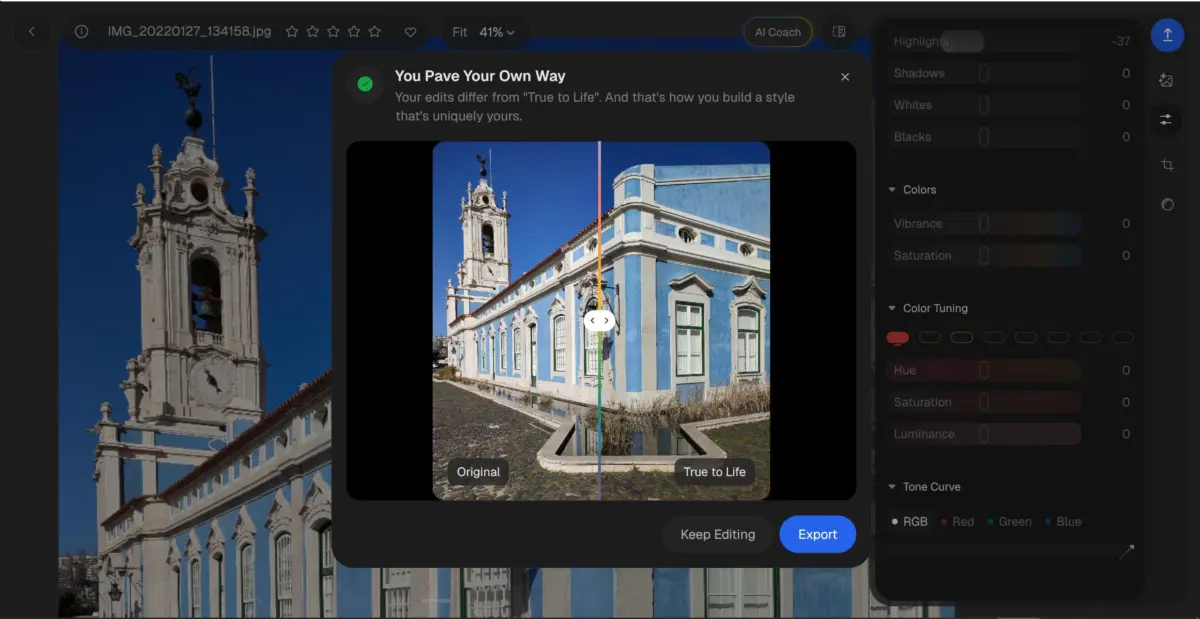
At the core of Photon’s value proposition is an innovative "AI Coach." Unlike conventional photo editing software that relies on opaque, one-click "auto-fix" algorithms, Photon’s AI Coach acts as an interactive mentor. It analyzes an image and explains—in plain, accessible language—exactly which parameters should be adjusted and, crucially, why. By prioritizing education over automation, Photon seeks to transform casual hobbyists into skilled digital artisans, offering a robust, non-destructive RAW editing environment without the burden of subscription paywalls.
Detailed Chronology: The Road to Photon and the 2026 Debut
The development and release of Photon represent a calculated expansion of Aftershoot’s core market. Founded to streamline the tedious workflows of high-volume wedding, portrait, and commercial photographers, Aftershoot built its reputation on high-speed AI culling and automated editing. To date, the company has processed over 8.8 billion photos and optimized workflows for more than 248,000 professional photographers globally.
However, as the consumer imaging market evolved, Aftershoot identified a massive, unserved demographic: enthusiastic amateurs and prosumers who own high-end cameras but lack the technical training or financial incentive to subscribe to industry-standard software like Adobe Lightroom Classic or Capture One Pro.
[Aftershoot Core Platform] ────> Focus: High-volume Pro Culling & AI Editing (Subscription)
          │
          ▼ (Market Expansion Strategy)
[Aftershoot Photon] ───────────> Focus: Educational RAW/JPEG Editing (Free / No Subscription)
To bridge this gap, Aftershoot initiated development on a lightweight, intuitive RAW editor built from the ground up to emphasize guided learning.
The public-facing journey of Photon reached a critical milestone at the MODE Conference in Minneapolis, held from September 18–20, 2026. At this premier industry gathering, Aftershoot officially unveiled Photon to an audience of creators, software engineers, and industry analysts. The global rollout followed immediately, making the application available for download on both macOS and Windows platforms.
Currently distributed as an active public beta, Photon represents a living software experiment, with Aftershoot actively collecting user telemetry and community feedback to refine its underlying AI models and processing speed.
Supporting Context & Metrics: The Camera Boom and Subscription Fatigue
The Surging Demand for Dedicated Hardware
The launch of Photon is timed to capitalize on an unexpected renaissance in the camera manufacturing industry. For over a decade, the rise of smartphones decimated the entry-level digital camera market. However, recent data indicates a powerful counter-trend.
According to reports from the Camera & Imaging Products Association (CIPA), global digital camera shipments reached 9.44 million units in 2025—marking the highest shipment volume recorded since the COVID-19 pandemic.
CIPA Global Camera Shipments (Key Metrics):
┌───────────────────────────────────────┬──────────────────────────────────┐
│ Metric Category                       │ Value / Growth Rate              │
├───────────────────────────────────────┼──────────────────────────────────┤
│ Total 2025 Shipments                  │ 9.44 Million Units               │
│ Consecutive Years of Growth           │ 2 Years (First time since 2007)  │
│ Compact Camera Shipment Increase      │ ~30% YoY Growth                  │
│ Mirrorless Camera Volume Shift        │ 5.6M (Previous) to 6.3M Units    │
└───────────────────────────────────────┴──────────────────────────────────┘
This resurgence is driven by two distinct phenomena:
- The Mirrorless Migration: Mirrorless camera shipments jumped from 5.6 million to 6.3 million units, proving that enthusiasts are willing to invest heavily in dedicated, large-sensor systems.
- The Compact Comeback: Fixed-lens compact cameras saw a massive 30% surge, fueled by Gen Z and millennial creators seeking a distinct, tactile aesthetic separate from the sterile, over-processed look of modern computational smartphone photography.
The Problem: The RAW Wall and Subscription Barriers
When these millions of new camera owners attempt to elevate their craft, they inevitably encounter the concept of "RAW" files. Unlike JPEGs, which are compressed and pre-processed by the camera’s internal computer, RAW files contain the uncompressed, unprocessed sensor data. This format offers unparalleled latitude for recovering highlights, opening up shadows, and manipulating color tones.
However, when a beginner imports a RAW file into a standard editor, they are met with a wall of unexplained sliders: Exposure, Contrast, Highlights, Shadows, Whites, Blacks, Dehaze, Clarity, Vibrance, and complex parametric curves.
Historically, to make sense of these tools, creators faced two options:
- The Financial Toll: Pay monthly subscription fees (ranging from $10 to over $50 per month) for software that assumes prior professional knowledge.
- The "Auto-Fix" Trap: Rely on automated "magic wand" tools that instantly adjust the image but teach the user nothing, resulting in a homogenous, cookie-cutter aesthetic across the creative community.
Photon enters this landscape as a direct counter-response to both the financial fatigue of the subscription economy and the creative stagnation of automated editing.
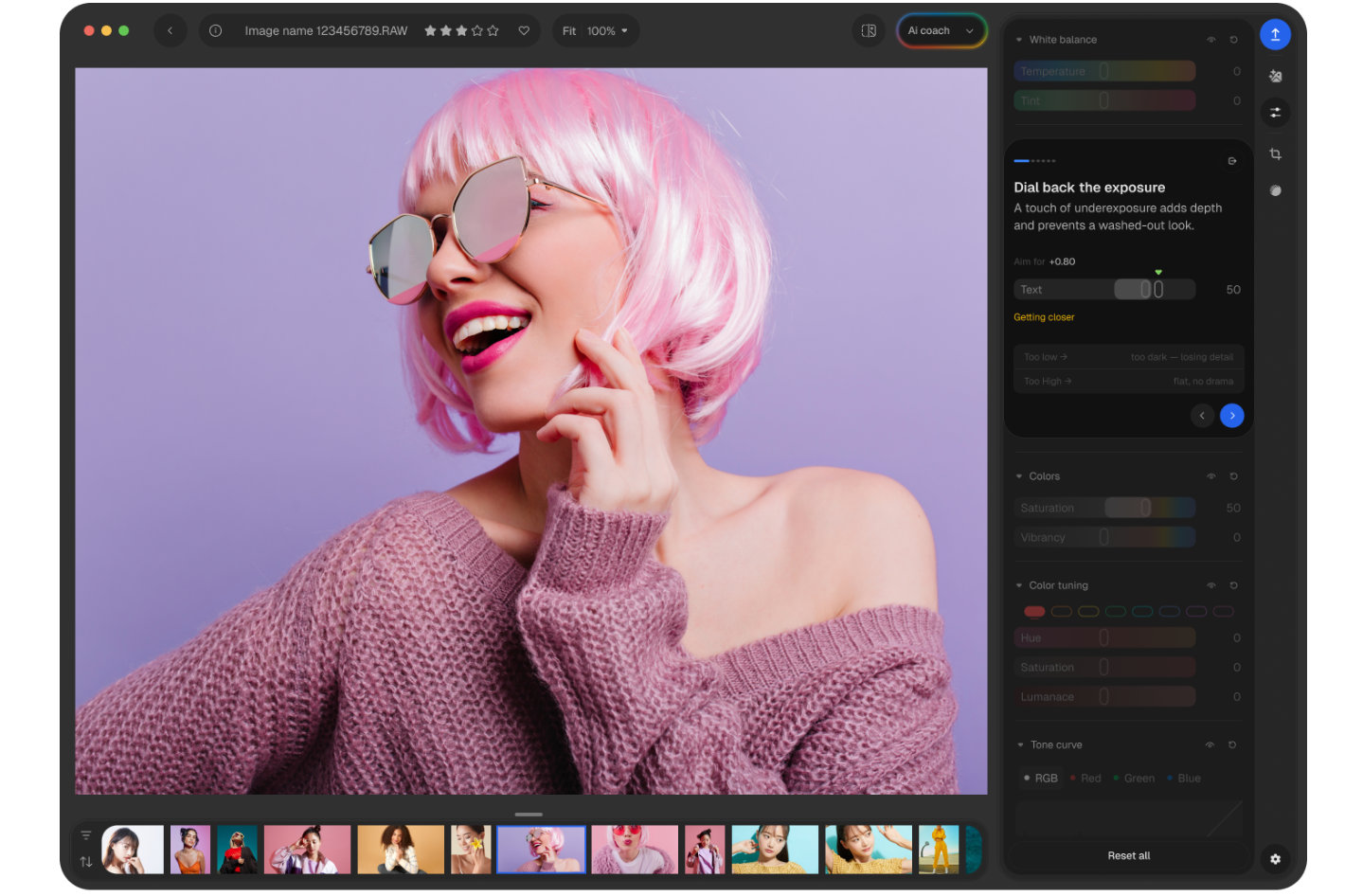
Inside the Software: How the AI Coach Redefines Guided Editing
The Human-Centric AI Workflow
Photon’s core architectural philosophy is that artificial intelligence should serve as a teacher, not a replacement for human agency.
When a user imports a RAW or JPEG file into Photon, the editing process follows a distinct, non-destructive pipeline:
[Import RAW/JPEG] ──> [Select Stylistic Direction] ──> [AI Coach Analysis]
                                                               │
   ┌───────────────────────────────────────────────────────────┘
   ▼
[Step-by-Step Educational Panel] ──> [Manual Adjustment via Sliders] ──> [Export]- Importation & Non-Destructive Engine: Photon imports the image and reads its metadata. The application utilizes a non-destructive editing engine, meaning all adjustments are saved as a set of instructions (sidecar data) rather than altering the original pixels of the RAW file.
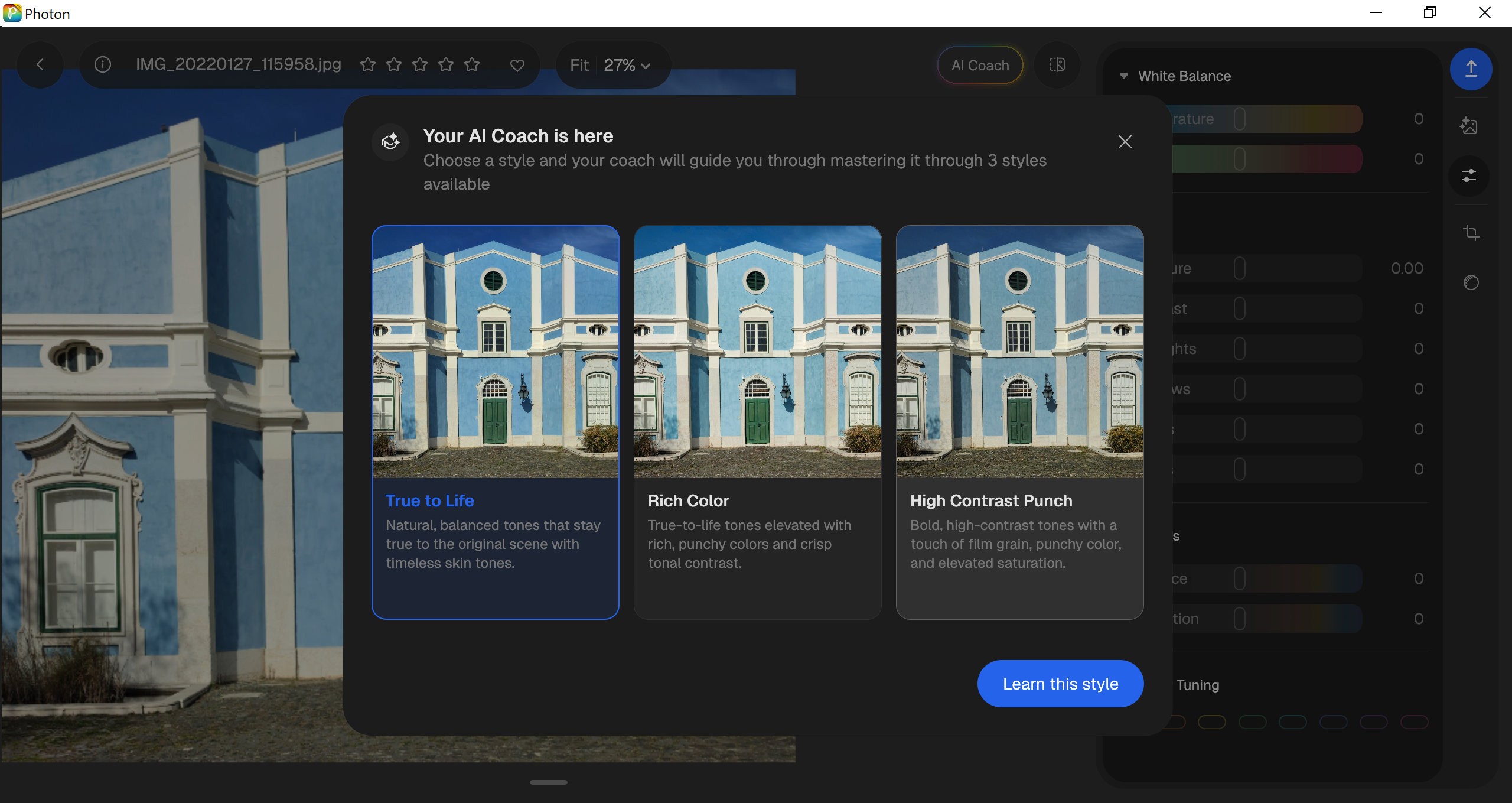
- AI Analysis & Style Selection: The user is presented with a selection of stylistic directions. Once a direction is chosen, the AI Coach analyzes the specific luminance histogram, color distribution, and structural composition of the photo.
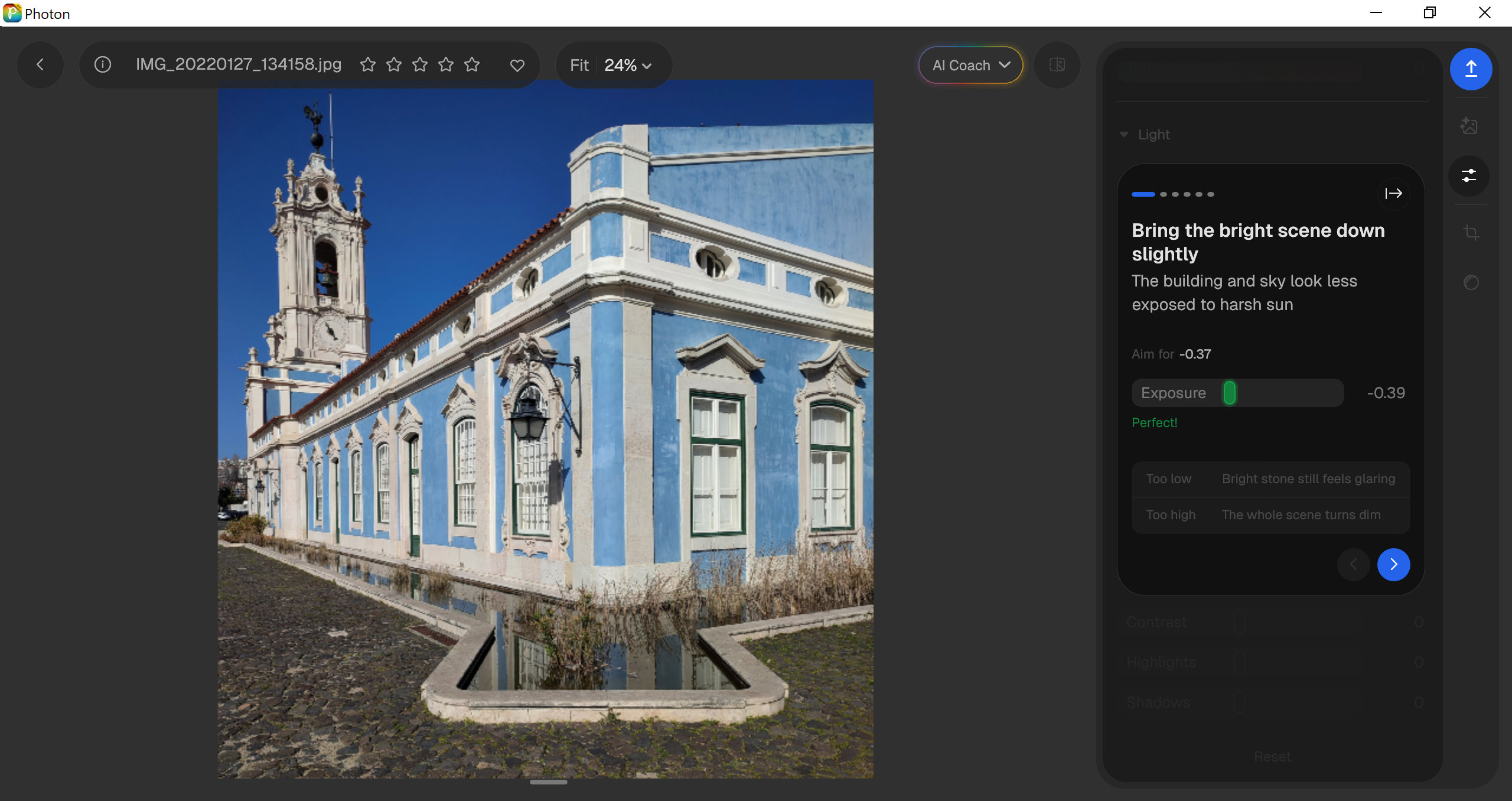
- The Pedagogical Breakdown: Instead of silently applying the changes, the AI Coach generates a personalized, step-by-step lesson. In the side panel, the Coach explains the image’s current state (e.g., "The highlights in the background sky are slightly blown out, obscuring cloud detail") and suggests a remedy ("Reduce the Highlights slider to -30 to recover these details without affecting the rest of the image").
- Interactive Adjustment: The user manually moves the sliders according to the Coach’s advice, observing the real-time transformation of the image and building muscle memory for future edits. At any point, the user can dismiss the Coach and use the application as a traditional, free-form manual RAW developer.
First-Hand Testing Notes and Beta Limitations
Hands-on testing of the early beta version of Photon reveals a highly promising, albeit still developing, piece of software.
- The Interface: The user interface is clean, minimalist, and uncluttered, presenting a welcome contrast to the dense, modular workspaces of Lightroom or Capture One. The typography is legible, and the sliders are highly responsive.
- The AI Coach in Action: During testing, the suggestions provided by the AI Coach were remarkably accurate. When presented with a high-contrast landscape photo, the Coach correctly identified underexposed foreground shadows and guided the tester through the process of balancing the exposure using shadow recovery and black-point adjustments.
- Current Beta Limitations: As a beta product, Photon still exhibits several areas that require refinement. The app currently offers a limited selection of only three primary editing styles/options through the AI Coach. Furthermore, the generation of the educational "lesson" can sometimes suffer from noticeable latency, taking several seconds to analyze the image and populate the text. Additionally, while optimized for RAW files, the software also supports JPEG editing, though the dynamic range recovery is naturally limited by the JPEG format’s compressed nature.
Official Statements: Insights from Aftershoot’s Leadership
Aftershoot’s leadership views Photon not as a competitor to their professional product suite, but as a vital gateway tool designed to foster the next generation of creative professionals.
Harshit Dwivedi, Founder of Aftershoot, emphasized the company’s commitment to lowering the barrier to entry for digital creators:

"For years, we’ve helped professionals get their time back through advanced automation. But most people who love photography never get a great place to start editing. Photon is that place. There is a clear, unaddressed space in the market for a high-quality RAW editor that is not locked behind subscription charges, but also actively helps photographers learn to edit through a guided, intuitive experience."
Addressing the industry-wide debate over whether artificial intelligence is eroding human creativity, Dwivedi framed Photon’s AI Coach as a collaborative mentor rather than an automated replacement:
"AI Coach is like having a mentor alongside you—helping you get the best out of your images while walking you through the editing process and explaining the why behind each adjustment. You’re not just getting better edits; you’re learning how to make them yourself. We believe in keeping the photographer in control of every single creative decision."
Future Outlook: The Implications for AI and Creative Autonomy
Disrupting the Software Business Model
The release of Photon poses an interesting challenge to the dominant software-as-a-service (SaaS) business model. By offering a robust RAW editor completely free of charge, Aftershoot is employing a classic "freemium" ecosystem strategy.
By capturing entry-level and enthusiast photographers early in their creative journeys with Photon, Aftershoot builds massive brand loyalty. As these hobbyists grow into professional, high-volume photographers, they are highly likely to transition into Aftershoot’s paid, enterprise-level ecosystem of AI culling, batch-editing, and client gallery hosting services.
                  [THE AFTERSHOOT CREATOR FUNNEL]

  ┌─────────────────────────────────────────────────────────────┐
  │                   AFTERSHOOT PHOTON (Free)                  │ <── Entry Point
  │  - Zero Subscription Fees                                    │     (Hobbyists, Amateurs,
  │  - Guided Learning / AI Coach                               │      New Camera Owners)
  │  - Basic RAW & JPEG Editing                                 │
  └──────────────────────────────┬──────────────────────────────┘
                                 │
                                 ▼ (Skill Growth & Volume Increase)
  ┌──────────────────────────────┴──────────────────────────────┐
  │                 AFTERSHOOT PRO SUITE (Paid)                 │ <── Monetization Point
  │  - AI-Powered Batch Culling                                 │     (Professionals,
  │  - High-Volume automated editing                            │      Commercial Studios)
  │  - Client Galleries & Cloud Workflows                       │
  └─────────────────────────────────────────────────────────────┘
The Evolution of the AI Coach
As Photon moves out of its beta phase, several developments are anticipated:
- Expanded Stylistic Libraries: The current limitation of three AI Coach editing directions is expected to expand, offering users highly specialized guidance for portraiture, street photography, astrophotography, and architectural imaging.
- Performance Optimization: Software updates will likely address the latency issues observed during the AI analysis phase, leveraging local hardware acceleration (such as Apple Silicon Neural Engines and Windows-compatible GPUs) to make the "lessons" load instantaneously.
- A Shift in AI Philosophy: In a tech landscape currently obsessed with generative AI—which synthesizes images out of thin air or completely replaces sky and background elements—Photon stands as a refreshing reminder of the power of interpretive and educational AI.
By focusing on teaching the timeless principles of light, contrast, and color theory, Photon ensures that the human photographer remains the ultimate author of the visual story. As the application matures, it may very well establish a new standard for how creative software is designed: not as a magic box that does the work for you, but as an intelligent, accessible mentor that helps you discover your own creative voice.