









Executive Overview
In the world of B2B software and enterprise technology, gravity is treated as an immutable law of physics. As companies scale past a multi-billion-dollar run rate, their growth curves inevitably flatten. The math of large numbers takes over: adding billions in top-line revenue requires cracking entirely new markets, fend off entrenched legacy incumbents, and overcome the structural inertia of enterprise procurement cycles. For decades, the playbook dictated that hyper-growth is a young company’s game—one that inevitably decays into single-digit or low-double-digit increases as the organization matures.
Palantir Technologies has completely shattered that mental model.
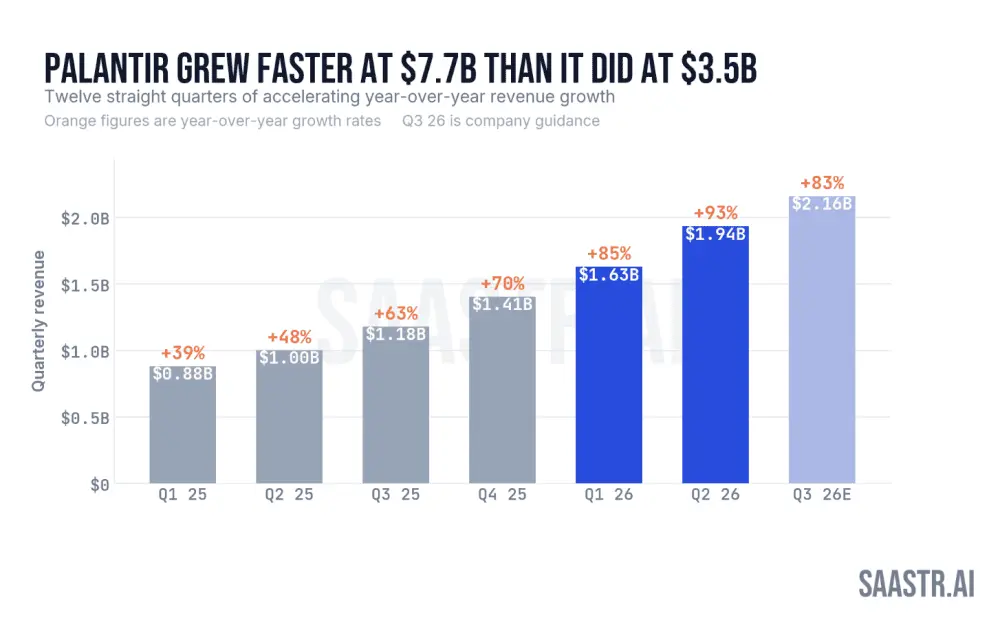
Reporting its financial results for the second quarter of 2026, Palantir delivered a performance that veteran market observers and tech executives have described as "otherworldly" and "unprecedented." Operating at an annualized revenue run rate approaching $8 billion, the company did not merely maintain its trajectory—it accelerated. Posting a staggering 93% year-over-year revenue increase to $1.935 billion, Palantir notched its twelfth consecutive quarter of accelerating growth.
Far from a hyper-growth anomaly driven by cash-burning acquisition strategies, this expansion was accompanied by 47% GAAP operating margins, a jaw-dropping 157% Net Dollar Retention (NRR) rate, and a Rule of 40 score reaching 155%. Even more remarkable is the efficiency of this growth: it was achieved across a concentrated customer base of just 1,049 total clients worldwide.
For B2B and enterprise AI founders, Palantir’s Q2 2026 earnings report is more than just a financial triumph; it is a masterclass in modern platform positioning, go-to-market execution, and the compounding power of enterprise AI deployment. This article provides a comprehensive, data-driven deep dive into the metrics, mechanics, and strategic lessons behind the quarter that rewrote the rules of enterprise software.
Detailed Chronology and Market Context: From Skepticism to Supremacy
Heading into the Q2 earnings print, market sentiment was uniquely tense. Despite its technological pedigree and deep entrenchment within Western defense and intelligence infrastructures, Palantir’s stock had experienced a 29% drawdown over the preceding months. Wall Street had already priced in an expectation of near-perfection, leaving little room for error.
When the numbers dropped, they did not just meet expectations—they obliterated them. The market reacted swiftly, sending the stock surging roughly 20% in post-earnings trading and forcing analysts to frantically revise their long-term valuation models.
CEO Alex Karp, known for his unfiltered and macro-level assessments of technology markets, characterized the quarter as "otherworldly." Meanwhile, Chief Revenue Officer Ryan Taylor offered a more calculated yet equally striking framing, describing the record-shattering results as "unprecedented, but entirely unsurprising."
Taylor’s framing underscores a fundamental reality: Palantir’s acceleration is the logical byproduct of years spent building foundational ontology and data integration architectures before the broader market even realized it needed them. When enterprise AI budgets flooded the market, Palantir was not scrambling to build wrappers or prototype LLM integrations; it was already sitting at the center of enterprise data gravity. As a result, what looks like an overnight hyper-growth explosion is actually the culmination of disciplined, compounding execution finally meeting a once-in-a-generation platform shift.
Supporting Context and Deep-Dive Metrics: 5 Critical Learnings for B2B Founders
To understand how a company of Palantir’s scale can pull off a 93% top-line expansion, one must look beneath the headline figures. Five core metrics from the quarter offer vital blueprints—and stern warnings—for modern B2B and AI software builders.
1. Growth Acceleration at a $7.7 Billion Run Rate
Palantir’s Q2 revenue hit $1.935 billion, representing a 93% year-over-year jump and a 19% sequential increase quarter-over-quarter. To put this in perspective, just one year prior, the company was pulling in roughly $1 billion per quarter.
The primary engine of this growth is overwhelmingly domestic. U.S. revenue skyrocketed 115% year-over-year and 23% sequentially to reach $1.573 billion—now accounting for more than 81% of total enterprise revenue.
- U.S. Commercial: Exploded by 149% year-over-year and 28% sequentially to $764 million.
- U.S. Government: Grew by 90% year-over-year to $809 million.
The Founder Takeaway: Deceleration at scale is a default assumption, not an economic law. Standard B2B planning models dictate that growth rates must compress as the revenue base expands. However, that rule only applies when a product is a mature, linear category replacement. When a product sits natively atop a foundational platform shift—and enterprise budgets align with that shift—the traditional decay curve breaks. Founders modeling future years by blindly discounting current growth rates may be planning for an artificial slowdown that the market is not demanding.
2. An NRR of 157% Across Just 1,049 Customers
Perhaps the most staggering metric of the quarter was Palantir’s Net Dollar Retention (NRR), which climbed to 157%—a 700 basis point expansion sequentially from Q1’s already elite 150%.
To contextualize this efficiency, consider Palantir’s customer footprint: the company boasts a total of only 1,049 customers globally. Of those, 870 are commercial accounts, with 653 concentrated in the U.S. commercial sector.

- Annualizing the current U.S. commercial revenue run rate ($764 million/quarter) across 653 customers yields an average of roughly $4.7 million per customer annually.
- Across the entire global base of 1,049 clients, the average annual value approaches $7.4 million per customer.
With customer count growing at a modest 24% while revenue surged 93%, it is clear that logo acquisition is secondary. The vast majority of growth comes from existing clients dramatically expanding their usage. Furthermore, NRR calculations explicitly exclude revenue from customers acquired in the trailing twelve months, meaning Palantir’s fastest-expanding cohorts are not even factored into that 157% figure.
The Founder Takeaway: In the era of B2B AI, the expansion motion is the business. Enterprise buyers do not deploy AI workflows to keep budgets flat; once a single workflow proves ROI, they double or triple their allocation. If a startup’s NRR is stagnating around 105% while management pours capital into top-of-funnel logo acquisition, the company is attempting to fix a leaky bucket rather than nurturing a compounding engine.
3. A 155% Rule of 40 Score Grounded in GAAP Realities
Palantir’s margin profile continues to defy software norms. The company reported a Rule of 40 score of 155%, up 10 points from Q1’s 145%. As Karp noted in previous commentary, scores of this magnitude have historically belonged exclusively to high-flying semiconductor and AI hardware infrastructure providers, not enterprise software applications.
Key margin components included:
- GAAP Operating Margins: 47%
- Adjusted Operating Margins: 62%
- GAAP EPS & Adjusted EPS: Bolstered slightly by unrealized gains on strategic equity holdings (such as SpaceX), though core operational strength remained the dominant driver.
While skeptics point to stock-based compensation as the bridge between the 62% adjusted margin and the 47% GAAP margin, the reality remains that a 47% GAAP operating margin paired with 93% top-line growth is virtually unprecedented in software history.
The Founder Takeaway: The capital markets permanently closed the era of growth-at-all-costs in 2025. Today, the undisputed bar for elite valuation is growth married to robust GAAP profitability. When a company can fund its own R&D and scaling efforts entirely out of operating cash flow, it regains strategic sovereignty, immunizing itself against hostile financing environments.
4. Backlog Outpacing Revenue: The Ultimate Leading Indicator
While revenue and earnings capture media attention, sophisticated analysts monitor remaining performance obligations (RPO) and total contract value (TCV) backlog. In Q2, Palantir’s backlog grew even faster than its realized revenue. U.S. commercial bookings grew 153%, outpacing the 149% growth in U.S. commercial revenue.
The Founder Takeaway: Contracted backlog-to-revenue ratio is the most potent leading indicator an enterprise tech company can track. Revenue tells you what you sold two to four quarters ago; backlog tells you what the next year looks like. When bookings outpace revenue, leadership can aggressively invest ahead of the curve backed by hard contractual evidence rather than hopeful projections.
5. 73 Deals Exceeding $10 Million in a Single Quarter
Palantir’s enterprise sales velocity reached hyper-speed in Q2, closing 73 deals valued at $10 million or more. To put this in perspective, the company closed 47 such deals in Q1. One-third of all disclosed million-dollar-plus deals in Q2 crossed the eight-figure threshold.
The structural mechanic behind these massive contracts is Palantir’s famous "bootcamp" sales model. Rather than engaging in protracted, multi-month slide-deck presentations, Palantir runs hands-on workshops where prospective clients build live workflows on their own proprietary data. This compressed sales cycle recently produced a landmark $15 million contract with a five-month initial term—proving that high-value enterprise sales can be closed rapidly when the sales event and the technical proof event are unified.
The Founder Takeaway: Land initial deployments within a single, highly measurable workflow, then horizontally expand across organizational silos. Enterprise AI adoption moves at the speed of demonstrable trust; credibility earned within one operational profit-and-loss center is the most cost-effective bridge to the next dozen.
Future Outlook: What Q2 2026 Signals for the Industry
Palantir’s historic performance in the second quarter of 2026 serves as a watershed moment for the enterprise software landscape. With 93% revenue growth, a 157% NRR, a 155% Rule of 40 score, and 73 mega-deals secured in ninety days, the company has proven that exceptional execution can break the gravity of scale.
For founders building in the B2B and enterprise AI ecosystems, the mandate is clear. The market no longer rewards linear thinking, sluggish expansion motions, or cash-burning customer acquisition loops. It rewards foundational platforms that integrate seamlessly into enterprise data architectures, deliver rapid and measurable operational ROI, and expand organically through trusted utility.
As Palantir marches further into its unprecedented trajectory, the debate surrounding whether it is the best-performing enterprise software company ever built at scale is no longer theoretical—it is rapidly becoming an undisputed reality.