Executive Overview
In a significant move toward platform accountability, X (formerly Twitter) has released expanded insights into the algorithmic source code that dictates post visibility, alongside a trial phase for a new feature designed to help users identify potential reach limitations. Published via GitHub and accompanying official developer announcements, this update aims to demystify the mechanics of the "For You" timeline. By offering granular visibility into how the platform amplifies or demotes content, X seeks to address long-standing user anxieties regarding content distribution, moderation parameters, and suspected "shadowbanning."
The newly open-sourced code provides a window into the ranking logic that governs individual post performance. Furthermore, X is testing a dedicated tool allowing a randomized cohort of eligible users to download a comprehensive history of account and post-level labels applied over the preceding 30 days. According to company executives, users can now cross-reference this raw code with their personal account metrics using Large Language Models (LLMs) to independently audit why their content performs the way it does.
While these developments represent a tangible step toward unprecedented technical transparency, they also arrive against a backdrop of historical skepticism. Since Elon Musk’s acquisition of the platform in late 2022, promises of algorithmic openness have faced criticism over partial disclosures and stagnant codebases. This report provides an exhaustive investigative look into X’s latest transparency initiative, examining the technical mechanisms, the broader context of platform governance, and the implications for creators and digital marketers navigating the evolving social media ecosystem.
Detailed Chronology: From 2023 Promises to 2024’s Expanded Code Release
To understand the significance of X’s current transparency push, it is essential to trace the chronology of the platform’s algorithmic disclosures over the past several years.
The 2023 Open-Source Initiative and Early Skepticism
In early 2023, just months after Elon Musk finalized his acquisition of Twitter, the billionaire owner announced that the platform would open-source its entire recommendation algorithm. The initial GitHub publication was hailed as a watershed moment for social media governance, with Musk promising regular, iterative updates to keep the public fully informed on how in-stream updates are ranked and displayed.
However, the initial rollout quickly drew scrutiny from software engineers and data scientists. Independent analysts discovered that the published code was only a partial representation of the platform’s production environment. Critical machine learning models, proprietary weights, and safety filters were omitted from the repository. Furthermore, despite initial assurances of continuous maintenance, the GitHub repository remained largely static throughout the subsequent months and years, frustrating researchers who relied on up-to-date data to study algorithmic bias and visibility trends.
The Resurgence of Transparency Demands
As platform policies shifted under Musk’s leadership—particularly regarding free speech absolutism balanced against brand safety and advertiser demands—user complaints regarding unpredictable reach intensified. Creators, journalists, and everyday users frequently reported sudden, unexplained drops in engagement, giving rise to persistent speculation regarding secret algorithmic penalties and shadowbans.
Recognizing that erosion of trust directly impacts user retention and creator monetization, X executives initiated a strategic pivot. Last month, Musk reiterated his intention to fully open-source the codebase to restore user trust. This set the stage for the current release, which goes beyond a static code dump by introducing actionable tooling for individual account audits.
The Current Release: GitHub Updates and Label Tracking
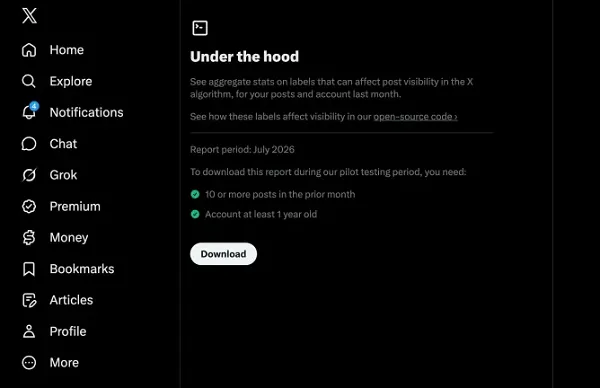
The latest update, deployed to X’s GitHub repository, expands significantly on the ranking logic governing the "For You" timeline. Crucially, it coincides with the initial testing phase of a user-facing tool located under the platform’s "Under the Hood" initiative. Currently rolling out to a randomized sample of accounts that are at least one year old, this feature allows users to inspect automated tags or labels applied to their profiles or individual posts over a 30-day window.
Technical Breakdown: How X’s Code, LLMs, and Label Tools Intersect
The mechanics of X’s new transparency architecture rely on a synthesis of open-source programming, user-executed data analysis, and internal platform telemetry.
The "For You" Timeline Code
The updated GitHub repository details the scoring mechanisms utilized by the recommendation engine. While previous iterations focused primarily on broad signals—such as likes, retweets, replies, and click-through rates—the expanded code offers deeper insight into the penalties and boosts associated with specific content labels. These labels can encompass anything from safety violations and sensitive media tags to automated classifications that identify potential spam or low-quality engagement bait.
Leveraging Large Language Models (LLMs) for Personal Audits
In a novel recommendation accompanying the release, X VP of Product Keith Coleman suggested that users can feed the platform’s source code directly into an LLM alongside their personal account and post data. By prompting the AI to analyze these two datasets in tandem, users can theoretically reverse-engineer the specific variables that caused a given post to be amplified or suppressed.
While innovative, this approach introduces a distinct friction point. Unpacking complex recommendation algorithms via an LLM requires a moderate degree of technical literacy and manual input. For the average casual user, the process may prove prohibitively complex. However, for professional creators, power users, and participants in the platform’s creator revenue share program, this capability transforms raw code into actionable, diagnostic intelligence.
The Mechanics of Content Restrictions and "Shadowbanning"
Industry experts have long debated the existence and definition of "shadowbanning"—a term colloquially used to describe the covert reduction of a user’s visibility without their knowledge. X has consistently maintained that traditional shadowbanning does not exist on its platform. Instead, the company applies explicit or implicit account- and post-level restrictions based on defined parameters, such as trust scores, safety filters, and community-driven context notes (Community Notes).
The new tracking tool aims to bridge the gap between user perception and platform reality. By providing a downloadable log of applied labels over a 30-day period, X is moving toward verifiable accountability, allowing users to see precisely whether their content has been flagged for limited distribution and why.
Supporting Context & Metrics: Creator Impact and Platform Governance
The implications of this transparency update extend far beyond theoretical computer science; they directly impact the economic viability of content creation on X.
The Creator Economy and Revenue Share Implications
For creators relying on X’s monetization programs—such as the creator revenue share initiative—predictability in content reach is paramount. Algorithmic volatility directly affects ad impressions, engagement metrics, and, consequently, payouts.
- Diagnostic Capabilities: Creators can now investigate unexpected dips in post-performance, distinguishing between organic audience fatigue and algorithmic suppression.
- Compliance Management: By identifying specific labels applied to their content, creators can adjust their publishing strategies to align with platform guidelines, avoiding inadvertent violations related to sensitive topics or automated engagement tactics.
- Data-Driven Optimization: Combining GitHub insights with LLM-assisted analysis enables data-driven content planning, giving professional users a competitive edge in audience acquisition.
Comparative Industry Standards
X’s move arrives amid a broader regulatory and cultural push for social media transparency globally. Under frameworks such as the European Union’s Digital Services Act (DSA), large platforms are increasingly mandated to provide researchers and users with meaningful insights into algorithmic curation and content moderation decisions.
While regulatory bodies in Europe and elsewhere have established formal requirements for algorithmic transparency reports, X’s approach—relying on open-source repositories and user-executed LLM audits—represents a decentralized, DIY model of accountability. Whether this open-source ethos satisfies regulatory watchdogs remains an open question, particularly given past inconsistencies in maintaining the published code.
Official Statements and Industry Reception
Reactions to X’s latest transparency initiative have been mixed, reflecting a tension between optimistic technical innovation and historical skepticism.
Official Positioning from X Leadership
In a statement detailing the release, X emphasized the philosophical underpinning of the update:
"Today, we are taking another major step in our ongoing efforts to increase transparency. We’re open-sourcing the code that affects a post’s visibility in the For You timeline, and releasing a new tool that shows people labels applied to their account or posts that might limit visibility. The goal is straightforward — we want people to be able to answer for themselves whether a platform is limiting their reach, whether the system is fair, and why they see particular content."
This sentiment was echoed by VP of Product Keith Coleman, who highlighted the empowering nature of combining open-source code with modern AI tooling. By encouraging users to audit their own data via LLMs, X is effectively crowdsourcing the auditing process, deflecting some of the burden of customer support and algorithmic explanation onto automated developer workflows.
Independent Analysis and Skepticism
Independent software developers and digital rights advocates have greeted the announcement with cautious optimism tempered by pragmatic doubt. While opening up visibility metrics is universally praised as a step in the right direction, industry observers note several persistent challenges:
- Maintenance and Currency: The primary criticism of X’s 2023 open-source rollout was the immediate abandonment of code updates. Critics point out that publishing a snapshot of code is insufficient if continuous updates fail to match live, rapidly evolving production environments.
- Accessibility Barriers: Relying on users to input raw code and account telemetry into third-party LLMs creates an elite tier of technical accessibility. True transparency, advocates argue, should be intuitive and native to the user interface without requiring intermediate developer skills or AI tooling.
- Completeness of Data: Questions remain regarding whether all proprietary ranking weights and commercial filtering criteria are present in the public GitHub repository, or if critical components remain proprietary.
Future Outlook: What Next for Algorithmic Transparency?
As X continues its phased rollout of the individual post label tool—currently restricted to a randomized group of accounts aged one year or older—the platform stands at a critical juncture in its product lifecycle.
Short-Term Rollout and Scaling
Over the coming months, the success of the trial phase will determine whether the label-tracking tool is expanded to the broader user base. If technical infrastructure holds up and user feedback remains constructive, X is expected to integrate these diagnostic features more deeply into the native user interface, potentially eliminating the need for manual LLM workarounds.
Long-Term Implications for Social Media
X’s experiment could establish a new precedent for how social media platforms handle accusations of censorship, shadowbanning, and algorithmic bias. By handing users the tools to interrogate the machine, the platform is attempting to shift the paradigm from opaque corporate moderation to verifiable, code-backed accountability.
However, the ultimate success of this initiative will hinge entirely on execution. If X maintains the GitHub repository with regular, accurate updates and scales the label-download tool universally, it could successfully reclaim its narrative as an industry leader in openness. Conversely, if the code lapses into obsolescence once again, the initiative risks being dismissed as a transient PR gesture.
For now, developers, creators, and digital strategists have a new, albeit complex, toolkit at their disposal—one that promises to bring unprecedented clarity to the hidden mechanics shaping the digital public square.