As the excitement of the FIFA World Cup reached its grand finale in New York, international law enforcement agencies quietly pulled back the curtain on what has officially been recorded as one of the largest and most complex anti-piracy operations in sports history.
Spanning multiple continents, crossing dozens of jurisdictions, and uniting public regulators with private intellectual property watchdogs, a coordinated global crackdown fundamentally disrupted the multibillion-dollar ecosystem of unauthorized sports streaming. Operationally dubbed "Operation Offsides" in the United States and "Operación Tarjeta Roja" (Operation Red Card) across Latin America, the campaign systematically targeted the digital domains, ad revenue pipelines, and physical distribution networks that profit from the unauthorized broadcasting of elite athletic competitions.
Executive Overview
The scale of the 2026 enforcement initiative dwarfed all previous attempts to curb digital piracy during major sporting events. While authorities seized a modest 78 domains during the 2022 FIFA World Cup in Qatar, the sheer breadth of the 2026 campaign saw well over a thousand pirate sports streaming domains disabled, geo-blocked, or seized by state prosecutors.
The multi-pronged strategy went far beyond mere domain takedowns. It incorporated coordinated cross-border criminal arrests, the systemic eradication of illicit advertising revenue streams, and specialized regional sweeps designed to dismantle high-tech cable-hacking syndicates.
By weaponizing international legal frameworks—most notably the U.S. Department of Justice’s (DOJ) International Computer Hacking and Intellectual Property (ICHIP) network—law enforcement proved that coordinated, rapid-response public-private partnerships can successfully puncture the veil of anonymity long enjoyed by global digital pirates.
Detailed Chronology of the Global Crackdown
Phase One: The U.S. Department of Justice Launches "Operation Offsides"
The opening salvo of the enforcement blitz was fired on June 26, 2026, when the U.S. Department of Justice officially announced Operation Offsides. Filed initially through seizure warrants issued in the Eastern District of Virginia, the operation targeted an initial cohort of nearly 400 domain names providing unauthorized live streams of World Cup matches.
The domains were flagged using intelligence compiled and cross-referenced by an unprecedented coalition of private-sector giants and sports bodies, including FIFA, beIN Media Group, NBCUniversal, the Alliance for Creativity and Entertainment (ACE), the Ultimate Fighting Championship (UFC), and Warner Bros.
However, the initial announcement proved to be merely the tip of the iceberg. As the tournament progressed, the operation expanded dramatically. Utilizing passive DNS tracking and ongoing intelligence feeds, investigators tracked pirate administrators as they desperately scrambled to deploy fallback infrastructure—including domain extensions rooted in foreign registries.
In subsequent waves, the DOJ seized more than 100 additional fallback domains. By the time final post-tournament figures were tabulated by the DOJ on July 20, the total tally of domains neutralized under Operation Offsides had surged past the 1,000 mark.
Phase Two: Latin America Coordinates "Operación Tarjeta Roja"
While U.S. authorities exerted pressure on domain registrars and hosting providers, a parallel and equally formidable multinational dragnet was unfolding across Latin America. Coordinated primarily by Colombia’s Fiscalía General de la Nación, "Operación Tarjeta Roja" brought together prosecutors, law enforcement bodies, and public ministries from nine sovereign nations: Colombia, the United States, Ecuador, Peru, Paraguay, Argentina, the Dominican Republic, Brazil, and Chile.
Operating on the premise that global digital piracy requires a globally synchronized defense, prosecutors from these jurisdictions convened for an intensive two-day strategic summit in Bogotá, facilitated by ICHIP São Paulo and the ICHIP network for Internet-Based Fraud and Public Health.
The results of Operación Tarjeta Roja were staggering. In Colombia alone, authorities blocked 1,140 domains and URLs. Across the entire Latin American theater, regional partners collectively blocked 1,970 illegal streaming sites.

Phase Three: Targeting the Physical Infrastructure – Arrests in Colombia
Operación Tarjeta Roja was not confined to cyberspace; it also targeted the physical and organized-crime syndicates operating behind the screens. In Colombia, authorities executed targeted raids in Bogotá, Itagüí, Cali, Acacías, and Bucaramanga, resulting in 15 arrests.
Among the most significant breakthroughs was the dismantling of a sophisticated cybercriminal network known as "Los Ciberinfiltrados" (The Cyber-Infiltrators). Operating out of Soacha, near Bogotá, four suspects were arrested and formally charged with orchestrating a high-level breach of a major telecommunications company’s systems.
According to DOJ and local prosecutorial reports, Los Ciberinfiltrados had been illicitly accessing corporate infrastructure since 2024. During the World Cup, the syndicate utilized stolen corporate employee credentials, intercepted multi-factor security authentication codes, Virtual Private Networks (VPNs), and corporate system profile manipulation to resell unauthorized, low-cost "pirated" cable television packages and streams to unsuspecting consumers. Two of the four primary suspects swiftly accepted the charges against them.
Simultaneously, the raids cracked down on physical counterfeiting rings. Authorities charged 11 individuals operating retail storefronts that sold bootleg World Cup merchandise. Law enforcement seized:
- 4,223 counterfeit sports apparel items
- 11,353 unauthorized logos ready to be heat-pressed onto garments
- 2,150 fraudulent Colombian Football Federation shields
Phase Four: Argentina Decapitates Regional Heavyweights
In early July, Argentina’s specialized cybercrime unit, the Unidad Fiscal Especializada en Ciberdelincuencia (UFECI), added significant momentum to Operación Tarjeta Roja by turning its sights on some of South America’s most notorious pirate streaming ecosystems.
Targeting platforms such as Stella TV, Tele Latino, and the sprawling network of sites associated with FútbolLibre—widely recognized as one of the most heavily trafficked sports piracy brands in the Spanish-speaking world—investigators acted on formal complaints filed by rightsholders DirecTV and Personal Flow.
Three federal judges ordered Argentina’s communications regulator (ENACOM) and the national domain registry (NIC Argentina) to execute sweeping DNS blocks against 14 primary platforms. Despite the technical whack-a-mole dynamic inherent in mirror sites and rapid domain regeneration, the coordinated judicial action severely degraded the operational capacity of these illicit networks during peak tournament viewing hours.
Supporting Context & Metrics: Choking the Financial Lifeblood
Government-led domain seizures and physical arrests represent only one side of the modern anti-piracy coin. A critical pillar of the 2026 enforcement strategy involved cutting off the financial oxygen that sustains pirate operations: digital advertising revenue.
The Trustworthy Accountability Group (TAG) launched a historic, first-of-its-kind initiative designed to starve unauthorized World Cup streaming sites of ad dollars. Utilizing its dynamic Pirate Domain Exclusion List, TAG successfully choked off programmatic advertising revenue to 1,376 distinct websites that had attempted to monetize stolen tournament broadcasts.
By intercepting illicit ad delivery networks and signaling to legitimate brands that their programmatic bids were landing on pirate infrastructure, the initiative targeted the economic incentive that underpins commercial digital theft.
The Regional Breakdown of Domain Blocks
Post-tournament disclosures released by the U.S. Department of Justice provided a granular, country-by-country accounting of the regional domains neutralized under the Latin American coalition:
- Colombia: 1,140 domains
- Brazil: 309 domains
- Dominican Republic: 256 domains
- Ecuador: 223 domains
- Peru: 28 domains
- Argentina: 14 domains
- United States (Operation Offsides): 1,000+ domains
Furthermore, private-sector intelligence gathering played a foundational role in enabling these state actions. The Alliance for Creativity and Entertainment (ACE) revealed that its global monitoring networks submitted over 3,000 verified leads regarding suspected piracy domains to the National Intellectual Property Rights Coordination Center (IPR Center), a massive intelligence-sharing effort that ultimately bridged 14 distinct private partners across 54 countries.

Official Statements and Industry Impact
The unprecedented scale of international cooperation drew high praise from leaders across the public and private sectors, signaling a unified global front against digital intellectual property theft.
"The sustained effort to seize more than a thousand domains dedicated to illegally streaming the World Cup confirms the administration’s commitment to intellectual property rights and to the success of the 2026 FIFA World Cup," stated A. Tysen Duva, U.S. Assistant Attorney General.
Echoing this sentiment from the perspective of global content creators and sports leagues, Charles Rivkin, Chairman and CEO of the Motion Picture Association (MPA) and Chairman of ACE, emphasized the velocity and efficiency of the campaign:
"Operation Offsides showed us what’s possible when rightsholders and law enforcement move quickly against shared targets. The speed and scale of these global actions have fundamentally shifted the landscape of digital enforcement."
From the prosecution side in South America, Raúl González Flechas of the Colombian Fiscalía highlighted the strategic timing of the multinational raids:
"While the planet focused on the FIFA World Cup 2026, a group of nations went after the structures that profit from counterfeiting and theft of digital content."
Future Outlook: The Ongoing War Against Digital Piracy
As the 2026 World Cup comes to a close, cybersecurity experts and intellectual property attorneys are left weighing the long-term efficacy of these sweeping enforcement campaigns.
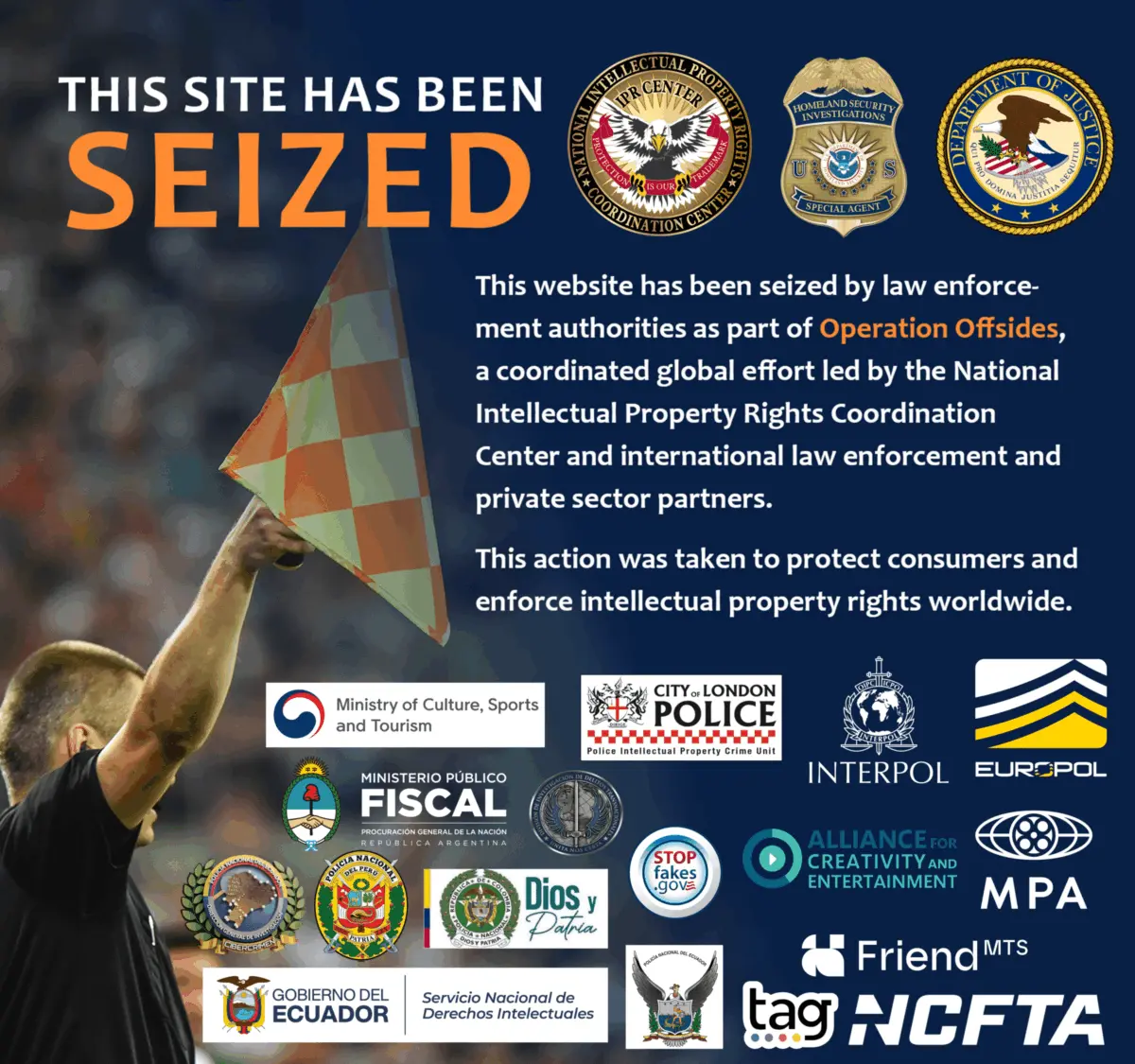
Undoubtedly, Operation Offsides and Operación Tarjeta Roja delivered a severe, highly disruptive blow to the infrastructure of commercial sports piracy. Millions of viewers attempting to access unauthorized streams encountered stark government seizure banners rather than live matches, and major ad networks successfully blacklisted thousands of infringing portals.
However, the resilience of the underground streaming economy remains a formidable challenge. While law enforcement agencies successfully disabled over a thousand domains, sophisticated pirate networks have consistently demonstrated an ability to adapt, migrating their core routing infrastructure to lax foreign-registry Top-Level Domains (TLDs), deploying decentralized peer-to-peer fallback networks, and utilizing encrypted messaging channels to distribute new access links.
The success of future iterations—such as the preparatory framework already being conceptualized ahead of the 2030 FIFA World Cup—will depend entirely on the adaptability of international legal frameworks. As criminal syndicates like "Los Ciberinfiltrados" evolve from simple domain operators into sophisticated enterprise-level hackers capable of breaching telecom infrastructure, law enforcement must maintain an equally agile, intelligence-driven, and borderless posture.
For now, international law enforcement agencies can look back at the summer of 2026 as a watershed moment: a masterclass in global coordination that proved, if only for a tournament, that the digital stadium can be successfully policed.