Executive Overview
In the modern digital economy, the traditional mandate to "publish or perish" has evolved into a more perilous directive: publish with precision, or waste capital into the void. For decades, marketing organizations treated content creation as an isolated creative exercise—blog posts were written, videos were produced, and whitepapers were published based largely on internal brainstorming sessions and subjective intuition. Today, that approach represents a catastrophic misallocation of resources. A content marketing ecosystem generates direct, measurable business value only when marketing teams distribute assets through data-backed channels designed to reach buyers at the precise moment of intent.
Publishing assets without connected measurement leads inevitably to wasted spend, unread content, and misaligned organizational goals. Industry data underscores this widespread inefficiency: recent findings from the Content Marketing Institute reveal that 58% of B2B marketers describe their strategy as only moderately effective. The root cause of this mediocrity is rarely a lack of creative talent; rather, it is the systemic absence of clear goals, robust buyer data, and unified measurement.
Enter modern marketing business intelligence (BI). By bridging the gap between audience research, multi-channel distribution networks, and advanced performance analytics, BI tools show leadership teams how to operate these diverse components as a single, highly aligned system. This article investigates the structural shift toward analytics-driven content marketing, exploring how data insights, omnichannel distribution, predictive automation, and structured lifecycle management are redefining modern enterprise growth.
Detailed Chronology: The Evolution of Content Marketing Measurement
To understand the urgent necessity of marketing business intelligence today, one must examine how the relationship between content creation and data analytics has evolved over the past two decades.
Phase 1: The Era of Vanity Metrics (Early 2000s–2010s)
In the early days of corporate blogging and digital publishing, the primary key performance indicators (KPIs) were strictly operational and surface-level. Teams measured success by page views, unique visitors, and total time spent on a page. While these metrics provided a basic pulse check on website traffic, they maintained a dangerous disconnect from actual revenue generation. A blog post could rack up 50,000 views, yet fail to generate a single qualified lead or influence a closed-won deal. Content creation operated in a silo, disconnected from customer relationship management (CRM) data and sales pipelines.
Phase 2: The Multi-Channel Proliferation (2010s–2020)
As digital ecosystems expanded, brands rapidly diversified their publishing footprints. Organizations moved beyond corporate websites to embrace social media feeds, corporate newsletters, digital events, and dedicated mobile apps. However, this expansion often resulted in fragmented execution. Channels were managed in isolation, with social media teams tracking engagement rates, email marketers tracking open rates, and content creators tracking downloads—all within separate, unintegrated dashboards. The lack of a unified customer view made it nearly impossible to trace a buyer’s journey across multiple touchpoints, leading to disjointed customer experiences and inflated acquisition costs.
Phase 3: The Integration of Business Intelligence (2020–Present)
The contemporary landscape is defined by the convergence of marketing operations and enterprise business intelligence. Prompted by rising customer acquisition costs and tighter enterprise budgets, marketing leaders are demanding end-to-end accountability. Modern BI infrastructure breaks down historical silos, fusing web analytics, CRM records, social metrics, and customer service logs into centralized data architectures. Content is no longer evaluated as a standalone creative asset, but as an integral component of a data-backed revenue engine that tracks prospects from initial search intent all the way through lifetime customer value.
Supporting Context & Metrics: The Data Behind the Shift
The transition from intuition-based content marketing to data-backed intelligence is not merely a stylistic preference; it is an operational survival strategy driven by hard metrics and technological maturation.
The Cost of Guesswork
Relying on subjective assumptions rather than concrete customer data creates massive inefficiencies in corporate marketing budgets. When organizations bypass rigorous audience research, they produce collateral that addresses topics internal teams assume are important, rather than problems customers are actively trying to solve.
As noted by the Content Marketing Institute’s 2025 research, 58% of B2B marketers categorize their overarching strategy as only moderately effective. This widespread underperformance correlates directly with a failure to ground editorial calendars in real user signals, search behaviors, and past purchase histories. Conversely, organizations that integrate business intelligence into their content workflows see a dramatic reduction in wasted spend, redirecting capital toward high-converting topics and high-performing distribution channels.
The Rise of Predictive Analytics and AI
The sophistication of data analytics is accelerating at a historic pace. According to projections by Gartner, 95% of data-driven business decisions will be automated or augmented by artificial intelligence by 2025 (Gartner, 2024). This technological leap fundamentally shifts marketing measurement from static, retrospective reporting to predictive, real-time insights.
Instead of waiting until the end of a quarter to realize a content campaign underperformed, modern marketing teams utilize automated dashboards that aggregate cross-platform data instantly. These systems detect subtle audience shifts, emerging search trends, and drops in engagement before they impact quarterly revenue targets.
Official Statements & Industry Perspectives
Thought leaders and enterprise executives across the technology and retail sectors increasingly emphasize that content marketing cannot exist independently of core business intelligence architectures.
"A content marketing ecosystem only generates direct business value when your team distributes assets through data-backed channels to reach buyers at the precise moment of intent. Publishing blog posts or videos without connected measurement leads to wasted spend and unread content."
— Enterprise Marketing Analyst
This sentiment is echoed in the operational strategies of consumer giants. For example, music streaming platform Spotify analyzes real-time streaming habits to curate hyper-personalized individual playlists for hundreds of millions of users. This operational workflow demonstrates how deep behavioral data can directly inform product delivery and user engagement.
Similarly, retail leader Sephora synchronizes email marketing campaigns with in-app notifications and loyalty reward updates, ensuring messaging remains seamlessly aligned across every customer touchpoint. By evaluating click rates, social shares, and conversions on a centralized analytics hub, Sephora keeps its multi-channel outreach tightly focused on measurable buyer intent.
In the B2B space, enterprise software leader Salesforce relies on centralized data architectures to organize and maintain thousands of sales enablement documents. By integrating business intelligence tools with content repositories, Salesforce ensures that its global sales teams can easily access top-performing case studies and whitepapers, preserving messaging quality and reducing content production hours.
Future Outlook: Building a Scalable Ecosystem
As we look toward the future of enterprise marketing, the organizations that dominate their respective industries will be those that master the continuous improvement loop powered by structured data management.
1. Moving Beyond Simple Page Views
To prove genuine business impact, leadership teams must discard vanity metrics in favor of advanced key performance indicators tied directly to pipeline revenue. Future content analytics frameworks will focus heavily on:
- Qualified Lead Generation: Tracking the volume and quality of leads generated by specific content assets.
- Conversion Rates: Measuring how effectively content moves prospects from the top of the funnel to the bottom.
- Customer Acquisition Cost (CAC): Evaluating the cost-efficiency of content-driven acquisition channels compared to paid media.
- Pipeline Velocity: Monitoring how specific educational assets or case studies accelerate the sales cycle.
2. Implementing Structured Marketing Data Management
Every publishing cycle yields a wealth of behavioral data—search queries, form submissions, customer service logs, and social interactions—that can sharpen subsequent campaigns. Structured marketing data management allows teams to audit their asset libraries efficiently. By identifying outdated articles that require updates, consolidation, or complete removal, enterprises can maintain lean, high-performing resource repositories.
3. Cultivating Continuous Improvement
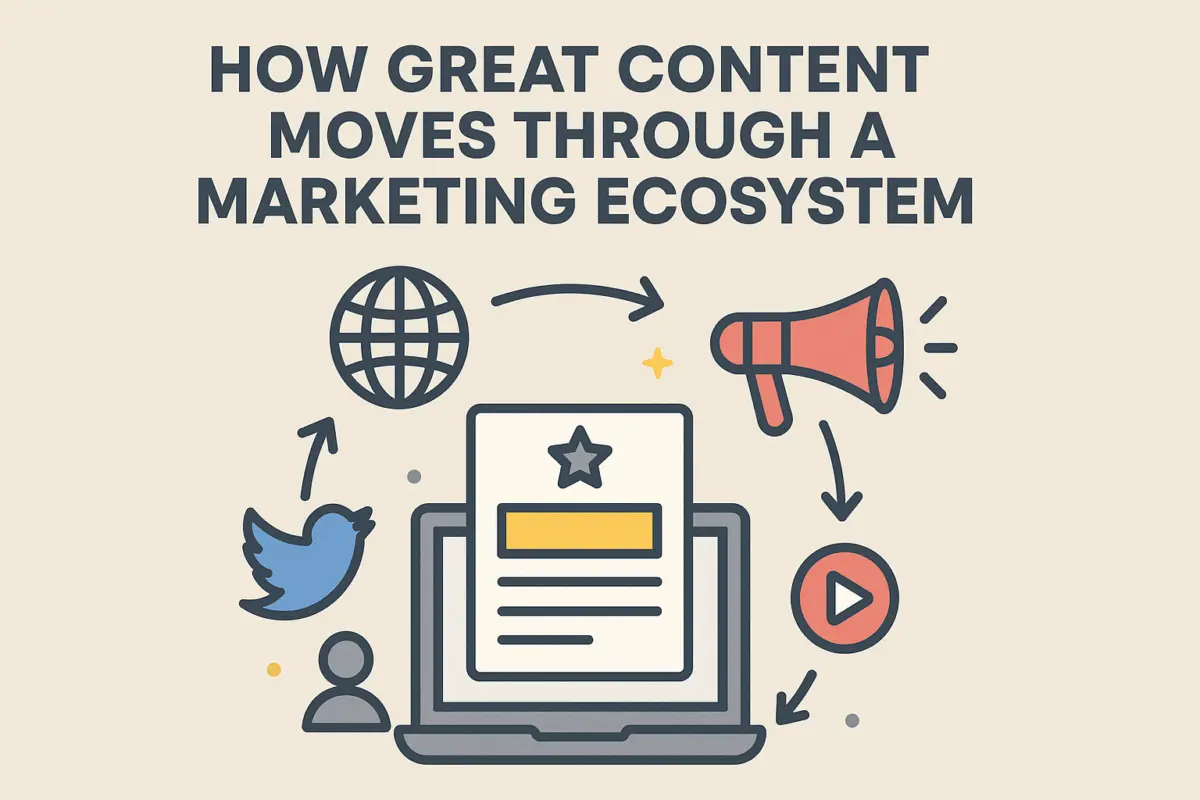
Great marketing succeeds when content moves through a structured, data-informed workflow. By pairing meticulous audience research with unified channel distribution and performance tracking, organizations create sustainable marketing content ecosystems that deliver compounding value over time.
Conclusion
The era of guessing what your audience wants to read, watch, or listen to is officially over. By embracing modern marketing business intelligence, aligning multi-channel distribution networks, and leveraging AI-driven predictive analytics, enterprise leaders can transform their content operations from a cost center into a predictable, scalable revenue engine. As you refine your corporate strategy, focus relentlessly on connecting every single publishing action to clear, measurable business outcomes—ensuring that each new campaign builds intelligently upon the data of the past.