Executive Overview
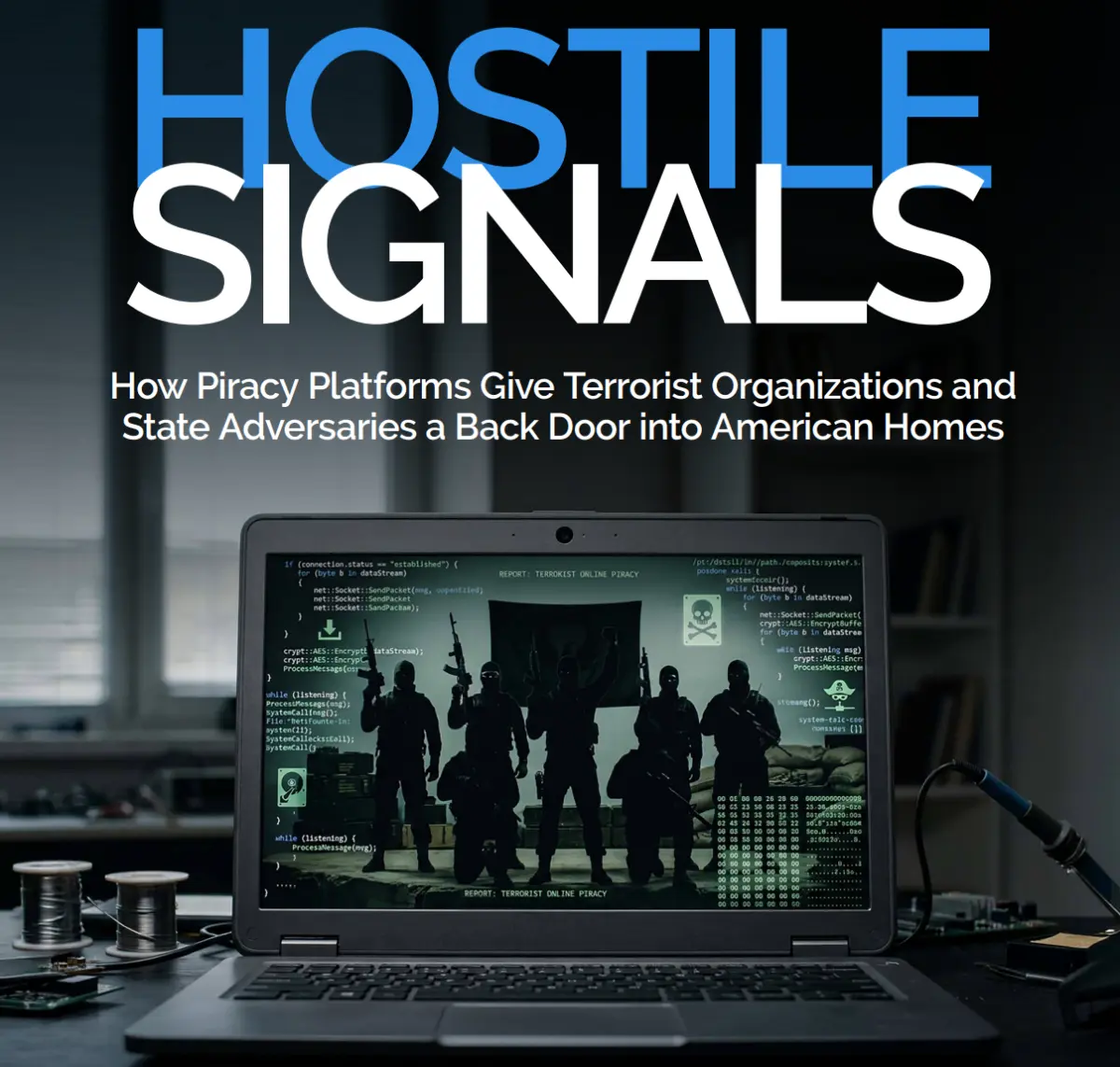
The intersection of digital copyright infringement and international security has once again become a flashpoint in Washington policy circles. For nearly three decades, rightsholders and anti-piracy coalitions have sought to expand the narrative surrounding intellectual property (IP) theft, shifting public perception from economic loss to matters of national security, transnational organized crime, and global terrorism. The latest contribution to this ongoing discourse is a newly published report titled Hostile Signals, released by the Washington-based advocacy group Digital Citizens Alliance (DCA) in collaboration with Atlanta-based cybersecurity firm risk3sixty.
Timed deliberately ahead of the 25th anniversary of the September 11 attacks, the report introduces a novel angle to the well-trodden copyright debate. Rather than focusing solely on lost revenues, counterfeit goods, or the illicit financing of criminal syndicates, Hostile Signals argues that unregulated pirate IPTV networks are inadvertently—or perhaps structurally—acting as sanction-circumventing broadcasting channels. According to the study, these platforms routinely distribute television stations controlled by designated terrorist organizations and state-sanctioned adversaries directly to Western audiences.
The findings are striking: researchers who subscribed to 25 consumer-facing pirate IPTV services from U.S. internet connections between May and August discovered that 17 of those services carried at least one television channel tied to a designated terrorist group or a sanctioned foreign government. Among the channels identified were Hezbollah’s Al-Manar, the Houthi-run Al-Masirah, Iran’s state-backed Al-Alam, and Hamas-affiliated Al-Aqsa TV.
While the report attempts to sound an alarm regarding radicalization risks and the circumvention of federal broadcasting bans, a deeper examination of the data, methodology, and legal landscape reveals a more nuanced reality. Many of the streams in question remain freely available on the open internet outside U.S. jurisdiction, and the report’s own admissions note a lack of empirical evidence regarding actual viewership, foreign language barriers, and the massive scale of mainstream content packages in which these channels are buried.
Nevertheless, the timing and framing of Hostile Signals are calculated to influence an active legislative battle in the United States. As lawmakers weigh aggressive new site-blocking legislation—such as the American Copyright Protection Act (ACPA) and the Foreign Anti-Digital Piracy Act (FADPA)—entertainment industry stakeholders are leveraging national security anxieties to build momentum for sweeping internet censorship mechanisms. This report serves as a case study in how copyright enforcement advocates utilize existential threats to reshape communications policy.
Detailed Chronology: The Evolution of the "Piracy-Terrorism" Nexus
To understand the strategic significance of the Hostile Signals report, it is necessary to examine the historical arc of how rightsholders have framed IP crime over the past thirty years. The rhetorical strategy of linking copyright infringement to high-level illicit networks is not a recent invention; rather, it has been systematically refined across multiple geopolitical eras.

The Late 1990s: Smuggling and Counterfeit Networks
The framing of piracy as an organized criminal enterprise first gained institutional traction in the late 1990s. As digital duplication technologies improved and physical black markets expanded globally, major trade organizations—most notably the International Federation of the Phonographic Industry (IFPI)—began raising alarms about transnational smuggling rings. During this period, the narrative focused primarily on illicit physical manufacturing, border crossings, and lost tax revenues, painting pirate organizations as sophisticated networks operating outside the bounds of international trade laws.
Post-9/11 Realignment (2003)
Following the seismic geopolitical shifts of the September 11 attacks, rightsholders and government agencies quickly adapted their rhetoric to align with the newly declared "War on Terror." In 2003, the U.S. House of Representatives held a landmark congressional hearing explicitly investigating piracy’s links to organized crime and terrorism.
Around the same time, the discourse received formal validation from international law enforcement leadership. During testimony before Congress, then-Interpol Secretary General Ronald Noble stated publicly that intellectual property crime had evolved to become "the preferred method of funding for a number of terrorist groups." This assertion provided a potent policy hook that copyright advocates would deploy in legislative battles for decades to come.
The 2009 RAND Corporation Study
Perhaps the most influential—and frequently criticized—milestone in this campaign arrived in 2009, when a prominent, movie industry-funded research report by the RAND Corporation explicitly connected film piracy, international gangs, and terrorist networks.
While the study blurred critical legal and economic boundaries between trademark counterfeiting (the unauthorized production of physical goods bearing false trademarks) and digital copyright piracy (the unauthorized copying of media), its conclusions were eagerly embraced by major content studios. Despite methodological criticisms from independent economists and civil liberties groups, the RAND report became a foundational citation for industry lobbyists seeking harsher criminal penalties and enhanced enforcement powers.
The 2017 Expansion: Bundling Threats
As the digital landscape shifted from physical media and peer-to-peer file sharing to streaming platforms and social media, the Digital Citizens Alliance took up the mantle of threat-bundling. In a 2017 report, the DCA grouped online piracy alongside entirely disparate digital scourges, including ISIS online recruitment videos, sophisticated malware distribution networks, and the burgeoning phenomenon of state-sponsored fake news. By placing copyright infringement in the same analytical bucket as violent extremism, the advocacy group successfully sustained the national security framing in the digital era.

2024 to Present: IPTV, Drugs, and "Hostile Signals"
In May of this year, the DCA published research linking pirate IPTV subscriptions to broader illicit enterprises, including international drug cartels, weapons trafficking, and mafia networks. This paved the way for the September release of Hostile Signals. By asserting that pirate networks serve not only as cash cows for criminals but also as unregulated distribution vectors for hostile state broadcasters, the report represents the culmination of a decades-long effort to categorize copyright infringement as an urgent national security threat.
Supporting Context & Metrics: Inside the Hostile Signals Investigation
The empirical core of the Hostile Signals report rests on an investigation conducted by Atlanta-based cybersecurity firm risk3sixty. Between May and August, researchers set out to evaluate the carriage of sanctioned and extremist-linked television programming within the consumer-facing pirate IPTV ecosystem available to residential internet users in the United States.
Methodology and Findings
The researchers subscribed to 25 distinct pirate IPTV services using U.S.-based internet connections. Their findings revealed a high prevalence of sanctioned media: 17 out of the 25 services—representing 68% of the sample—carried at least one television channel officially designated by the United States government as tied to a terrorist organization or a sanctioned state broadcaster.
The report details the specific distribution frequency among these 17 compliant platforms:
- Al-Manar: The primary television outlet of Hezbollah, a group designated by the U.S. as a Foreign Terrorist Organization (FTO) with a history of targeting American interests, was available on all 17 identified piracy platforms.
- Al-Masirah: The broadcasting network operated by the Houthi movement in Yemen was discovered on nine of the services.
- Al-Alam: The Arabic-language news channel operated by the state broadcaster of the Islamic Republic of Iran appeared on seven platforms.
- Al-Aqsa TV: The media arm associated with Hamas was found on two of the services.
Named Platforms and the "Back Door" Phenomenon
The report identifies several commercial pirate IPTV providers that allegedly facilitate the carriage of these streams to U.S. consumers, including Lion OTT, Sansat VIP, OTTOcean, Belitvision, and Wish IPTV.
The inclusion of Hezbollah’s Al-Manar holds particular symbolic weight within the document. The United States government officially banned Al-Manar’s satellite transmission feeds in 2004 under counter-terrorism authorities. The enforcement mechanisms of that era yielded high-profile criminal prosecutions, such as the case of a Brooklyn resident sentenced to 69 months in federal prison for providing material support to a designated terrorist organization after selling subscription access to the channel to local New York customers.

Despite two decades of federal interdiction and satellite-level blocking, the report argues that modern pirate IPTV services have effectively punched a hole through these regulatory walls. As the authors summarize: "A piracy subscription has restored what two decades of federal action removed."
Contextual Nuances and Counterarguments
While the numerical findings of the risk3sixty audit are clear, the report itself acknowledges several critical nuances that complicate its overarching national security narrative:
- Lack of Viewership Data: The study openly admits that the technical availability of a channel on an IPTV platform says nothing about whether subscribers actually watch it. Pirate IPTV packages typically offer thousands of live international channels, video-on-demand libraries, and pay-per-view sports events.
- Language and Subtitle Barriers: The controversial channels identified in the study broadcast exclusively in Arabic, largely without English subtitles. For the vast majority of Western consumers purchasing these packages for sports or entertainment, these foreign-language ideological channels represent useless noise buried deep within massive channel guides.
- Open Web Availability: Many of the targeted streams—including those of Hezbollah’s Al-Manar—are freely accessible to anyone with an internet connection via the broadcasters’ own web domains. Although the U.S. Department of Justice seized 13 Hezbollah-linked domains in 2023 (including seven bearing the network’s name), the station’s primary website continues to operate under Lebanon’s
.lbtop-level domain. Because this domain falls completely outside U.S. jurisdictional control, it remains accessible and streams live video directly to American internet users without the mediation of a pirate IPTV service.
Official Statements and Industry Reactions
The release of Hostile Signals was met with immediate amplification from major content industry stakeholders and anti-piracy advocates who view the study as a timely instrument to influence federal policy.
The Digital Citizens Alliance framed the issue in starkly urgent terms, warning policymakers that the digital architecture of commercial piracy has evolved into an unmonitored vector for foreign adversaries:
"National security officials, policymakers and citizens alike should be concerned. Piracy platforms have created a new avenue for terrorist organizations and state adversaries to distribute recruitment messaging to U.S. audiences, including content intended to inspire acts of violence."
Furthermore, the report deliberately invokes the emotional and patriotic resonance of the impending 9/11 anniversary. Concluding with the emphatic declaration that "‘Never Forget’ became the enduring rallying cry for those who experienced the 9/11 attacks. It’s also a reminder to never let the terrorists back in, in any form," the authors align copyright enforcement with the sacred duty of national defense.

This messaging mirrors parallel efforts by major motion picture studios and sports leagues. Earlier this year, Motion Picture Association (MPA) Chairman and CEO Charles Rivkin, alongside leaders from the National Intellectual Property Rights Coordination Center (IPR Center), utilized the law enforcement crackdowns surrounding global sporting events to lobby for aggressive new Internet controls. Industry executives argue that traditional enforcement methods—such as individual domain seizures, DMCA takedown notices, and civil lawsuits—are fundamentally insufficient when facing agile, overseas piracy syndicates that instantly pop up under new domain names.
Future Outlook: The Legislative Push for U.S. Site-Blocking
The strategic utility of Hostile Signals extends far beyond public relations; its primary objective is to alter the legislative calculus in Washington as Congress evaluates sweeping structural changes to internet governance.
The Battle Over Site-Blocking Legislation
For years, content owners have looked enviously at European and Commonwealth nations (such as the United Kingdom, Australia, and France) where courts routinely issue mandatory site-blocking orders, compelling Internet Service Providers (ISPs) to block domestic consumer access to designated pirate domains. In the United States, however, site-blocking proposals have historically faced fierce opposition from a coalition of civil liberties groups, technology companies, and public interest organizations. Critics argue that court-ordered or administrative site-blocking creates dangerous slippery slopes toward censorship, threatens network neutrality, and relies on overbroad technical mechanisms that inadvertently block legitimate web traffic.
Despite these constitutional and technical concerns, momentum for domestic site-blocking legislation has steadily grown on Capitol Hill. Two major bills currently sit on the legislative table:
- The American Copyright Protection Act (ACPA): Championed by Rep. Darrell Issa, the ACPA seeks to establish a targeted legal framework allowing copyright holders to seek court orders requiring ISPs and search engines to block access to blatant commercial piracy sites hosted overseas.
- The Foreign Anti-Digital Piracy Act (FADPA): Sponsored by Rep. Zoe Lofgren, FADPA represents another legislative vehicle designed to curb foreign copyright infringement by targeting offshore streaming operators.
Key lawmakers, including Rep. Issa, have publicly signaled that a bipartisan, bicameral compromise bill combining elements of these proposals is drawing closer to introduction.
The Convergence of Copyright Enforcement and National Security
This is where reports like Hostile Signals play a decisive role. By intertwining the economic grievances of Hollywood studios and sports broadcasters with existential anxieties regarding international terrorism and foreign state-sponsored propaganda, rightsholders are attempting to reframe site-blocking. What was once debated as an economic remedy for intellectual property theft is now being packaged as an essential tool of national defense and homeland security.

As policy discussions continue in Washington, content-owner lobbies are expected to wield the findings of the DCA and risk3sixty study as empirical justification for why the U.S. must abandon its historical reluctance toward structural internet filtering. By arguing that foreign piracy networks serve as conduits for sanctioned extremists and hostile state broadcasters, proponents of site-blocking hope to overcome legislative stalemates.
Ultimately, whether lawmakers will be persuaded to adopt systemic internet-blocking frameworks under the banner of national security remains an open question. However, the release of Hostile Signals ensures that the debate over digital copyright infringement will no longer be fought on economic grounds alone, setting the stage for a high-stakes legislative showdown between intellectual property enforcement and digital civil liberties in the months ahead.