Executive Overview
For over a decade, DevOps and platform engineering teams have methodically matured software delivery lifecycles. They have embedded automated testing, comprehensive logging, rigorous secrets management, and absolute auditability directly into deployment pipelines. Yet, as organizations race to operationalize Artificial Intelligence (AI) and Machine Learning (ML), a glaring operational disconnect has emerged.
Machine learning pipelines frequently bypass this hard-won governance. While they may not deploy classical monolithic web applications, ML workflows collect sensitive training data, ingest external parameters, generate critical decision-making artifacts, and directly influence high-stakes production choices. Despite this outsized business impact, many data science and engineering teams still rely on fragile automation scripts where a "green DAG" (Directed Acyclic Graph) is mistakenly accepted as proof of a successful, secure run.
The reality, however, is starkly different: a task can return a successful execution status while quietly handling compromised API keys, processing malformed runtime inputs, ingesting corrupted boundary data, or saving an untrusted, unverified model artifact.
To bridge this operational security gap, modern platform teams are turning to SecMLOps—the intentional synthesis of security controls and machine learning operations. A recent, highly practical experimental implementation built on Apache Airflow demonstrates how traditional DevSecOps methodologies can be seamlessly mapped onto automated ML pipelines. By shifting security left into the workflow orchestrator itself, organizations can transform machine learning from a black-box art form into a transparent, verifiable, and enterprise-ready engineering discipline.
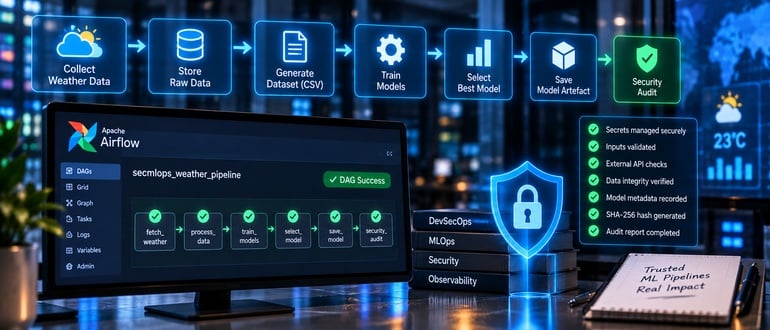
Detailed Chronology: Anatomy of a SecMLOps Experiment
To understand how security can be systematically integrated into an ML workflow without crippling velocity, engineering researchers recently conducted Experiment 13: The SecMLOps Airflow Weather Pipeline.
The experiment took a standard, prototypical weather ML pipeline and systematically injected foundational security controls across its entire lifecycle. The reference pipeline collects meteorological data from the OpenWeatherMap API, stores raw JSON payloads, transforms them into structured CSV datasets, trains a suite of regression models, evaluates their performance, selects the optimal performer, and finally serializes the winning model artifact.
Phase 1: From Workflow Success to Workflow Trust
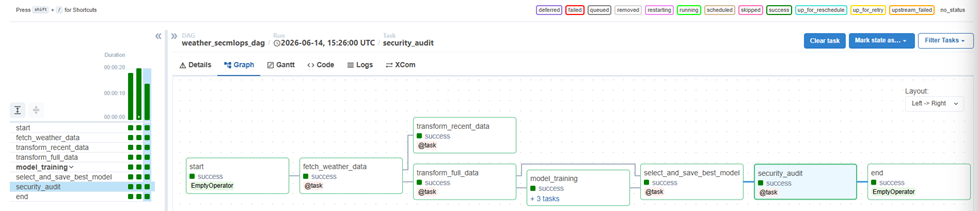
In traditional Airflow deployments, developers celebrate when all tasks turn green. However, as platform security engineers know, workflow execution success does not equal artifact integrity.
[OpenWeatherMap API] ──> [Input Validation] ──> [Dataset Check] ──> [Model Training] ──> [SHA-256 Hashing] ──> [Security Audit Task] (DAG Success)The experimental architecture established that a green state is a hollow victory if:
- API credentials were hardcoded or exposed during transport.
- Runtime city parameters contained malicious injection payloads.
- The external weather API returned truncated, poisoned, or malformed JSON payloads.
- Upstream errors caused empty CSV datasets to be passed silently into the training loop.
- The finalized model artifact lacked a cryptographically verifiable identity or traceable metadata.
To solve these vulnerabilities, the experiment mapped seven distinct security controls across the pipeline’s execution timeline, ensuring that every operational stage undergoes strict, automated validation.
Phase 2: Runtime Secret Separation
The first and most fundamental control addressed in the architecture is the handling of secrets. In early-stage data science prototypes, API keys are frequently hardcoded directly into Python modules or stored in plain-text configuration files tucked away inside git repositories.
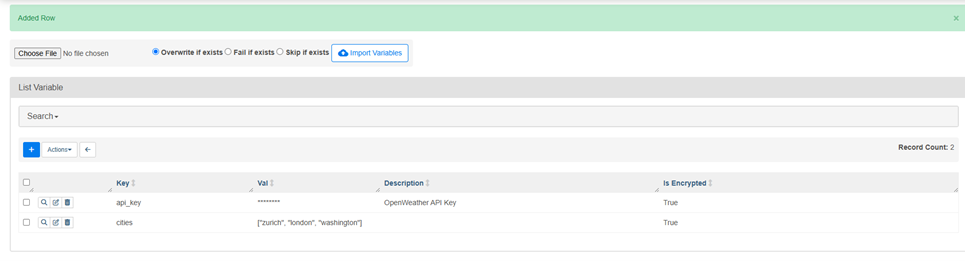
The SecMLOps pipeline eradicates this practice by forcing all secrets out of the repository and into the runtime environment. Leveraging Apache Airflow’s native variable management secured with Fernet symmetric encryption, secrets are loaded dynamically at execution time.
from airflow.models import Variable

api_key = Variable.get("api_key", default_var=None)
if api_key is None or len(api_key.strip()) == 0:
    raise ValueError("Missing Airflow variable: api_key")
By failing fast if the variable is missing or empty, the pipeline prevents any downstream tasks from initiating unauthenticated or improperly scoped calls to external infrastructure.

Phase 3: Runtime Input Validation and Boundary Defense
Variables that appear benign—such as a list of target cities for weather data collection—frequently serve as vectors for unexpected execution errors or injection attacks. In the experimental DAG, input validation acts as an active gatekeeper before any automation scripts run.
A strict regular expression pattern is enforced against every entry in the city list, rejecting malformed inputs instantly:
import re

CITY_REGEX = re.compile(r"^[A-Za-zÀ-ÿ .']1,50$")

for city in cities:
    city = city.strip().lower()
    if not CITY_REGEX.match(city):
        raise ValueError(f"Invalid city name: city")
Beyond internal inputs, external API boundaries are treated with zero trust. Network calls to OpenWeatherMap are wrapped with explicit connection timeouts and rigorous HTTP status code validation. If the external boundary returns an unexpected status code (anything other than a pristine 200 OK), the pipeline halts immediately rather than swallowing the error and feeding corrupt records into data transformation routines.
import requests

response = requests.get(
    "https://api.openweathermap.org/data/2.5/weather",
    params="q": city, "appid": api_key, "units": "metric",
    timeout=10,
)

if response.status_code != 200:
    raise RuntimeError(f"API error for city: response.status_code")
Phase 4: Dataset Protection and Artifact Integrity
Once data is successfully ingested and transformed into tabular datasets, the pipeline guards against silent failures. A newly generated CSV file is not automatically assumed to be a valid dataset. Empty dataset protection mechanisms inspect file structures to guarantee that upstream anomalies have not produced hollow files destined to poison downstream regression models:
if df.empty:
    raise ValueError(f"filename is empty")
return output_path
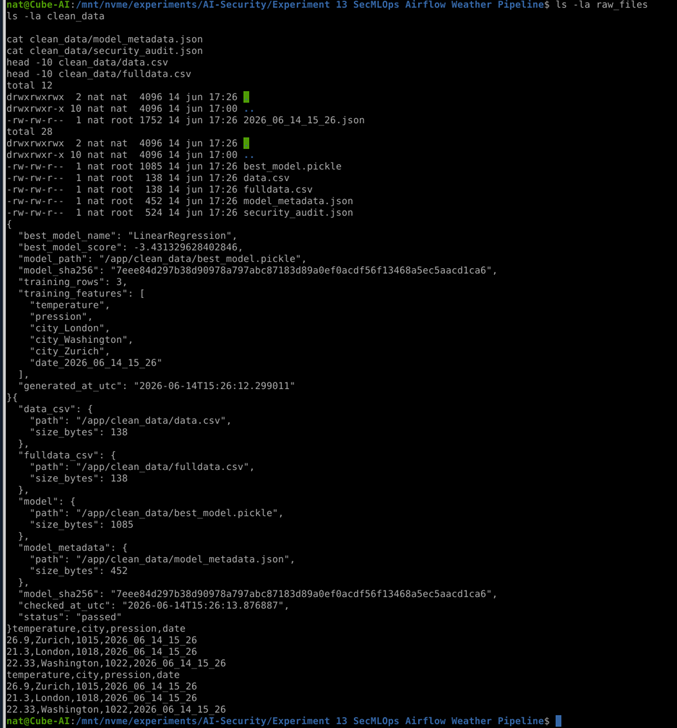
When the training phase concludes and a model is selected, the artifact is handed a verifiable identity. Rather than existing as an anonymous binary file on disk, the model is subjected to cryptographic hashing using SHA-256. This ensures that any unauthorized modification to the binary file post-training is immediately detectable.
import hashlib

def get_file_sha256(path):
  sha256 = hashlib.sha256()
  with open(path, "rb") as file:
    for block in iter(lambda: file.read(4096), b""):
      sha256.update(block)
  return sha256.hexdigest()
Simultaneously, a comprehensive metadata report is generated, documenting crucial training context: the model’s identifier, performance score, utilized feature sets, training row count, and precise timestamps.
Phase 5: Audit as an Indivisible Pipeline Task
Perhaps the most crucial architectural innovation of the SecMLOps experiment is the positioning of the security audit. In traditional IT environments, security reviews are often conducted asynchronously by external teams via manual checklists after deployment.
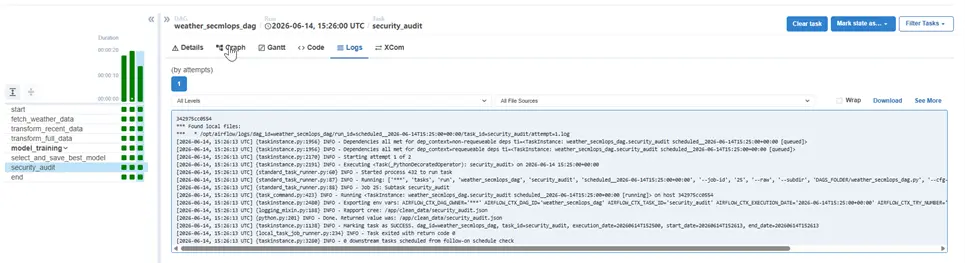
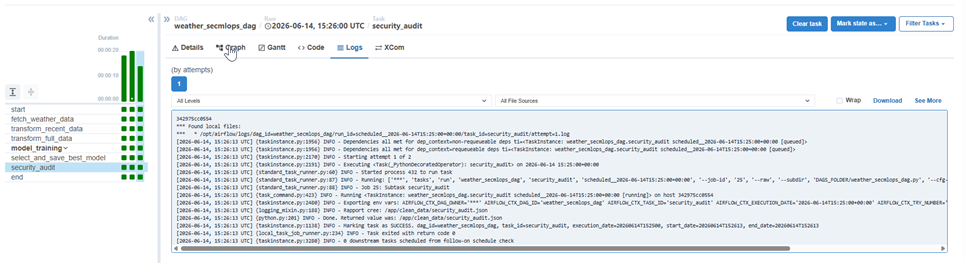
In this Airflow pipeline, the security audit is embedded directly into the DAG as an essential, non-negotiable task. The workflow is architected so that it only reaches its final success state after the audit task programmatically verifies the existence and non-empty status of all expected datasets, models, and metadata files, calculates the model’s cryptographic hash, and writes a formalized security_audit.json report.

from airflow.decorators import task

@task
def security_audit(model_path):
  checks =
      "data_csv": check_file_exists_and_not_empty(DATA_PATH),
      "fulldata_csv": check_file_exists_and_not_empty(FULLDATA_PATH),
      "model": check_file_exists_and_not_empty(model_path),
      "model_metadata": check_file_exists_and_not_empty(MODEL_METADATA_PATH),
      "model_sha256": get_file_sha256(model_path),
      "status": "passed",

  write_json_report(SECURITY_AUDIT_PATH, checks)
  return SECURITY_AUDIT_PATH
Supporting Context & Metrics
To appreciate why SecMLOps is rapidly transitioning from an experimental framework to an enterprise necessity, one must examine the systemic vulnerabilities inherent in standard, unmanaged MLOps lifecycles.
Industry analyses indicate that over 70% of machine learning projects fail to transition successfully from experimental Jupyter notebooks into production-grade, automated pipelines. Among the projects that do make the transition, a significant percentage suffer from "silent drift" or data corruption issues that go unnoticed because orchestrators like Airflow, Kubeflow, or Prefect are configured exclusively to check for operational task completion (exit code 0) rather than semantic artifact validity.
| Security Control | Traditional MLOps Pipeline | SecMLOps Airflow Pipeline | Risk Mitigated |
|---|---|---|---|
| Secrets Management | Hardcoded API keys or plaintext config files in Git. | Fernet-encrypted Airflow Variables loaded strictly at runtime. | Credential exposure, repository compromise, unauthorized API access. |
| Input Validation | Unfiltered string processing passed directly to automation scripts. | Regex-enforced boundary validation for all runtime variables. | Injection attacks, malformed queries, unexpected execution crashes. |
| External Boundaries | Unbounded HTTP requests with silent failure handling. | Strict timeouts, explicit status checks, and fail-fast exception handling. | Pipeline stagnation, downstream data poisoning, cascading infrastructure failures. |
| Data Quality Checks | Automatic assumption that generated files contain valid records. | Programmatic empty dataset and schema verification before training. | Training on corrupted data, degraded model accuracy, phantom regressions. |
| Artifact Identity | Anonymous binary file storage (model.pkl or .h5). |
SHA-256 cryptographic hashing and structured metadata generation. | Model tampering, lack of reproducibility, absence of audit trails. |
| Compliance & Audit | Manual checklists and asynchronous reviews post-deployment. | Automated security audit task producing an immutable security_audit.json report. |
Regulatory non-compliance, untraceable production decisions, inability to prove lineage. |
The implementation of these metrics transforms the operational profile of the machine learning pipeline. Rather than operating as an opaque script that "throws models over the wall," the SecMLOps pipeline functions as a transparent, self-auditing machine that provides cryptographic and programmatic proof of its integrity.
Official Statements and Industry Perspectives
Platform engineers and security researchers pioneering the SecMLOps movement emphasize that machine learning assets must be viewed with the same rigorous threat-modeling mindset applied to traditional application binaries and database schemas.
"For too long, the machine learning community has operated under the assumption that speed and experimentation justify the suspension of standard engineering controls," notes a leading platform security architect specializing in AI pipelines. "A green DAG tells you that your Python scripts executed without crashing. It tells you nothing about whether the data was poisoned, whether your API keys leaked to public version control, or whether the resulting model artifact is mathematically and cryptographically trustworthy. SecMLOps closes that dangerous blind spot."
As enterprise adoption of generative AI and automated decision systems accelerates, regulatory bodies worldwide are tightening compliance expectations around algorithmic accountability. Organizations can no longer deploy models into production without being able to answer fundamental provenance questions: Where did this data originate? How was it transformed? Who authorized the execution? Can we prove the model binary has not been tampered with?
Integrating automated audit tasks and artifact hashing directly into workflow orchestration engines provides an immediate, technically sound answer to these regulatory pressures without introducing burdensome manual bottlenecks into the development lifecycle.
Future Outlook: The Maturation of SecMLOps
As machine learning pipelines continue to evolve—transitioning from simple cron-scheduled Python scripts to complex, distributed, multi-cloud architectures involving large language models (LLMs), retrieval-augmented generation (RAG) pipelines, and real-time feature stores—the principles demonstrated in Experiment 13 will become baseline operational standards.
We are entering an era where SecMLOps will no longer be treated as an optional overlay, but as a core architectural requirement. Future iterations of orchestrators like Apache Airflow, Prefect, and Dagster are expected to ship with native, out-of-the-box cryptographic provenance tracking, automated dataset schema enforcement, and declarative security policy evaluations built directly into core operator libraries.
Furthermore, as supply chain attacks targeting AI components (such as malicious model poisoning via compromised Hugging Face repositories or poisoned training datasets) become more sophisticated, the implementation of SHA-256 artifact hashing and automated post-training security audits will transition from experimental best practices to mandatory compliance gates.
Organizations that proactively adopt SecMLOps principles today will not only secure their production machine learning infrastructure against emerging threat vectors, but will also establish the foundational trust required to scale AI innovation safely and sustainably across the enterprise.
Frequently Asked Questions
What is SecMLOps?
SecMLOps is the deliberate integration of security controls throughout the entire machine learning lifecycle. It brings proven DevSecOps practices—such as rigorous secrets management, automated input validation, cryptographic artifact integrity, and embedded auditability—directly into ML pipelines, replacing external manual reviews with automated, inline security gates.
Why hash ML model artifacts with SHA-256?
A SHA-256 cryptographic hash provides generated model artifacts (such as serialized .pkl or .joblib files) with a verifiable, immutable identity. Platform teams and automated validators can use this hash to ensure that a model file has not been modified or tampered with unexpectedly between its training phase and its production deployment, while securely linking the binary to its corresponding metadata and audit reports.
Why make the security audit an integrated task within the Airflow DAG?
Embedding the security audit as an explicit, final task inside the Directed Acyclic Graph (DAG) ensures that the workflow cannot achieve a true success state unless all expected datasets, models, and metadata files have been programmatically verified, checked for emptiness, and summarized within an immutable security report (e.g., security_audit.json). This prevents pipelines from silently passing downstream unverified or compromised assets.
To explore the complete codebase, configuration files, sample data, and step-by-step documentation for the experiment referenced in this article, visit the public AI Security repository on GitHub.