Executive Overview
In the modern enterprise, the software used to evaluate frontline workforce capabilities is frequently failing the very environment it was designed to measure. For decades, talent management technology has suffered from an office-centric bias. Platforms are routinely procured based on the aesthetic appeal of their administrative dashboards, the comprehensiveness of their feature checklists, and the assumption that every end-user is sitting comfortably at a desktop computer with a high-speed, uninterrupted internet connection.
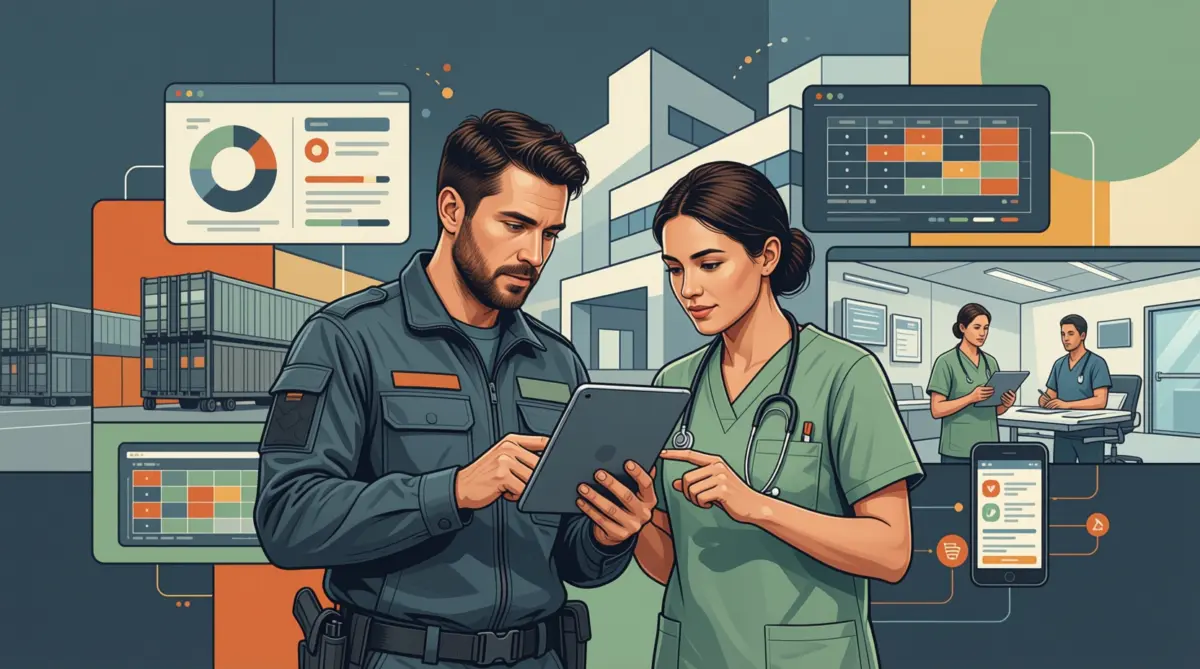
For the millions of workers operating on shop floors, inside hospital rooms, across construction sites, and throughout sprawling logistics warehouses, this assumption is dangerously disconnected from reality. Frontline employee assessment software must deliver reliable psychometric evidence while running flawlessly on the hardware workers actually carry. If an evaluation process assumes a stable office connection and a dedicated laptop, it is engineered for failure in the field.
Selecting software for these environments demands a fundamental shift in priorities. Scale and field-resilience must precede content creation. Organizations can no longer rely on repurposed learning management system (LMS) quiz modules that merely track content completion rather than measuring true operational competency. Furthermore, modern enterprises must look past sales brochures to demand rigorous proof of offline capabilities, mobile-first design, stringent anti-cheating protocols, deep HRIS integrations, multi-language side-by-side authoring, and raw psychometric reporting. Ultimately, the evaluation of the software itself is the ultimate differentiator between an organization that merely ticks compliance boxes and one that builds a defensible, highly capable workforce.
Detailed Chronology: The Evolution and Pitfalls of Enterprise Assessment Software
To understand how modern enterprises arrived at the current crossroads of workforce evaluation technology, one must trace the historical trajectory of testing software and the systemic oversights that plague current procurement cycles.
Phase 1: The Desktop and LMS Era (Early 2000s–2010s)
In the early days of digital training, assessment tools were inextricably bound to the desktop computer. Organizations deployed sprawling Learning Management Systems designed to handle compliance training for office-bound employees. These platforms excelled at tracking course completion—logging whether an employee clicked through a series of slides—but treated assessment as an afterthought. Quiz modules were bolted on primarily to satisfy regulatory checkboxes.
As the workforce shifted increasingly toward deskless, frontline operations, enterprise buyers attempted to force these legacy desktop tools onto mobile browsers and shared tablets. The result was widespread user friction. Employees on factory floors struggled with tiny, unoptimized text boxes, login timeouts, and interfaces that assumed mouse-and-keyboard navigation.
Phase 2: The Mobile-First Promise vs. Field Realities (2015–2020)
Recognizing the deskless workforce boom, software vendors began marketing "mobile-friendly" platforms. However, this transition was largely superficial. Vendors demonstrated applications on high-end smartphones connected to robust corporate Wi-Fi during pitch meetings. Buyers frequently failed to test these systems under actual working conditions—such as a remote warehouse with intermittent connectivity, a noisy manufacturing floor using shared, low-end handheld devices, or a hospital basement with heavy signal interference.
During this era, administrative friction also escalated. HR teams found themselves manually uploading and updating massive spreadsheets of employee rosters, leading to severe data bottlenecks. Disconnected systems created a chasm between operational data and talent management records.
Phase 3: The Psychometric and Regulatory Awakening (2020–Present)
Today, organizations are waking up to the realization that an operational assessment is vastly different from a casual course quiz. When assessment scores are tied to high-stakes decisions—such as hiring, safety certifications, and promotions—the legal and operational stakes rise exponentially.
Modern regulatory scrutiny, combined with a growing demand for data integrity, has forced enterprises to look past the dashboard. Buyers are now demanding raw psychometric data, item-level difficulty indices, and verifiable legal defensibility under frameworks like the Uniform Guidelines on Employee Selection Procedures. The focus has shifted decisively from how pretty a report looks to whether the underlying data can withstand scientific and legal scrutiny.
Supporting Context & Metrics: The Cost of Disconnected Systems
The disconnect between corporate talent strategies and frontline realities is not merely an inconvenience; it represents a profound structural vulnerability for global organizations.
The Skills Data Gap
According to benchmark research from Gartner published in late 2024, only 8% of organizations report having reliable, actionable data regarding their workforce’s actual skills. This staggering deficit is largely driven by disconnected talent systems and manual administrative processes. When HR teams must manually handle roster changes via spreadsheets or rely on legacy LMS platforms that fail to capture granular competencies, organizational visibility drops to near zero.
The True Cost of Poor Question Design
In high-volume frontline assessments, a single poorly constructed question can distort performance metrics across thousands of evaluations before anyone notices the error. Without item-level analysis—such as tracking the item discrimination index—organizations frequently deploy questions that actively penalize high-performing workers while rewarding low performers due to confusing phrasing or ambiguous logic. Similarly, inclusionless distractor options (incorrect multiple-choice answers that no one selects) render four-option questions into ineffective three-option guesses, eroding the diagnostic validity of the entire test.
Regulatory Exposure and Compliance
For organizations governed by strict labor and employment standards, unverified testing mechanisms create severe legal liabilities. The Uniform Guidelines on Employee Selection Procedures mandate that any test used for hiring, promotion, or placement must show documented evidence of validity and freedom from adverse impact. Software platforms that obscure their statistical methodologies behind generalized corporate dashboards leave employers defenseless in the face of legal challenges regarding promotional fairness or safety compliance.
Official Industry Perspectives and Vendor Evaluation Frameworks
Navigating the crowded marketplace of workforce assessment tools requires a disciplined, evidence-based procurement strategy. Industry analysts and HR leaders emphasize several non-negotiable criteria that must be evaluated long before pen touches paper on a multi-year software contract.
1. Beyond the LMS Quiz Module
Organizations must first audit the capabilities of the learning management systems they already own. If an existing LMS possesses robust question banking, weighted scoring, and granular reporting capabilities, deploying a separate dedicated platform may be redundant. However, organizations must rigorously test whether their current systems can handle operational assessments—which demand complex question types, partial credit, and adaptive difficulty—as opposed to simple course-completion checks.
2. The Mobile Stress Test
True mobile optimization cannot be judged via a polished laptop demo. Procurement teams are advised to conduct practical field tests:
- Open the candidate platform on a low-end smartphone or shared industrial handheld device.
- Test the application over a degraded, real-world network connection representative of actual job sites.
- Evaluate whether text remains legible, buttons are easily tappable under pressure, and navigation remains seamless throughout the entire assessment workflow, not just the login screen.
3. Demanding Real Offline Functionality
For field workers in remote or signal-deprived environments, offline capability is a make-or-break feature. Vendors often claim "offline support," but procurement teams must demand a live demonstration of edge cases:
- What happens precisely when connectivity drops mid-assessment?
- Are assets cached locally?
- Are completed answers queued securely so that no data is lost upon reconnection?
- Can the user smoothly resume their session without administrative intervention?
4. Anti-Cheating and Identity Verification
Security measures must be balanced against operational realities. While automated proctoring and identity checks (via device registration or credentials) are valuable, they must not lock out legitimate shift workers. Furthermore, when automated systems flag suspicious behavior—such as unusually quick completion times or similar answer patterns—human reviewers must have access to transparent audit trails to distinguish genuine misconduct from innocent anomalies.
5. Integration Depth Before Pricing
Administrative overhead is where most software rollouts collapse. Seamless integration with existing HRIS and HCM platforms via automated user provisioning and grade synchronization is mandatory. Procurement teams must test Single Sign-On (SSO) and SAML support directly, verifying that account creation, mid-career transfers, and terminations update rosters instantaneously without requiring manual spreadsheet uploads from HR personnel.
6. Granular Reporting Over Corporate Averages
Operations managers do not need rolled-up, enterprise-wide compliance scores; they need hyper-localized visibility. Effective reporting must operate at the site, team, and shift level. If an operations manager cannot instantly view the specific competencies missing from their immediate unit this week, the software has failed to provide actionable operational intelligence.
Future Outlook: The Next Generation of Frontline Evaluation
As artificial intelligence, advanced psychometric modeling, and ubiquitous mobile connectivity continue to converge, the future of workforce assessment will be defined by hyper-personalization, zero-friction deployment, and absolute legal defensibility.
Adaptive Testing and AI-Driven Calibration
The integration of Item Response Theory (IRT) and adaptive testing algorithms will allow platforms to dynamically adjust question difficulty in real time based on the test-taker’s demonstrated competency. This will drastically shorten assessment durations while improving measurement precision. However, as noted by psychometric experts, these advanced models require massive, clean response pools to calibrate properly. Future software vendors will need to prove the validity of their AI models using domain-specific data rather than generic industry assumptions.
The Rise of Continuous Competency Verification
The traditional paradigm of annual compliance testing is rapidly giving way to continuous, micro-assessment models. Rather than subjecting frontline workers to high-stakes, multi-hour examinations once a year, future platforms will weave brief, scenario-based knowledge checks directly into the daily workflow via mobile devices. This approach reinforces safety protocols and operational standards organically, capturing real-time skill gaps before they manifest as critical errors on the factory floor or construction site.
Absolute Accessibility and Inclusion
Future procurement standards will place unprecedented emphasis on universal accessibility. Compliance with strict Web Content Accessibility Guidelines (WCAG) will no longer be viewed as an optional add-on for office workers, but as a core requirement for all frontline employees, accommodating diverse linguistic needs, physical abilities, and technological literacy levels.
Conclusion
Ultimately, the software selection process serves as a mirror for organizational maturity. Feature lists and flashy sales pitches will always attempt to hide operational flaws. By demanding rigorous, field-driven trials on mobile devices, validating true offline resilience, insisting on transparent psychometric data, and prioritizing granular, shift-level reporting, organizations can move past the illusion of the dashboard. In doing so, enterprises will secure reliable, legally defensible workforce data that protects both the business and the invaluable frontline workers who drive it.