Executive Overview
The landscape of software development is undergoing a paradigm shift. For the past several years, artificial intelligence has served primarily as an advanced autocomplete or a sophisticated chat assistant, helping developers write individual functions, translate syntax, or debug isolated blocks of code. While these tools have undeniably accelerated development cycles, they have also kept engineers tethered to a synchronous, micro-management workflow. Developers have remained the bottleneck—forced to supervise every keystroke, manually trigger tests, and context-switch constantly between writing code, triaging tickets, and investigating production incidents.
Amazon Web Services (AWS) is aiming to shatter that bottleneck. This week, AWS announced the official release of Kiro Crew, an open-source workspace designed for its Kiro artificial intelligence coding tool. Kiro Crew represents a fundamental leap forward by introducing asynchronous, autonomous AI agents capable of shouldering heavy development workloads. Instead of merely suggesting the next line of code, Kiro Crew allows application developers to offload entire workflows—such as autonomous code testing, ticket queue triage, and root-cause incident investigation—while maintaining persistent context across multiple sessions.
Developed organically from AWS’s own internal engineering struggles, Kiro Crew emerged from an initiative where more than 500 internal AWS developers contributed to a project now relied upon by thousands across the organization. Spearheaded by Darko Mesaros, a Distinguished Developer Advocate at AWS, Kiro Crew is built to bridge the gap between general-purpose AI agent capabilities and the strict security, sandboxing, and compliance requirements mandated by enterprise IT environments.
By orchestrating sub-agents using the Agent Client Protocol (ACP) and offering an unprecedented level of real-time observability through a unified dashboard, Kiro Crew seeks to strip away the "toil" of software engineering. The ultimate objective? To return developers to the high-level architectural design and creative problem-solving that originally defined the craft.
Detailed Chronology: The Evolution of Kiro and the Birth of Kiro Crew
To understand the significance of Kiro Crew, one must examine the trajectory of AWS’s developer tooling strategy over recent years. The journey from basic AI-assisted coding to autonomous agentic engineering did not happen overnight.
The Rise of Kiro and the Command-Line Foundation
AWS initially developed Kiro as an extension of the developer command-line interface (CLI) experience. Recognizing that modern cloud-native developers live in their terminals and IDEs, AWS engineers sought a native tool that could understand the nuances of AWS infrastructure, cloud architectures, and complex codebases without requiring developers to constantly copy and paste code into external web interfaces.
Kiro’s early iterations focused on contextual code generation and ecosystem integration. However, as adoption scaled internally within AWS—surpassing thousands of active users—engineers hit a psychological and operational wall. While Kiro made writing individual scripts faster, developers were still bogged down by asynchronous administrative overhead: waiting for test suites to run, manually sorting through Jira queues, and context-switching to handle urgent operational alerts.
Internal Incubation and the 500-Developer Contribution
Recognizing that individual productivity gains were reaching a plateau, a grassroots effort began inside AWS. More than 500 internal developers and engineers collaborated on an internal project aimed at transforming Kiro from a reactive coding assistant into an autonomous workforce.
This internal incubation period allowed AWS to stress-test agentic workflows in real-world, high-stakes cloud environments. Developers began experimenting with letting AI sub-agents handle repetitive code refactoring, automated regression testing, and preliminary bug triage. The lessons learned during this period laid the groundwork for the open-source release of Kiro Crew, transforming an internal productivity hack into a standardized, extensible open-source workspace designed for the broader global developer community.
The Open-Source Debut and Technical Architecture
With the official public unveiling of the Kiro Crew workspace, AWS has opened the floodgates for enterprise-grade agentic engineering. Unlike proprietary, closed-box AI coding assistants that operate as black boxes, Kiro Crew is built on transparent, open-source principles.
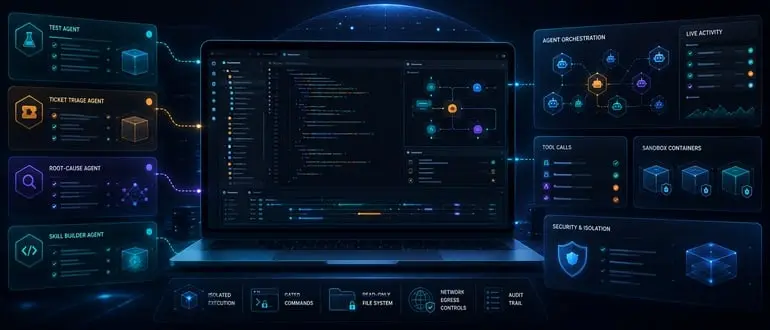
At its operational core, Kiro Crew utilizes the Agent Client Protocol (ACP) to orchestrate complex webs of sub-agents. When a developer assigns a high-level task—such as investigating a regression or triaging a backlog of bug reports—Kiro Crew breaks the assignment down, spawns the necessary sub-agents, and executes the work in parallel.
Crucially, Kiro Crew introduces a granular Activity view dashboard. Each agent is represented by an individual card on the dashboard, offering real-time visibility into the agent’s internal reasoning, every tool call it executes, and its output results as they happen. This real-time observability solves one of the primary anxieties surrounding autonomous AI: the fear of losing control over what the machine is modifying in the codebase.
Supporting Context & Metrics: Security, Sandboxing, and the Enterprise Dilemma
As the software industry races toward autonomous AI agents, security professionals and enterprise architects have voiced legitimate concerns. General-purpose AI agents—such as open-source frameworks like OpenClaw—offer impressive autonomy, but they often operate with broad permissions that can expose corporate networks to supply-chain attacks, unauthorized code execution, and data exfiltration.
The Sandbox Paradox: Security vs. Autonomy
AWS designed Kiro Crew to directly address the security paradox of agentic engineering. While developers want maximum autonomy from their AI tools, enterprise security teams demand rigorous guardrails.
Darko Mesaros emphasized that Kiro Crew distinguishes itself from general-purpose AI agents through a comprehensive, defense-in-depth security architecture. Kiro Crew incorporates:
- Operating System-Level Sandboxing: All agent actions and tool executions are isolated within a secure sandbox environment, preventing unauthorized interactions with the host system.
- Denied-by-Default Commands: By default, agents have no execution privileges. Every specific command must be explicitly evaluated and permitted.
- Suspicious-Pattern Blocking: Built-in heuristics scan for malicious or anomalous command sequences, blocking potential prompt-injection exploits and unauthorized data-scraping attempts.
- Input Validation & Sensitive-Path Blocking: Strict boundaries ensure that agents cannot access or modify protected directories, configuration files, or hardcoded secrets.
- Credential Redaction: Sensitive tokens, API keys, and passwords are automatically scrubbed from logs and context windows to prevent accidental leaks.
- Signed Audit Logs: Every action taken by an agent is cryptographically recorded in a signed audit log, providing complete traceability for compliance and post-incident analysis.
For instance, if an external AI agent or dynamically installed tool attempts to bypass security controls or install unauthorized binaries, Kiro Crew immediately denies access and logs the event. This balance of autonomy and ironclad security makes Kiro Crew uniquely viable for regulated enterprise environments.
Autonomous Learning: Custom AI Skills Generation
Another critical metric of Kiro Crew’s sophistication is its ability to adapt to specific organizational workflows. Most generic AI coding tools rely on static training data or broad foundational models that lack context regarding a company’s proprietary internal libraries, bespoke frameworks, or unique IT environments.
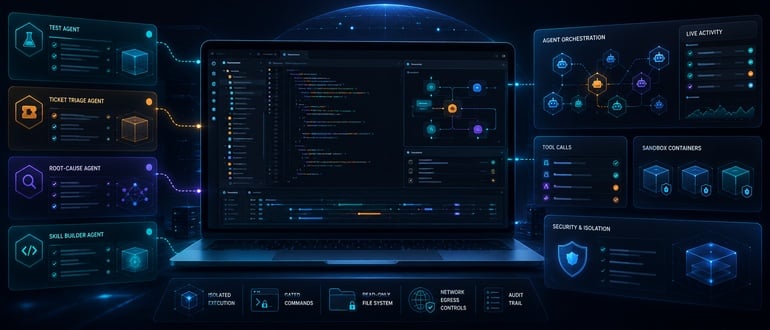
Kiro Crew solves this by observing developers as they write code and interact with the workspace. Over time, the platform identifies recurring patterns and workflows unique to a developer or team. Instead of forcing engineers to manually build and maintain custom AI skills or plug-ins, Kiro Crew monitors development habits and automatically recommends—and generates—custom AI skills tailored to that specific IT ecosystem.
As large language models (LLMs) continue to evolve, many basic coding capabilities will be absorbed directly into foundational models. However, the hyper-specific, localized skills required to build applications for a unique enterprise infrastructure will always remain specialized. Kiro Crew bridges this gap by turning observational data into reusable, automated developer capabilities.
Official Statements and Industry Perspective
The launch of Kiro Crew has sparked significant commentary across the cloud computing and software development sectors. Industry leaders are increasingly recognizing that the future of development lies not in faster typing, but in intelligent orchestration.
In an official blog post detailing the launch and accompanying technical documentation, AWS highlighted the philosophy driving the project:
"The overall goal is to remove more of the toil that takes time away from ensuring that the underlying architecture of the application being created is optimized for a specific use case."
Expanding on this during technical briefings, Darko Mesaros, Distinguished Developer Advocate at AWS, elaborated on the psychological and professional toll that modern software engineering has placed on developers. In an era dominated by microservices, complex CI/CD pipelines, and endless Jira tickets, developers often spend less than 30% of their actual workday writing code or solving creative architectural problems. The rest of the day is consumed by administrative upkeep, testing verification, and bug triage.
"At this juncture, just about every developer is, to one degree or another, making use of AI coding tools," Mesaros noted. "The challenge now is taking those efforts to the next level by embracing more advanced agentic engineering tools to not just write code faster, but also regain the simple joy that comes from building an application that solves a problem for the business."
Mesaros also pointed out the distinction between Kiro Crew and experimental, general-purpose agents. While tools like OpenClaw have captured the imagination of developers looking for maximal automation, their lack of native enterprise guardrails makes them a liability in production environments. Kiro Crew’s combination of OS-level sandboxing, signed audit logs, and credential redaction provides the enterprise assurance that CISOs demand without sacrificing the fluid autonomy that developers crave.
Future Outlook: What’s Next for Kiro and Agentic Engineering
As Kiro Crew establishes its footing in the open-source community, AWS is already charting an aggressive roadmap for its expansion. The platform’s initial success—born from internal adoption by thousands of AWS engineers—serves as a strong validation of its underlying architecture, but the journey has only just begun.
Expanding Beyond Linux: The Windows Horizon
Currently, Kiro and its accompanying Crew workspace have been deeply optimized for Unix-based command-line environments, aligning with the dominant workflows of cloud-native and backend developers. However, AWS recognizes that enterprise software development is heterogeneous.
Addressing this reality, Darko Mesaros confirmed that AWS is actively developing a dedicated Windows edition of Kiro. This expansion will bring autonomous agentic engineering to Windows-centric enterprise shops, .NET developers, and desktop-bound engineers who require seamless integration with Windows Subsystem for Linux (WSL) and native enterprise tooling.
The Shift Toward Multi-Agent Orchestration
Looking further ahead, the broader software industry is transitioning from single-model chat interfaces to collaborative multi-agent ecosystems. In this future, specialized AI agents—some trained in database optimization, others in frontend accessibility, and still others in security compliance—will negotiate and collaborate asynchronously to build software under human supervision.
Kiro Crew’s use of the Agent Client Protocol (ACP) places AWS at the forefront of this architectural shift. By allowing developers to hand off complex, multi-step operations—such as delegating an entire ticket queue for autonomous triage or tasking an agent with investigating a production incident root cause while the engineer focuses elsewhere—AWS is redefining the role of the developer.
In the near future, developers will transition from being manual coders to AI orchestrators and architects. They will spend less time wrestling with syntax, regression tests, and deployment scripts, and more time defining business logic, evaluating agent performance, and ensuring that underlying system architectures are resilient, scalable, and secure.
Conclusion
AWS’s introduction of Kiro Crew marks a watershed moment in the evolution of AI coding tools. By moving past synchronous autocomplete and embracing asynchronous, autonomous agentic engineering, AWS has provided a blueprint for how enterprises can harness the power of AI without compromising security or losing visibility.
As Kiro Crew expands to Windows platforms and gains adoption across the broader open-source community, it promises to alleviate the crushing administrative toil that burdens modern engineers. In doing so, it just might accomplish its most ambitious goal: helping developers rediscover the joy of building software.