Executive Overview
In a dramatic escalation of its decades-long legal crusade against digital piracy, adult entertainment producer FlavaWorks has filed a groundbreaking federal lawsuit targeting users of the now-defunct private file-sharing community, Gay-Torrents.org. Filed in the U.S. District Court for the Northern District of Illinois, the complaint breaks new legal ground by deploying the Racketeer Influenced and Corrupt Organizations (RICO) Act against individual participants of a peer-to-peer torrent tracker.
For the past twenty years, the Illinois-based adult studio has earned a fierce reputation as one of the most aggressive enforcers of intellectual property rights within the adult entertainment industry. However, this latest legal maneuver shifts the battlefield from traditional copyright infringement claims to high-stakes federal racketeering. The newly unsealed complaint names 75 defendants—consisting of one primary "anchor" individual and 74 "John Doe" participants identified only by their site usernames and internal tracking IDs.
By framing the private tracker not merely as a loose collective of file-sharers, but as an "association-in-fact enterprise" engaged in a sprawling racketeering operation, FlavaWorks is attempting to bypass historical jurisdictional limitations that previously forced the studio to scale back earlier lawsuits. Furthermore, the complaint alleges a massive, multi-million-euro payment-laundering scheme that ropes in financial transactions, VIP subscriptions, and web-hosting fronts. While FlavaWorks has already achieved its primary operational objective—forcing the complete shutdown of Gay-Torrents.org earlier this year—this aggressive escalation introduces unprecedented legal jeopardy for everyday torrent users, raising the specter of treble damages, conspiracy liability, and financial ruin.
Detailed Chronology: From First Strikes to Federal Racketeering
The roots of the current legal showdown extend back across a multi-year cat-and-mouse game between FlavaWorks and the administrators and users of illicit distribution networks. Over the past two decades, the company has methodically targeted both individual pirates and sprawling private platforms through federal courts, establishing legal precedents that favor content creators in digital spaces.
The Initial Strike and the Collapse of Gay-Torrents.org
Earlier this year, FlavaWorks launched a high-profile federal lawsuit aimed directly at the infrastructure of Gay-Torrents.org. That initial complaint cast a wide net, naming the site’s operators, system administrators, a mysterious Bulgarian shell company, and over 325 individual members. The pressure applied by the legal filing proved to be an existential blow to the platform; shortly after the complaint surfaced, the operators pulled the plug, causing Gay-Torrents.org to vanish entirely from the public internet.
Despite the platform going dark, the legal crosshairs remained firmly fixed on the site’s user base. Recognizing that its initial approach—which relied heavily on standard copyright and state-law claims—was vulnerable to jurisdictional hurdles that forced the dismissal or dropping of numerous out-of-state defendants, FlavaWorks legal counsel went back to the drawing board.

The RICO Pivot
Last week, the studio filed a completely revamped, highly sophisticated complaint in the same Illinois federal court. This new legal filing strategically pivoted away from standard copyright-only arguments, introducing federal RICO charges against a fresh batch of 75 members.
At the center of this new campaign is a single Virginia resident, Jason A. S., designated by the legal team as the "anchor defendant." According to the complaint, Jason A. S. maintained an active, paying subscription to legitimate FlavaWorks websites between March 2020 and July 2021. During this window, investigators allege he systematically downloaded more than 200 copyrighted works owned by the company.
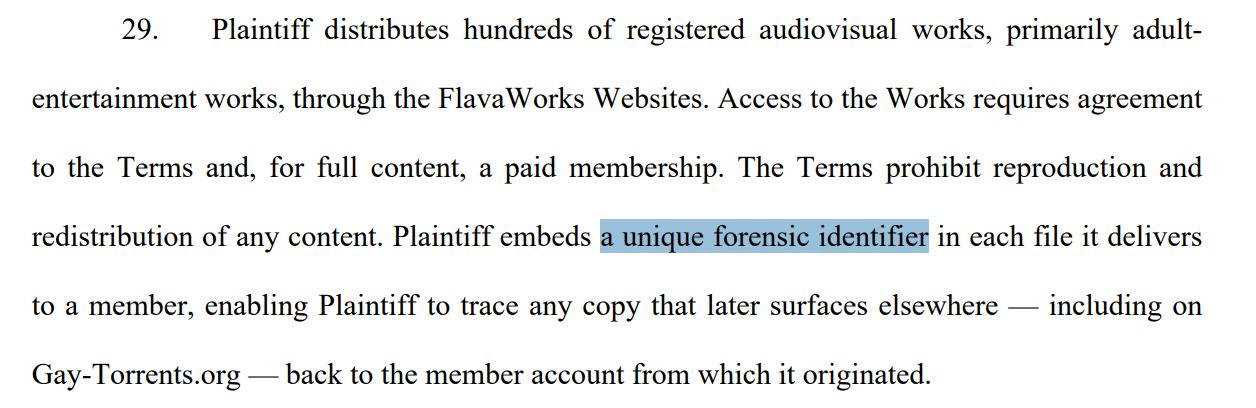
FlavaWorks utilized a proprietary forensic watermarking system to track these files. By embedding unique, invisible identifiers into every video delivered to its paying subscribers, the company was able to trace leaked content directly back to Jason A. S.’s subscription profile when those exact files subsequently appeared on Gay-Torrents.org. Despite receiving a formal cease-and-desist notice from FlavaWorks investigators in 2022, the defendant allegedly continued his involvement with the illicit network, with his watermarked copies circulating across the tracker as late as 2025. Because Jason A. S. resides within the jurisdictional umbrella of the federal court and allegedly participated in both uploading content and paying for VIP status, he provides the essential legal hook required to pull dozens of out-of-state co-conspirators into the Illinois litigation under RICO’s nationwide service of process provisions.
Supporting Context & Metrics: The Anatomy of a €7 Million "Enterprise"
To satisfy the stringent legal thresholds of the RICO statute, FlavaWorks had to meticulously detail how Gay-Torrents.org operated not as a passive bulletin board, but as a structured criminal enterprise designed to generate illicit commercial advantage.
The Sharing-Ratio and VIP Ecosystem
The complaint breaks down the user base of the defunct tracker into distinct operational tiers:
- Lower-Rung Participants: These are the standard members who utilized the site’s mandatory sharing-ratio system. By uploading and downloading infringing content, they directly supplied and maintained the tracker’s vast inventory of pirated media.
- Funders (VIP Members): These participants bypassed sharing-ratio restrictions by paying financial subscriptions for VIP access. Under the plaintiff’s legal theory, these financial transactions form the bedrock of an additional wire fraud allegation.
The Sham Web-Hosting Scheme
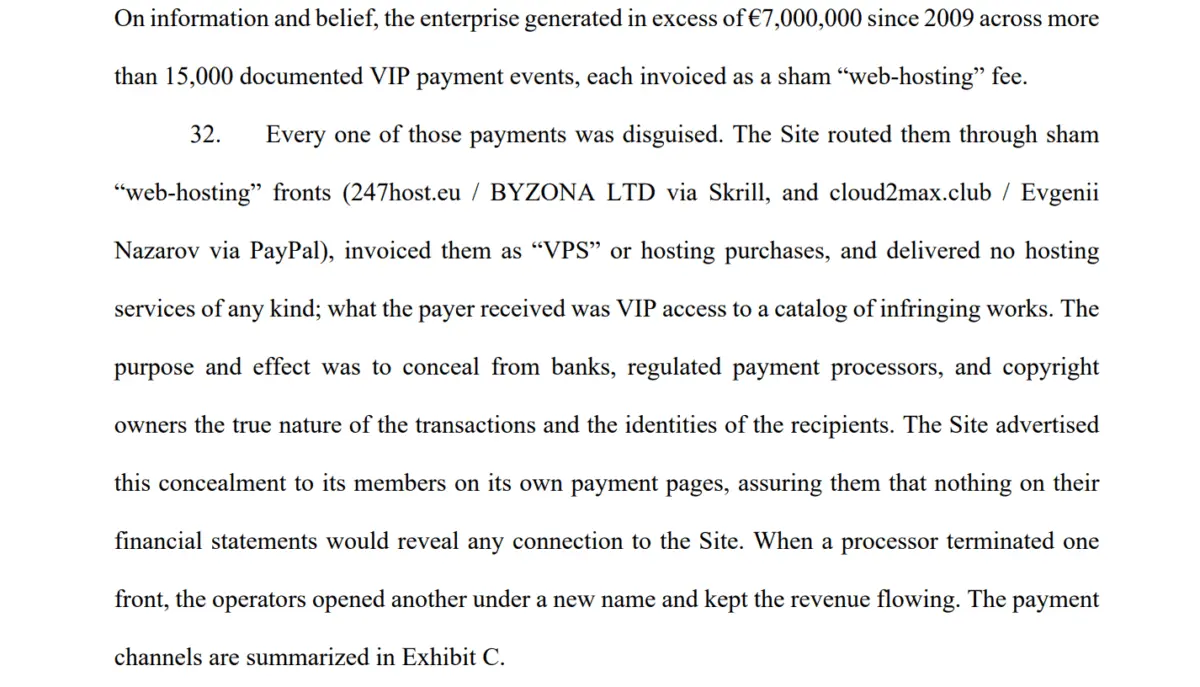
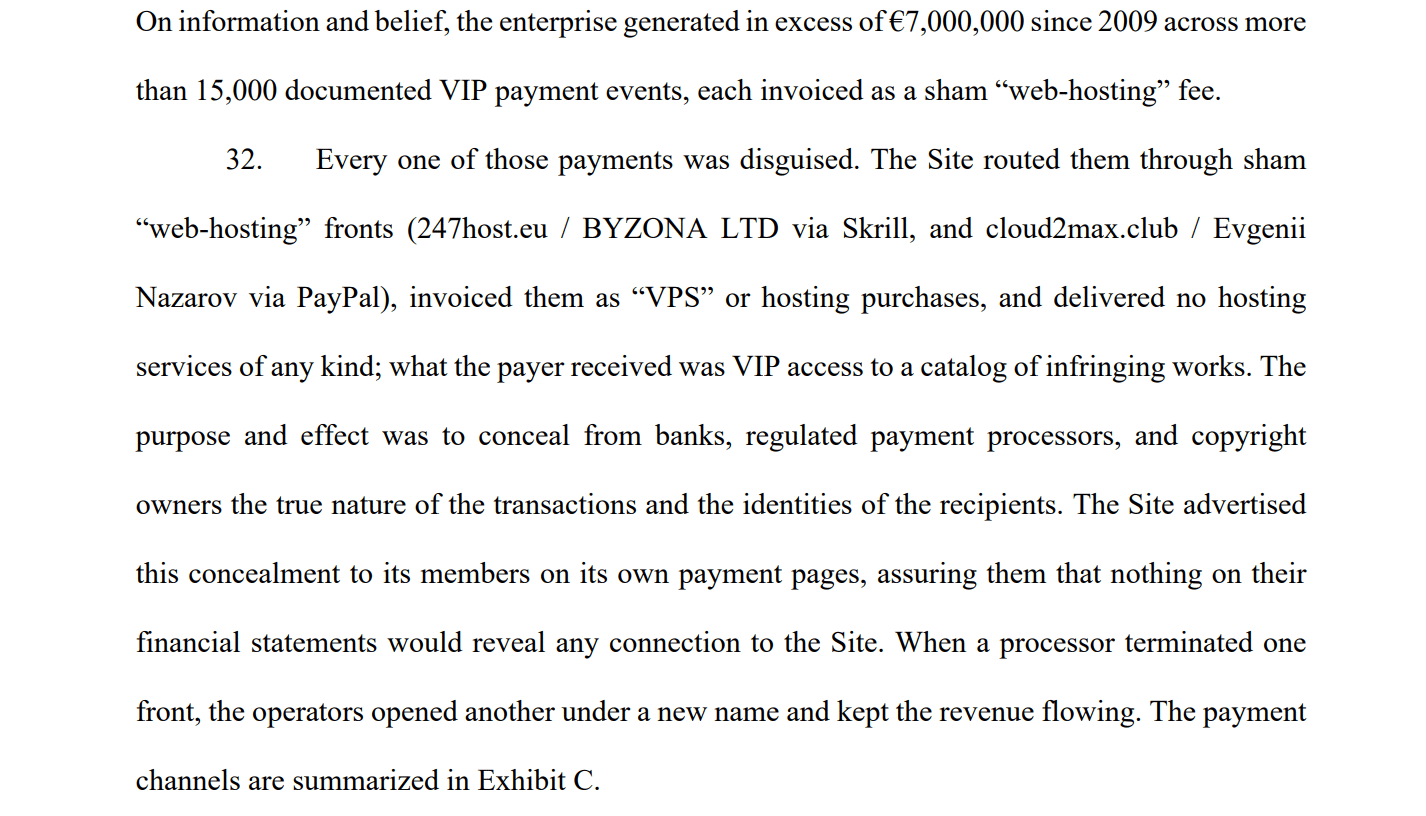
FlavaWorks argues that every single VIP payment processed by the platform constituted a fraudulent act designed to deceive financial institutions. Rather than processing payments openly for adult media or torrent access, the enterprise allegedly directed members to sham web-hosting fronts, instructing them to purchase "Virtual Private Server (VPS) plans" that both parties knew were entirely fictitious.
The primary objective of this intricate financial camouflage was to obscure the true nature of the transactions from major credit card companies, banks, and payment processors, thereby preventing merchant account shutdowns.
[Gay-Torrents.org Users]
       │
       ▼ (Directs payments to)
[Sham Web-Hosting Fronts]
       │
       ▼ (Disguised as "VPS Plans" to deceive banks)
[Payment Processors (PayPal, Skrill)]
       │
       ▼
[Enterprise Revenue Generation (€7M+ estimated since 2009)]
Financial Scale and Forensic Evidence
In its filings, FlavaWorks presents staggering financial estimations regarding the scale of the operation. Based on internal calculations spanning a 17-year history, the studio estimates that the enterprise generated in excess of €7,000,000 since 2009. This massive revenue stream was allegedly accumulated across more than 15,000 documented VIP payment events, each routinely invoiced as a fraudulent web-hosting fee.
This same seven-figure financial estimate was heavily emphasized in the April lawsuit, where FlavaWorks successfully pursued asset-freezing orders targeting the tracker’s alleged payment processors, including PayPal and Skrill. Subpoenas issued to these financial institutions during the earlier litigation have provided the evidentiary paper trail necessary to trace transactions, match user identities, and tie specific defendants to financial contributions that sustained the network.
Legal Analysis: Why RICO Changes the Rules of Digital Piracy Litigation
The deployment of the Racketeer Influenced and Corrupt Organizations Act in a copyright infringement context represents a massive escalation in intellectual property enforcement tactics. Understanding why FlavaWorks chose this path requires examining the unique mechanical advantages and hurdles of RICO litigation.
Overcoming Jurisdictional Barriers
In traditional copyright lawsuits spanning multiple states, plaintiffs frequently run into constitutional due process walls. If a copyright holder files suit in Illinois, but the majority of defendants reside in California, Texas, or New York without sufficient minimum contacts to the forum state, those defendants can successfully move for dismissal based on a lack of personal jurisdiction. This exact hurdle forced FlavaWorks to prune hundreds of defendants from its initial spring lawsuit.
RICO fundamentally alters this dynamic. The federal racketeering statute authorizes nationwide service of process. Under this provision, once a plaintiff establishes personal jurisdiction over a single "anchor defendant" residing within the forum state (in this case, Jason A. S. in Virginia, whose connection to Illinois is established through overlapping corporate interactions, or through the federal court’s broad reach), the court gains jurisdiction over all other domestic co-conspirators linked to the enterprise, regardless of where they live within the United States.
Amplified Financial Stakes and Conspiracy Liability
Beyond jurisdictional convenience, RICO introduces devastating financial exposure:
- Treble Damages: Successful RICO claims permit courts to award up to three times the actual economic damages sustained, layered on top of statutory copyright damages that can reach up to $150,000 per willful infringement.
- Conspiracy Liability: Under RICO conspiracy provisions, liability expands outward. A user who merely paid a VIP subscription fee and never uploaded a single byte of copyrighted material can nonetheless be held jointly and severally liable for the entire enterprise’s copyright infringement and racketeering fallout.
The Evidentiary Burden
Despite these potent advantages, RICO raises the evidentiary bar significantly for the plaintiff. To survive judicial scrutiny and prevail at trial, FlavaWorks must clear rigorous hurdles:
- Pattern of Racketeering: The plaintiff must demonstrate a continuous, related pattern of racketeering activity rather than isolated, disjointed criminal acts.
- Specific Intent (Scienter): For the criminal copyright and wire fraud allegations, FlavaWorks must prove willfulness, deliberate commercial advantage, and exact financial gain.
- Detailed Fraud Pleading: The wire-fraud counts demand strict adherence to federal pleading standards, requiring the plaintiff to document the "who, what, when, and how" of each alleged fraudulent transaction.
Future Outlook: The Road Ahead for Digital Enforcement and Torrent Users
As this high-stakes legal drama unfolds in the U.S. District Court for the Northern District of Illinois, legal experts across the intellectual property and digital rights landscapes are closely monitoring the proceedings.
A High-Pressure Settlement Strategy?
Legal analysts note that while filing a complex RICO case dramatically increases the psychological and financial pressure on the 74 anonymous John Does—who now face the terrifying prospect of being unmasked via upcoming ISP subpoenas—actually litigating a sprawling civil RICO trial to a jury verdict is exceptionally difficult and resource-intensive.
In many similar digital piracy campaigns, the primary objective of aggressive multi-defendant federal litigation is not necessarily a lengthy courtroom trial, but rather the facilitation of swift, lucrative settlement negotiations. Facing the prospect of joint-and-several liability, treble damages, and unsealed legal bills, individual defendants frequently opt for confidential financial settlements rather than risking a federal judgment.
A New Precedent for Content Creators?
For FlavaWorks, the overarching strategic victory has already been secured: Gay-Torrents.org is permanently offline, its administrators have retreated, and its community has been fractured. Whatever financial recoveries or default judgments emerge from this ongoing RICO complaint serve primarily as an aggressive bonus and a stern warning to the remaining underground digital piracy ecosystem.
If FlavaWorks successfully navigates the complex pleading standards and jurisdictional minefields of civil RICO in this case, it could establish a dangerous new playbook for copyright holders. Major media conglomerates, movie studios, and other adult entertainment producers may soon adopt racketeering frameworks to dismantle private torrent trackers, Usenet communities, and IPTV networks, transforming casual file-sharing into high-stakes federal racketeering litigation.
For the 74 John Does waiting in the digital shadows—and for the broader peer-to-peer community watching from the sidelines—the era of anonymous file-sharing on private trackers has entered a much more perilous legal reality.