








Executive Overview
The landscape of digital advertising has undergone a profound, irreversible shift. Artificial intelligence now powers the engine room of Google Ads, dictating how campaigns are targeted, how ad copy is dynamically generated, and where budgets are ultimately spent. While machine learning algorithms have undeniably unlocked unprecedented opportunities for audience reach—especially when paired with robust first-party data and meticulous conversion tracking—they have also introduced a new class of digital marketing hazard: autonomous misdirection.
For years, media buyers relied on a familiar playbook of negative keywords and placement exclusions to keep unwanted traffic at bay. If an advertiser sold luxury leather goods, adding "cheap" as a negative keyword was a simple, effective way to filter out low-intent window shoppers. However, in today’s hyper-advanced, intent-driven search environment, traditional exclusion methods are no longer enough. Modern searchers do not always type their intentions into a search box; an individual seeking a budget laptop case might search using innocuous terms like "laptop cases," bypassing traditional negative keyword filters entirely while still harboring fundamentally misaligned buying intent.
Consequently, modern digital advertising requires a fundamental shift in philosophy. Advertisers can no longer rely solely on telling Google’s AI what terms to avoid—they must explicitly train the machine on who to avoid. By leveraging advanced features such as text guidelines, asset optimization, account-level automated asset controls, and strategic timing for optimized targeting, media buyers can erect the necessary guardrails to protect their brand equity and ad spend. This article explores the mechanics of AI governance in Google Ads, providing a comprehensive blueprint for reclaiming control over automated campaigns.
Detailed Chronology: The Evolution of AI Exclusions in Google Ads
To understand the urgency of modern AI guardrails, it is necessary to examine how Google Ads has transitioned from manual, rule-based systems to fully automated, black-box ecosystems over the past decade.
Phase 1: The Era of Exact Control (Pre-2018)
In the early days of paid search, advertisers enjoyed granular control over every lever of their campaigns. Match types (Exact, Phrase, Broad) behaved predictably, and search queries closely mirrored keyword lists. Exclusions were straightforward: advertisers built exhaustive negative keyword lists and managed ad extensions manually. Google’s algorithms assisted with bidding, but the creative output and audience targeting remained firmly in human hands.
Phase 2: The Rise of Smart Bidding and Close Variants (2018–2021)
As machine learning began to permeate Google Ads, the platform introduced automated bidding strategies like Target CPA and Target ROAS. Concurrently, Google expanded the definition of "close variants" for keywords. Suddenly, exact match keywords were no longer exact, and broad match algorithms began aggressively interpreting user intent. Advertisers found themselves spending more time managing unexpected search queries and fighting against automated expansions that blurred the lines of intent.
Phase 3: The Introduction of Performance Max and Broad Automation (2021–2024)
The launch of Performance Max (PMax) marked a watershed moment. PMax campaigns consolidated search, display, YouTube, Discover, Gmail, and maps into a single, goal-driven campaign type powered entirely by black-box machine learning. While PMax delivered remarkable efficiency gains for many e-commerce brands, it also stripped away visibility and control. Advertisers frequently complained that Google’s AI was showing ads on irrelevant placements, using unapproved imagery, and bidding on low-value search terms just to hit conversion quotas.

Phase 4: The Era of AI Governance and Guardrails (2025–Present)
Recognizing advertiser frustration over brand safety and wasted spend, Google began rolling out sophisticated governance features. The introduction of Text Guidelines for Performance Max and AI Max Search campaigns provided a mechanism for advertisers to feed behavioral and messaging guardrails directly into the LLM-driven ad creation engine. Today, the conversation has shifted from how to give Google more data to how to safely constrain Google’s autonomous capabilities.
Supporting Context & Metrics: The Hidden Costs of Unchecked Automation
The shift toward AI-first advertising is driven by impressive performance metrics, yet these figures often obscure hidden inefficiencies. Google frequently highlights that campaigns utilizing optimized targeting and automated assets see an average uplift of 20% in conversions. However, seasoned media buyers know that an increase in raw conversions does not automatically translate to a healthier bottom line.
The Conversion Quality Dilemma
Consider the metrics surrounding automated ad generation and AI-driven expansion. When Google’s AI is given free rein to populate sitelinks, callouts, and dynamic images, it optimizes strictly for the conversion signal it has been fed. If a campaign is optimized for sheer lead volume or low-cost transactions, the AI will enthusiastically pursue bargain-hunting users who happen to convert at a high rate on low-order values.
For brands operating in the mid-to-high market tiers, this creates a dangerous disconnect. An influx of low-intent traffic can severely degrade metrics such as Average Order Value (AOV), Customer Lifetime Value (LTV), and Return on Ad Spend (ROAS). Furthermore, unmonitored automated assets can inadvertently damage brand perception—such as when Google dynamically pulls a clearance-level discount promotion onto a landing page intended for a luxury product line.
The Anatomy of Intent-Driven Misalignment
Traditional negative keywords operate on a reactive principle: If user types X, do not show ad. But semantic search and large language models interpret conceptual intent rather than literal strings.
- Literal Search Query: "Cheap laptop sleeve" $rightarrow$ Blocked by negative keyword ("cheap").
- Conceptual Intent Query: "Affordable protective bag for notebook computer" $rightarrow$ Missed by traditional negatives, but captured by AI targeting.
To combat this, advertisers must move beyond word-matching and into behavioral profiling via text guidelines and asset optimization.
Official Strategies: How to Implement Advanced AI Guardrails
Reclaiming control over Google Ads requires navigating both highly visible interface elements and deeply buried advanced settings. Advertisers must systematically apply four critical safeguards.
1. Harnessing Text Guidelines and Asset Optimization
Text guidelines represent one of the most powerful recent additions to Performance Max and AI Max Search campaigns. Because Google’s AI dynamically generates ad copy and pairs it with dynamic landing page experiences, it requires explicit semantic boundaries to understand brand positioning.
By setting up text guidelines, advertisers can explicitly instruct the AI on:
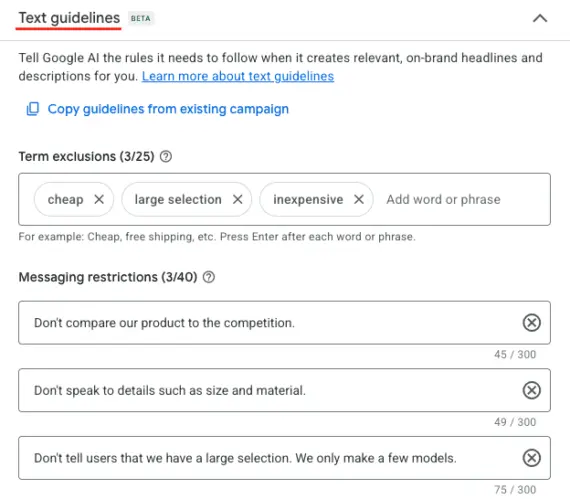
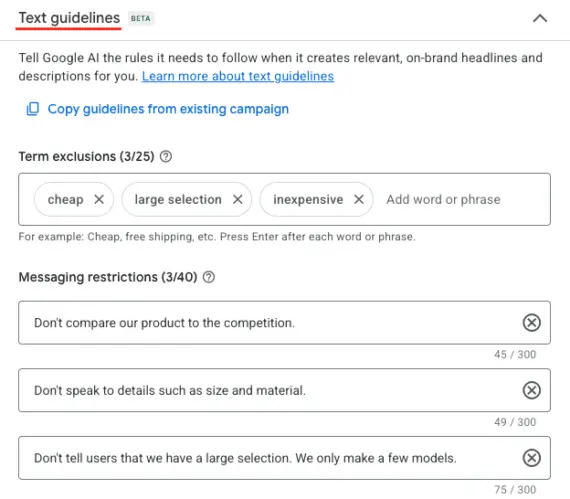
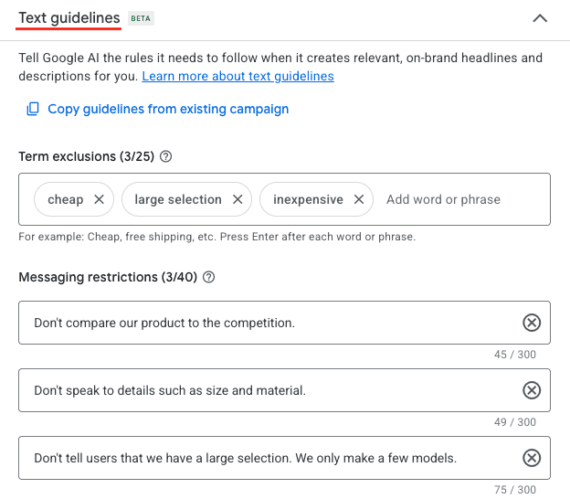
- Term Exclusions: Prohibiting the inclusion or implication of terms like "cheap," "inexpensive," or "discount" when selling premium merchandise.
- Messaging Restrictions: Directing the model to avoid specific comparative claims (e.g., "Don’t compare our product to the competition") or unauthorized promotional language.
Simultaneously, Asset Optimization allows media buyers to toggle off automated image and video enhancements within Performance Max campaigns, ensuring that only brand-approved visual assets are deployed in the wild. Additionally, URL exclusions prevent Google from driving high-intent traffic to inappropriate landing pages, such as clearance portals or out-of-stock product categories.
[Google Ads AI Engine]
       │
       ├──► Unchecked: Pulls random assets, targets low-intent traffic, auto-generates discounts.
       │
       └──► Governed by Guardrails:
              ├── Text Guidelines (Defines who to avoid & messaging restrictions)
              ├── Asset Optimization (Disables unapproved visual enhancements)
              └── URL Exclusions (Blocks clearance/irrelevant landing pages)
2. Auditing Account-Level Automated Assets
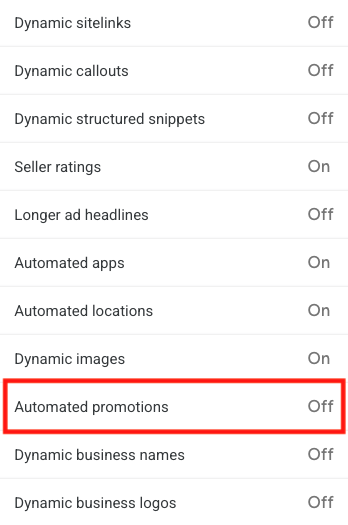
Tucked deep within the Google Ads interface lies a feature with immense power and potential for brand disruption: Account-level automated assets. Google frequently enables these features by default, allowing the system to dynamically populate sitelinks, callouts, images, and automated promotions pulled directly from the advertiser’s website.
To audit and control these settings:
- Navigate to the main menu in your Google Ads account.
- Select Assets from the left-hand navigation pane.
- Access the account-level settings and look for automated extensions.
- Review Advanced Settings to check the status of automated promotions and dynamic branding elements.
Left unchecked, Google may automatically pull company names and logos in ways that violate brand guidelines or create inaccurate visual representations. Advertisers can isolate assets created by Google by filtering the Assets view with the parameter "Added by: Google AI," allowing for rapid identification and removal of rogue creative elements.
3. Exercising Caution with Optimized Targeting and Audience Expansion
Google aggressively promotes features like Optimized Targeting (for Search Partners and Display Network) and Audience Expansion (for Demand Gen and Video campaigns), often dangling the promise of incremental conversions. While these tools can effectively scale reach, turning them on prematurely is a recipe for wasted ad spend.
When a new campaign launches, the AI lacks sufficient conversion data to understand the nuances of a brand’s ideal customer profile. Enabling optimized targeting too early invites the algorithm to cast too wide a net, diluting performance and wasting budget on peripheral audiences.
Best Practice: Keep optimized targeting and audience expansion turned off during the initial launch phase. Allow the campaign to run long enough to accumulate a robust repository of first-party conversion data. Once the AI has been properly trained on genuine, high-value conversions, gradually introduce audience expansion features to scale reach safely.
Future Outlook: The Autonomous Agency and the Rise of AI Oversight
As we look toward the future of digital marketing, the role of the media buyer is evolving from a tactical operator into an AI governance specialist. The days of manually adjusting keyword bids and writing every line of ad copy are rapidly disappearing, replaced by systems managed entirely by generative AI and machine learning algorithms.
However, full automation does not mean total abdication of human responsibility. In fact, as Google’s AI models grow more autonomous and sophisticated, the strategic importance of human oversight will only increase. Future advertising success will not be defined by who can write the best prompt, but by who can build the most robust structural guardrails.
Advertisers who master the art of negative reinforcement—training AI models not just on who to find, but precisely who to ignore—will maintain superior brand equity, higher profit margins, and protected ad spend. Those who leave Google’s AI running on default settings will find themselves subsidizing low-intent traffic, fighting brand degradation, and wondering why their conversion volume no longer translates to business growth.
The frontier of digital advertising belongs to those who know how to build the fence before letting the algorithm graze.