Executive Overview
In the rapidly evolving landscape of digital marketing, artificial intelligence has undeniably become the beating heart of Google Ads. Modern advertising platforms utilize advanced machine learning models to dynamically construct ad copy, target complex audience segments, optimize bidding strategies in real-time, and serve creative assets tailored to the granular intent of individual users. When paired robustly with first-party data and precise conversion tracking, these AI-driven systems can unearth high-value opportunities that traditional, manual campaign structures could never hope to identify.
However, a fundamental misconception continues to plague media buyers and digital strategists alike: the belief that feeding algorithms more data and granting them absolute autonomy is always the most effective path forward.
As Google Ads pushes deeper into intent-driven search, automated asset creation, and ubiquitous campaign types like Performance Max and AI Max, advertisers are learning a hard lesson. What we instruct AI to exclude is just as vital—and frequently more profitable—than what we instruct it to target.
For decades, advertisers relied on basic negative keywords and placement exclusions to block irrelevant traffic. If you didn’t want your luxury goods showing up next to bargain-basement queries, you simply added "cheap" or "discount" to your negative keyword list. But in today’s semantic, intent-driven ecosystem, traditional negative keywords are no longer sufficient. An algorithm can easily bypass a static keyword list by identifying a user whose underlying intent is budget-conscious, even if the exact search query—such as a broad search for "laptop cases"—contains none of your blacklisted terms.
To maintain brand integrity, prevent wasted ad spend, and protect profit margins, advertisers must shift their strategy from merely filtering out keywords to actively programming AI on who to avoid. This comprehensive investigative report explores the critical mechanisms available within the modern Google Ads interface—ranging from text guidelines and asset optimizations to hidden account-level automated settings and tightly managed audience expansion—that allow sophisticated marketers to build essential guardrails around their AI-driven campaigns.
Detailed Chronology: The Evolution of AI Controls in Google Ads
To understand why modern advertisers must take a hands-on approach to AI governance, it is necessary to examine how Google Ads has transitioned from a manual keyword-matching platform to an autonomous, black-box ecosystem.
Phase 1: The Era of Manual Granularity
In the early days of search engine marketing, control was absolute. Advertisers hand-picked keywords, wrote static text ads, chose specific ad groups, and manually adjusted bids based on performance reports. Exclusions were simple: if a search term produced irrelevant clicks, it was added to a negative keyword list. The platform acted as a direct mirror of human inputs. If you didn’t tell it to show an ad, it didn’t show it.
Phase 2: The Rise of Smart Bidding and Expanded Match Types
As Google’s machine learning capabilities matured, automated rules and Smart Bidding (Target CPA, Target ROAS) began replacing manual bid adjustments. Concurrently, match types evolved. Broad match and phrase match stopped looking for strict character strings and started relying on user intent, contextual signals, and historical search patterns. While this unlocked vast new pools of traffic, it also introduced unpredictability, forcing marketers to rely more heavily on audience signals and automated exclusions.
Phase 3: The Black-Box Revolution (Performance Max and AI Max)
The introduction of Performance Max (PMax) marked a paradigm shift. Moving away from keyword-based search structures entirely, PMax campaigns allowed Google to marshal all available inventory—Search, Display, YouTube, Discover, Gmail, and Maps—through a single, highly automated campaign type. Google’s AI took complete control of asset combination, bidding, and placement generation.
While efficient, this shift stripped away traditional visibility. Advertisers could no longer see exact search queries or placement URLs with the same granularity, leading to widespread anxiety over wasted spend on irrelevant channels and low-quality placements.

Phase 4: The Push for Guardrails and Advanced Text Guidelines
Recognizing that enterprise brands and performance marketers alike required greater control over automated outputs, Google began rolling out advanced governance features. Recent updates to Performance Max and AI Max Search campaigns introduced Text Guidelines and expanded Asset Optimizations.
These tools marked a turning point in platform philosophy: rather than forcing advertisers to surrender entirely to the algorithm, Google provided mechanisms to inject brand safety parameters, term exclusions, and messaging restrictions directly into the AI’s core training loops. Today, mastering Google Ads is no longer just about optimizing what goes in, but aggressively dictating the boundaries of what stays out.
Supporting Context & Metrics: The Hidden Costs of Unchecked AI
The commercial stakes of failing to implement proper AI guardrails are immense. Without strict boundaries, machine learning algorithms are fundamentally incentivized to maximize volume and conversions according to the specific primary metric defined in the campaign settings—often at the expense of profit margin, brand positioning, or customer lifetime value.
The Semantic Blind Spot of Traditional Negative Keywords
Consider a consumer searching for a heavy-duty, military-grade, premium aluminum laptop case. They are willing to pay a premium price for durability. However, another consumer is looking for a cheap, flimsy neoprene sleeve because they are on a strict budget.
If an advertiser relies solely on traditional negative keywords like "cheap" or "discount," they will miss the buyer whose search behavior signals bargain-hunting without using those exact words. They might search for "laptop cases" while filtering retail aggregators by lowest price, or they might browse secondary markets.
An advanced AI model, left unguided, will look at historical conversion rates and deduce that broader terms like "laptop cases" yield high click-through rates and cheap conversions. It will aggressively allocate budget toward those high-volume, low-intent terms, dragging down average order values and introducing low-intent prospects into a luxury sales funnel.
The Impact of Automated Assets and Unchecked Expansions
According to internal Google case studies and platform prompts, features like "Optimized Targeting" claim to drive an average of 20% more conversions by expanding reach beyond manually defined audience segments. For many growth-focused marketers, that metric is a siren song.
However, diving into optimized targeting too early in a campaign’s lifecycle—before the algorithm has ingested enough clean, high-value conversion data—can be catastrophic. The AI, lacking a mature definition of a "good" customer, will cast a wide net across Google Search Partners and the Display Network, capturing low-quality leads, accidental clicks, and window shoppers.
Furthermore, account-level automated assets can dynamically pull promotional discounts, sitelinks, callouts, and even corporate logos from an advertiser’s website. If an e-commerce brand is running a high-end, full-price collection campaign, automated promotions might unearth an old clearance page or a deep discount code, displaying it prominently next to a luxury product and instantly destroying the brand’s premium positioning.
Deconstructing the Controls: How to Train Google’s AI on Who to Avoid
Successfully managing modern Google Ads campaigns requires a deliberate, multi-step process of auditing platform settings, establishing text guidelines, and leveraging hidden configurations. Here is a tactical breakdown of how to build robust guardrails.
1. Utilizing Text Guidelines and Asset Optimization
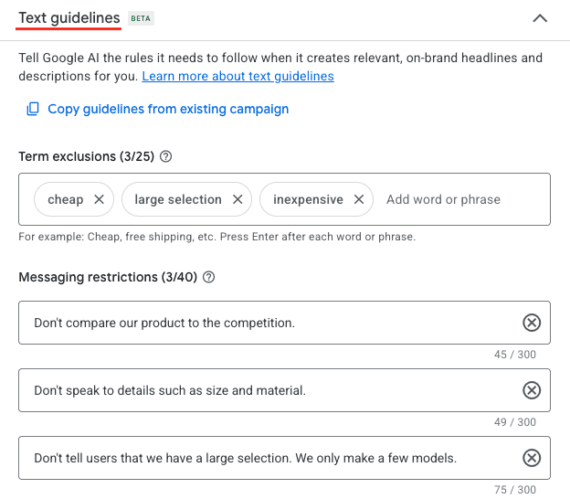
Text guidelines represent one of the most powerful—and underutilized—additions to Performance Max and AI Max Search campaigns. Because Google’s AI dynamically generates ad copy and determines landing page destinations, it requires clear boundary markers to align with brand strategy.
+-----------------------------------------------------------------+
|                    Google Ads AI Guardrails                     |
+-----------------------------------------------------------------+
|  [Term Exclusions]      -->  Block "cheap," "inexpensive," etc. |
|  [Messaging Limits]     -->  Prohibit competitor comparisons    |
|  [URL Exclusions]       -->  Block clearance/outlet pages       |
|  [Automated Assets]     -->  Disable unwanted logo/promo pulls  |
+-----------------------------------------------------------------+
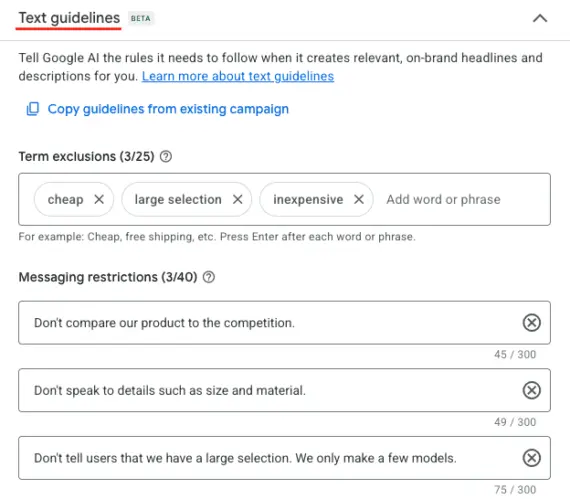
By inputting specific term exclusions and messaging restrictions, advertisers can explicitly teach the AI how the brand positions itself in the marketplace. For example, if a company manufactures only a limited run of high-end laptop cases, the text guidelines should instruct the AI to:
- Exclude terms like "cheap," "budget," and "inexpensive."
- Enforce messaging restrictions such as "Do not compare our product to the competition."
- Reject broad claims like "massive selection" if the product line is boutique and exclusive.
Concurrently, Asset Optimization settings allow media buyers to toggle off automated image and video enhancements in Performance Max campaigns. This ensures that the system does not auto-generate subpar visual assets that clash with professional brand guidelines. URL Exclusions can similarly be deployed to prevent Google from driving high-intent traffic to clearance pages, outlet sections, or irrelevant blog posts when the goal is to sell flagship, full-price items.
2. Navigating Account-Level Automated Assets
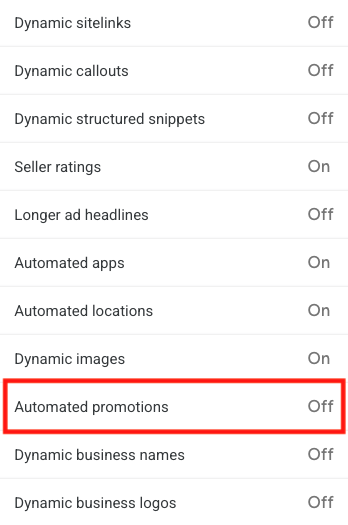
Many advertisers are unaware that Google automatically opts accounts into dynamic asset generation. Tucked away within the labyrinthine Google Ads interface are account-level automated assets that can dynamically populate sitelinks, callouts, images, and automated promotions pulled directly from the website’s scraped metadata.
To audit and control these settings, advertisers must navigate through the account hierarchy:
- Locate the primary campaign or account settings dashboard.
- Access the Advanced Settings menu to review the live status of account-level automated assets.
- Explicitly disable features like Automated Promotions if pricing control is vital to your sales strategy.
- Review assets added by machine learning by navigating to the Assets tab in the left-hand menu and filtering by the parameter "Added by: Google AI."
Failing to perform this audit regularly can result in Google automatically utilizing brand names and logos in contexts that compromise brand integrity or misrepresent product offerings.
3. Strategic Sequencing of Optimized Targeting and Audience Expansion
Features like Optimized Targeting (for Search, Display, and Video campaigns) and audience expansion (for Demand Gen campaigns) are designed to scale reach by finding prospective buyers outside of established parameter lists. However, timing is everything.
The Golden Rule of AI Expansion: Never enable optimized targeting or broad audience expansion when launching a brand-new campaign or working with sparse historical data.
If an algorithm is fed insufficient or polluted conversion data, expansion features will act as a budget incinerator, drifting far away from ideal customer profiles. Campaigns must run long enough—accumulating robust, verified first-party conversion data—to firmly train the AI on the true characteristics of a high-value purchaser. Only once the baseline model is stable and accurate should optimized targeting be enabled to safely scale the account.
Official Statements and Industry Expert Perspectives
As the digital marketing industry grapples with the increasing autonomy of platform algorithms, prominent agency leaders and platform architects have weighed in on the changing nature of campaign management.
Industry analysts frequently emphasize that the role of the modern media buyer has shifted from an executor of tactical tasks to a strategic governor of machine learning systems.
"We are no longer building campaigns brick-by-brick; we are training digital interns," notes a senior director of paid search at a leading global digital agency.
"If you leave an intern alone in a room without a strict handbook, a brand style guide, and clear boundaries on what projects to reject, they will take the easiest, fastest path to complete their task—regardless of whether it aligns with your long-term business goals. Google’s AI operates on the exact same principle. It optimizes for the metric you gave it, and nothing else. It is up to the marketer to define the negative space."
Google’s engineering teams, through various developer conferences and product documentation updates, have consistently maintained that features like Text Guidelines and Asset Optimizations are designed to bridge the gap between creative autonomy and brand safety. Representatives have emphasized that while machine learning excels at pattern recognition and semantic matching, human oversight remains irreplaceable when it comes to brand ethos, pricing psychology, and strategic exclusion.
Future Outlook: The Next Frontier of AI Governance in Paid Search
Looking ahead over the next three to five years, the tension between algorithmic automation and advertiser control will only intensify. As large language models (LLMs) become natively integrated into search engines and advertising platforms, the definition of a "keyword" will continue to dissolve in favor of fully conversational, context-aware ad generation.
1. Predictive Intent Filtering
Future iterations of AI governance tools will likely move beyond static text guidelines and term exclusions into predictive intent modeling. Advertisers will be able to train algorithms using qualitative parameters—such as "customer lifetime value potential," "purchase readiness scores," or "churn risk"—allowing the AI to autonomously reject low-intent searchers before a single impression is served, based on real-time micro-behavioral signals.
2. Autonomous Brand Safety Audits
As automated assets become more sophisticated, we can anticipate the rise of automated governance layers. Third-party software tools and native platform plugins will likely emerge to continuously scan dynamic ad variations, ensuring that generated copy, automated promotions, and landing page pairings strictly adhere to enterprise compliance frameworks without requiring manual interface audits.
3. The Revaluation of Human Strategy
Ultimately, the future of Google Ads belongs neither to the absolute purists who demand manual control over every keyword nor to the hands-off marketers who surrender their entire budgets to black-box algorithms.
The winners in the next era of digital advertising will be those who master the art of collaborative guardrails. By understanding how to rigorously train the AI on who not to target, defining clear brand parameters through advanced text guidelines, and strategically sequencing automated expansion features, advertisers can harness the unprecedented scale of machine learning while protecting their margins, brand equity, and bottom lines.