









Executive Overview
For decades, the Achilles’ heel of the digital retail economy has been the product return. While e-commerce has scaled to unprecedented heights—capturing trillions of dollars in global transaction volume—logistical reverse-supply chains have struggled under the weight of "bracket buying," impulse purchasing, and systemic buyer’s remorse. For online merchants, returns are not merely an operational inconvenience; they are a persistent financial hemorrhage eating deep into operating margins, generating vast amounts of carbon waste through return shipping, and complicating inventory forecasting.
However, a structural shift is quietly unfolding across the digital marketplace. According to groundbreaking data released in the August 2026 AI Traffic Trends Report by Adobe—which draws on Adobe Analytics data tracking over one trillion visits to U.S. retail sites and 100 million distinct SKUs, alongside a comprehensive July 2026 survey of 5,000 U.S. consumers—artificial intelligence is beginning to solve this foundational e-commerce dilemma.
Early insights from the report reveal a compelling narrative: consumers who leverage AI assistants throughout their shopping journey are dramatically more confident in their purchasing decisions and significantly less likely to initiate a return. Furthermore, AI-referred traffic is proving to be radically more valuable than traditional web traffic, converting at rates up to 60% higher while driving superior revenue per visit.
This deep-dive investigation explores the mechanics behind this paradigm shift. We will examine how intelligent software agents are altering consumer behavior, reshaping product discovery, raising the stakes for merchant data transparency, and offering the digital retail sector a viable pathway toward drastically reduced return rates.
Detailed Chronology: The Evolution of AI in E-Commerce Discovery
To understand the profound impact that AI assistants are having on modern retail, it is vital to trace how the digital shopping journey has evolved over the past decade, culminating in the sophisticated agentic ecosystems of 2026.
Phase 1: The Keyword-Driven Era (2010–2020)
For many years, online shopping was predominantly search-driven and transactional. Consumers relied heavily on search engines or internal site search bars, inputting basic keywords. The burden of research rested entirely on the buyer. A shopper looking for a specialized appliance or a specific apparel item would have to open dozens of browser tabs, cross-referencing customer reviews, reading technical specifications, comparing pricing grids, and guessing at product sizing or compatibility. This fragmented process frequently led to cognitive overload, rushed decision-making, and, consequently, high rates of post-purchase dissatisfaction.
Phase 2: The Conversational Chatbot Wave (2021–2024)
The initial wave of conversational AI introduced automated chatbots to e-commerce storefronts. While these early tools were helpful for tracking packages, processing basic returns, or answering frequently asked questions, they were largely reactive. They lacked the contextual intelligence and cross-web visibility required to guide a consumer through a complex, multi-brand purchasing decision. They functioned more as digital customer service representatives than as proactive shopping companions.
Phase 3: The Rise of Agentic AI and Autonomous Browsing (2025–2026)
By 2026, the retail landscape had transformed through the introduction of advanced agentic AI systems. Modern platforms—exemplified by technologies like Meta’s Muse—no longer wait for human prompts to browse single pages; they utilize autonomous virtual web browsers to traverse dozens of e-commerce sites simultaneously.
These sophisticated systems can ingest vast amounts of data in milliseconds, parsing complex specifications, structural dimensions, cross-brand compatibility metrics, shipping timelines, and verified user sentiment. By the time an AI assistant presents a product recommendation to a consumer, the platform has already performed the heavy lifting of comparative research. Consequently, when a shopper arrives at an online retailer’s checkout page via an AI referral, they are no longer browsing out of idle curiosity; they are informed, highly intentional buyers whose uncertainty has been systematically dismantled.
Supporting Context & Metrics: Decoding the Adobe August 2026 Report
Buried within a specialized section of Adobe’s extensive 59-page AI Traffic Trends Report for August 2026 are statistics that demand the attention of every digital merchant, supply chain executive, and retail strategist.

The Metrics of Confidence and Retention
Adobe’s July 2026 survey of 5,000 U.S. consumers provides hard quantitative backing for what was previously only anecdotal observation. The findings reveal a stark psychological shift among tech-enabled shoppers:
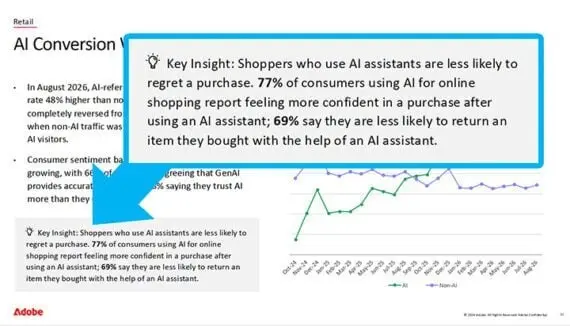
- 77% of AI-Assisting Shoppers Felt Higher Purchase Confidence: Nearly eight out of ten respondents who utilized AI tools during their shopping journey reported feeling significantly more secure in their final purchasing choices. This heightened confidence directly counters the hesitation and buyer’s remorse that typically plague high-consideration e-commerce categories.
- 69% Are Less Likely to Return Items: Among those who completed purchases with AI assistance, an impressive 69% stated they were less likely to return the acquired merchandise. Given that return rates in categories like apparel and consumer electronics often hover between 20% and 30%, a structural reduction of this magnitude could transform the profitability profile of digital retail.
Conversion and Revenue Supercharge
Beyond the reduction in reverse-logistics friction, AI-referred traffic is fundamentally outperforming legacy acquisition channels. According to Adobe Analytics data from July 2026:
- 60% Higher Conversion Rates: Retail visitors arriving via AI platforms convert at rates roughly 60% higher than traditional, non-AI-referred traffic sources (such as standard organic search, direct navigation, or display advertising).
- 53% Greater Revenue Per Visit: Because these consumers arrive with pre-qualified intent and narrowed parameters, they generate 53% more revenue per visit, maximizing the efficiency of merchant acquisition funnels.
| Metric Category | Traditional Traffic Baseline | AI-Aided Traffic (Adobe Data) | Strategic Impact |
|---|---|---|---|
| Consumer Confidence | Variable / Moderate | 77% High Confidence | Drastic drop in post-purchase anxiety |
| Return Likelihood | Industry Standard (20-30%) | 69% report lower return intent | Alleviation of reverse-logistics costs |
| Conversion Rate | Benchmark Average | +60% vs. Non-AI Traffic | Superior checkout funnel efficiency |
| Revenue Per Visit (RPV) | Standard Baseline | +53% Increase | Higher cart value and purchase intent |
Official Insights & The Merchant Mandate: Perfecting Product Information
As AI intermediaries increasingly stand between the consumer and the online storefront, the strategic priorities for e-commerce merchants are undergoing a fundamental re-alignment. Success in the AI-driven retail era is no longer solely about search engine optimization (SEO) or eye-catching banner ads; it is about AI Discovery Optimization (ADO) and data integrity.
The Rise of AI Discovery Optimization
An AI assistant can only mitigate purchase uncertainty if it is fed accurate, granular, and comprehensive data. When an agent like Meta’s Muse or similar advanced platforms evaluates a product catalog, it looks far beyond marketing taglines and hero images. It requires structured, machine-readable data detailing:
- Precise physical dimensions and material compositions.
- Granular cross-compatibility and variant specifications.
- Transparent shipping estimates and delivery timelines.
- Up-to-date pricing, inventory levels, and return policy parameters.
- Synthesized customer reviews and verifiable FAQ repositories.
If a merchant’s product information is ambiguous, outdated, or incomplete, autonomous AI assistants will simply bypass that catalog in favor of competitors whose data parameters are clear and verifiable.
Bridging the Gap Between Search and Reality
The core reason AI assistance correlates with fewer returns is alignment. Traditional online shopping often relies on emotional impulse buying sparked by stylized imagery, which frequently fails to match reality upon delivery (e.g., an article of clothing that fits differently than expected, or a piece of furniture that does not match room dimensions).
By contrast, an AI shopping agent cross-references user constraints—such as precise body measurements, specific technical requirements, or use-case restrictions—against structured merchant data before making a recommendation. By ensuring that the right product is matched to the right consumer from the outset, AI bridges the gap between digital expectations and physical reality.
Future Outlook: The Next Frontier of Frictionless Retail
While the data from Adobe’s August 2026 report provides an encouraging glimpse into the future, industry analysts caution that it is still early days. The integration of generative and agentic AI across the mass consumer base is a moving target, and long-term longitudinal studies will be required to measure the exact percentage drop in enterprise-level return volumes across various retail sectors.
Nevertheless, the trajectory is clear. As autonomous shopping agents become deeply embedded in the daily consumer routine, the competitive advantage will decisively shift toward merchants who embrace structural transparency and data excellence.
Key Predictions for the Next Three Years:
- Standardization of Product Data Schemas: Retailers will increasingly adopt universal, machine-readable metadata standards specifically tailored for consumption by third-party AI shopping agents, ensuring seamless discovery across all platforms.
- Redefining Reverse Logistics Budgets: As lower return rates materialize at scale, enterprise e-commerce companies will reallocate capital away from reverse-logistics management and restocking operations, channeling those funds back into product innovation and customer experience.
- The Maturation of Agentic Commerce: Shopping will transition from a manual search-and-compare task to an outsourced, delegated activity where AI agents negotiate, verify, and purchase on behalf of consumers with near-zero error rates regarding fit, function, and preference.
Conclusion
The August 2026 Adobe AI Traffic Trends Report serves as a critical signpost for the digital economy. It demonstrates that artificial intelligence is not merely a novelty designed to generate marketing copy or speed up customer service chats; it is a foundational architecture capable of solving one of e-commerce’s oldest and most expensive problems. By fostering informed, highly confident shoppers who buy precisely what they need, AI is transforming product returns from an inevitable cost of doing business into a manageable, minimized anomaly. For merchants willing to adapt their data strategies to meet the demands of intelligent agents, the future promises higher conversions, greater customer loyalty, and a leaner, more sustainable bottom line.