








Executive Overview
In an era where the boundary between digital interaction and physical academic life has dissolved completely, social media platforms face unprecedented pressure to safeguard their youngest users. On Tuesday, Instagram announced a substantial expansion of its School Partnerships program, marking a major evolution in how the platform manages online safety, cyberbullying, and institutional communication.
First introduced in March 2025, the initiative was originally conceived as a direct pipeline for educators to flag potential online safety threats and harmful behavior directly to Instagram’s moderation teams. By prioritizing reports submitted by verified educational personnel, the platform sought to cut through bureaucratic red tape and protect vulnerable students from targeted harassment.
Now, following a successful rollout that has seen partnerships established with nearly 17,000 schools globally, Instagram is scaling up the program. The latest update introduces dedicated in-app school information hubs, enhanced institutional broadcasting tools—including Channels, School Stories, and Notes—and a novel "Verified Students" feature. Furthermore, through a strategic collaboration with student identity verification provider UNIDAYS, Instagram is empowering approved student contributors to utilize specialized communication and alert features.
This comprehensive update arrives at a critical juncture for parent company Meta. As lawmakers worldwide debate sweeping restrictions on teen social media usage and critics intensify allegations regarding the platform’s psychological impact on adolescents, the expansion of the School Partnerships program represents a high-stakes effort. By weaving schools directly into the digital safety net, Meta hopes to rebuild parental trust, demonstrate proactive governance, and pivot the narrative from reactive defense to collaborative community protection.
Detailed Chronology: From Concept to Campus Integration
To fully understand the weight of Instagram’s latest announcements, it is necessary to trace the trajectory of the School Partnerships program from its inception to its current iteration.
March 2025: The Genesis of Direct Educational Reporting
For years, educators, school administrators, and guidance counselors found themselves structurally excluded from effective communication channels with major tech companies. When cyberbullying spilled over from physical school yards into private direct messages or ephemeral Stories, schools often lacked a streamlined mechanism to alert platforms to coordinated harassment campaigns or severe safety crises.
Recognizing this gap, Instagram launched its School Partnerships program in March 2025. The core premise was straightforward yet revolutionary: establish a trusted-reporter network comprising accredited educational institutions. Under this framework:
- Prioritized Escalation: Safety reports submitted by approved school representatives bypassed the standard, often sluggish automated reporting queues.
- Contextual Insight: Educators could provide necessary context regarding real-world dynamics—such as escalating offline altercations translating into digital bullying—giving moderators vital information to act swiftly.
- Early Intervention: The system aimed to stop viral harassment loops before they caused lasting psychological harm to teenage users.
The Growth Phase: Scaling to 17,000 Institutions
In the months following its debut, the program experienced rapid adoption. Recognizing the urgency of teen safety amid a shifting regulatory landscape, educational administrators eagerly signed on. By late 2025 and into early 2026, Instagram reported that nearly 17,000 schools worldwide had integrated into the ecosystem.
This massive influx of institutional participants provided Meta’s engineering and trust-and-safety teams with an invaluable dataset. Feedback loops revealed that while expedited reporting was vital, schools needed more than just a panic button; they needed proactive channels to foster positive school culture, disseminate safety alerts, and reach students where they spent a significant portion of their waking hours.
Tuesday’s Announcement: The Next Frontier of Integration
Building directly on educator feedback, Instagram announced a sweeping expansion of the initiative. Rather than functioning solely as a disciplinary or reporting hotline, the program is transforming into a fully integrated digital campus ecosystem.
The new updates bridge the gap between institutional authority and student autonomy. By introducing school-related in-app hubs, specialized broadcast channels, and verified student roles, Instagram is attempting to legitimize the platform as an official extension of the educational environment—one carefully monitored and fortified against external bad actors.
Supporting Context & Metrics: Navigating the Teen Mental Health Crisis
To contextualize Instagram’s motivations for expanding the School Partnerships program, one must examine the broader socio-political and psychological landscape surrounding youth technology consumption.
The Regulatory and Public Relations Pressure Cooker
Meta has spent the better part of the decade defending its products against mounting public scrutiny. A chorus of pediatricians, psychologists, parent advocacy groups, and lawmakers has continuously asserted that algorithms designed to maximize user engagement are inherently detrimental to developing minds.
These concerns have materialized into tangible legislative challenges:

- Geographic Restrictions: Multiple regions globally are actively implementing or debating strict bans on social media access for minors, or requiring verifiable parental consent before account creation.
- Litigation Waves: Meta, alongside other tech giants, faces coordinated lawsuits from school districts, state attorneys general, and families alleging that addictive platform designs have fueled a youth mental health crisis characterized by anxiety, depression, and self-harm.
The Statistical Reality of Digital Bullying
Cyberbullying remains one of the most insidious threats facing modern adolescents. According to various public health and digital safety metrics:
- A significant percentage of teenagers report experiencing online harassment or hate speech during their middle and high school years.
- Unlike traditional schoolyard bullying, cyberbullying follows victims into their homes, offering no safe harbor and often resulting in severe academic and emotional distress.
- Schools frequently bear the brunt of these digital conflicts, as offline tensions born on social media inevitably spill over into classrooms and hallways.
By embedding safety protocols directly into the educational infrastructure, Meta is attempting to position itself not as the adversary of schools and parents, but as an indispensable partner in solving a shared societal challenge.
Official Features & Mechanism breakdown
The expanded School Partnerships program introduces several distinct architectural and functional updates to the Instagram application. Each feature has been meticulously designed to balance connectivity with stringent safety parameters.
1. In-App School Information Hubs and Broadcasting Tools
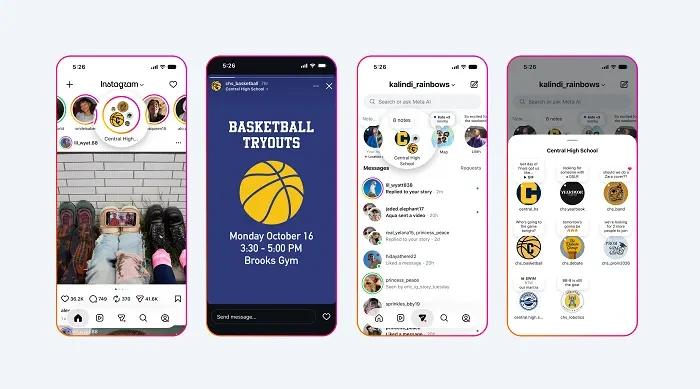
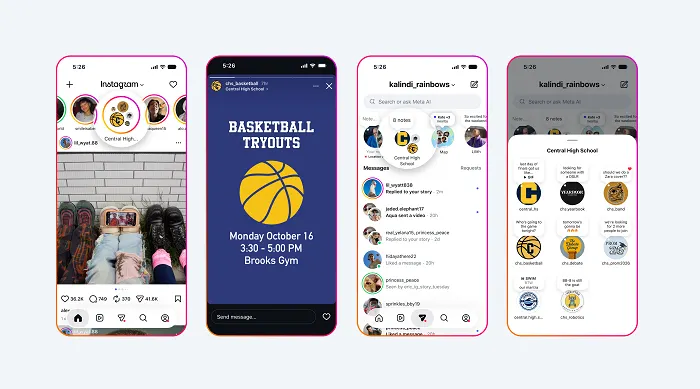
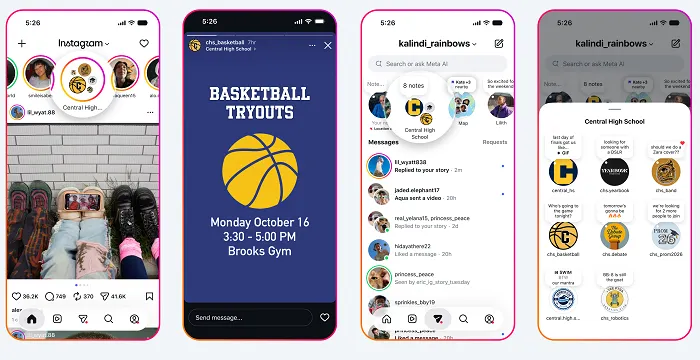
Participating schools now gain access to centralized in-app hubs specifically engineered to broaden message reach and streamline communication. Within these hubs, educational institutions are equipped with advanced broadcasting tools:
- Channels: Allowing schools to push official announcements, event reminders, and mental health resources directly to the feeds of enrolled students.
- School Stories and Notes: Providing dynamic, ephemeral formats for schools to foster school spirit, announce closures, or highlight positive student achievements.
- Tailored Resource Access: Educators, parents, guardians, and students receive customized toolkits containing digital literacy guides, cyberbullying prevention resources, and direct support links.
2. Verified Student Contributors
Recognizing that peer-to-peer communication is far more influential among teenagers than top-down messaging from administrators, Instagram is rolling out a "Verified Students" tier.
- Approved student leaders and contributors gain access to specialized connection and alert features.
- These students can help amplify institutional safety announcements, draw attention to emerging online concerns within their peer groups, and act as a bridge between the student body and administrative safety teams.
3. Student Directories, Banners, and UNIDAYS Integration
To prevent the formation of fake accounts, malicious impersonation, and outside infiltration—common vectors for harassment and grooming—Instagram has partnered with UNIDAYS, a leading global student verification platform.
- Rigorous Verification: High school students must successfully verify their student status through UNIDAYS before they can access their official school community within the app.
- Directories and Banners: Once verified, students can view secure directories of their classmates and create custom school banners.
- Strict Visibility Controls: To ensure total privacy and prevent predatory monitoring from adults or non-students, these directories and banners are strictly quarantined. They are exclusively visible to fellow verified students and mutual teen followers whom the user already follows back.
Official Statements and Industry Perspectives
While Meta has framed the program expansion as a monumental leap forward for student safety, industry analysts and educational stakeholders maintain a cautiously optimistic perspective.
In its official release detailing the expansion, Instagram emphasized the collaborative nature of the initiative:
"This will make it easier for schools to reach students, and for students to stay safe and informed on Instagram… By expanding our partnerships with nearly 17,000 schools and introducing verified student contributors, we are ensuring that safety is a community-driven effort anchored in real-world educational communities."
Independent digital safety experts have praised the integration of verified student roles and the partnership with UNIDAYS, noting that identity verification is the single most effective barrier against anonymous trolling and predatory accounts.
However, critics and privacy advocates also raise valid cautionary notes. Handing educational institutions a direct line to moderate or flag content on a commercial social media platform touches upon delicate questions regarding student free expression, digital privacy, and the potential overreach of school discipline into students’ private digital lives outside of school hours. Ensuring that school administrators do not weaponize expedited reporting to stifle lawful student dissent or off-campus personal expression will be a critical challenge for Instagram’s oversight teams moving forward.
Future Outlook: Can Tech and Education Coexist Safely?
As Instagram continues to roll out these enhanced safety measures throughout 2026, the long-term success of the School Partnerships program will be judged by several key performance indicators:
- Adoption Rates: Will the program successfully scale beyond its current base of 17,000 schools to encompass tens of thousands more globally, particularly in underfunded school districts?
- Mitigation Efficacy: Will the combination of UNIDAYS verification, student directories, and prioritized educator reporting demonstrably lower the incidence of severe cyberbullying and teen mental health distress?
- Regulatory Acceptance: Will global lawmakers and regulators acknowledge these proactive self-regulatory steps, or will momentum toward sweeping teen social media bans continue unabated?
Ultimately, Instagram’s expanded School Partnerships program signifies a tacit acknowledgment by Big Tech that artificial intelligence moderation and automated safety filters alone are insufficient to protect young users. By anchoring digital spaces in the trusted infrastructure of real-world schools and verified peer communities, Meta is attempting to forge a new paradigm for online safety. Whether this blueprint can successfully withstand the immense pressures of the modern digital landscape remains one of the most vital narratives in contemporary technology and education.