








Executive Overview
The scene is agonizingly familiar across software engineering organizations worldwide: mere hours before a major product release, a routine automated dependency scan flashes a critical warning. A newly flagged library vulnerability threatens to derail months of hard work. The development team scrambles to formulate a solution, only to realize that applying the immediate patch risks breaking core working features. Security and operations teams are pulled into emergency syncs, waiting anxiously for formal executive sign-off to either halt the deployment or accept the residual risk.
This end-of-line race against the clock is the textbook symptom of an organizational anti-pattern—postponing security decision-making until the final hours of a delivery cycle. In modern software development, treating security as a monolithic gate at the end of the pipeline creates friction, degrades morale, and forces impossible choices between velocity and safety.
True DevSecOps transformation is not merely about accumulating security tools; it is about establishing fluid protocols, injecting contextual feedback as work progresses, and decentralizing risk ownership. This article explores the root causes of the dreaded "release-day security gate," examines how to redesign the delivery pipeline into a collaborative partnership, and provides actionable frameworks for negotiating software releases when unresolved security dilemmas inevitably arise.
Detailed Chronology: Anatomy of a Release-Day Crisis
To understand why final security gates slow organizations to a crawl, one must trace the lifecycle of a typical eleventh-hour security finding. The friction does not stem from a lack of care on the part of developers or security engineers; rather, it is the structural result of siloed timelines and reactive workflows.
Phase 1: The Late Discovery
Weeks of feature development culminate in code freeze. Code moves into staging environments, and comprehensive automated compliance and dependency scans run. Weeks or months after a developer originally wrote a line of code or imported a third-party package, the scanner highlights a critical vulnerability.
At this stage, the developer has context-switched to entirely new projects. Re-engaging with old code requires cognitive ramp-up time. More critically, the automated scanner issues a stark red alert devoid of vital context: it flags that a library is vulnerable, but it cannot determine whether the application actually executes the vulnerable code path.
Phase 2: The Triage Paralysis
With release hour looming, the pressure mounts. The discovery raises immediate, difficult questions that should have been asked during architectural design weeks prior:
- Should the developer be expected to drop everything and investigate every opaque scanner finding?
- Can the security team issue a blanket waiver in lieu of a code change?
- Who holds the organizational authority to decide whether an unresolved issue is acceptable to ship?
Because clear escalation paths and pre-negotiated risk thresholds are rarely defined, organizations default to bureaucratic paralysis. Formal approvals are mandatory for security-sensitive alterations, yet the decision-makers lack the deep contextual understanding of the codebase required to judge the actual exploitability of the bug.
Phase 3: The Compromise or Halt
Lacking a clean path forward, leadership faces a binary choice: delay a high-stakes release—costing the business financially and damaging credibility—or push code containing unmitigated risk into production. Neither option is palatable, and both are entirely preventable symptoms of a broken feedback loop.
[Code Commit] ---> [Pull Request Check] ---> [Build Stage Scan] ---> [Pre-Deployment Gate] ---> [Release]
     ^                      ^                       ^                         ^
     |                      |                       |                         |
(Shift-Left)         (Contextual Alert)      (Actionable Triage)      (Pre-Defined Risk Policy)
Supporting Context & Metrics: Rethinking Security Partnership
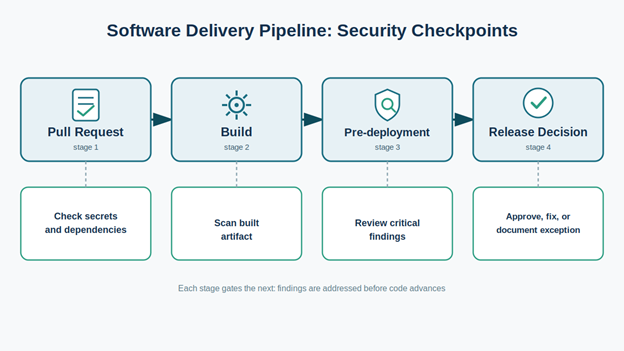
Working with security as a true operational partner must begin long before code reaches the review stage. Instead of functioning as compliance gatekeepers who examine polished code for flaws, security engineers must integrate into the product lifecycle at three critical milestones: architectural design, pull request validation, and pre-deployment exception handling.
The Power of Clear Guardrails
Security guardrails act as constructive boundaries rather than arbitrary roadblocks. They provide engineering teams with explicit behavioral frameworks to govern known risks. Effective guardrails regulate:
- Approved Source Repositories: Mandating centralized, scanned registries for all dependencies.
- Secret Scanning: Automatically blocking code commits that contain hardcoded API keys or credentials.
- Access Control: Restricting production credential access strictly to audited service accounts.
- Authentication Mandates: Requiring peer review for any modifications to authentication or authorization logic.
Making Failed Checks Actionable
Nothing breeds developer resentment faster than a cryptic red build paired with an obscure vulnerability code. Security tools must be tuned to communicate effectively. A message specifying the exact exposed file, the nature of the risk, and a concrete remediation path is infinitely more valuable than a generic warning.
When vulnerability triage provides actionable insights, it answers four fundamental questions for the developer:
- What specific component or file is affected?
- Is the vulnerable behavior actually reachable and exposed by our application logic?
- What is the realistic business impact if exploited?
- Is an immediate patch available, or what practical mitigation can be applied today?
Metrics That Actually Matter
Organizations often measure DevSecOps success using vanity metrics—such as the sheer volume of scans executed or the total number of vulnerabilities logged. These metrics say little about the true evolution of security culture, as they prioritize quantity over impact.
Furthermore, a drop in blocked releases can be misleading: it might indicate that issues are being caught earlier through healthy collaboration, or it could simply mean that teams have grown complacent and are bypassing checks. To accurately gauge the health of a DevSecOps partnership, organizations should track telling indicators such as:
- Mean Time to Remediate (MTTR): How quickly valid vulnerabilities are addressed after discovery.
- False Positive Rate: The percentage of scanner alerts that prove irrelevant, indicating the quality of tool tuning.
- Exception Request Volume: The frequency with which teams must bypass standard rules, highlighting whether guardrails are realistic or overly restrictive.
- Feedback Latency: The time it takes for a developer to receive a response on a security review or exception request.
Official Perspectives: The Philosophy of "Shift-Left"
The industry mantra of "shifting left" is frequently misinterpreted as merely moving automated scans earlier in the delivery pipeline. In practice, true left-shifting is cultural: it is a brief, collaborative design conversation rather than a lengthy, bureaucratic approval meeting.
Consider a common scenario: an engineering team plans to redesign the user login and password recovery flow. In a traditional workflow, security evaluates the implementation only after it is coded, leading to late-stage rework.
In a mature DevSecOps culture, a security engineer participates in the initial design review. When reviewing the architecture, the engineer asks a simple question: "What protects this system from multiple concurrent recovery requests targeting the same account?"
This single question prompts the developers to re-evaluate their design, uncovering a logic flaw before a single line of code is written. Protective rate-limiting mechanisms are integrated into the blueprint immediately, transforming a potential post-production vulnerability into a non-issue.
Traditional Model:
[Design] ---> [Code] ---> [Test] ---> [Security Review (Bottleneck)] ---> [Deploy]

DevSecOps Model:
[Design + Security Input] ---> [Code + PR Checks] ---> [Automated Build] ---> [Streamlined Release]
Case Study: Handling a Vulnerable Dependency in Practice
Let us revisit the release-day vulnerable dependency scenario to see how a mature organization navigates it without descending into chaos.
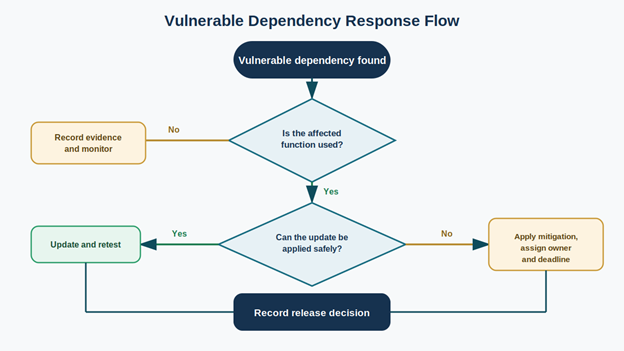
- Investigation: Upon receiving the scan alert, the developer immediately checks which version of the library is installed and evaluates whether the application code invokes the vulnerable method.
- Immediate Remediation Attempt: If an updated, secure version of the package is available, the developer applies the patch and triggers automated regression tests.
- Risk Acceptance & Mitigation: If upgrading the package immediately risks breaking core application functionality due to breaking changes, the team pivots to a mitigation strategy. They document the risk, apply compensating controls (such as input sanitization around the vulnerable component), and log an approved exception in accordance with company governance standards.
- Transparent Release: The release proceeds with the documented mitigation attached, ensuring full transparency regarding the nature of the problem and the timeline for a permanent fix.
Future Outlook: Building Resilient Delivery Pipelines
As software delivery velocity continues to accelerate with the adoption of cloud-native architectures, artificial intelligence-generated code, and continuous deployment models, traditional security gates will become completely untenable. Organizations that cling to manual, end-of-line sign-offs will find themselves perpetually choosing between security and speed.
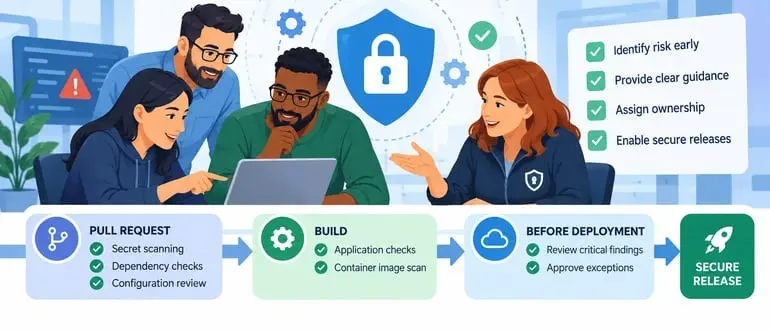
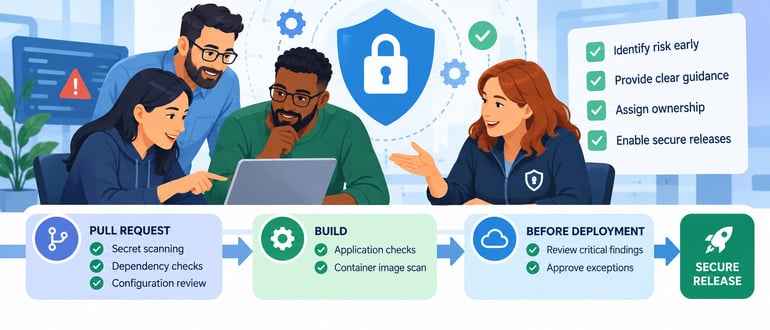
Future-proof organizations are embedding security directly into every stage of the CI/CD delivery pipeline:
| Pipeline Stage | Useful Security Check | Expected Output for the Team |
|---|---|---|
| Pull Request | Secret, dependency, and configuration checks | The affected file, clear security concern, and a practical next step. |
| Build | Application and container image security audits | Vulnerability results strictly tied to the specific version prepared for release. |
| Pre-Deployment | Review of critical findings and open exceptions | A definitive decision, assigned risk owner, and recorded justification. |
Empowering Code Ownership
Security cannot be outsourced to a dedicated compliance team. Ultimately, ownership of application risk must remain with the engineers building and operating the software. Developers understand their applications best and are uniquely positioned to make safe, contextual modifications.
When time runs out and perfection is unattainable, designated service owners must take ownership of any residual risk. Creating lightweight documentation for risk acceptances ensures that accountability is shared across development, operations, and security.
Turning Incidents into Guardrails
No security program is infallible, and incidents will occur. The true measure of a mature DevSecOps organization is how it treats those failures. When an incident occurs—such as an outage caused by overly broad service permissions—it should never result in finger-pointing.
Instead, the post-incident review must directly inform policy updates. If broad permissions caused the breach, the team codifies a specific guardrail to automatically scan for and block similar permission changes in future pull requests. Collaboration thrives when a post-mortem conversation leads directly to a process improvement.
Conclusion
The vulnerable library discovered hours before a product release remains a formidable challenge, but it does not have to be a crisis. By establishing transparent requirements, maintaining ongoing collaborative reviews, providing relevant context, and designating clear decision-makers, organizations can empower DevSecOps teams to act as enablers rather than obstacles at every stage of software delivery.
For organizations striving to achieve secure, high-velocity software delivery, the primary strategic priority must be introspection: At what point did this risk first originate, and what collaborative framework could have helped our team address it weeks earlier? Answering that question is the first step toward dismantling the final security gate for good.