








Executive Overview
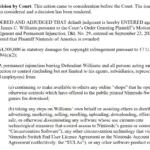
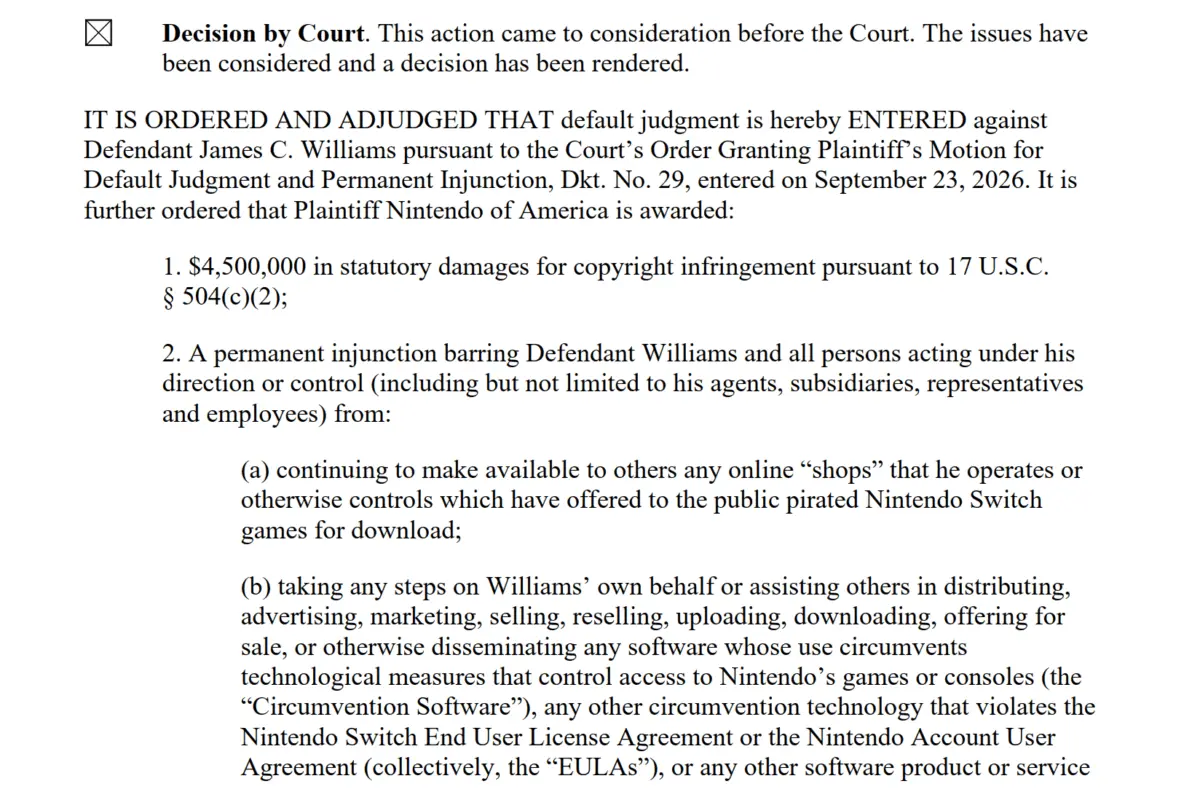
In a decisive legal victory that underscores its aggressive enforcement of intellectual property rights, Nintendo has secured a staggering $4.5 million default judgment against James C. Williams, an Arizona resident widely known in online emulation and piracy circles as ‘Archbox.’ U.S. District Judge Lauren King of the Western District of Washington issued the ruling, which brings down the hammer on a prolific operation that distributed vast libraries of pirated Nintendo Switch titles and circumvention software.
Williams, who served as a prominent moderator for the popular Reddit community r/SwitchPirates, chose not to formally respond to Nintendo’s initial June 2024 complaint—despite previously retaining legal counsel to object to a Google subpoena. Because of this strategic non-responsiveness, the federal court treated Nintendo’s extensive allegations as undisputed fact, culminating in a sweeping default judgment.
In addition to the multi-million-dollar financial penalty, the ruling establishes a permanent injunction. This legal mandate explicitly bars Williams from distributing pirated software, deploying technological circumvention tools, or encouraging others to access copyright-infringing materials. The case serves as a powerful deterrent to the broader digital underground, signaling that Nintendo’s legal war on console modification and game piracy shows no signs of slowing down.
Detailed Chronology: From Digital Subversion to Federal Courtroom
The unraveling of the ‘Archbox’ piracy ring is the culmination of a protracted digital cat-and-mouse game between Nintendo’s legal teams and online software modification communities. Understanding how this case developed requires a close examination of the timeline leading up to Judge King’s landmark ruling.
The Rise of ‘Archbox’ and r/SwitchPirates
For years, Reddit served as a primary hub for users seeking to bypass the security measures of the Nintendo Switch. Within communities like r/SwitchPirates, James C. Williams operated under the pseudonym ‘Archbox,’ ascending to a position of significant influence as a leading moderator. According to court filings, Williams leveraged this platform not merely to discuss technical modifications, but to actively operate and promote a network of unauthorized digital distribution hubs known colloquially as "pirate shops."
These operations offered public access to massive libraries of pirated Nintendo Switch games. To fund the acquisition of new titles, Williams allegedly solicited eShop gift card "donations" from community members. Once purchased, these games were decrypted and uploaded to the pirate shops for public consumption, accompanied by step-by-step instructions and technical support designed to help users install circumvention software.

The Crackdown and Legal Filing (March – June 2024)
Nintendo’s systematic enforcement efforts initially targeted Williams through administrative channels. In March 2024, the gaming giant issued a comprehensive cease-and-desist letter to Williams, demanding the immediate closure of his pirate shops and the cessation of all copyright-infringing activities. While this pressure prompted the initial offline transition of several targeted networks, Nintendo determined that administrative warnings were insufficient to fully neutralize the threat.
Consequently, in June 2024, Nintendo filed a formal federal lawsuit in the U.S. District Court for the Western District of Washington. The complaint accused Williams of widespread copyright infringement, trafficking in circumvention technologies, and orchestrating a commercial-scale piracy enterprise that caused severe, measurable harm to the company’s intellectual property ecosystem.
Default and Judicial Resolution (October 2024 – Present)
As the legal proceedings advanced, Williams took a calculated, albeit legally fatal, gamble: he completely stopped engaging with the court. Although he had previously hired counsel to contest a third-party subpoena directed at Google—attempting to shield his personal data from Nintendo’s investigators—he failed to file an answer to the core complaint.
Recognizing this procedural default, Nintendo formally moved for a default judgment in October 2024, requesting the statutory maximum for copyright infringement alongside a permanent injunction. This week, Judge Lauren King granted the motion in its entirety, cementing a decisive, uncontested victory for the multinational entertainment titan.
Supporting Context & Metrics: Analyzing the $4.5 Million Penalty
The financial damages awarded in the Nintendo v. Williams case are substantial, reflecting both the scale of the infringement and the defendant’s open defiance of copyright law. A breakdown of the metrics and judicial reasoning behind the $4.5 million figure reveals how the court arrived at its historic conclusion.
Statutory Damages Breakdown
Under U.S. copyright law, rightsholders can seek statutory damages for willful infringement, ranging up to $150,000 per infringed work. Nintendo requested this statutory maximum for exactly 30 distinct titles featured within Williams’ distribution network.
The selected catalog included powerhouse commercial anchors of the Nintendo Switch platform, such as:
- The Legend of Zelda: Tears of the Kingdom
- Mario Kart 8 Deluxe
- Super Smash Bros. Ultimate
When multiplied across the 30 specified titles, the calculation yielded the exact $4.5 million figure requested by Nintendo’s legal counsel.
Justifying the Maximum Award
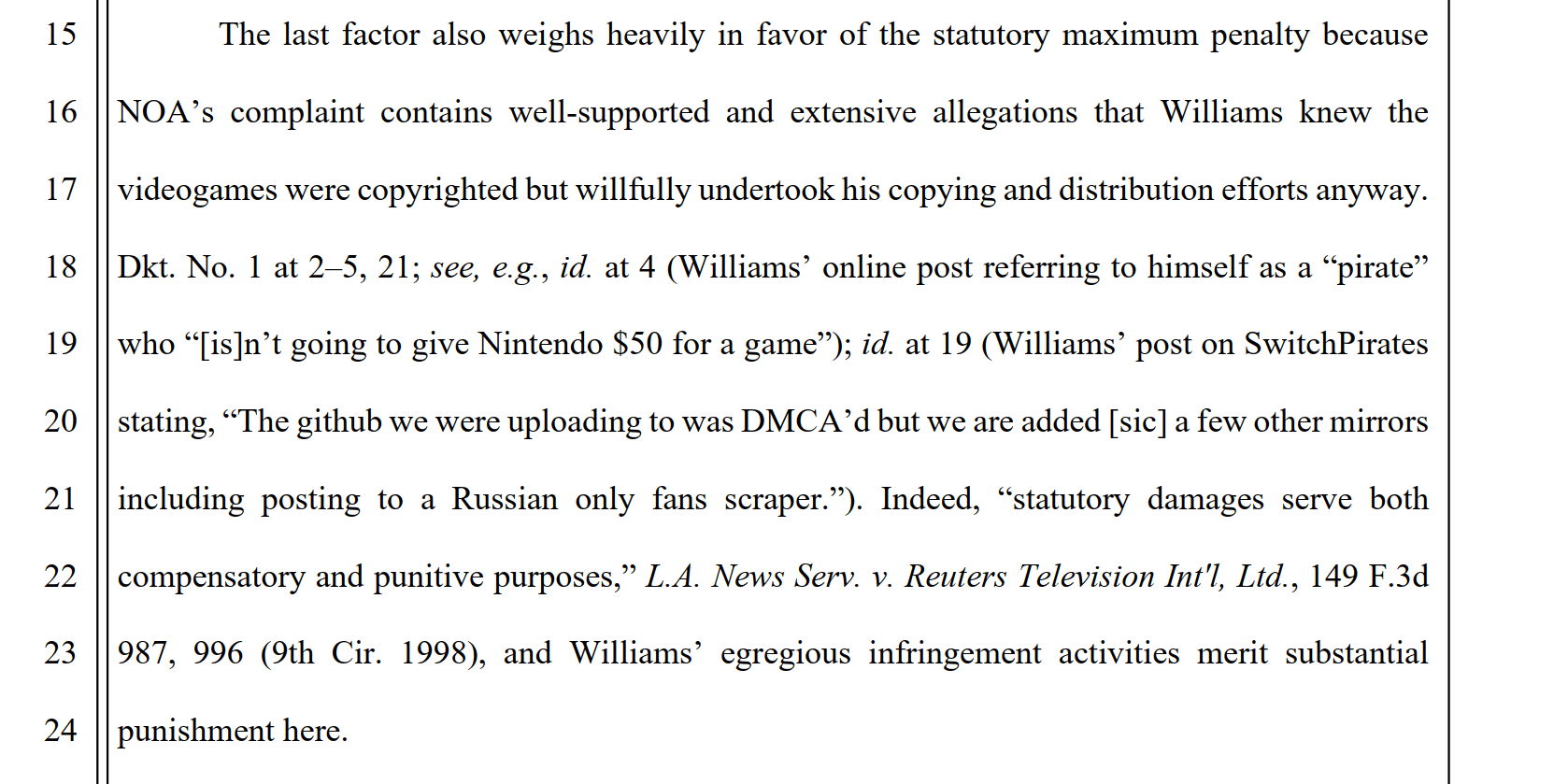
Judge King’s written opinion meticulously justified the imposition of the statutory maximum, pointing to clear evidence of willful misconduct. During the investigation, Nintendo’s legal team unearthed and submitted numerous public forum posts authored by Williams that demonstrated a premeditated, unapologetic disregard for intellectual property protections.
In one particularly damning excerpt cited directly in the court order, Williams explicitly self-identified as a "pirate," bluntly stating that he was "n’t going to give Nintendo $50 for a game." The court noted that because retail prices for major Switch titles hover around the $50 mark, cumulative lost sales resulting from free, unauthorized distribution easily run into the hundreds of thousands of dollars, rendering Nintendo’s $4.5 million request a grounded and realistic estimate of aggregate harm rather than an arbitrary penalty.
Furthermore, Judge King highlighted Nintendo’s strategic restraint as a factor supporting the award. As a "gesture of reasonableness," Nintendo declined to pursue additional damages under the Digital Millennium Copyright Act (DMCA) or seek reimbursement for mounting attorney’s fees. The court viewed this selective enforcement favorably, viewing the $4.5 million award as a necessary, proportionate punishment for "egregious infringement activities."
Official Statements and Judicial Injunctions
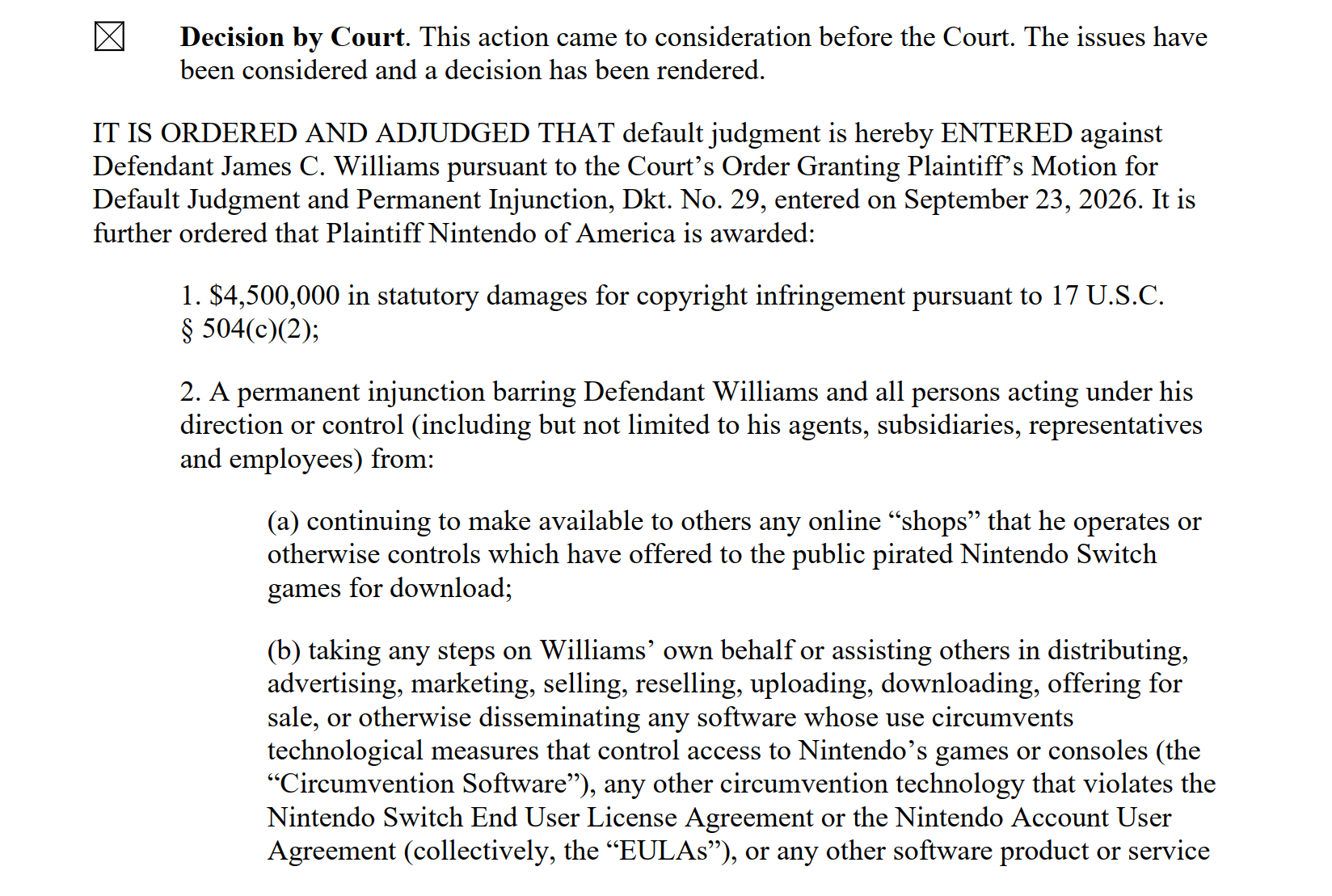
The scope of Judge King’s final order extends far beyond a purely financial judgment. The accompanying permanent injunction serves as a digital death sentence for Williams’ network of accounts and platforms.
The Scope of the Permanent Injunction
The federal injunction categorically prohibits Williams from engaging in any future distribution of pirated Nintendo software—restricted neither solely to the 30 named titles nor even to games currently in existence. It covers:
- The distribution, marketing, or sharing of any unauthorized Nintendo game titles.
- The proliferation of software, hardware modifications, or digital tools designed to circumvent Nintendo’s proprietary console and game encryption protections.
- Any public outreach, forum moderation, or community encouragement intended to direct users toward pirated software or circumvention mechanisms.
To enforce these restrictions, the court order mandates the immediate disablement of all pirate shops and digital distribution vectors operated by the defendant. Specifically, the injunction targets user accounts across a broad spectrum of digital communication platforms, including Reddit, Instagram, X (formerly Twitter), TikTok, Discord, and Telegram.
The Reality of Enforcement
In practical terms, the enforcement of these digital bans has largely been rendered academic by prior events. The primary Reddit account associated with the ‘Archbox’ persona—u/archbox—has already been self-deleted, and the associated pirate shops were largely driven offline following the receipt of Nintendo’s March 2024 cease-and-desist letter.
However, legal experts note that while disabling accounts is straightforward, recovering the $4.5 million in financial damages from an unresponsive, defendant-side party presents a formidable logistical hurdle. Because Williams failed to mount a defense, the legal claims were never subjected to adversarial testing in court, leaving questions regarding his current liquid assets and ability to pay largely unanswered.
Future Outlook: Nintendo’s Broader War on Piracy
The Archbox ruling does not exist in a vacuum; it represents one front in an aggressive, synchronized campaign by Nintendo to safeguard its hardware and software ecosystems from widespread modification and illicit distribution.
Parallels with the ‘Modded Hardware’ Case
The timing and execution of Nintendo’s legal strategy are vividly illustrated by looking at a parallel lawsuit filed on the very same day in June 2024. In that action, Nintendo targeted a rival operation known as "Modded Hardware." Unlike the Archbox case, which concluded via default judgment due to total unresponsiveness, the Modded Hardware litigation ended in a negotiated settlement late last year, with its operator agreeing to a $2 million judgment.
Together, these twin legal actions establish a clear blueprint for Nintendo’s litigation strategy:
- Administrative Warnings: Deploy swift, forceful cease-and-desist letters to disrupt operations at their inception.
- Federal Litigation: File multi-pronged federal lawsuits alleging willful copyright infringement and DMCA circumvention violations.
- Severe Financial Retribution: Pursue maximum statutory damages to create a chilling financial deterrent for other prospective software pirates.
- Comprehensive Injunctions: Demand systemic shutdowns of social media presences, community hubs, and communication channels used to facilitate piracy.
The Broader Industry Impact
As the Nintendo Switch approaches the twilight of its commercial lifecycle while remaining a primary target for emulation and homebrew communities, Nintendo’s legal posture sends an unmistakable message to the wider gaming underground. The message to moderators, repository hosts, and digital distributors is clear: operating within the grey areas of online emulation communities carries existential legal and financial risks.
While piracy networks will undoubtedly attempt to adapt, decentralized communities now operate under the shadow of a $4.5 million federal precedent. For James C. Williams, the moniker ‘Archbox’ has transitioned from a prominent symbol of digital subversion into a cautionary tale of the severe liabilities that accompany large-scale intellectual property infringement in the modern digital age.