Executive Overview
Long before the private aerospace sector captured the public’s imagination or the internet made scientific data instantly accessible, the intersection of popular entertainment and cutting-edge science occurred on Sunday night television. On September 24, 1961—precisely 65 years ago—The Walt Disney Company introduced a character who would bridge the gap between academic rigor and family-friendly animation: Professor Ludwig Von Drake.
Conceived specifically for the small screen, this brilliant, eccentric, and perpetually lecturing uncle of Donald Duck was more than just a comedic addition to the expanding Disney menagerie. He was a pedagogical tool, a cultural phenomenon, and, crucially, a caricature born directly from the minds and mannerisms of the early Space Age’s most prominent rocket scientists and aerospace visionaries.
As the world stood on the precipice of the lunar landing, hurtling forward through the Cold War space race, Walt Disney utilized his television platform to demystify complex scientific principles for millions of American households. Through episodes like the celebrated 1963 feature Inside Outer Space, Von Drake became the animated ambassador of the cosmos. By blending educational documentary footage, visionary forecasts, and recycled animation from pioneering 1950s space specials, Disney’s creative engine captured the profound optimism—and the frantic pace—of a civilization racing toward the stars.
Detailed Chronology: From Concept to Cosmos
To understand the genesis of Professor Ludwig Von Drake, one must trace the timeline of Disney’s television ambitions and the shifting cultural landscape of the mid-20th century.
The Dawn of Disney Television (1954–1960)
When Walt Disney launched his weekly anthology series on ABC in 1954—initially titled Disneyland before evolving through various monikers—he recognized television’s unprecedented power to shape public discourse. While the park of the same name was taking physical shape in Anaheim, California, the television screen served as an ideological testing ground for what Disney called "Tomorrowland."
During the mid-to-late 1950s, Disney partnered with legendary aerospace figures, including German-American rocket pioneer Wernher von Braun, aviation medicine specialist Dr. Heinz Haber, and science writer Willy Ley. Together, they produced a celebrated trilogy of television specials:
- Man in Space (1955)
- Man and the Moon (1955)
- Mars and Beyond (1954–1957)
These programs were not mere cartoons; they were high-budget, highly accurate depictions of the technological milestones required to leave Earth’s atmosphere. They were utilized by government agencies, shown in classrooms, and viewed by millions of awestruck citizens.
The Birth of Von Drake (September 24, 1961)
By the dawn of the 1960s, Disney’s anthology series had migrated to NBC and was retitled Walt Disney’s Wonderful World of Color. To fully harness the visual capabilities of color television—and to introduce a new narrative device capable of carrying dense educational content—the studio needed a fresh character.
On September 24, 1961, Ludwig Von Drake made his grand debut. Described by Disney himself as "the outstanding genius of the century," Von Drake was a self-professed scientist, lecturer, psychologist, and world traveler. With a shock of unruly gray hair, an accent that hinted at a vague Central European pedigree, and a penchant for launching into fast-paced, multi-subject monologues, the character instantly resonated with viewers. He was designed to make complex topics approachable, breaking down everything from the physics of color transmission to the history of aviation.
Inside Outer Space and the Peak of Edutainment (February 10, 1963)
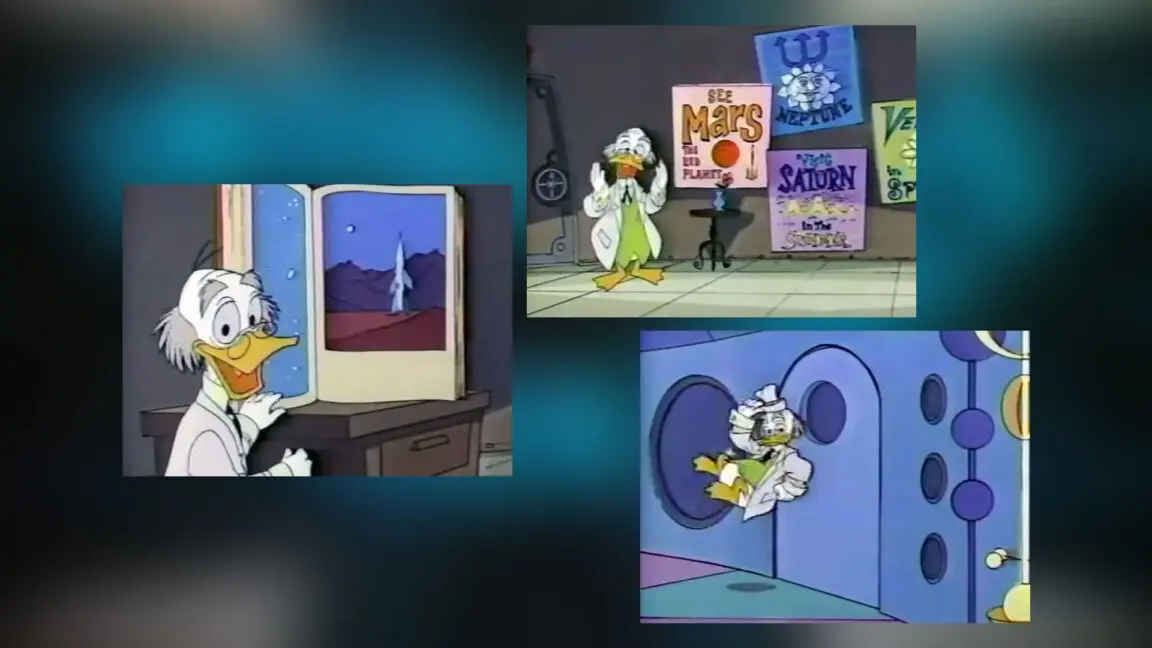
Having tackled terrestrial subjects, Von Drake inevitably set his sights upward. On February 10, 1963, Disney broadcasted the episode Inside Outer Space. The segment began with the professor holding a self-authored guidebook, quipping about the infinite mysteries of the cosmos and warning viewers to purchase copies before rapid advancements rendered them obsolete.
Crucially, this episode capitalized on the immense public appetite for space exploration in the wake of Yuri Gagarin’s historic orbital flight and Alan Shepard’s suborbital journey. Rather than starting from scratch, Disney’s production team ingeniously repurposed and updated stunning animation from the earlier Tomorrowland specials Man and the Moon, Man in Space, and Mars and Beyond—episodes whose foundations had been laid mere months after the October 4, 1957, launch of Sputnik 1.
Supporting Context & Metrics: The Real-World Rocket Scientists Behind the Duck
While Ludwig Von Drake was animated with webbed feet and a feathered bill, his behavioral DNA was lifted straight from the drafting tables of Huntsville, Alabama, and the lecture halls of post-war American research institutions.
The Wernher von Braun Connection
The primary archetype for Von Drake’s intellectual fervor was Dr. Wernher von Braun. As the technical director of the Army Ballistic Missile Agency (and later a pivotal figure at NASA’s Marshall Space Flight Center), von Braun was the charismatic public face of American rocket development.
Von Braun possessed several traits that found their way into the caricature of Ludwig Von Drake:
- The Accent and Demeanor: A distinct, cultured European accent coupled with an absolute, unwavering certainty regarding technical matters.
- The Multidisciplinary Approach: Much like Von Drake, who claimed expertise in psychology, physics, and world travel, von Braun was frequently called upon to speak on a vast array of subjects extending far beyond rocketry, including medicine, sociology, and geopolitical strategy.
- The Visual Presentation: When von Braun appeared on television screens—most notably alongside Disney, Haber, and Ley—he frequently used props, chalkboards, and elaborate models (such as the famous "bottle suit" for space survival) to explain orbital mechanics to laymen.
The Educational Impact Metrics
The collaboration between Disney and the early Space Age scientific community yielded staggering cultural metrics:
- Audience Reach: During the early 1960s, Walt Disney’s Wonderful World of Color regularly commanded tens of millions of viewers on Sunday nights, representing a dominant share of the American television viewing audience.
- Classroom Integration: Educational 16mm prints of the Tomorrowland space specials and Von Drake segments were distributed to thousands of schools across the United States, directly inspiring a generation of engineers who would later build the Apollo guidance systems.
- Sputnik Catalyst: The educational push intensified exponentially following the October 1957 launch of Sputnik. Within five years, Disney had institutionalized space literacy as a form of popular entertainment, ensuring that terms like "escape velocity," "weightlessness," and "orbital insertion" entered the vernacular of American children.
Official Statements and Archival Insights
The synergy between the entertainment industry and the space program was not accidental; it was a deliberate, state-adjacent campaign to foster public support for the nascent space race.
In archival documents preserved by the Walt Disney Archives and NASA history collections, executives noted the deliberate strategy of using humor to alleviate public anxiety regarding atomic energy and space flight.
"We are living in an age of incredible scientific acceleration," Walt Disney remarked during the development of the Tomorrowland television block. "The average citizen is asked to comprehend dimensions and forces that stagger the imagination. If we can use the warmth of animation and the charm of character comedy to open the door to these concepts, we are performing a vital service for the future."
Similarly, rocket scientists of the era recognized the immense value of Disney’s platform. In memoirs and interviews preserved by the Smithsonian National Air and Space Museum, colleagues of Wernher von Braun noted that the German scientist viewed the Disney television specials not merely as entertainment, but as an essential propaganda tool to secure public funding and congressional goodwill for NASA’s sprawling ambitions.
When Von Drake joked in Inside Outer Space that viewers ought to buy his guidebook before technological progress made it obsolete, he was inadvertently echoing the frantic, breakneck reality of the early 1960s. In an era where rocket designs changed from month to month and lunar module concepts evolved overnight, today’s cutting-edge theory was literally tomorrow’s historical footnote.
Future Outlook: The Enduring Legacy of Animated Science Communication
Sixty-five years after Ludwig Von Drake first adjusted his spectacles on television, the landscape of science communication has undergone a radical transformation. Yet, the blueprint established by Disney, von Braun, and their contemporaries remains strikingly relevant.
Today, as humanity stands on the threshold of returning to the Moon through the Artemis program and looks toward eventual crewed missions to Mars, the challenge of explaining complex astrodynamics to the general public persists. Modern science communicators—from digital content creators to aerospace engineers utilizing social media—owe an implicit debt to the methodology pioneered by Ludwig Von Drake: take the intimidating expanse of the cosmos, ground it in accessible narrative structures, and deliver it with enthusiasm and charm.
Professor Von Drake may have playfully worried about the depreciation of his fictional guidebook, but the principles he espoused—curiosity, interdisciplinary study, and an unshakeable belief in human ingenuity—have aged remarkably well. As we gaze into the "inside" of outer space today, the eccentric duck with the German accent remains a timeless reminder that the journey to the stars begins not just with powerful rockets, but with the imagination of the human mind.