Executive Overview
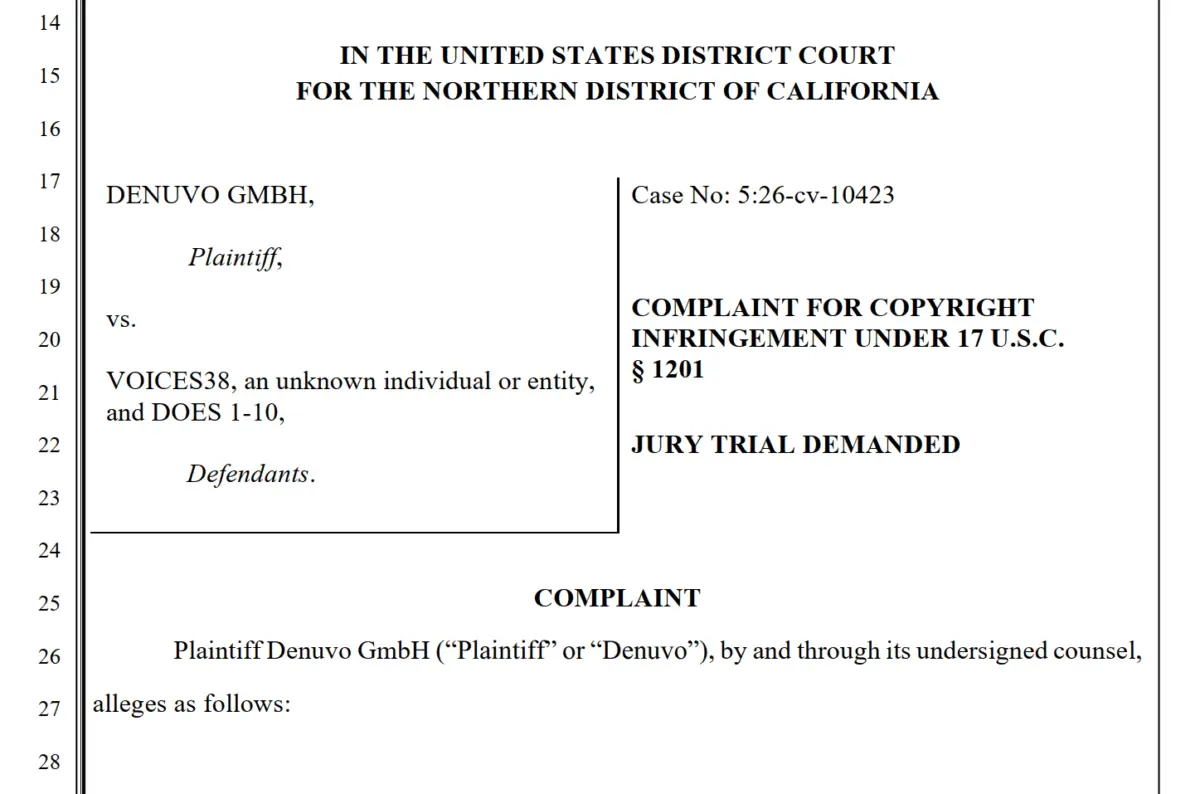
In an aggressive escalation of the ongoing war against video game piracy, Austrian anti-tamper software provider Denuvo GmbH has taken unprecedented legal action. Filing a formal complaint in the U.S. District Court for the Northern District of California, Denuvo has targeted an anonymous, high-profile software engineer operating under the moniker “voices38.” The lawsuit marks a historic milestone in the digital rights management (DRM) industry, representing the first time Denuvo has directly initiated legal proceedings against a video game cracker in a United States court.
The core of the dispute revolves around the circumvention of Denuvo’s robust Anti-Tamper technology across at least 26 major video game titles. Rather than pursuing traditional copyright infringement claims—an avenue closed to them because Denuvo does not own the underlying intellectual property of the games it protects—the company has invoked the anti-circumvention provisions of the Digital Millennium Copyright Act (DMCA). Denuvo argues that the defendant’s actions directly undermine its proprietary business model, which relies on safeguarding multi-million-dollar software assets for publishing giants such as Electronic Arts, Ubisoft, Capcom, and Sony.
While the legal filing currently targets an "unknown individual or entity," Denuvo’s investigators have laid out a digital trail featuring Reddit accounts, Discord identifiers, and connected Steam profiles. The company intends to leverage the subpoena powers of the federal court to unmask the real-world identity behind the handle. Despite the looming threat of sweeping injunctions and substantial financial damages, the elusive cracker has remained defiant, offering a cool dismissal of the legal thunderbolt across public forums: "All is fine. Everything will continue as normal."
Detailed Chronology of the Conflict
The Rise of Old-School Cracks
The digital landscape for high-end PC gaming security has faced unprecedented turbulence throughout the year. Earlier in 2024, a wave of sophisticated hypervisor-based bypasses emerged, enabling underground piracy groups to strip Denuvo protection from major releases on their very launch days. While Irdeto, Denuvo’s parent company, scrambled to engineer countermeasures against these hypervisor exploits, a separate, more insidious threat began taking shape in the shadows of online forums.

An anonymous developer known as “voices38” chose a different path—one that appealed directly to a broad segment of the gaming underground. Eschewing the complex, invasive system-level modifications required by hypervisor bypasses, voices38 focused on traditional, old-school reverse engineering. By directly patching Denuvo’s internal telemetry and verification checks within game executables, the cracker manufactured traditional standalone cracks.
These traditional patches possessed a massive advantage over their hypervisor counterparts: they did not force end-users to disable vital Windows security features, such as Virtualization-Based Security (VBS) or Kernel DMA Protection. Consequently, consumer demand skyrocketed. Capitalizing on this momentum, voices38 dramatically accelerated output over the summer months. The tipping point for corporate patience arrived earlier this month when the cracker dropped an astonishing five Denuvo-protected releases within a single twenty-four-hour window. For Denuvo headquarters, the sheer volume and audacity of these releases necessitated an immediate and public response.
The Federal Filing in California
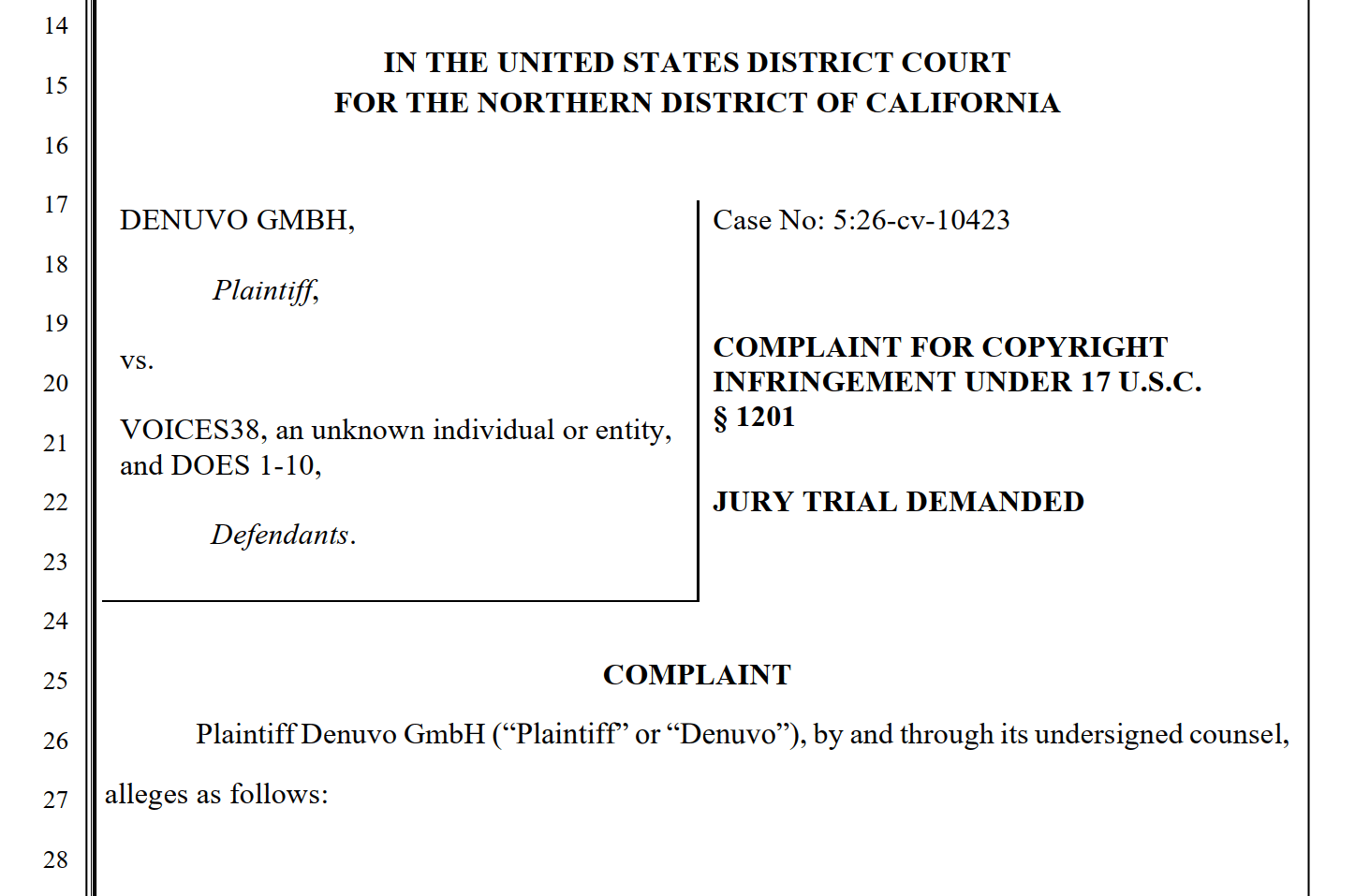
On Monday, legal representatives for Denuvo GmbH officially filed their complaint in the U.S. District Court for the Northern District of California. The document details a systematic campaign by voices38 to systematically strip away the Anti-Tamper barriers protecting a catalog of 26 prominent titles.
The lawsuit highlights a diverse array of targeted software, bridging legacy sports titles like FIFA 20 and PES 2020 with massive contemporary blockbusters. Among the listed games are critical and commercial juggernauts such as Hogwarts Legacy, Black Myth: Wukong, Resident Evil Requiem, Doom: The Dark Ages, Persona 3 Reload, and Star Wars Outlaws.
Denuvo’s legal team characterized the defendant in stark terms within the court filings:
"Defendant is a computer hacker who is focused on reverse engineering, hacking, or ‘cracking’ video games employing Denuvo’s Anti-Tamper product… Defendant has bypassed DRM restrictions in copyrighted works, removing protections that allow copyright owners to restrict who may access their works, and allowing for pirated versions of those copyrighted works."
Supporting Context & Metrics: The DMCA and the Business of Protection
The Legal Framework: Anti-Circumvention vs. Copyright
One of the most fascinating aspects of Denuvo’s lawsuit is the legal mechanism chosen to prosecute the hacker. Because Denuvo GmbH provides third-party security middleware rather than developing the games themselves, the company holds no direct copyrights to the interactive entertainment it protects. Therefore, traditional copyright infringement lawsuits—the standard weapon in a publisher’s legal arsenal—were unavailable to them.
Instead, Denuvo’s strategy relies entirely on Section 1201 of the Digital Millennium Copyright Act (DMCA). The anti-circumvention provisions of the DMCA prohibit two distinct actions:
- Gaining unauthorized access to a copyrighted work by bypassing a technological measure (a "digital lock") that effectively controls access to that work.
- Manufacturing, distributing, or offering technologies, products, or services that are primarily designed to circumvent access controls.
Crucially, the DMCA grants standing not only to the copyright holder but to any person or entity injured by a violation of these provisions. Denuvo argues that its entire corporate valuation and business viability rest on its reputation as an impenetrable fortress for digital assets. If software pirates can consistently and publicly dismantle its Anti-Tamper measures without legal friction, publishers will lose faith in the product, dealing a catastrophic blow to Denuvo’s commercial operations.
The Target Catalog
The scope of the lawsuit is breathtaking, encompassing high-profile titles across multiple generations of hardware and a diverse array of global publishers. The official complaint lists the following 26 games and their respective rightsholders:
- Need for Speed Heat (Electronic Arts)
- EA Sports FIFA 20 (Electronic Arts)
- Star Wars: Squadrons (Electronic Arts)
- Need for Speed: Hot Pursuit Remastered (Electronic Arts)
- EA Sports FIFA 21 (Electronic Arts)
- Hi-Fi Rush (Bethesda)
- F1 2021 (Electronic Arts)
- Dead Space Remastered (Electronic Arts)
- Doom: The Dark Ages (Bethesda)
- Mafia: The Old Country (2K Games)
- LEGO Batman: Legacy of the Dark Knight (WB Games)
- Hogwarts Legacy (WB Games)
- Total War: Three Kingdoms (SEGA)
- Starlink: Battle for Atlas (Ubisoft)
- Shining Resonance Refrain (SEGA)
- PES 2020 (Konami)
- Shin Megami Tensei III Nocturne HD Remaster (SEGA)
- Scott Pilgrim vs. The World (Ubisoft)
- Anno 1800 (Ubisoft)
- Sonic Frontiers (SEGA)
- Assassin’s Creed Mirage (Ubisoft)
- Pragmata (Capcom)
- Resident Evil Requiem (Capcom)
- Black Myth Wukong (Game Science)
- Stellar Blade (Sony)
- 007 First Light (IO Interactive)
Official Statements and Digital Footprints
Unmasking the Defendant: The Digital Trail
At the heart of the litigation lies a frustrating ambiguity: the true identity of voices38 remains unknown. The federal complaint officially names the defendant as "an unknown individual or entity," accompanied by ten placeholder "Doe" defendants to account for potential accomplices or distributors in the distribution chain.
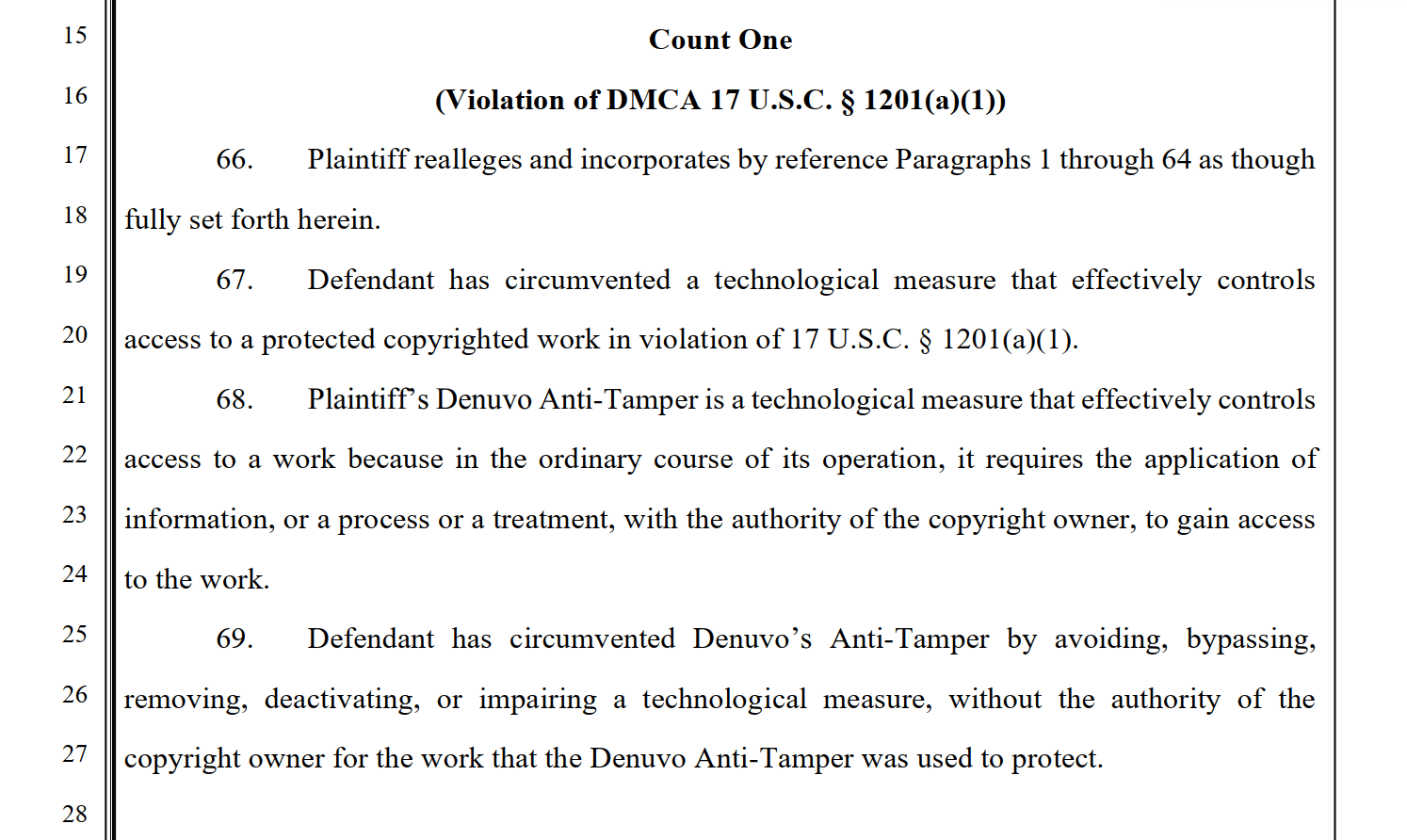
However, Denuvo’s legal and technical teams have not arrived empty-handed. The court filing outlines a collection of digital breadcrumbs compiled during months of investigation. Included in the documentation are:
- A specific Discord user identifier utilized within community release channels.
- The primary Reddit account (
voices38) used to announce and circulate crack releases. - A portfolio of seven distinct Steam profiles believed to be owned or controlled by the defendant.
These Steam profiles represent the linchpin of Denuvo’s strategy to unmask the hacker. To reverse-engineer and crack a modern Denuvo-protected game, the protected executable and its licensing certificates must first be legally acquired. Because digital storefronts like Steam tie transactions to real-world financial instruments, billing addresses, and IP connection logs, Denuvo plans to use the federal court’s subpoena powers. Once formal discovery opens, Denuvo will compel Valve, Reddit, and Discord to surrender internal user data, payment logs, and communication metadata associated with these profiles.
The Hacker’s Defiant Response
Within hours of the lawsuit breaking across cybersecurity and gaming news outlets, voices38 broke their silence. Posting on Reddit—the very platform cited in the legal filings as a primary dissemination vector—the cracker addressed the international legal pressure with characteristic nonchalance:
"All is fine. Everything will continue as normal."
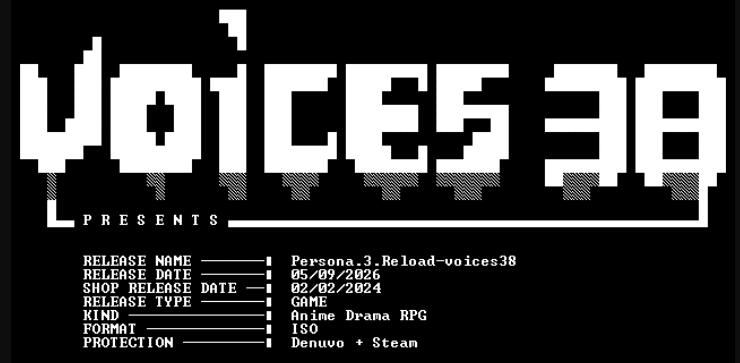
Accompanying this brief statement was the continued release of new cracking projects, proving that the threat of federal litigation has done little to immediately slow down the pace of software releases. Projects such as Persona 3 Reload and Star Wars Outlaws have continued to receive the attention of the underground workshop, signaling that voices38 views the lawsuit as an occupational hazard rather than a fatal blow.
Future Outlook and Industry Implications
What Happens Next in Court?
As the legal battle enters its formative stages, several critical milestones will determine the trajectory of the case:
- Subpoena Issuance and Compliance: The immediate test will be whether tech giants like Valve, Reddit, and Discord are ordered by the court to hand over account telemetry, and whether that data points to a real person hiding behind VPNs and obfuscated payment methods.
- Default Judgments and Injunctions: Should voices38 choose to ignore the U.S. court summons—a common tactic for pseudonymous international hackers—Denuvo could secure a default judgment. Even without unmasking the individual, a sweeping permanent injunction from a federal judge would make it vastly easier for Denuvo to issue copyright takedowns, scrub download links from indexers, and shut down community hubs dedicated to the distribution of these specific cracks.
- Deterrence Factor: For Denuvo, the lawsuit serves a dual purpose. Beyond any potential statutory damages or legal remedies, the mere existence of a federal lawsuit acts as a psychological deterrent. By proving that the company is willing and legally equipped to hunt down crackers across international borders, Denuvo hopes to intimidate other hobbyists and software engineers considering entering the reverse-engineering scene.
The Broader War on DRM
The confrontation between Denuvo and voices38 highlights the permanent, high-stakes arms race at the heart of modern PC gaming. As publishers demand increasingly draconian measures to protect launch-window sales figures, the underground engineering community responds with increasingly sophisticated methods of software preservation and circumvention.
Whether Denuvo’s historic foray into American federal court succeeds in unmasking voices38 or simply drives the underground further into encrypted obscurity, the legal precedent being set in Northern California will reverberate across the software protection industry for years to come. For now, the digital chess match continues: one side wielding the full weight of statutory law, and the other armed with disassemblers, debuggers, and a defiant refusal to yield.