







Executive Overview
In the high-stakes, infrastructure-heavy worlds of oil, gas, and petrochemical processing, the backbone of operations often comes down to a deceptively simple component: the bolt. Specifically, millions of heavy-duty steel fasteners known as bolted flange joints seal the sprawling networks of pipe systems that snake across North America and beyond. For decades, the arduous task of loosening and tightening these critical components has fallen entirely on human pipefitters—skilled tradespeople who endure grueling hours, punishing physical labor, and repetitive strain injuries in harsh industrial environments.
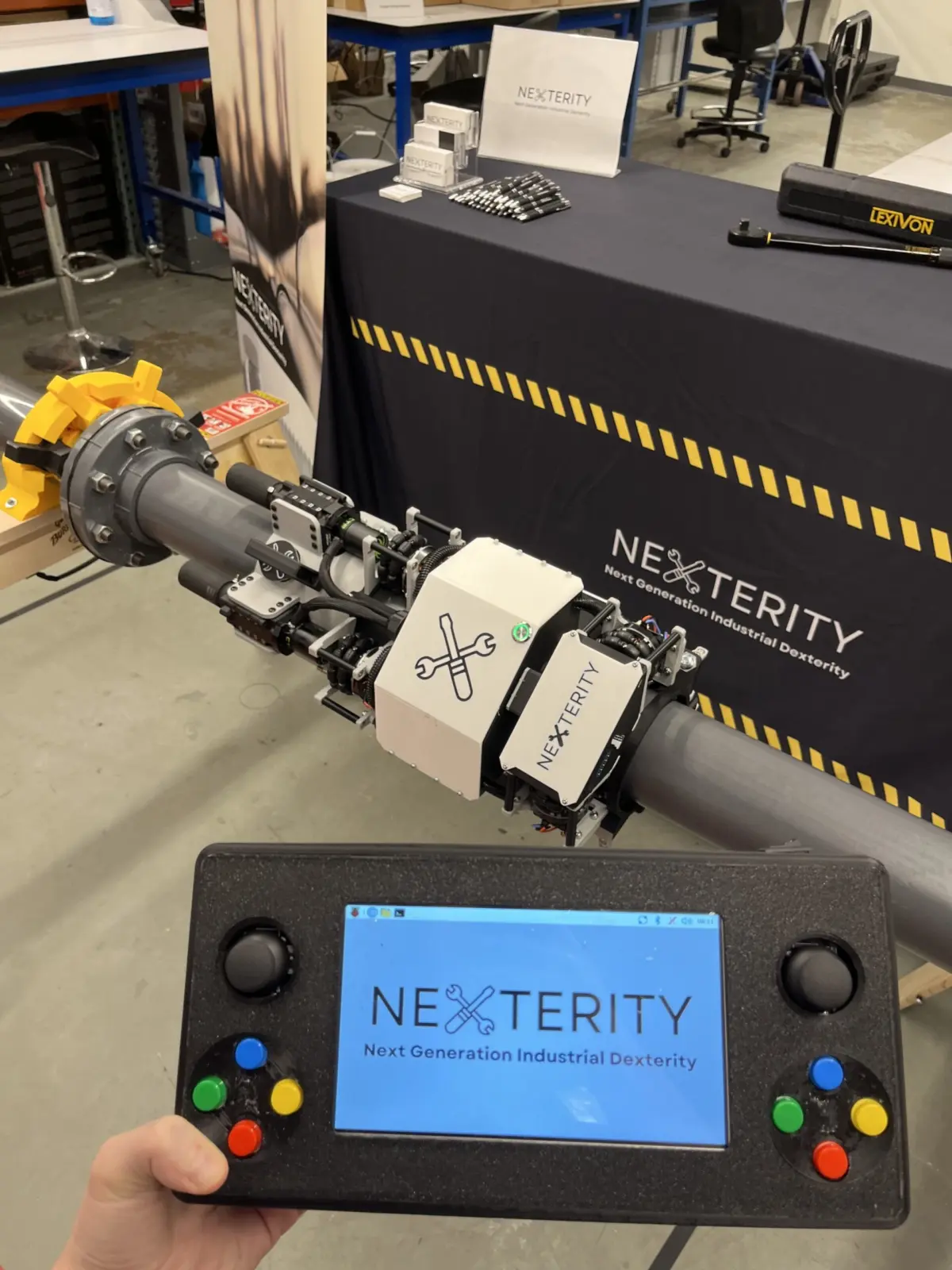
Enter Lindsey Elliott, a former ExxonMobil engineer and planner who has spent years analyzing the inefficiencies plaguing industrial infrastructure. Recognizing a convergence of acute labor shortages, sagging productivity metrics, and severe physical toll on workers, Elliott founded Nexterity. As a startup selected for the prestigious Startup Battlefield 200 at TechCrunch Disrupt, Nexterity is tackling an industry-wide blind spot with a straightforward yet high-impact solution: a remote-controlled, battery-powered robotics system designed to handle the heavy lifting of flange maintenance.
By automating the repetitive, high-torque manual labor traditionally performed by pipefitters, Nexterity’s portable, two-piece robotic units promise to redefine safety, ergonomics, and efficiency across multiple industrial sectors. Operating under a flexible "Equipment-as-a-Service" rental model, the startup aims to bring modernization to a blue-collar trade that has changed very little over the past century. As industrial facilities face mounting pressure to optimize operations while navigating a shrinking skilled labor pool, innovations like Nexterity’s bolt-handling robot represent a fundamental shift in how heavy industry approaches maintenance, safety, and technological integration.
Detailed Chronology: From ExxonMobil Planning to the Startup Battlefield
The Genesis of an Idea: Recognizing the Bottleneck
The journey toward Nexterity began long before the company had a name or a prototype. During her tenure as an engineer and planner at ExxonMobil, Lindsey Elliott spent countless hours scrutinizing the operational workflows that keep petrochemical plants running. While many engineers focus on chemical reactions, fluid dynamics, or large-scale machinery, Elliott found her attention drawn to the micro-level mechanics of the facilities: the piping infrastructure and the hardware holding it together.
Day in and day out, Elliott observed the immense physical exertion required to maintain basic piping systems. Every time a section of pipe needed inspection, modification, or repair, maintenance crews had to manually unbolt and re-bolt heavy flanges, often working in cramped spaces, extreme weather, and exhausting 12-hour shifts.
Immersing in the "Torque Dork" Community
To truly understand the nuances of the problem, Elliott embedded herself within the specialized communities dedicated to industrial fastening. Her immersion culminated at the Annual Bolting Symposium—an event featuring the 13th installment where she fondly recalls playing "Bolting Bingo" alongside self-proclaimed "torque dorks."
Beyond the camaraderie, these gatherings provided critical market intelligence. Through extensive conversations with attendees, industry veterans, and members of the Pressure Vessels & Piping Division of the American Society of Mechanical Engineers (ASME), Elliott uncovered a staggering statistical insight: approximately 80% of all industrial piping infrastructure falls within a diameter range of two to eight inches (technically designated as NPS2 to NPS8).
This discovery was a revelation. High standardization and vast repeatability across millions of linear feet of industrial piping made this exact segment a prime target for automation.
Founding Nexterity and Entering TechCrunch Disrupt
Armed with data, engineering expertise, and firsthand accounts of low productivity from pipefitters across the United States and Canada, Elliott founded Nexterity. She realized that the traditional approach—relying entirely on human muscle to break stubborn, corroded, or torqued bolts—was unsustainable in an era defined by labor shortages and burnout.
The company’s breakthrough prototype quickly caught the attention of the tech and venture capital ecosystems, earning Nexterity a coveted spot among the Startup Battlefield 200 participants at TechCrunch Disrupt. This milestone propelled the startup from an under-the-radar industrial engineering concept into the national spotlight, validating the massive commercial potential of merging heavy industrial maintenance with intelligent robotics.
Supporting Context & Metrics: The Labor Crisis and Market Scope
The Human Toll of Traditional Pipefitting
To appreciate the disruptive value of Nexterity’s technology, one must examine the realities of modern pipefitting. North American craft labor productivity has faced structural headwinds for decades. The work is physically punishing, requiring workers to apply immense leverage using heavy pneumatic or manual torque multipliers, often in awkward ergonomic postures.
"Those people get really tired when they’re asked to work 12 hours a day for three months in a row," Elliott explained in an interview. The combination of grueling shift work, repetitive strain injuries, and an aging workforce has created a severe labor deficit. Younger generations are increasingly reluctant to enter trades characterized by high injury risks and extreme physical exhaustion, leaving industrial facilities scrambling to maintain staffing levels.
The Staggering Scale of the Target Market
While casual observers rarely give a second thought to the miles of industrial piping crisscrossing the landscape, the market for flange maintenance spans virtually every heavy industrial sector on earth.
"I think it would shock a lot of people just how big this market is," Elliott noted. While oil, gas, and petrochemical refineries are the most obvious beneficiaries, the underlying infrastructure is universally shared. Water treatment plants, municipal wastewater facilities, food and beverage manufacturing operations, mining sites, nuclear power stations, and emerging green energy production plants all rely on bolted piping systems to transport fluids and gases.
Because standard pipe dimensions (NPS2 to NPS8) dominate these diverse industries, a modular robotic solution can scale horizontally across vastly different industrial verticals without requiring customized redesigns for every new application.
Inside the Technology: Engineering for Portability and Flexibility
Nexterity’s hardware solution was designed with operational realities in mind. Rather than developing a massive, cumbersome industrial gantry or a stationary machine, the engineering team focused on modularity and field-readiness.
- Dual-Piece Modular Architecture: The robot consists of two primary interlocking pieces designed to snap securely around a standard pipe section.
- Autonomous Mobility: Once clamped into position, the battery-powered unit can slide smoothly along the exterior of the pipe to target specific flange joints.
- Multi-Bolt Operation: The system is engineered to rapidly loosen and tighten up to four bolts simultaneously, drastically cutting down the time required to break down or seal a joint.
- Pelican-Case Portability: Despite its robust capabilities, the entire assembly is compact and lightweight enough to fit neatly inside a standard Pelican case, allowing a single worker to easily transport, deploy, and operate the equipment in remote or confined spaces.
The Equipment-as-a-Service Business Model
Recognizing that industrial plants are often hesitant to invest heavily in capital-intensive hardware that sits idle between maintenance turnarounds, Nexterity structured its business model around flexibility. By treating the robots like rental construction equipment, the startup lowers the barrier to entry for plant operators. Facilities can scale their robotic fleet up or down based on immediate project demands, turnaround schedules, and maintenance cycles.
Official Statements and Industry Insights
The philosophy driving Nexterity centers on a memorable internal mantra coined by its founder: "More dork, less torque." This lighthearted phrase encapsulates a serious mission: replacing brute physical force with precision engineering and intellectual automation.
Reflecting on her interactions with industry veterans, Lindsey Elliott emphasizes that automation in the trades should never be viewed as a threat to workers, but rather as an essential relief valve.
"I’ve talked to pipefitters across the U.S. across Canada, and just repeatedly have been told North American pipefitting productivity is notoriously low. What I learned from the people, the torque dorks per se, is that 80% of our pipes are between two to eight inches in diameter… And so when you have that much repeatability, you have a fantastic candidate for automation."
By removing workers from the direct line of fire during high-stress bolting operations, Nexterity addresses both sides of the industrial equation: safeguarding human capital against debilitating injuries while simultaneously multiplying operational output per shift.
Future Outlook: The Road Ahead for Industrial Robotics
As Nexterity transitions from its initial prototype and Startup Battlefield exposure toward commercial deployment, the company stands at the vanguard of a broader industrial transformation. The integration of robotics into blue-collar trades is no longer a futuristic sci-fi concept; it is becoming an economic and operational necessity.
Scaling Commercial Pilots and Fleet Expansion
The immediate horizon for Nexterity involves expanding field trials across diverse industrial sectors. While initial validation centered on oil, gas, and petrochemical applications, upcoming pilots in water treatment and sustainable manufacturing will test the true cross-industry versatility of the hardware. Refining the robot’s software interface, improving battery endurance, and scaling manufacturing partnerships will be critical milestones for the startup over the coming 12 to 24 months.
Transforming the Future of Industrial Labor
Looking further ahead, startups like Nexterity offer a glimpse into the future of skilled trades. Rather than replacing human expertise, robotics will increasingly absorb the most hazardous, repetitive, and physically destructive aspects of industrial labor. Pipefitters of the future will evolve from manual laborers straining against rusted bolts into robotic operators, technicians, and system supervisors.
In doing so, these technologies have the power to revitalize interest in the trades, making industrial careers safer, more sustainable, and accessible to a broader demographic of workers. For Lindsey Elliott and her team of "torque dorks," the humble bolt is just the beginning. By solving one of the most stubborn bottlenecks in industrial maintenance, Nexterity is proving that even the most traditional blue-collar environments are ripe for a high-tech revolution.