









EXECUTIVE OVERVIEW
For decades, conventional corporate wisdom has prescribed a distinct trajectory for growing companies: as organizations scale past the precarious early-stage scramble, executives must shed their tactical skin. Founders and board members are routinely told that leadership is about "working on the business, not in the business." The narrative dictates that a Vice President or C-level executive should "graduate" from individual contribution, retreating to the lofty altitudes of pure strategy, high-level management, and capital allocation.
Yet, empirical observation from the trenches of venture capital tells a starkly different story.
Having evaluated patterns across more than 30 direct investments, 10-plus unicorns, and hundreds of portfolio company board meetings, a single, highly reliable predictor of executive failure emerges. It is neither a subpar resume, an underwhelming pedigree, nor a poor interview performance. It is whether the executive still does the actual work themselves.
In the modern economic landscape—particularly in the hyper-competitive technology and SaaS sectors—the era of the ivory-tower executive is drawing to a close. Whether examining Chief Revenue Officers who refuse to carry a bag, Chief Technology Officers who haven’t touched a codebase in years, Chief Marketing Officers who delegate every campaign, or Chief Customer Officers who hide behind dashboards rather than meeting clients face-to-face, the mandate is clear. Executives who stay close to the craft win. Those who become pure managers and strategists lose.
DETAILED CHRONOLOGY OF AN EXECUTIVE DECAY
To understand how executive disconnection destroys corporate value, one must trace the lifecycle of a modern startup trying to scale from $5 million to $50 million and beyond in Annual Recurring Revenue (ARR). The decay rarely happens overnight; rather, it follows a predictable, chronological sequence of detachment.
Phase 1: The Honeymoon and the Hired Pedigree
A young company hits product-market fit and decides it needs "grown-up" leadership. The founders recruit an executive with a glittering resume from a Fortune 500 company or a decacorn success story. The new VP arrives with slick slide decks, frameworks, and a vocabulary rich in corporate jargon. During the first 90 days, the organization gives them grace to "assess the landscape" and "build out systems."
Phase 2: The Great Retreat from the Craft
By month six, the structural divide begins. Believing their job is purely to manage the department, the executive stops getting their hands dirty.
- The CRO stops jumping on enterprise discovery calls, delegating all deal negotiations to account executives while reviewing only post-mortem pipeline reports.
- The CTO stops shipping code or debugging production environments, viewing their role as attending architectural syncs and reviewing pull requests from a comfortable distance.
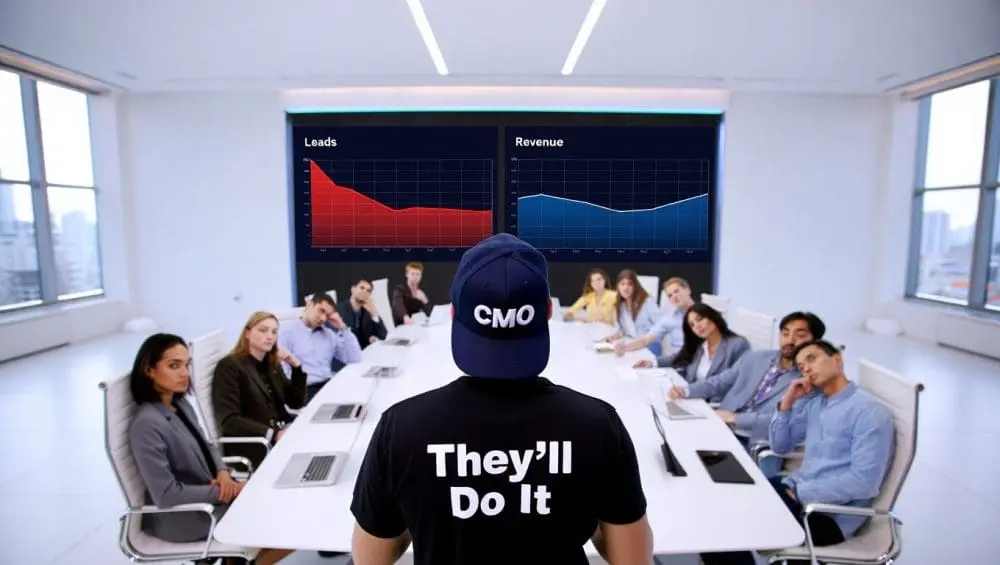
- The CMO stops writing copy or building demand-generation campaigns, transforming into a "brand philosopher" who oversees agencies rather than testing market resonance.
- The CCO stops meeting with churning customers, relying instead on health-score dashboards and Net Promoter Score (NPS) summaries assembled by junior analysts.
Phase 3: The Blind Spots and Compounding Errors
By month twelve, the disconnect manifests in missed metrics. Conversion rates dip, feature delivery stalls, pipeline growth flatlines, and customer churn spikes. Because the executive is completely decoupled from the day-to-day mechanics of the work, they cannot accurately diagnose the root cause.
To a CRO who hasn’t heard a live prospect objection in a year, dropping win rates look like "territory misalignment" when they are actually product-market friction. To a CTO who hasn’t opened an IDE, a delayed release looks like "engineering laziness" when it is actually technical debt compounding from architectural shortcuts made months prior. By the time the dashboard reflects the crisis, the damage is already systemic.
SUPPORTING CONTEXT & METRICS: THE SCALING PARADOX
Conventional wisdom suggests that as a company scales past $50 million or $100 million in ARR, the need for hands-on execution diminishes because organizational mass requires pure strategic oversight. This premise is fundamentally flawed.
In reality, the details matter more at scale, not less. Consider the arithmetic of a scaling business:
- At $10 million ARR, a minor miscalculation in marketing messaging or sales discovery is an annoying speed bump.
- At $50 million ARR, a two-point decrease in win rates translates directly to a loss of $1 million or more in annual revenue.
- At $100 million ARR, that same operational blindness bleeds $2 million or more straight off the top line.
An enterprise cannot afford to have its executive leadership floating 30,000 feet above the ground when millions of dollars hinge on the nuanced, tactical realities of the current market.
Furthermore, the modern scaling paradox dictates that the best executives derive their leverage from doing, not from delegating. When a high-performing CRO closes a $500,000 enterprise deal, they achieve three critical objectives simultaneously:
- They generate immediate, high-margin revenue.
- They test the company’s messaging against real, live buyers in real-time.
- They coach and inspire the junior sales team by demonstrating winning behaviors rather than merely preaching them.
Manager-only executives, by contrast, become organizational bottlenecks. If an executive cannot execute the work themselves, they lose the ability to mentor junior talent, accurately estimate project timelines, or evaluate the true quality of their team’s output.
OFFICIAL PERSPECTIVES: THE VAI / INVESTOR REALITY CHECK
Venture capitalists and board members who have monitored dozens of market cycles are increasingly vocal about the dangers of hiring "pretend" executives.
Industry veterans note that founders frequently fall into a psychological trap during the hiring process. They are seduced by an applicant’s pedigree, how eloquently they speak about leadership theory, and the prestigious logos on their CV. Founders ask: Do they look the part? Do they sound the part?
They rarely ask the critical screening question: Will they actually write the code, run the campaign, close the account, or take the customer call when things get tough?
Market observers argue that the integration of Artificial Intelligence makes this hands-on imperative more urgent than ever. The productivity gap between doers and non-doers is expanding exponentially.
- A CTO leveraging modern AI tools (such as Cursor or Claude) can be 5 to 10 times more productive in the codebase than they were just two years ago. A CTO who refuses to code has fallen into total obsolescence; their engineering team’s output has accelerated, but the executive’s comprehension has flatlined, leaving them entirely incapable of evaluating technical trade-offs.
- A CMO who actively utilizes generative AI tools to run marketing experiments and draft content maintains an acute pulse on market resonance. A CMO who refuses to touch the tactical tools can no longer distinguish between mediocre and exceptional creative output.
FUTURE OUTLOOK: HIRING FOR THE HANDS-ON ERA
As the business world navigates an increasingly automated and fast-paced economic climate, the criteria for evaluating executive talent must undergo a radical overhaul. The traditional playbook of hiring "professional managers" who parachute into a company strictly to oversee people must be replaced by a demand for player-coaches—leaders who maintain mastery over their craft.
For companies currently building out their executive suites, the diagnostic framework for vetting candidates must shift across three distinct milestones:
- During Interviews: Push candidates past high-level strategy questions. Ask them about the last time they personally executed a task in their domain. For a technical leader, ask about recent architectural challenges they debugged. For a revenue leader, ask about the toughest customer objection they personally handled in the last quarter. If they pivot immediately to "my team handles that," view it as an immediate red flag.
- During Reference Checks: Specifically probe past colleagues and direct reports about the candidate’s proximity to the actual work. Did they roll up their sleeves when the company hit a roadblock, or did they retreat to slide decks and administrative status meetings?
- During the First 90 Days: Enforce a hands-on immersion period. Great executives do not consider themselves "above" the foundational labor of the enterprise. They prove their competence by diving straight into the trenches, earning the profound respect of the teams they lead through demonstrated mastery rather than inherited authority.
The Verdict
The mandate for sustainable corporate growth is remarkably simple, forged in the fires of dozens of market successes and failures: Stay hands-on or fail.
It matters not whether an organization is scaling its sales engine, architecting its software stack, driving market acquisition, or retaining its client base. The executive teams that win are those capable of executing at the absolute highest level, even as they build and lead robust organizations.
For founders making high-stakes leadership hires, the rule moving forward is absolute: if an executive has "graduated" beyond doing the actual work, run the other way. For executives currently holding the reins: get back in the game, stay close to the craft, or prepare to watch your enterprise fall behind.