








Executive Overview
The landscape of AI-assisted software development has officially shifted from single-session code generation to automated, multi-threaded project coordination. On September 17, Anthropic introduced a sweeping redesign of Claude Projects, transforming what was previously a static repository for files and chat histories into an active, project-manager-grade orchestration layer.
For months, developers leveraging tools like Claude Code have faced a recurring logistical bottleneck: running multiple concurrent AI coding sessions on the same codebase required manual orchestration. Engineers had to partition workloads themselves, meticulously assign specific files to separate sessions, track individual progress across disparate terminals, and manually stitch the final results together. While the underlying language models demonstrated an impressive ability to write clean, sophisticated code in parallel, the grueling administrative overhead of coordinating that parallel work remained squarely on human shoulders.
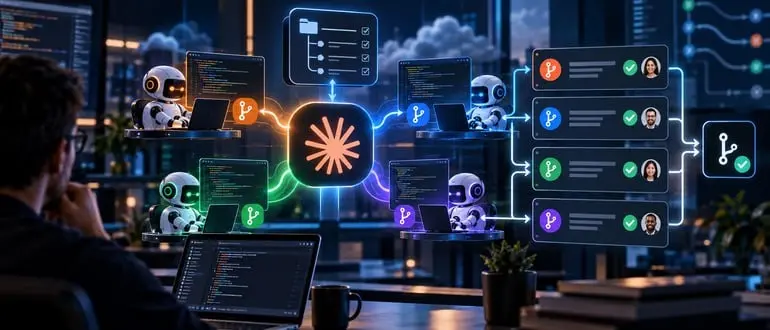
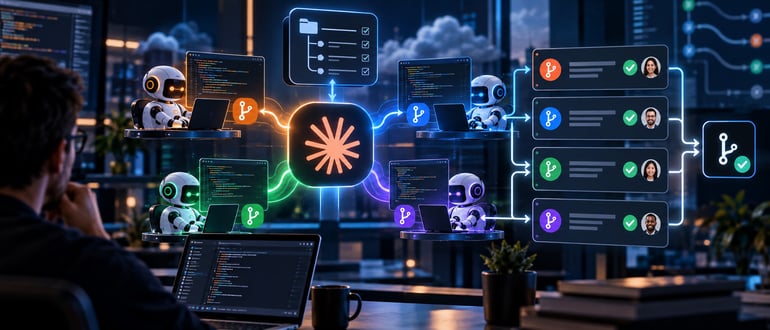
Anthropic’s latest rollout directly targets this friction. The redesigned Claude Projects architecture allows a user to input a high-level goal and connect relevant repositories or contextual files. A primary coordinator thread then automatically scopes the objective, breaks it down into distinct tasks, and spins up dedicated worker threads to execute them in parallel. Each worker thread operates as a full Claude Code cloud session running on its own isolated branch, capable of spawning subagents, handling iterative loops, and executing complex workflows without human hand-holding.
Critically, Anthropic has avoided the trap of unchecked automation by anchoring the system to standard developer workflows. All changes are delivered via traditional pull requests (PRs), ensuring that human oversight remains the final gatekeeper before any code touches production branches. Combined with persistent project memory that retains technical decisions, deadlines, and codebase preferences across sessions, this update represents one of the most pragmatic leaps forward in agentic software engineering to date.
Detailed Chronology: From Static Containers to Autonomous Coordinators
The Pain Point of Pre-Redesign Multi-Session Coding
To understand the significance of Anthropic’s September 17 announcement, one must examine the daily workflow of modern AI-augmented engineering teams prior to the update. Developers utilizing advanced LLMs for heavy refactoring or rapid feature development quickly realized that serial execution—asking a model to solve one problem, waiting for completion, and moving to the next—was inefficient.
Naturally, engineers began spinning up multiple terminal windows or browser tabs to run simultaneous Claude Code sessions. However, this introduced a new category of cognitive load:
- File Collision Management: Developers had to manually ensure that Session A and Session B were not modifying the same core utility files, which would inevitably result in catastrophic merge conflicts.
- Context Fragmentation: Each new session started with a blank slate, requiring developers to repeatedly feed the AI background information, project architecture rules, and coding standards.
- Manual Integration: Once the parallel sessions completed their respective coding tasks, the engineer was left to manually copy-paste, patch, and reconcile the disparate code blocks.
The September 17 Rollout and Architectural Mechanics
Anthropic’s redesign completely re-engineers this pipeline. The mechanics of the new Claude Projects environment are designed to mirror human engineering management structures:
- The Goal-Oriented Prompt: The user defines a broad objective within the project dashboard (e.g., "Audit our API endpoints for latency bottlenecks and refactor the slow data-fetching loops").
- The Coordinator Thread: Acting as a virtual tech lead, a top-level coordinator thread analyzes the request, maps it against the connected repositories and project documentation, and determines how the work can be safely partitioned.
- Parallel Worker Threads: The coordinator spins up isolated worker threads. Each worker functions as a full-fledged Claude Code cloud session operating on a separate, dedicated Git branch.
- Subagent Delegation: For tasks complex enough to warrant further division, individual worker threads possess the capability to spawn their own subagents, running loops and specialized workflows to solve isolated sub-problems.
- Standardized Delivery via PRs: Once a worker thread completes its assigned slice of the project, it packages the changes and submits them as a standard pull request.
Anthropic highlighted targeted workloads that immediately benefit from this architecture. For instance, optimizing checkout latency across a dozen disparate API endpoints simultaneously, or retiring a deprecated internal API across dozens of repositories that still rely on legacy calls. These tasks share a common profile: conceptually simple in isolation, but logistically exhausting at scale.
Persistent Memory and Context Retention
Another critical pillar of the redesign is the overhaul of project memory. Historically, starting a new chat session meant forcing the AI to re-learn project nuances. The new Claude Projects implementation introduces persistent memory that spans across all threads within a given project.
This memory layer retains vital institutional knowledge: architectural decisions, strict coding style preferences, project deadlines, and dynamic updates (such as a release date shifting from Wednesday to Friday). Furthermore, a centralized project library aggregates uploaded documentation, reference files, and Claude-generated artifacts into a unified workspace. When one worker thread produces an analytical report or a schema update, subsequent threads can instantly locate and build upon those assets without redundant prompting.
Supporting Context & Metrics: Safety, Autonomy, and Staged Rollouts
Balancing Autonomy with Guardrails
A persistent anxiety surrounding multi-agent AI systems is the risk of runaway automation—systems executing unverified changes deep within a codebase before anyone realizes something has gone wrong. Anthropic has addressed this operational risk by baking granular control mechanisms directly into the coordinator framework.
Users can explicitly configure the boundaries of the coordinator’s autonomy:
- Check-in Frequency: Determining how often the coordinator pauses to update the human operator.
- Thread Spanning Limits: Controlling how aggressively the system is allowed to spin up new worker threads.
- Verbosity Controls: Adjusting the level of detail surfaced in real-time progress updates.
Moreover, the entire ecosystem is accessible via mobile devices. While writing code on a smartphone screen remains impractical, managing the review-and-approve loop—accepting or rejecting pull requests, reading progress summaries, and steering stalled threads—becomes frictionless. This keeps the human engineer firmly in the loop as an architectural director rather than a micro-manager.
The Staged Rollout Strategy
Recognizing that changing how code is merged into a repository carries inherent operational risks, Anthropic has adopted a cautious, staged rollout strategy:
- Phase 1 (Initial Beta): Claude Pro and Max subscribers utilizing cloud sessions within Claude Code who do not already have projects configured on web or desktop.
- Phase 2 (General Availability): A broader rollout extending to standard chat interfaces, the Cowork environment, and Team and Enterprise subscription plans in the weeks following the initial launch.
By targeting individual power users and developers first, Anthropic can stress-test the coordinator logic in fast-moving environments before introducing the capability to enterprise platform teams managing critical production branches.
Official Statements and Industry Perspectives
The introduction of pull-request-based AI coordination has sparked immediate dialogue across the software lifecycle engineering community. Industry analysts have pointed to the integration of standard Git workflows as the defining factor that will dictate enterprise adoption rates.
Mitch Ashley, Vice President and Practice Lead for CIO & Technology Buyers and Software Lifecycle Engineering at The Futurum Group, emphasized that the technical success of multi-agent systems relies heavily on psychological trust and workflow familiarity.
"Running work in parallel is the easy part to sell," Ashley noted. "The part that actually earns trust is that every thread still lands as a pull request someone reviews. That’s the difference between a tool platform teams can adopt on their own terms and one they have to fight to keep visible."
Ashley’s perspective resonates deeply with DevOps professionals. For years, the conversation surrounding agentic AI has been dominated by theoretical multi-agent orchestration frameworks that promised total autonomy. Anthropic’s approach grounds these ambitions in reality by wrapping autonomous agents inside familiar development gates: branches, pull requests, and human code reviews.
Future Outlook: The Operational Frontier of Agentic Engineering
As software development teams evaluate the implications of Anthropic’s redesigned Claude Projects, the core question has evolved. The industry has moved past debating whether large language models can successfully split a programming task into multiple concurrent threads—numerous tools have demonstrated that capability for quite some time.
Instead, the defining challenge of the next phase of AI-assisted engineering is operational judgment.
- Can an automated coordinator logic decide what to delegate, when to merge, and what constitutes "done" with the reliability of a human tech lead?
- Can these multi-agent frameworks maintain structural integrity across messy, legacy-laden enterprise codebases that far exceed the pristine parameters of product demos?
These are fundamentally operational and architectural questions, not purely algorithmic ones. Platform engineering teams and engineering managers evaluating Claude Projects must assess how well the system’s coordinator logic aligns with their internal quality standards and compliance pipelines.
If Anthropic’s pull-request-gated, memory-persistent approach proves robust in production environments, it will establish a new baseline for how humans and AI collaborate. Rather than replacing the software engineering team, multi-agent orchestration may finally deliver on the promise of freeing engineers from logistical toil, elevating them from manual scripters to directors of automated technical workforces.