








Executive Overview
For years, the Python web development ecosystem has faced a recurring architectural dilemma. Frameworks like Django offer unparalleled maturity, robust built-in features, an exhaustive ORM, and a massive ecosystem of packages that make building enterprise-grade web applications swift and secure. However, as applications scale and traffic surges, Python’s inherent performance limitations—governed in part by the Global Interpreter Lock (GIL) and interpreted execution—often force engineering teams to make agonizing choices.
Historically, scaling a bottlenecked Django API meant either undertaking a costly, multi-month rewrite of the application layer into a high-performance language like Go or Rust, or horizontally scaling infrastructure with expensive container clusters to brute-force through inefficiencies.
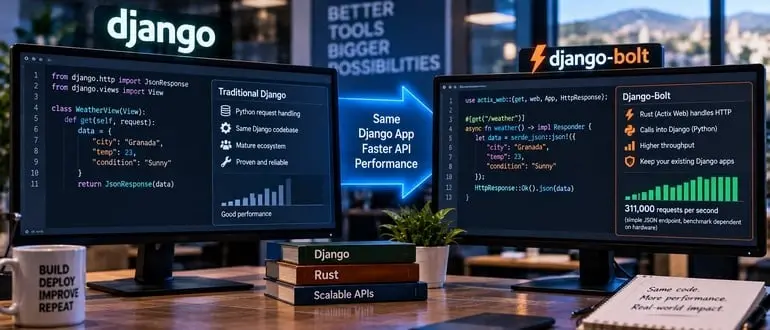
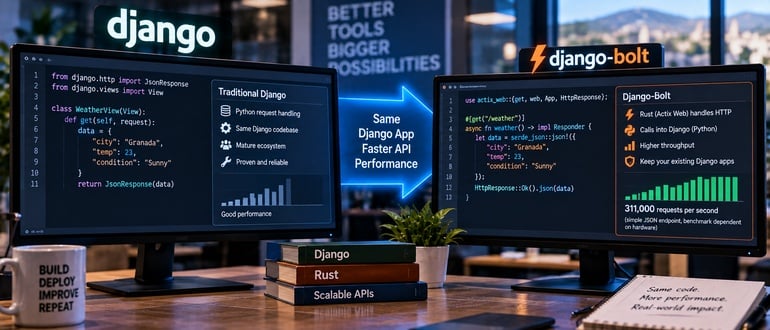
Enter Django-Bolt, an innovative open-source project designed to bridge this divide. By keeping the core Django framework entirely intact while offloading heavy HTTP request-handling and parsing duties to a lightning-fast Rust backend, Django-Bolt promises dramatic performance improvements without requiring teams to abandon their legacy Python codebases.
Initial headline benchmarks paint an astonishing picture: up to 311,000 requests per second (RPS) for a simple JSON endpoint. Yet, beneath these eye-catching metrics lies a more nuanced engineering reality. Synthetic benchmarks tell only part of the story. Real-world applications rarely serve static strings; they authenticate users, execute complex database queries, apply middleware, serialize large data structures, and execute intricate business logic.
This comprehensive analysis explores the mechanics of Django-Bolt, deconstructs its architectural underpinnings, evaluates how its performance gains translate to real-world workloads, and weighs the hidden operational costs of injecting a Rust runtime into a traditional Python production stack.
Detailed Chronology: The Evolution and Architecture of Hybrid Runtimes
To understand why Django-Bolt represents a significant shift in Python web development, one must first trace the historical attempts to solve Python’s performance bottlenecks.
The Traditional Python Web Stack
For over two decades, the standard deployment architecture for Django applications relied on WSGI (Web Server Gateway Interface) servers like Gunicorn or uWSGI paired with an Nginx reverse proxy, eventually evolving into ASGI (Asynchronous Server Gateway Interface) servers like Uvicorn and Hypercorn. While ASGI introduced asynchronous capabilities and improved concurrency handling, the request-response cycle remained deeply entrenched in the Python runtime. When traffic spikes, the Python interpreter quickly becomes the primary resource constraint, leading to elevated CPU utilization, increased latency, and dropped connections.
The Shift Toward Polyglot Architectures
Recognizing that rewriting entire applications in systems languages is often economically unviable, the software engineering community has increasingly gravitated toward hybrid runtimes. Projects like FastAPI demonstrated the power of leveraging high-performance Python bindings over fast C/C++ or Rust libraries (such as Starlette and Pydantic v2).
Django-Bolt takes this hybrid philosophy a step further by removing Python from the outermost edge of the network entirely.
How Django-Bolt Changes the Stack
At its core, Django-Bolt acts as a high-performance wrapper around an existing Django application. It decouples the HTTP transport layer from the application framework through a carefully engineered bridge:
- The Actix Web Foundation: Incoming HTTP requests hit a Rust-based server powered by Actix Web, one of the fastest and most robust web frameworks in the Rust ecosystem. Actix handles socket management, connection pooling, and initial HTTP parsing at native machine speeds.
- The PyO3 Bridge: When a request requires application logic, authentication, or database operations managed by Django, PyO3—a robust library for binding Rust and Python—seamlessly passes the execution context back into the Python interpreter.
- The Django Core: Once inside the Python runtime, Django executes its views, interacts with the database via the ORM, runs middleware, and prepares the response.
- Rust-Powered Serialization: For high-throughput endpoints, Django-Bolt utilizes msgspec for data encoding and decoding, achieving serialization speeds drastically faster than standard Python JSON libraries.
Crucially, this architecture allows teams to test an entirely new, high-performance serving layer without touching a single line of their established Django models, views, or business logic.
Supporting Context & Metrics: Unpacking the Benchmarks
Headline performance figures are vital for grabbing attention, but experienced systems architects know they can easily mislead. To evaluate Django-Bolt objectively, one must deconstruct its benchmarks and examine how performance scales under real-world pressure.
The 311,000 RPS Phenomenon
In published benchmarks, Django-Bolt reports handling roughly 311,000 requests per second for a minimal JSON endpoint. This number demonstrates the raw capability of the Actix Web server when it is unburdened by application logic. A static JSON endpoint demands very little: the request arrives, the server instantly emits a pre-serialized byte array, and the connection closes.
However, synthetic benchmarks test the framework, not the application. A production-grade Django API rarely performs this efficiently because of what happens after the request is received.
The Reality of Database and ORM Overhead
When engineers introduce database interactions into their benchmarks, the performance landscape shifts dramatically. In tests featuring an asynchronous ORM endpoint fetching just 10 rows from a SQLite database, Django-Bolt’s throughput drops to roughly 21,000–27,000 requests per second.
This drop illustrates a fundamental law of systems performance: speeding up the transport layer does not accelerate the database.
- If an API endpoint spends 90% of its execution time waiting for a PostgreSQL or MySQL query to resolve, getting the request to the application layer a few microseconds faster yields negligible end-user improvements.
- Furthermore, a faster server can inadvertently exacerbate downstream bottlenecks. If Django-Bolt successfully pushes thousands of concurrent requests through the application layer in a compressed timeframe, it can flood the database connection pool, driving up queue wait times and causing latency spikes that simple requests-per-second charts fail to reveal.
Serialization with Msgspec
Serialization overhead is another major drag on traditional Python APIs. Standard libraries like json struggle when serializing large nested object graphs. Django-Bolt integrates msgspec, which benchmarks suggest can be 10x to 85x faster than traditional Python JSON encoders.
Yet, much like database queries, the value of faster serialization depends entirely on payload size. Returning a solitary integer or a tiny string leaves virtually no optimization headroom. Conversely, endpoints returning hundreds of complex serialized database records will experience dramatic efficiency gains, validating the inclusion of high-performance serialization libraries.
Official Statements and Architectural Insights
Developers and core maintainers evaluating hybrid frameworks frequently debate the long-term maintainability and safety of embedding Rust components into Python applications.
The Granularity of Modern Optimizations
According to engineering discussions surrounding Django-Bolt, the project’s primary design goal is minimizing operational friction. Traditional framework migrations require rewriting URL routers, rebuilding authentication middleware, and redefining database schemas. Django-Bolt adopts a non-invasive stance:
"A team can test a different serving layer without first turning the exercise into a rewrite of the Django application. For a codebase with years of models, permissions, middleware, and integrations behind it, that is a much smaller change than moving the API to another framework."
Designing a Fair, Real-World Performance Test
Industry experts warn against relying solely on empty endpoint benchmarks. To accurately measure whether Django-Bolt can solve a specific performance bottleneck, engineers are advised to follow a staged benchmarking methodology:
- Baseline Static Test: Measure the raw throughput of a minimal JSON endpoint to establish maximum framework overhead limits.
- Database Integration Test: Introduce ORM queries while keeping hardware and concurrency parameters constant to observe the degradation curve as database I/O enters the equation.
- Full-Feature Test: Layer on authentication checks, custom middleware, and complex payload serialization incrementally.
Code Snippet: Staged Endpoint Evolution
# Stage 1: Minimal JSON Endpoint (Transport Layer Focus)
@api.get("/json-1k")
async def json_1k():
    return JSON_1K

# Stage 2: Database-Integrated Endpoint (ORM & I/O Focus)
@api.get("/users", response_model=list[UserSchema])
async def users():
    return [user async for user in User.objects.all()[:10]]
By observing the performance delta between Stage 1 and Stage 2, engineering teams can pinpoint precisely where their application loses efficiency—clarifying whether the bottleneck lies in the web server, the Python interpreter, or the database.
Future Outlook: Production Readiness, Maintenance, and Maintenance Trade-Offs
Deploying any performance-enhancing tool involves a careful cost-benefit analysis. While Django-Bolt offers alluring speed increases, adopting it in a mission-critical production environment requires weighing several non-functional requirements.
Operational Complexity and Debugging
Introducing Rust into a Python-centric team changes the operational risk profile. While Django-Bolt allows developers to write normal Python views, low-level HTTP handling, socket management, and concurrency are now governed by a compiled Rust binary.
If a catastrophic failure occurs at the transport layer—such as a memory segmentation fault, a panic in the Actix thread pool, or an unhandled foreign function interface (FFI) error via PyO3—debugging requires a different set of diagnostic tools. Engineers accustomed to reading Python tracebacks may find themselves deciphering Rust stack traces. For organizations with dedicated systems engineers fluent in Rust, this is a minor hurdle; for pure Python shops, it represents a steep learning curve during a production incident.
Project Maturity and Ecosystem Support
At the time of writing, Django-Bolt remains in its early alpha stages on PyPI. While this status should not deter experimental deployments or staging-environment benchmarks, enterprise architects must exercise caution before committing core production traffic to alpha software. Established alternatives like the Django REST Framework, FastAPI, and traditional ASGI servers benefit from years of battle-tested security patches, community plugins, and extensive troubleshooting documentation.
Strategic Recommendations for Engineering Teams
Should your team adopt Django-Bolt? The answer depends entirely on your specific bottleneck profile:
- Adopt Django-Bolt If: Your Django application suffers specifically from high HTTP connection overhead, slow serialization, or thread-starvation issues at the web server layer, and you want to scale performance without migrating away from Django’s unmatched ecosystem of packages and ORM features.
- Look Elsewhere If: Your application latency is predominantly bound by inefficient database queries, unoptimized third-party API calls, or complex business logic running inside Python views. In these scenarios, speeding up the HTTP transport layer will do little to improve overall user experience.
Ultimately, Django-Bolt represents a compelling evolution in Python web engineering. By successfully fusing the developer velocity and architectural maturity of Django with the raw, uncompromising performance of Rust and Actix Web, it provides a powerful new tool for teams determined to push their Python applications further than ever before.