








Executive Overview
For centuries, the enduring brilliance of ancient Egyptian art has captivated historians, archaeologists, and the general public alike. From the vibrant pigments adorning wooden coffins and limestone architectural elements to the intricate wall paintings buried within elite tombs, these masterpieces have withstood millennia of environmental stress. Yet, despite decades of rigorous academic study, the precise organic recipes employed by ancient artisans to bind these pigments, prepare grounds, and adhere structural elements have largely remained elusive.
Traditional analytical methods, often constrained by the requirement for large sample sizes or limited by narrow target parameters, frequently failed to capture the full molecular complexity of ancient binding media. However, a scientific revolution is underway in the cultural heritage sector. By harnessing the unprecedented sensitivity and expansive analytical scope of mass spectrometry-based proteomics, researchers are now opening a transformative window into the workshop practices of the ancient world.
In a landmark study that bridges molecular biology, archaeology, and art history, an international team of scientists has successfully decoded the protein-based binders utilized by ancient Egyptian artisans. Spanning a chronology from the height of the New Kingdom in 1425 BCE to the Roman Period in 400 CE, the investigation analyzed micro-samples extracted from artifacts housed across prestigious collections in Sweden, the United Kingdom, and Denmark.
The findings upend long-held assumptions regarding material selectivity in ancient Egyptian craft production. Rather than employing specific animal tissues or species for ritualistic, symbolic, or aesthetic reasons, ancient artisans demonstrated a pragmatic reliance on whatever organic resources were readily available. By boiling animal skins and connective tissues, these craftsmen produced versatile glues and paint binders derived from cows, sheep, goats, horses, donkeys, and antelopes.
This comprehensive report explores the methodological mechanics of mass spectrometry-based proteomics, details the chronological scope and sampling parameters of the study, evaluates the broader implications of the findings, and outlines the future trajectory of biochemical archaeology.
Detailed Chronology and Methodological Framework
The Rise of Proteomics in Cultural Heritage
Mass spectrometry-based proteomics is a relative newcomer to the analytical toolkit of archaeological science, yet it has rapidly established itself as an indispensable asset. Unlike older methods, proteomics is capable of providing a thorough, highly detailed characterization of any protein residues present in a given sample, alongside a readout of any accumulated molecular damage sustained over millennia.
The technique possesses extraordinary sensitivity, requiring significantly smaller sample material than traditional biochemical assays. This low-invasive threshold is of paramount importance when dealing with irreplaceable cultural heritage artifacts, where destructive sampling must be kept to an absolute minimum. Furthermore, unlike gas chromatography-mass spectrometry (GC-MS), which is typically restricted to predefined target compounds, proteomics is untargeted. It possesses the capability to characterize all proteins present in a sample regardless of mixture complexity, delivering an unbiased profile of the original biological matrix.
The maturation of this technology has yielded remarkable breakthroughs across multiple historical epochs over recent years:
- 2023: Scientists deployed mass spectrometry-based proteomics to investigate the canvas primers used by artists of the Danish Golden Age, discovering that beer byproducts were frequently utilized to prepare painting surfaces.
- Early 2026: Researchers identified proteins extracted from the fingerprints of Renaissance scholars and readers who had rifled through the pages of historical medical manuals. This shed unprecedented light on the tactile interactions and knowledge-sharing mechanics of the early modern period.
- The Latest Investigation: Building upon these milestones, a team of researchers turned their focus toward antiquity, applying proteomics to solve enduring conservation and art-historical mysteries embedded within ancient Egyptian material culture.
Sampling and Artifact Selection
To capture a representative overview of Egyptian protein utilization, the study’s authors secured micro-samples from a diverse array of artifacts. These objects, dating between 1425 BCE and 400 CE, were curated across various European institutions in Sweden, the UK, and Denmark.
The material corpus included:
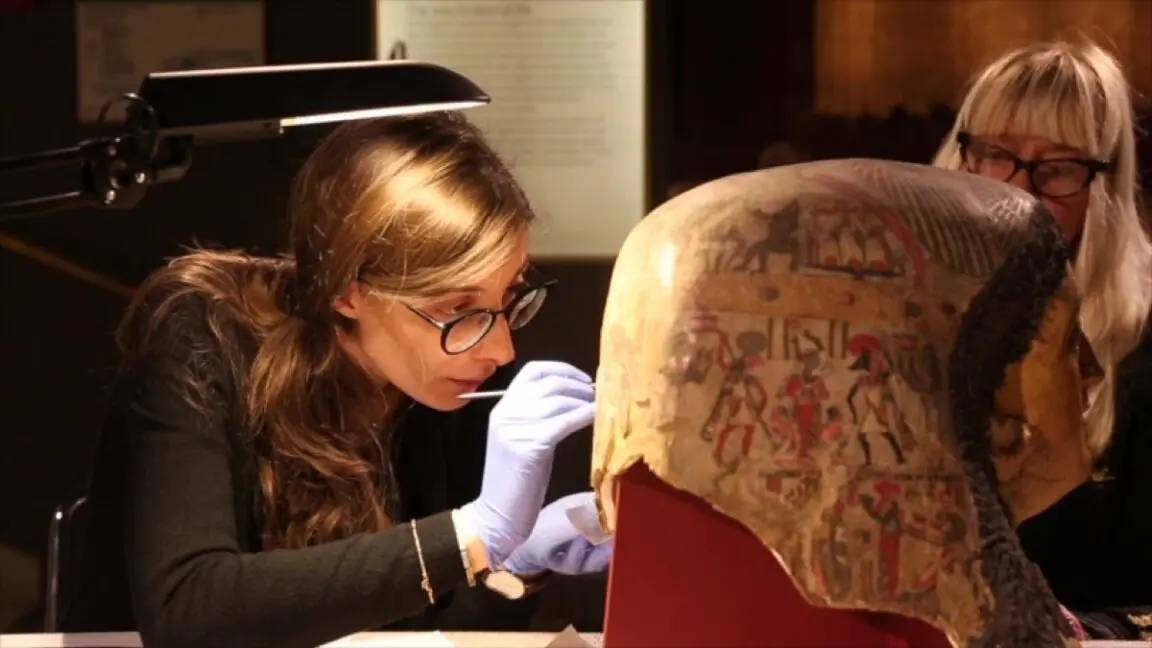
- Painted Wooden Coffins: Highly decorated sarcophagi displaying complex iconographic programs and layered polychrome decorative schemes.
- Tomb Wall Painting Fragments: Architectural and decorative segments salvaged from elite burial sites, offering direct insight into interior tomb decoration.
- Painted Plaster: Molded structural elements utilized in the creation of mummy busts, highlighting the intersection of sculpture and surface ornamentation.
- Painted Limestone Architectural Elements: Structural stone blocks coated with prepared ground layers and vibrant mineral pigments.
Rigorous Contamination Controls
In ancient protein analysis, distinguishing between original organic binders and modern contamination introduced during handling, restoration, or excavation is a paramount challenge. To ensure absolute data integrity, the research team instituted strict methodological safeguards.
In addition to analyzing the ancient artifacts, the investigators processed blank negative control samples in parallel. Crucially, they conducted a deep biochemical examination of the chemical damage signatures—such as amino acid deamidation and oxidation—inherent to all detected proteins. By evaluating the specific degradation patterns accrued over millennia, the team effectively excluded modern laboratory contamination, confirming that the recovered proteins were contemporary with the manufacture of the artifacts.
Supporting Context & Metrics
Molecular Profiling of Ancient Adhesives and Binders
The mass spectrometry analysis delivered definitive proof regarding the specific organic components integrated into ancient Egyptian workshops. The results confirmed that ancient artisans frequently utilized cow glue, alongside collagens derived from a wide range of domesticated and wild ungulates, including sheep, goats, horses, donkeys, and antelopes.
+-----------------------------------------------------------------+
|              ANALYTICAL METRICS AT A GLANCE                     |
+-----------------------------------------------------------------+
| Chronological Span:      1425 BCE – 400 CE                      |
| Geographic Scope:        Collections in Sweden, UK, Denmark     |
| Primary Protein Sources: Cow, Sheep, Goat, Horse, Donkey, Antelope|
| Analytical Method:       LC-MS/MS Proteomic Sequencing          |
| Key Processing Technique: Boiling of animal skin & connective   |
|                          tissues                                |
+-----------------------------------------------------------------+
Historically, scholars debated whether the selection of animal glues was dictated by specific aesthetic requirements, ritual purity laws, or regional trade networks. However, the proteomic data revealed a surprising lack of specialization.
These animal-derived materials were identified not only in isolated adhesive samples—such as structural joints and joinery reinforcements—but also integrated directly into paint matrices and ground layers. This pervasive distribution indicates that animal glues functioned as multi-purpose mediums, serving simultaneously as primers, paint binders, and structural adhesives.
The Economics of Pragmatism: Availability Over Artistry
The most striking revelation of the study centers on the motivations governing workshop material selection. When cross-referencing the protein identifications with archaeological variables, the researchers uncovered a profound lack of correlation.
As noted by the authors of the study: "No notable correlation was observed between the choice of the animal species/part and the object type, the nature of the application, the color, the chronology, the geographical origin, or the use context (funerary or palatial)."
This lack of pattern points directly to a culture of pragmatic resource management. Ancient Egyptian workshops appear to have operated on principles of immediate availability and operational efficiency. Whether an artisan was decorating a royal-associated funerary monument or a domestic palatial wall, the decision to use cow, sheep, or equid collagen was driven by what raw animal byproducts were locally accessible from butchery waste and tannery operations, rather than rigid theological or artistic dogmas.
Official Statements and Expert Perspectives
The integration of proteomics into archaeological science has generated widespread enthusiasm across the academic community, shifting the boundaries of what can be recovered from degraded material culture.
Lead researchers and conservators emphasize that these molecular insights fundamentally reshape our understanding of ancient technology:
"For generations, we have relied on visual inspection and rudimentary chemical spot tests to infer how ancient artisans prepared their canvases and bound their pigments. Proteomics allows us to pierce through millennia of degradation and look directly at the biological building blocks chosen by the craftspeople of the Nile Valley. What emerges is not an image of dogmatic, highly specialized ritual manufacturing, but rather a picture of resourceful, highly practical ancient artisans utilizing whatever suitable organic material was at hand."
— Excerpts from the Research Team
Art historians and archaeological scientists point out that understanding these organic binders is also critical for modern conservation efforts:
"When museums undertake restoration or preservation work on ancient polychrome artifacts, knowing the exact composition of the original binding media is non-negotiable. Applying synthetic adhesives or cleaning agents that chemically conflict with ancient collagen structures can accelerate decay. This research gives conservators an empirical roadmap for preserving these treasures for future generations."
— Museum Conservation Specialist
Future Outlook: The Next Horizon in Proteomic Archaeology
As mass spectrometry hardware continues to evolve and sample preparation protocols become increasingly refined, the future of proteomic archaeology shines brightly. The success of this multi-institutional study on ancient Egyptian artifacts paves the way for several exciting avenues of future inquiry.
1. Expanding the Global Chronological Database
Researchers are eager to apply high-sensitivity proteomics to broader geographic and temporal horizons. While this study successfully mapped artifacts from 1425 BCE to 400 CE, extending the methodology further back into the Old and Middle Kingdoms—as well as outward to contemporaneous civilizations in the Levant, Mesopotamia, and the Aegean—will allow scientists to track trade networks of animal byproducts and technological exchanges on an unprecedented scale.
2. Refining Post-Translational Modification Analysis
Future research will likely focus deeper on the specific post-translational modifications (PTMs) and degradation kinetics of ancient proteins. By analyzing how environmental humidity, temperature fluctuations, and burial microenvironments alter protein structures over millennia, scientists hope to develop predictive models for archaeological preservation, helping field teams assess the survivability of organic residues before excavation even begins.
3. Integrating Multi-Omics in Cultural Heritage
The convergence of proteomics with other advanced analytical techniques—such as ancient DNA analysis (aDNA), stable isotope ratio mass spectrometry, and metabolomics—promises a holistic "multi-omics" approach to art history. By simultaneously recovering genetic data, metabolic signatures, and protein sequences from a single microscopic paint chip, researchers will soon reconstruct not only the materials used to create an artwork, but potentially the environmental conditions of the flora and fauna that supplied them.
Ultimately, this study demonstrates that even the most thoroughly studied civilizations retain deeply buried secrets waiting to be unlocked. By listening to the microscopic whispers trapped within ancient proteins, modern science continues to bridge the gap between deep history and contemporary understanding, breathing new life into the silent masterpieces of the ancient world.