









FLORIDA — Major Spanish-language broadcaster TelevisaUnivision (TU) is aggressively pushing the boundaries of American copyright enforcement. In a comprehensive legal filing submitted to a federal court in Florida, the media giant is asking U.S. District Judge Kathleen Williams to enter a default judgment against a network of evasive pirate IPTV operations.
The motion, filed on September 4, calls for a staggering $32.7 million in statutory damages. However, it is the sweeping, self-expanding nature of the requested permanent injunction that has drawn intense scrutiny from legal scholars and digital rights advocates alike. If granted as written, the order would grant rightsholders unilateral powers to continually scale up enforcement without ever having to step foot back inside a courtroom—a mechanism historically confined to European jurisdictions, but now making dangerous inroads into the United States legal system.
Executive Overview
The landmark legal battle centers around a multi-pronged assault on unauthorized streaming services that siphon proprietary content from TelevisaUnivision. Initially targeting five core pirate IPTV operations—Thunder TV, Sunset TV, Tele Latino, Pop TV, and Kaelus TV—the preliminary injunction obtained by TU in July rapidly spiraled into a sprawling dragnet. Within weeks of the defendants’ failure to appear in court, the operation ballooned to encompass hundreds of domains, dozens of newly added brands, and a massive web of digital intermediaries.
The broadcaster’s latest legal maneuvers are designed to lock down a permanent victory against the elusive operators. The requested default judgment seeks $26.7 million for willful copyright infringement (calculated at the statutory maximum of $150,000 per registered work) and an additional $6 million for willful trademark counterfeiting ($2 million per defendant group).
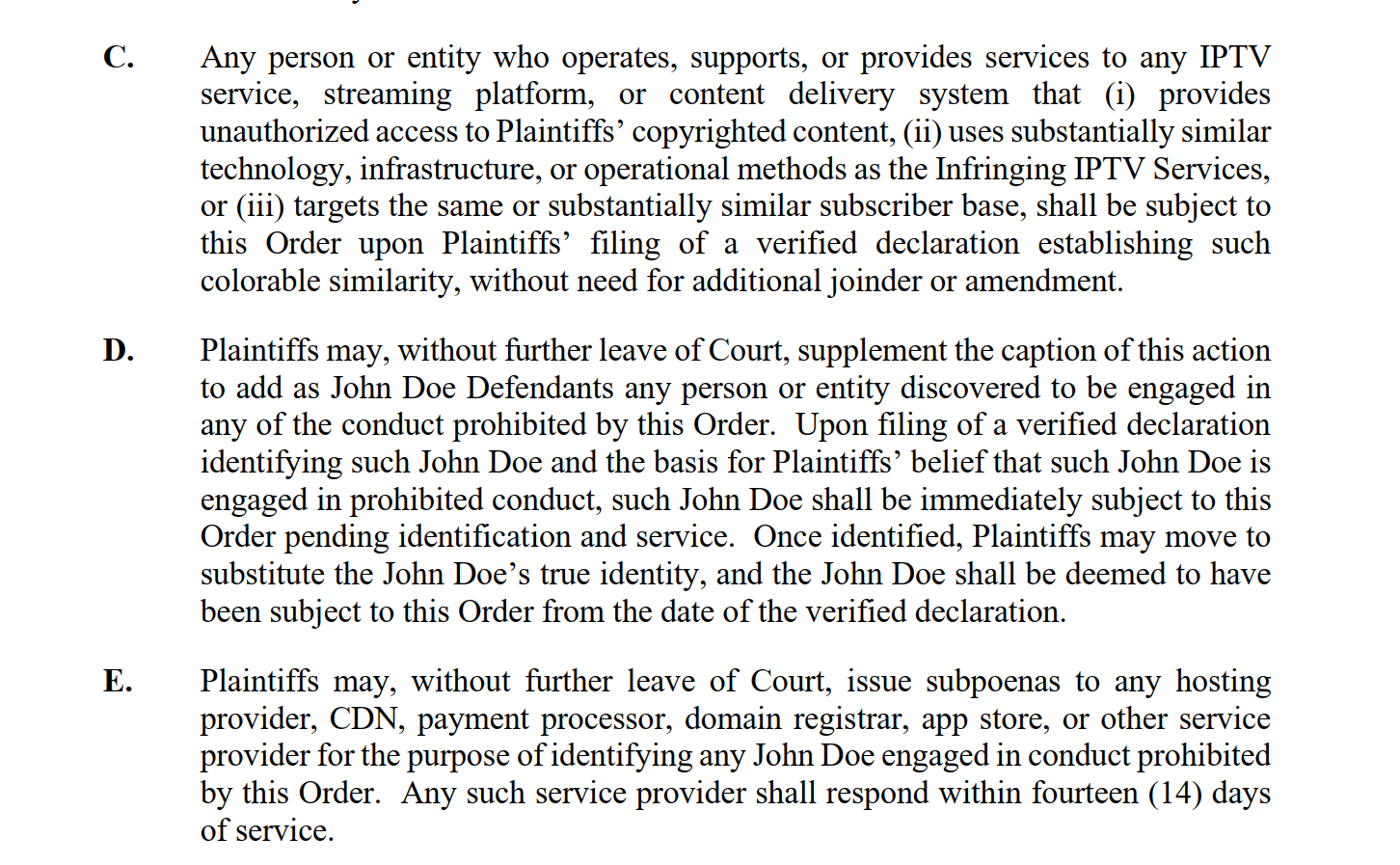
Yet, the real teeth of the filing lie within the proposed permanent injunction. TelevisaUnivision is not merely asking for a static takedown order. Instead, it is demanding a self-updating, infinitely expandable regulatory framework that bypasses traditional judicial oversight. Under the proposed terms, TU could autonomously add new domains, IP addresses, derivative brands, and even newly discovered John Doe defendants to the injunction on the fly.
As copyright holders increasingly clash with decentralized, borderless pirate operations, TelevisaUnivision’s aggressive stance threatens to set a profound precedent—one that shifts the burden of policing the internet from the courts directly onto the shoulders of global tech intermediaries and infrastructure providers.

Detailed Chronology of the Legal Battle
The current confrontation between TelevisaUnivision and the pirate streaming ecosystem did not happen overnight; it represents the culmination of escalating friction within the digital media landscape.
Summer 2024: The Initial Preliminary Injunction
In July, TelevisaUnivision secured a pivotal preliminary injunction from a federal court in Florida. The action initially targeted five distinct pirate IPTV services: Thunder TV, Sunset TV, Tele Latino, Pop TV, and Kaelus TV. Because these services relied on anonymous registrations and foreign infrastructure, the defendants predictably failed to mount a defense or even show up in court.
Seizing upon this judicial vacuum, TU utilized the flexible terms of the preliminary injunction to proactively expand its scope. Within a single month, the broadcaster exercised its self-updating powers twice, pulling entirely new pirate brands into the legal crosshairs.
The September 4 Motion for Default Judgment
With the preliminary period drawing to a close and zero cooperation from the named defendants, TU took the next logical legal step. On September 4, the broadcaster formally requested that Judge Kathleen Williams enter a default judgment.
The motion specifically targets six named individuals and entities operating Thunder TV, Sunset TV, and Tele Latino. Meanwhile, the operators behind Pop TV and Kaelus TV remain elusive, categorized merely as unidentified "John Does." Alongside the financial penalties, the motion lays out the blueprint for a permanent injunction that supercharges the powers granted in the summer preliminary order.
Adaptability and Evading Tactics
The cat-and-mouse nature of modern digital piracy is acutely demonstrated by the behavior of the defendants. According to supplemental declarations filed by TU, the operators of Thunder TV subtly shifted strategies when their primary infrastructure faced pressure. While Thunder TV itself allegedly stopped carrying TelevisaUnivision content, its operators quickly stood up a mirror application christened "Black Eye."
Worryingly for the broadcaster, users could access Black Eye using their exact same Thunder TV login credentials. It is precisely this kind of jurisdictional sleight-of-hand—where old brands morph into new ones overnight—that has driven TelevisaUnivision to demand an exceptionally broad, self-expanding judicial order.
Supporting Context & Metrics: The Scale of the Digital Dragnet
The sheer breadth of TelevisaUnivision’s legal target list is unprecedented in modern U.S. copyright litigation. The comprehensive paperwork submitted to the court reads like a global map of internet infrastructure.
Nearly 600 Domains and Derivative Brands
The updated Schedule A attached to the injunction covers nearly 600 unique domain names. This massive list accounts for the initial five services alongside seven additional brands that were subsequently flagged, including:
- XuperTV
- Tarjeta Roja
- Pirlo TV
- Roja Directa
Individual networks within the infringement ring account for staggering clusters of URLs. Thunder TV and Tele Latino account for more than 90 domains each. Meanwhile, XuperTV—which TU characterizes as a "white label" service built upon the exact same underlying infrastructure as Tele Latino (associated with the Magis TV network)—contributes upwards of 110 individual domains to the total tally.
A Mammoth Web of 121 Intermediaries
Beyond the pirate domains themselves, the injunction targets an unprecedented 121 digital intermediaries. These entities are divided into several operational categories:
- 51 Domain Registrars
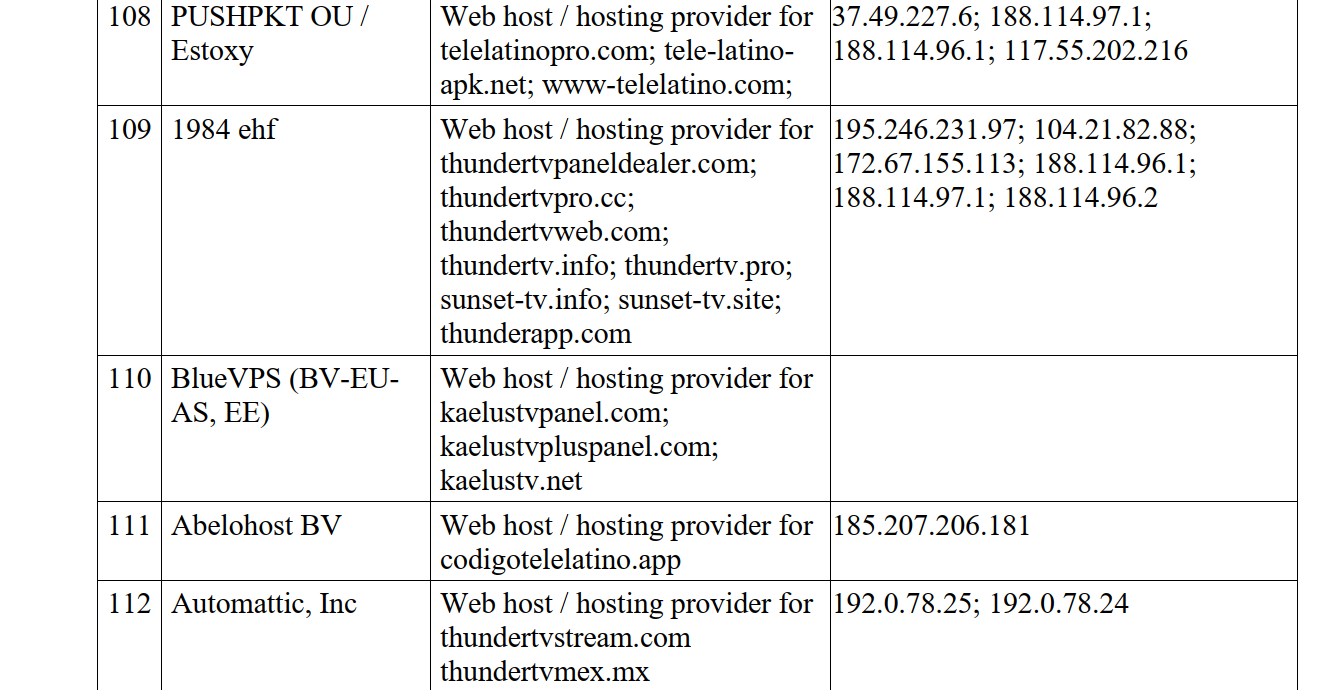
- 58 Web Hosting and Content Delivery Network (CDN) Providers
- 5] Payment Channels
- 5] App Distribution Platforms
The global reach of the intermediary list is striking. It ensnares major U.S.-based technology companies like Namecheap and GoDaddy, alongside a volatile mix of international registrars and services. These include Russia’s REGTIME-SU, Vietnam’s Mat Bao, Peru’s NIC.PE, the Netherlands’ Registrar.eu, Iran’s Aria Shatel, and even a Romanian state research institute, ICI Bucuresti.
Furthermore, mainstream software and web-building platforms have found themselves swept up in the dragnet. Companies such as GitHub, Vercel, Canva, Wix, Squarespace, and Automattic (the parent company of WordPress.com) are explicitly listed because individual accounts on their platforms were linked to pirate domains or promotional materials.
Technical Missteps and Specific Demands
While the net is wide, it occasionally scoops up technical anomalies. Notably, the proposed injunction lists regional internet registries RIPE NCC (Europe) and APNIC (Asia-Pacific). In a technical mischaracterization, the legal filing labels these non-profit registries as "web hosts / hosting providers." In reality, RIPE and APNIC allocate raw IP address space to Local Internet Registries (LIRs); they do not host websites nor do they possess the technical capability to block access to specific IP addresses.
Conversely, the injunction takes aim at specific technical choke points with surgical precision:
- Cloudflare: Given its ubiquity as a reverse proxy, Cloudflare is singled out in a dedicated section. For each of the roughly 90 IP addresses tied to the pirate domains, Cloudflare is ordered to unmask its operations by surrendering the true origin server details, along with the account holder’s name and email address.
- Roku and AFTVnews: The popular streaming hardware maker Roku, alongside the AFTVnews Downloader app, are ordered to actively remove pirate applications from their ecosystems and block the numerical short codes commonly used by users to side-load these illicit streaming apps onto smart devices.
Financial Penalties: $32.7 Million on Paper
The financial demands put forward by TelevisaUnivision are eye-watering. The total requested sum of $32.7 million is broken down into two distinct categories of intellectual property violation:
- Willful Copyright Infringement ($26.7 Million): TU is seeking the statutory maximum of $150,000 for each registered work intentionally infringed upon by the network.
- Willful Trademark Counterfeiting ($6 Million): The broadcaster is asking for $2 million per defendant group for the unauthorized, fraudulent use of its protected brand assets.
The Reality of Collections Against Foreign Operators
Industry legal experts are quick to point out that collecting $32.7 million from anonymous, overseas-based pirate operators is practically a statistical impossibility. The defendants frequently operate behind corporate veils, utilizing false identities, offshore shell companies, and cryptographic protections.
TelevisaUnivision is undoubtedly aware of this grim financial reality. Rather than expecting a massive cash payout, the multi-million-dollar damages figure serves a strategic dual purpose. First, it establishes a powerful deterrent and sets a high-water mark for statutory damages in IPTV piracy cases. Second, it forms part of the core justification for why a traditional damages remedy is wholly insufficient—and why an expansive, self-expanding permanent injunction is the only effective remedy to completely disrupt the technical infrastructure of the pirate networks.

This aggressive financial posture mirrors recent trends in American copyright enforcement. In March, streaming giants Amazon and Netflix successfully secured an $18.75 million judgment against a Dallas-based IPTV operator. Similarly, major Hollywood studios walked away with a $9 million default judgment against a Pennsylvania pirate operation in June. However, TU’s case takes the structural ambition of these past victories and amplifies them significantly.
Future Outlook and Industry Implications
As the motion sits pending before U.S. District Judge Kathleen Williams, the digital rights community and legal scholars are watching closely. The core issue before the court is whether the most expansive, self-enforcing provisions of TU’s proposed order will survive judicial scrutiny.
The Threat of "Dynamic" and Self-Expanding Orders
Dynamic site-blocking orders—which allow copyright holders to add new mirror sites and domain iterations to an existing injunction without returning to court for fresh litigation—have been a staple of intellectual property enforcement in the United Kingdom, European Union, and Australia for years. However, importing this legal mechanism into the United States federal court system represents a significant shift.
By demanding the power to unilaterally update case captions and add new "John Doe" defendants without judicial oversight, TelevisaUnivision is pushing the envelope of due process. Critics argue that such broad mechanisms risk sweeping legitimate third-party services, shared hosting platforms, and innocent web infrastructure into the crossfire, placing undue censorship burdens on technical intermediaries.
Setting a Dangerous Precedent for IPTV Litigation
If Judge Williams approves the permanent injunction in its current form, it will establish a potent new legal playbook for the broader media and entertainment industry. Broadcasters and sports leagues plagued by real-time pirate streams—particularly those originating from ephemeral IPTV networks—will undoubtedly cite this ruling in future actions to demand their own self-updating digital dragnet.
Conversely, if the court pushes back against the overreach of the proposed provisions, it could establish a healthy boundary on how far rightsholders can bypass traditional judicial checkpoints in the digital age.
For now, the legal world waits to see how the bench evaluates the tension between the pressing need to combat rampant digital piracy and the foundational principles of American civil procedure. Whatever Judge Williams decides, the ripples of this Florida federal case will be felt across the global streaming ecosystem for years to come.