Executive Overview
In the high-stakes, shadow-veiled world of elite private BitTorrent trackers, legal battles are rarely straightforward. However, a federal lawsuit currently unfolding before Judge Andrea R. Wood has transcended the typical boundaries of intellectual property litigation, morphing into a bizarre tale of alleged identity theft, vanishing digital footprints, uncanny cinematic coincidences, and high-stakes procedural warfare.
At the center of this controversy is a series of copyright infringement lawsuits launched against several prominent, invite-only private torrent trackers—including operations colloquially tracked as PTP (PassThePopcorn) and BTN (BroadcastheNet). The plaintiff, filing under the name Matthew Schneider, initiated legal action demanding the exposure of the operators behind these elite file-sharing communities.
Yet, what began as a routine copyright enforcement action has devolved into a profound existential crisis for the lawsuit itself. Defense attorneys representing the anonymous tracker operators dropped a bombshell last month, informing the federal judge that the individual driving the litigation may be an outright impostor.
As the case hurdles toward a crucial in-person evidentiary hearing, the court is confronted with an extraordinary puzzle: Two distinct individuals, both claiming the name Matthew Schneider, have emerged. One is a verified Canadian independent filmmaker who completely denies any involvement in the lawsuit. The other is a self-described creative professional from the United Kingdom who insists he is the rightful plaintiff—and that it is merely a jaw-dropping coincidence that he independently produced three films with the exact same titles, featuring the exact same rare character names, years prior to the Canadian productions.
This comprehensive investigative report breaks down the timeline, examines the evidentiary contradictions, explores the procedural counterattacks, and evaluates the broader implications of a federal lawsuit that has pushed the boundaries of credibility in digital copyright law.
Detailed Chronology
The Genesis of the Subpoena Campaign
The legal drama began when an individual styling himself as Matthew Schneider initiated federal litigation targeting a cadre of exclusive, invite-only private torrent trackers. Unlike public BitTorrent indexers, private trackers operate under strict vetting protocols, closed registration, and community-enforced sharing ratios. For copyright holders and aggressive litigants, penetrating these walled gardens is notoriously difficult.

To unmask the anonymous administrators and operators running these platforms, the plaintiff issued a barrage of third-party subpoenas. Major technology, hosting, and financial entities—including Reddit, GoDaddy, Cloudflare, PayPal, Stripe, Namecheap, and X Corp (formerly Twitter)—were served with demands to turn over identifying account records, IP logs, and financial transaction histories.
Recognizing the existential threat these subpoenas posed to their anonymity, defense counsel Erin Russell and Haley Finch mobilized. They successfully petitioned the court to place all subpoena productions on hold in May, effectively freezing the forced unmasking of the tracker operators while deeper jurisdictional and evidentiary issues were investigated.
The Defense Discovery and the First Twist
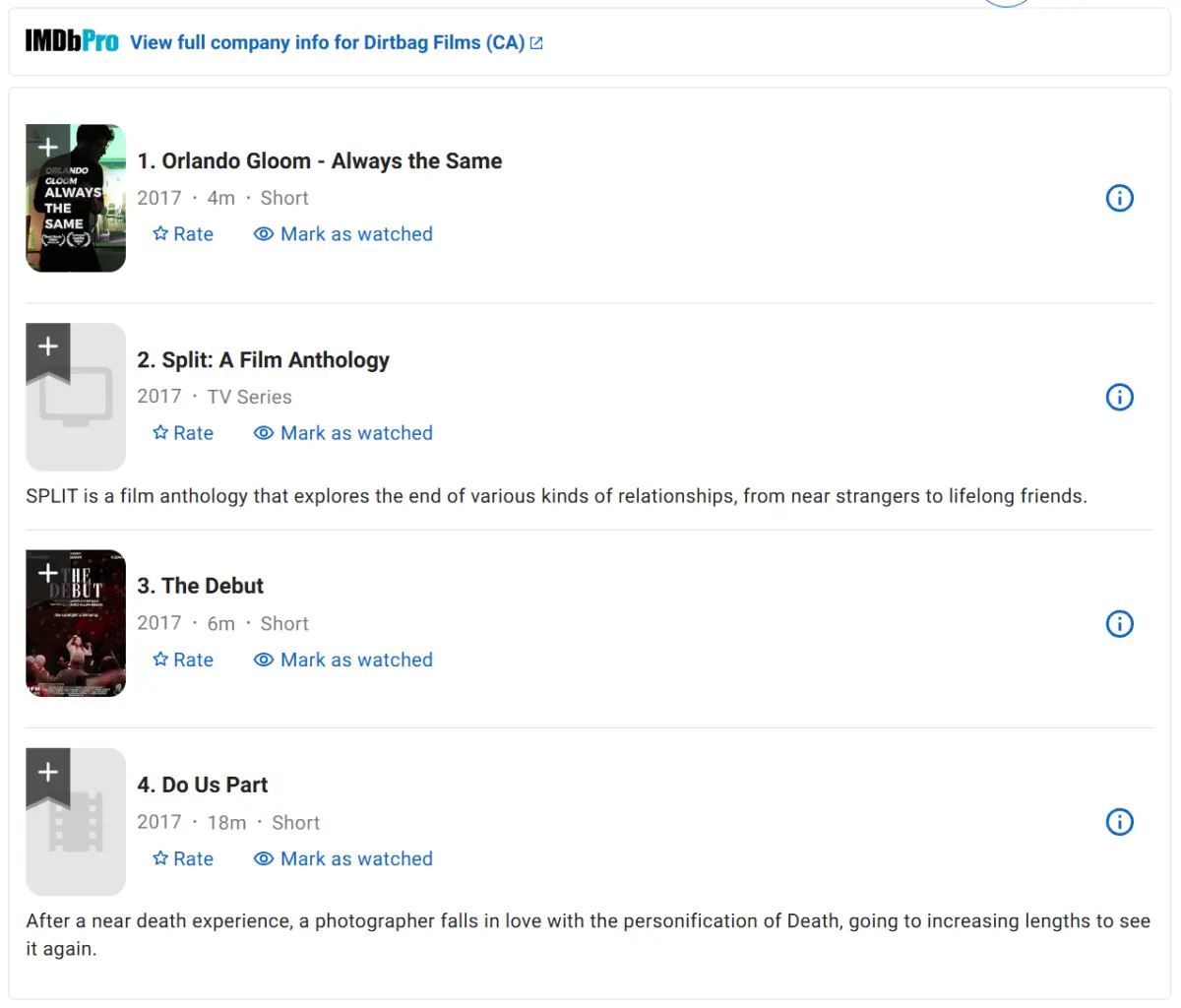
As defense attorneys dug deeper into the background of the plaintiff, cracks began to form in the foundation of the lawsuit. Filings submitted under the name Matthew Schneider relied on a standardized mail-drop address and a primary contact email (matthew.schneider94). The copyright claims heavily leaned upon three specific titles: "Split: A Film Anthology," "Do Us Part," and "Orlando Gloom, Always the Same."
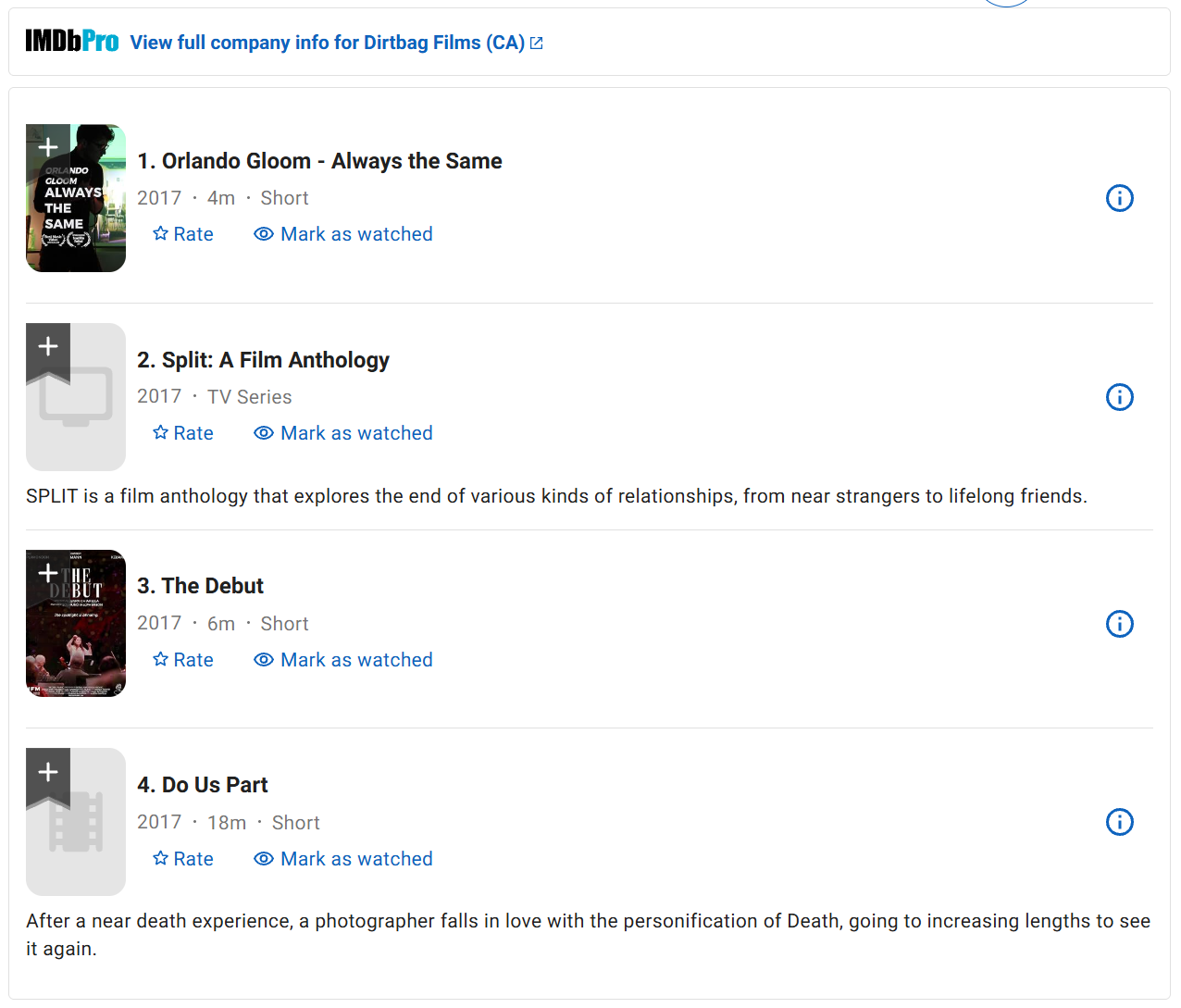
Upon running these titles through public databases, defense counsel identified an IMDb profile matching these exact three films, linked to a Canadian high-school filmmaking collective known as "Dirtbag Films." Realizing that the plaintiff’s assertions did not align with the verifiable history of these cinematic works, the defense took the extraordinary step of tracking down the actual creators north of the border.
Finding their findings deeply irregular, defense attorneys informed Judge Andrea R. Wood that the case may have been filed by an impostor. The judge promptly placed the case on a sanctions track and scheduled an in-person hearing, setting the stage for a dramatic reckoning.
The Appearance of the "Real" Matthew Schneider
Representing the anonymous tracker operators, defense counsel submitted a sworn declaration from Matthew A. Schneider of Ottawa, Ontario. The Canadian filmmaker confirmed his historical identity on IMDb as the creator of Split: A Film Anthology, Do Us Part, and Orlando Gloom, Always the Same, projects he executed alongside high-school peers.
Under oath, the Canadian Schneider delivered an unequivocal denial:
"I am not involved in, nor have I ever appeared in, this case. Furthermore, I do not know and am not associated with the person purporting to be ‘Matthew Schneider’ in this case."
To corroborate this, Solmund MacPherson—a collaborator within the Dirtbag Films collective—submitted a parallel sworn declaration. MacPherson confirmed that the group had never sold or transferred the intellectual property rights to their films, nor did he recognize the matthew.schneider94 email address plastered across every federal court filing in the lawsuit.
Furthermore, MacPherson surfaced a copy of Do Us Part, featuring the real Matthew Schneider in an on-screen speaking role—providing the court with definitive audio evidence to compare voice prints against anyone claiming to be the plaintiff in upcoming hearings. An archival Instagram photograph of the Canadian filmmaker further solidified his physical identity, though he has long since stepped away from active filmmaking.
The UK Plaintiff Strikes Back: Two Matthew Schneiders?
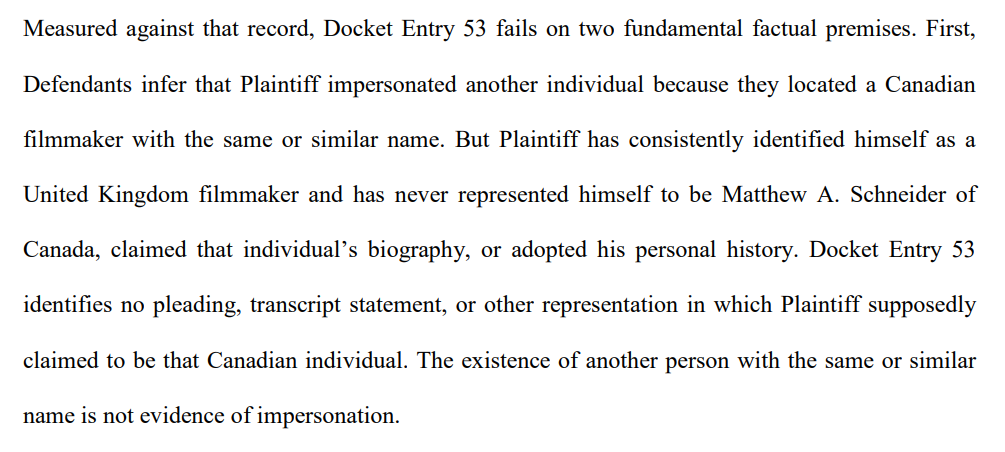
Confronted with compelling declarations from Canada, a rational litigant might have folded. Instead, the individual operating as the plaintiff doubled down. In a sharply worded court filing submitted late last week, the plaintiff argued that the existence of another person bearing the same name is entirely circumstantial and legally irrelevant.
The plaintiff asserted that he has "consistently identified himself in this action as Matthew Schneider, an independent filmmaker and creative professional from the United Kingdom." He maintained that he never claimed to be the Canadian creator, nor did he ever mention Dirtbag Films in his foundational pleadings.
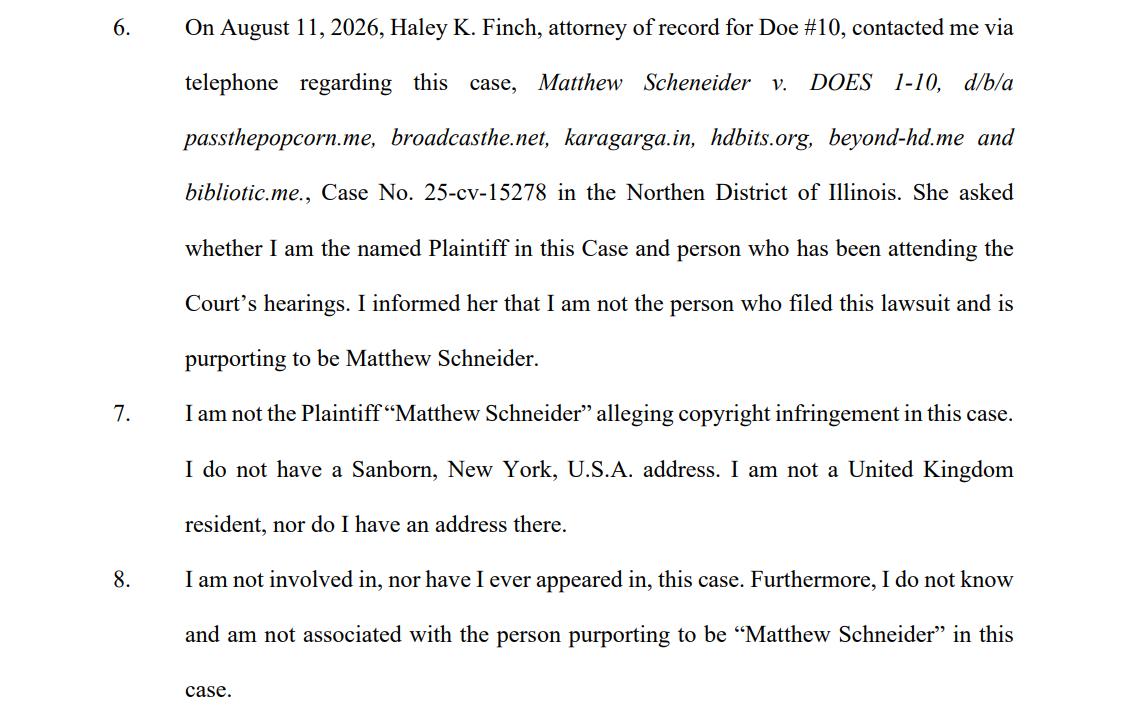
"The existence of another person with the same or similar name is not evidence of impersonation," the plaintiff argued in his formal opposition.
Supporting Context & Metrics
The plaintiff’s defense relies on an astronomical mathematical anomaly: the assertion of an independent, parallel cinematic universe.
The Implausible Coincidence of Identical Titles
To justify his ownership of the works, the UK-based plaintiff filed an evidentiary exhibit containing metadata for his own self-proclaimed versions of the three disputed films. According to his court submissions, he created his versions in the United Kingdom significantly earlier than the Canadian productions:
- Split: A Film Anthology – UK Version dated 2011 (vs. Canadian version in 2017)
- Do Us Part – UK Version dated 2012 (vs. Canadian version in 2017)
- Orlando Gloom, Always the Same – UK Version dated 2012 (vs. Canadian version in 2017)
By establishing dates five to six years prior to the Dirtbag Films releases, the plaintiff argues that he could not possibly have copied works that "did not yet exist."
However, forensic analysis of the submitted metadata reveals glaring omissions. While the exhibit provides rudimentary technical details—filenames, video resolutions, and frame rates—it completely lacks:
- Official U.S. or international copyright office registration numbers.
- Credited cast members or production crew lists.
- High-resolution production stills, behind-the-scenes documentation, or publicly accessible streaming trails.
- Any verification on IMDb or equivalent industry registries.
Furthermore, the statistical improbability of two independent filmmakers sharing the exact same name and producing three identically titled short films is staggering. The anomaly becomes even more glaring with the title "Orlando Gloom, Always the Same." The name "Orlando Gloom" directly references an actual independent musician for whom the Canadian Dirtbag collective explicitly produced an associated music video—a hyper-specific creative collaboration that defies accidental replication by an anonymous UK-based creator.
| Feature / Metric | Canadian Creator (Dirtbag Films) | UK Plaintiff (Current Litigant) |
|---|---|---|
| Geographic Origin | Ottawa, Ontario, Canada | United Kingdom |
| IMDb Documentation | Fully verified with active credits | Non-existent / Unlisted |
| Collaborators | Solmund MacPherson & high-school peers | None publicly verified |
| Audio/Video Evidence | On-screen speaking roles & social media archives | Metadata-only text files |
| Copyright Registration | Unassigned; held by original creators | Unverified / Missing office numbers |
| Scope of Complaint | Defends 3 out of 10 total listed works | Ignores 5 short films & 2 literary works |
Official Statements & Legal Counterattacks
Sensing vulnerability, the individual litigating as Matthew Schneider launched an aggressive procedural counterattack against defense attorneys Erin Russell and Haley Finch, attempting to turn the court’s scrutiny away from his identity and onto the conduct of the defense.
Accusations of Ex Parte Communications
The plaintiff’s response sharply condemns defense counsel for alleged improper ex parte contact with Judge Andrea R. Wood. Specifically, the plaintiff pointed to a phone call made by defense counsel to the judge’s chambers prior to the critical August hearing—a step attorney Russell had previously characterized as an extraordinary, emergency measure.
The plaintiff argues that this phone call violated foundational legal prohibitions against one-sided, unrepresented communications with a judicial officer. Citing the American Bar Association’s (ABA) rules of professional conduct and relevant Seventh Circuit judicial precedent, the plaintiff contends that such contact warrants judicial sanctions.
Within his filings, the plaintiff demands that the court:
- Formally disclose the precise dates and substantive content of the disputed communications.
- Disregard and strike any arguments or evidentiary presentations derived from matters discussed outside his presence.
- Weigh the imposition of professional sanctions against defense counsel Russell and Finch.
Collusion and High School Connections
In an effort to undermine the credibility of the defense’s supporting declarations, the plaintiff’s brief highlights a curious geographical and institutional coincidence: both Canadian declarants (Matthew A. Schneider and Solmund MacPherson) share historical ties to the same Winnipeg high school as defense attorney Haley Finch. The plaintiff argues that these shared institutional connections suggest the declarations cannot be treated as independent, unbiased corroboration without exhaustive judicial inquiry.
Whether Judge Wood views the pre-hearing chambers call as an improper procedural violation or a justified, good-faith alert regarding an active fraud upon the court remains one of the central questions the bench must resolve.
Future Outlook
As this remarkable legal saga approaches its next major milestone, multiple critical questions remain unanswered:
- The Fate of the Unaddressed Works: The plaintiff’s latest defense addresses only three of the ten total works cataloged in the original federal complaint. The remaining five short films and two distinct literary works—which defense counsel asserts have zero verifiable creators or paper trails—remain completely unaccounted for in the plaintiff’s recent filings.
- The In-Person Hearing: All involved parties are scheduled to appear before Judge Andrea R. Wood for a high-stakes, in-person evidentiary hearing later this week. Legal observers anticipate that this confrontation will force the individual claiming to be the UK-based Matthew Schneider to provide concrete, verifiable proof of his identity under oath—or face immediate contempt citations and severe judicial penalties.
- The True Motive Behind the Subpoenas: If the court ultimately determines that the litigant is indeed an impostor, legal analysts will be left to dissect the underlying motivation. The aggressive subpoena campaign targeted at corporate giants like Reddit, Cloudflare, Namecheap, and major financial processors strongly suggests an intent to unmask the private operators of elite torrent tracking ecosystems—whether for civil shakedowns, competitive sabotage, or external intelligence gathering.
For now, the subpoena freeze remains firmly in place, protecting the anonymous operators of PTP, BTN, and companion private trackers. As Judge Wood prepares to weigh conflicting metadata against sworn testimony, canonical high-school filmmaking histories against anonymous UK digital files, and procedural counterattacks against allegations of identity fraud, this case stands as a landmark warning in the intersection of digital privacy, copyright enforcement, and federal litigation integrity.