









Executive Overview
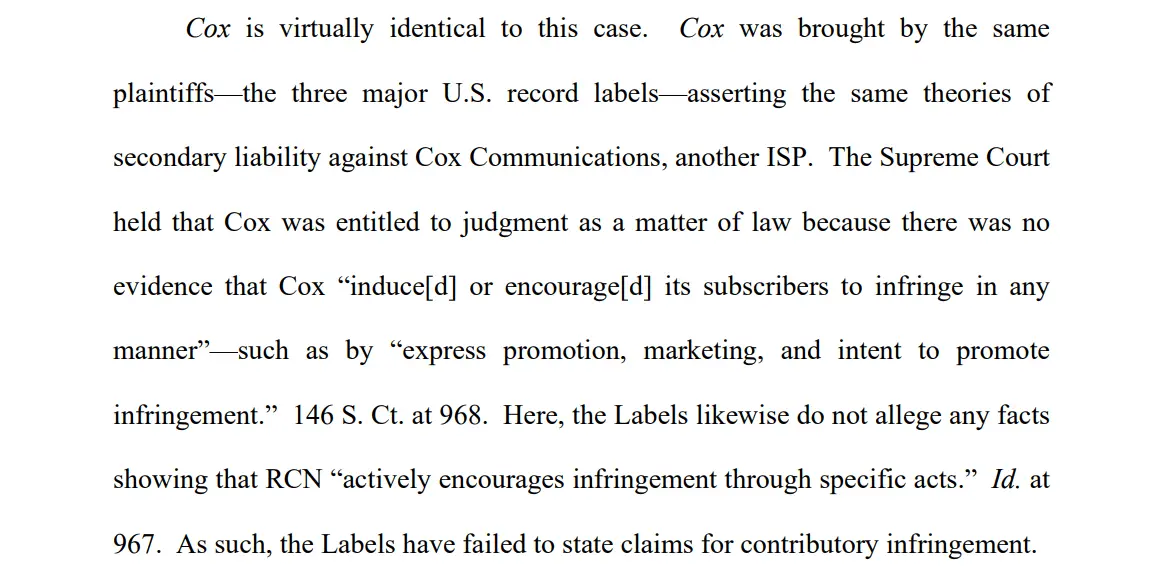
Internet service provider (ISP) RCN has officially petitioned a New Jersey federal court to reconsider a six-year-old ruling and dismiss a high-stakes, multi-million-dollar copyright infringement lawsuit brought by the world’s major record labels. The legal maneuver, filed in the U.S. District Court for the District of New Jersey, hinges directly on a recent, paradigm-shifting decision by the Supreme Court of the United States: Cox v. Sony.
According to RCN, the Supreme Court’s ruling effectively dismantles the foundational legal framework that major copyright holders have used for nearly a decade to target internet service providers for the unlawful downloading habits of their subscribers. Under the new legal standard, ISPs cannot be held liable for contributory copyright infringement simply because they continue to provide internet access to individuals flagged for digital piracy.
With peer ISPs across the United States swiftly securing the dismissal of identical litigation in the wake of the Cox verdict, RCN’s defense team argues that the remaining music industry lawsuit is a procedural anomaly. RCN contends it stands as the last major record label piracy lawsuit of its kind still active in the American court system—a lingering ghost kept alive not by legal merit, but by protracted discovery disputes and tactical leverage.
RCN’s motion asks the federal court to vacate an older 2020 order, dismiss the labels’ amended complaint with prejudice, and bring an abrupt end to a legal saga that has spanned the better part of a decade.
Detailed Chronology: The Evolution of ISP Piracy Liability
To understand the weight of RCN’s current motion, it is necessary to examine the nearly ten-year campaign waged by major entertainment conglomerates against American internet service providers.
The Rise of "Repeat Infringer" Litigation
For years, a united front of major record labels, music publishers, and Hollywood movie studios pursued a unified legal strategy against ISPs. Armed with logs of copyright infringement notices—typically generated by digital anti-piracy tracking firms—rightsholders demanded that ISPs act as digital police forces. Under their theory of the case, internet providers had a legal obligation to aggressively disconnect subscribers accused of downloading copyrighted media via peer-to-peer (P2P) networks like BitTorrent.
When ISPs resisted cutting off paying customers—often citing contractual obligations, due process concerns, or the sheer administrative unreliability of automated infringement notices—rightsholders shifted from negotiation to litigation. They filed sweeping lawsuits alleging two primary theories of secondary liability:
- Contributory Infringement: The argument that the ISP materially contributed to copyright infringement by knowingly continuing to provide services to flagged repeat infringers.
- Vicarious Infringement: The argument that the ISP profited directly from the infringing activity while maintaining the right and ability to supervise or stop it.
For a time, this strategy yielded massive payouts for rightsholders. Most notably, a federal jury handed down a staggering $1 billion verdict against Cox Communications under similar "repeat infringer" claims, setting a terrifying precedent for the telecommunications industry.
The Turning Point: Cox v. Sony
The music and film industries’ grand legal strategy unraveled in March, when the U.S. Supreme Court delivered a decisive blow to rightsholders by reversing the billion-dollar verdict against Cox Communications.
The Supreme Court established a strict, narrow interpretation of contributory infringement in the digital age. The justices ruled that an internet service provider is not contributorily liable for copyright infringement merely because it continues to service subscribers known to have been flagged for piracy. Unless an ISP actively induces copyright infringement—through explicit marketing, encouragement, or providing a network structure devoid of substantial non-infringing uses—its mere provision of standard internet access does not cross the threshold of liability.

Furthermore, the legal battle over vicarious infringement clarified that flat-rate monthly subscription fees do not constitute a "direct financial benefit" derived from copyright infringement. Because subscribers pay the exact same monthly fee regardless of whether they are streaming high-definition educational lectures, browsing social media, or illegally downloading copyrighted albums, the revenue cannot be directly tied to the underlying piracy.
The Immediate Fallout
The impact of the Cox decision was immediate and sweeping. Within weeks of the Supreme Court’s ruling, the recording industry and major Hollywood studios began quietly pulling the plug on their aggressive campaigns against other broadband providers:
- The major labels dropped active secondary copyright infringement lawsuits against Verizon and Altice.
- Movie studios behind major box office titles voluntarily dismissed near-identical lawsuits against RCN with prejudice.
- Parallel litigation against WideOpenWest (WOW!) was similarly terminated by the plaintiffs.
- Sister ISP Grande Communications—which, alongside RCN, operates under the Astound Broadband umbrella—saw the legal landscape shift beneath its feet as well.
According to RCN’s legal filings, virtually every secondary copyright infringement case targeting a major U.S. internet service provider has now been dismissed, settled, or dropped—leaving RCN’s New Jersey case as the solitary outlier.
RCN’s Legal Defense: No Inducement, No Claim
In its freshly minted motion for reconsideration, RCN lays out a comprehensive argument detailing why the Cox precedent applies directly to its own case, completely neutralizing the labels’ claims.
The Collapse of Contributory Infringement
RCN emphasizes that the legal foundation of the record labels’ amended complaint has been rendered legally void by the Supreme Court. Under current law, establishing contributory liability requires concrete proof that an ISP actively engineered its business model to encourage piracy or offered a service with no legitimate, non-infringing purpose.
RCN argues that its internet service is "virtually identical" to the service provided by Cox Communications: it is a standard, general-purpose broadband connection utilized by millions of consumers for everyday digital activities, telecommuting, education, and entertainment. The failure to unilaterally disconnect subscribers based on unverified third-party infringement notices does not legally equate to "intent" or "inducement."
The Myth of "Direct Financial Benefit"
Addressing the second prong of the labels’ complaint—vicarious infringement—RCN underscores that the Fourth Circuit’s reasoning in the Cox litigation (which the Supreme Court ultimately left intact) decisively blocks this claim.
To prove vicarious liability, plaintiffs must demonstrate that the defendant directly profits from the specific infringing acts. RCN points out the undeniable economic reality of modern telecommunications: RCN subscribers pay a fixed monthly fee. Whether a user spends their bandwidth allocation downloading illegal torrents or updating their professional portfolio on LinkedIn, the financial yield to the provider remains entirely unchanged. Therefore, subscription revenue cannot legally be classified as a direct financial benefit derived from copyright infringement.
Supporting Context & Metrics: A Four-Year Standoff and Bureaucratic Leverage
With the substantive legal arguments heavily favoring RCN, the obvious question facing the New Jersey federal court is simple: Why is this specific lawsuit still active after nearly seven years of litigation?
The case originated back in 2019, but it quickly morphed into a protracted legal stalemate. According to RCN’s recent court submissions, the record labels never genuinely intended to take the matter all the way to a jury trial. Instead, RCN alleges that the lawsuit was filed primarily as a strategic cudgel—legal leverage designed to force a favorable settlement in concurrent negotiations with sister company Grande Communications.
Once filed, the case became bogged down in endless administrative and procedural maneuvers centered around internal Digital Millennium Copyright Act (DMCA) records and privilege disputes.
- May 2022: Magistrate Judge Tonianne J. Bongiovanni entered a stay halting all fact depositions until unresolved document discovery disputes could be ironed out.
- The Standstill: That discovery stay has remained firmly in place for years, weathering at least 20 separate discovery letter briefs submitted by both sides.
RCN argues that the record labels are intentionally weaponizing the ongoing privilege dispute to keep the case alive. By dragging out the litigation, the plaintiffs are reportedly banking on the assumption that RCN might eventually capitulate and pay a financial settlement simply to avoid the legal costs and administrative burden of resolving the underlying document disputes.
Official Statements and Procedural Next Steps
The legal posture of both parties reflects a stark divergence in strategy. While RCN has moved aggressively to capitalize on the shifting legal landscape, the major record labels have yet to formally respond to the motion for reconsideration.
In its official filings, RCN has requested that the U.S. District Court for the District of New Jersey take the following decisive actions:
- Vacate the court’s previous 2020 order that allowed the litigation to proceed past initial dismissal stages.
- Dismiss the major record labels’ amended complaint entirely, with prejudice—meaning the claims cannot be refiled.
- Grant an in-person or virtual oral argument to allow legal counsel to articulate how the Cox v. Sony precedent explicitly requires the termination of the case.
Copies of RCN’s formal motion for reconsideration and the accompanying legal memoranda have been made publicly available through the U.S. District Court for the District of New Jersey docket.
Future Outlook: The End of an Era for ISP Piracy Suits?
The outcome of RCN’s motion carries profound implications for the broader telecommunications, technology, and entertainment sectors.
For over a decade, copyright holders utilized the threat of secondary liability lawsuits to compel ISPs into acting as private copyright enforcement agents. The underlying strategy was clear: make the cost of defending massive contributory infringement lawsuits high enough that ISPs would willingly police their networks, track down repeat infringers, and implement automated disconnection policies.
However, the combination of the Supreme Court’s Cox ruling and the systematic withdrawal of parallel lawsuits by major movie studios and record labels signals a definitive closing chapter for this era of copyright litigation. If the New Jersey federal court follows the clear trajectory set by the Supreme Court and grants RCN’s motion, it will mark the final nail in the coffin for the music industry’s campaign against ISP-level piracy liability.
For RCN, a favorable ruling will finally bring closure to a grueling seven-year legal battle. For the wider internet service provider industry, it serves as a triumphant vindication, cementing the legal principle that broadband providers are conduits of digital communication, not guarantors of copyright compliance.