






Executive Overview
At the VMware Explore conference, Broadcom made a landmark announcement aimed at transforming how modern enterprises manage, secure, and deploy open-source software. The company unveiled TrueSource Trusted Artifacts by Broadcom, an expansive suite of hardened libraries and container images designed specifically for the widely used open-source Spring framework, along with the 5,000 vital dependencies required to operate it seamlessly in production environments.
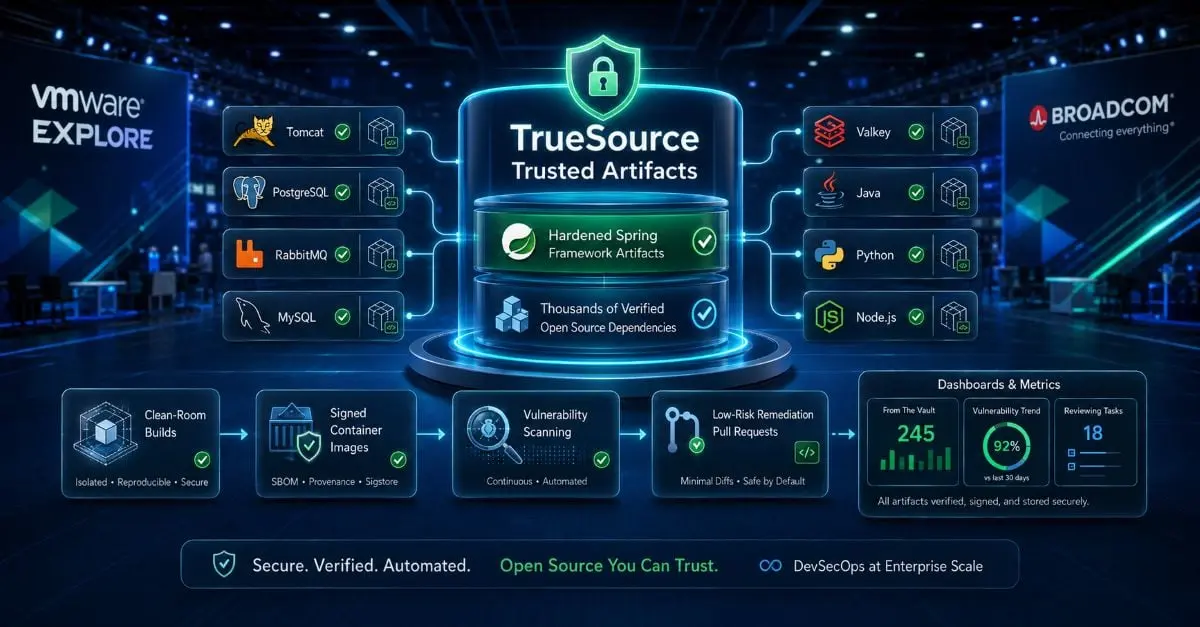
In an era where artificial intelligence has drastically accelerated both the velocity of software development and the sophistication of cyber threats, enterprise DevSecOps teams find themselves overwhelmed. The sheer volume of vulnerabilities, security advisories, and code patches has outpaced human capacity. Broadcom’s TrueSource initiative attempts to bridge this gap by combining advanced AI scale with rigorous human engineering. The service provides secure, clean-room-built libraries for Java, Python, and Node.js—spanning major data engines and middleware such as Apache Tomcat, Kotlin, PostgreSQL, RabbitMQ, MySQL, and Valkey. Furthermore, it integrates deeply with the Bitnami Secure Images catalog to deliver verifiably built container images for hundreds of popular open-source packages.
By automatically scanning customer codebases, assessing the "blast radius" of potential vulnerabilities, and opening low-risk pull requests, TrueSource seeks to lift the administrative and technical burden of vulnerability management off enterprise engineering teams. This comprehensive report explores the drivers behind Broadcom’s announcement, the technical architecture of TrueSource, executive insights from industry leaders, and the broader implications for the future of enterprise software security.
Detailed Chronology of the Open-Source Security Crisis
To understand the strategic significance of Broadcom’s TrueSource release, one must examine the compounding pressures that have transformed open-source maintenance from a manageable community task into a high-stakes enterprise security challenge.
The Rise of AI-Driven Vulnerabilities
Over the past two years, the proliferation of generative AI and frontier large language models (LLMs) has fundamentally altered the threat landscape. Bad actors and automated threat scripts now leverage AI to scan open-source repositories, discover zero-day vulnerabilities, and synthesize functional exploits at an unprecedented scale.
Simultaneously, development teams are utilizing AI coding assistants to write code faster than ever before. While this boosts productivity, it often introduces complex dependency chains and subtle bugs that traditional static application security testing (SAST) tools struggle to catch. The result is a hyper-accelerated cycle where vulnerabilities are identified, weaponized, and deployed faster than security teams can issue patches.
The Historic Surge in Spring Advisories
Earlier this year, Broadcom published alarming internal metrics revealing a 1,700% surge in monthly security advisories reported by the Spring community. This exponential increase culminated in the generation and delivery of the largest set of security patches in the 23-year history of the Spring framework.
For decades, the Spring framework has served as the foundational backbone for enterprise Java applications globally. A disruption or security flaw within its ecosystem reverberates across thousands of corporate infrastructures worldwide. Recognizing that traditional, manual patch management was no longer viable in the face of this 1,700% surge, Broadcom’s Tanzu Division accelerated the development of a centralized, automated remediation pipeline.
The VMware Explore Unveiling
Culminating months of intensive behind-the-scenes engineering and large-scale AI modeling, Broadcom officially introduced TrueSource at the VMware Explore conference. The announcement marked a strategic shift from reactive patching to proactive, automated supply chain fortification. Rather than leaving individual enterprises to navigate the deluge of advisories, Broadcom positioned TrueSource as an end-to-end trust pipeline—taking raw open-source components, hardening them in a clean room, validating them through human engineers, and delivering them directly into customer workflows with automated remediation pathways.
Technical Architecture & Core Capabilities of TrueSource
TrueSource Trusted Artifacts by Broadcom is not merely a repository of secure code; it is an integrated ecosystem designed to secure every layer of the enterprise software stack.
Clean-Room Construction and Human Validation
At the heart of TrueSource is a rigorous curation and build process. The service provides curated artifacts written in Java, Python, and Node.js, built from the ground up in secure clean-room environments. These include instances of critical data engines and middleware:
- Apache Tomcat
- Kotlin
- PostgreSQL
- RabbitMQ
- MySQL
- Valkey
Every library and artifact is vetted against a strict enterprise reference architecture. Crucially, while Broadcom utilizes frontier AI models to scan and analyze vast expanses of code, every patch and artifact is ultimately built and verified by human Broadcom engineers.
This human-in-the-loop requirement is a vital differentiator. Broadcom emphasizes that AI-generated patches, while fast, frequently introduce regression bugs, logic errors, or compatibility issues that can crash production applications. By insisting on human validation, Broadcom ensures that enterprise stability is never sacrificed for raw speed.
Automated Remediation and Pull Request Workflows
TrueSource extends far beyond static artifact delivery by actively participating in the enterprise software lifecycle:
- Repository Scanning: The service continuously scans customer repositories to map their exact dependency trees.
- Blast Radius Assessment: When a new vulnerability or patch is released, TrueSource assesses the potential "blast radius"—determining precisely which applications and services within the enterprise are impacted.
- Automated Pull Requests: Rather than dumping advisory reports onto overwhelmed DevSecOps desks, TrueSource automatically opens pull requests based on the lowest-risk remediation path identified.
- DevSecOps Dashboards: Dedicated dashboards allow engineering and security teams to track fixed vulnerabilities, monitor pending tasks, and audit compliance in real-time.
Early Access and Critical Infrastructure Programs
Recognizing that not all organizations face the same threat profiles, Broadcom has integrated specialized tiers within the TrueSource framework:
- Early Access Remediation: DevSecOps teams can submit not-yet-public vulnerabilities they discover internally for early-access remediation and collaborative patching.
- Critical Infrastructure Protection: A specialized program dedicated to critical infrastructure organizations (such as financial institutions, healthcare providers, and government agencies) provides dedicated access to deep patch insights, threat intelligence, and tailored mitigation advice.
Finally, in keeping with the spirit of open-source collaboration, Broadcom has committed to contributing all internally developed fixes and remediations directly back to the original maintainers of the open-source software projects.
Supporting Context, Metrics, and Industry Analysis
The launch of TrueSource addresses deep-seated inefficiencies in modern software engineering. To fully grasp its impact, industry analysts have evaluated both the scale of Broadcom’s internal efforts and the operational relief the service brings to corporate IT departments.
The Twelve Billion Token Investment
Scaling security analysis to match the volume of modern threats requires computational power on an industrial scale. According to Purnima Padmanabhan, General Manager for the Tanzu Division at Broadcom, company engineers spent over 12 billion tokens against frontier AI models over a five-month period.
This massive computational investment was directed toward scanning the entire Spring portfolio. By deploying AI at this scale before vulnerabilities were publicly exploited, Broadcom’s engineering teams ensured that every supported release line was patched proactively, intercepting threats before they could be weaponized in the wild.
Streamlining the Enterprise Software Supply Chain
Mitch Ashley, Vice President and Practice Lead for Software Lifecycle Engineering at The Futurum Group, highlighted the operational transformation enabled by TrueSource. According to Ashley, implementing a curated pipeline directly inside a customer’s build and deploy path satisfies a fundamental requirement of modern software supply chain security.
"Teams pull libraries, images, and data engines already built, signed, and pinned to the versions their release lines support, with automation that opens pull requests carrying the lowest-risk fix," Ashley noted.
For years, enterprises have absorbed an unsustainable amount of overhead dedicated to manual tasks: triaging a ceaseless stream of security advisories, running localized tests on patches, and gambling on what is safe to ship to production. By automating this entire pipeline—from threat discovery to low-risk pull request generation—TrueSource returns thousands of productive hours to enterprise engineering organizations.
Frequently Asked Questions (FAQ)
To provide additional clarity on Broadcom’s TrueSource offering, the following frequently asked questions address the core mechanics, technological scope, and strategic rationale behind the service:
Why does Broadcom emphasize human validation of AI-generated patches?
While artificial intelligence dramatically accelerates vulnerability discovery and the initial drafting of code patches, raw AI outputs frequently lack contextual awareness regarding production environments. Unverified AI patches can introduce severe compatibility issues, break downstream dependencies, or inadvertently cause application crashes. By having human Broadcom engineers review, test, and verify every supported artifact, the company ensures that enterprise-grade stability and security go hand-in-hand.
What open-source technologies are included in the TrueSource service?
The offering encompasses the enterprise edition of the Spring framework, along with its 5,000 vital dependencies. It provides secure, clean-room-built libraries for Java, Python, and Node.js, including enterprise instances of Apache Tomcat, Kotlin, PostgreSQL, RabbitMQ, MySQL, and Valkey databases and middleware. Additionally, the service extends to the Bitnami Secure Images catalog, supplying hardened, verifiably built container images for hundreds of commonly deployed open-source packages.
Why is Broadcom expanding its Spring security efforts at this specific time?
Broadcom’s aggressive expansion is a direct response to a massive escalation in cyber threats. Earlier this year, the company revealed that monthly security advisories reported by the Spring community surged by more than 1,700%. This explosion of alerts generated the largest collection of security patches in the framework’s 23-year history. TrueSource was built specifically to provide automated, curated remediation, allowing DevSecOps teams to keep pace with an otherwise overwhelming volume of vulnerabilities.
Future Outlook: The New Paradigm of Secure Open-Source Consumption
As we look toward the future of enterprise software engineering, the release of Broadcom’s TrueSource serves as a bellwether for how the technology industry will manage open-source risk in the age of AI.
The traditional model—where enterprise IT departments independently monitor open-source repositories, manually vet security advisories, and scramble to apply patches under tight deadlines—is officially broken. The asymmetry between automated AI-driven attacks and manual human defense has made traditional patch management unsustainable.
Broadcom’s holistic approach points the way forward. By fusing industrial-scale AI scanning (evidenced by their 12-billion-token initiative) with rigorous human engineering, clean-room builds, and automated pull-request workflows into customer environments, Broadcom is redefining enterprise trust.
In the coming years, success in enterprise software development will no longer be measured solely by how fast features can be shipped, but by how seamlessly and securely the underlying software supply chain can be maintained. Platforms like TrueSource signal that the industry is moving from an era of reactive firefighting to an era of automated, predictive resilience—ensuring that open source can continue to power the global digital economy safely and sustainably.