









Executive Overview
For years, sports federations, major broadcasting networks, and rightsholders have sounded alarm bells over the rampant, highly profitable underground economy of unauthorized live-streaming. Despite mounting pressure, the European Union’s approach to tackling digital piracy has long been criticized as fragmented, sluggish, and fundamentally ill-equipped to combat the blistering speed of modern live broadcasts.
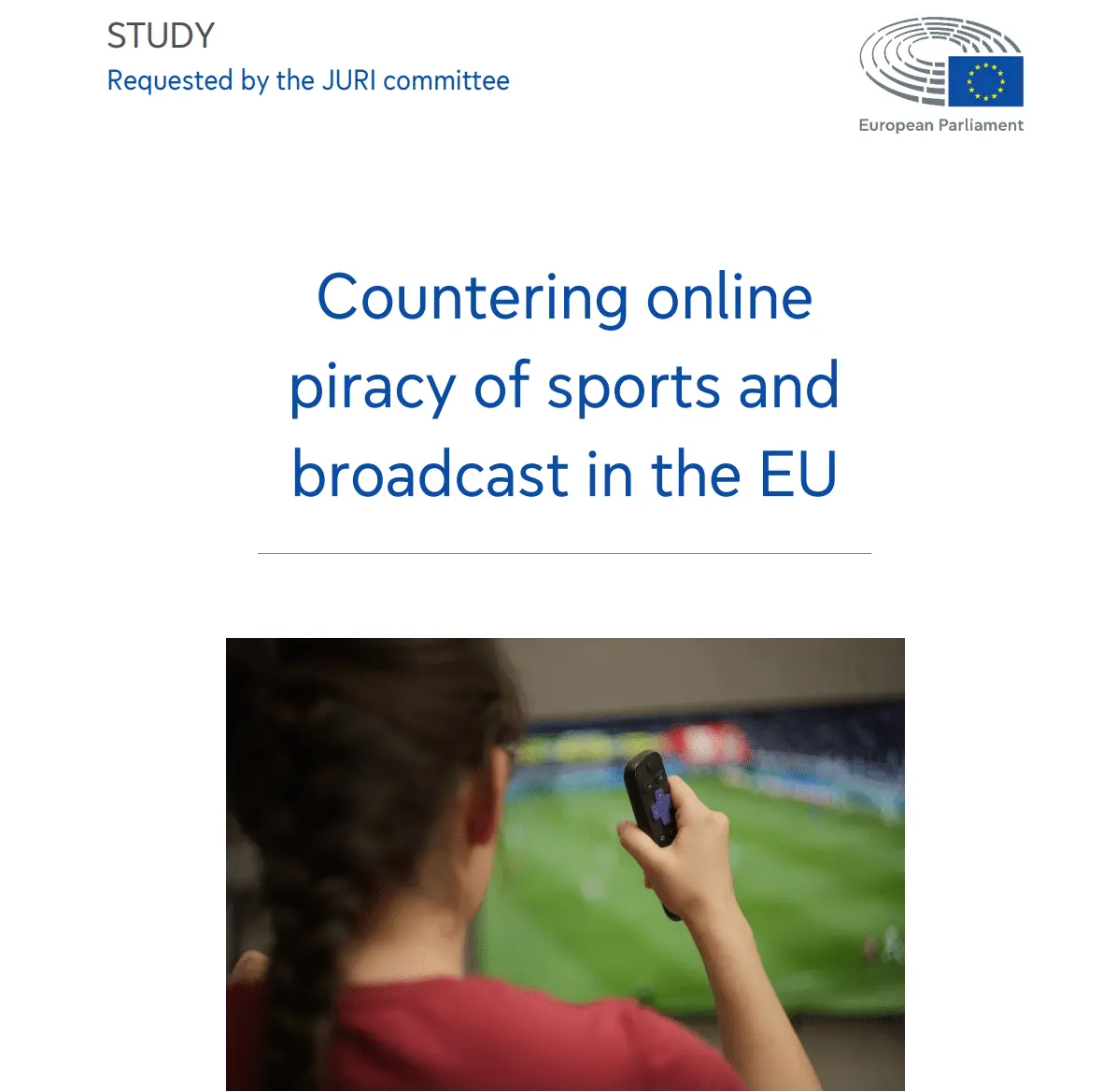
Now, a sweeping new study commissioned by the European Parliament’s Committee on Legal Affairs (JURI) threatens to upend the status quo. Authored by Professor Giovanni Maria Riccio of the University of Salerno and titled “Countering online piracy of sports and broadcast in the EU,” the report delivers an unvarnished assessment of current enforcement mechanisms. Its core thesis is simple yet radical: voluntary guidelines have failed, and the EU must transition to a hard, binding Regulation specifically targeted at live-content piracy.
At the center of the report’s recommendations is a controversial measure modeled closely on Italy’s aggressive “Piracy Shield” system: a mandatory 30-minute takedown timer for internet service providers (ISPs) and a vast expansion of targets to include content delivery networks (CDNs), virtual private network (VPN) providers, and third-party Domain Name System (DNS) resolvers.
However, the path forward is fraught with friction. While rightsholders celebrate the push for decisive, union-wide enforcement, civil liberties groups, tech giants, and technical experts have raised serious red flags. The report itself openly acknowledges that IP and DNS blocking are "blunt instruments" prone to severe collateral damage—highlighting real-world instances where aggressive anti-piracy blocks accidentally torpedoed access to major humanitarian, educational, and corporate cloud infrastructure.
As the European Commission weighs its ongoing review of the Copyright in the Digital Single Market Directive, this study serves as both a roadmap for aggressive copyright enforcement and a cautionary tale about the perils of sweeping digital blocks.
Detailed Chronology of EU Anti-Piracy Policy
To understand the weight of Professor Riccio’s new study, it is necessary to examine how the European Union’s legislative landscape has evolved in response to live-streaming piracy.
The Era of Voluntary Guidance (2023)
For well over a decade, rightsholders across Europe argued that existing intellectual property enforcement directives—such as the 2004 Enforcement Directive and the 2001 InfoSoc Directive—were designed for an analog or static digital era. They could not keep pace with pirated streams of UEFA Champions League matches, Formula 1 races, and high-stakes boxing bouts that materialize and vanish within minutes.
Under immense pressure, the European Commission stepped in during May 2023, publishing a targeted recommendation designed to encourage member states to implement prompt, administrative takedowns of live streams. However, the document came with a fatal flaw for rightsholders: it was entirely non-binding.
While proactive nations like Italy took the recommendation as a green light to build radical new automated systems, other EU member states took little to no action. The result was a patchwork enforcement landscape across the continent, where a pirate stream easily accessible in one country could be swiftly blocked in another, creating a legal loophole that bad actors routinely exploited.
The Rise of Italy’s "Piracy Shield"
Frustrated by legislative inertia, Italy forged ahead alone, launching its infamous Piracy Shield platform. Designed to automate the blocking of IP addresses and domain names associated with unauthorized live sports broadcasts, the system gained notoriety for its unprecedented velocity. Under Italian law, rightsholders can flag illicit streams, and certified intermediaries are legally compelled to execute blocks within a blistering 30-minute window.
While Italy hailed the Piracy Shield as an unmitigated success for copyright protection, digital rights advocates and technical communities viewed it with deep suspicion, citing a lack of judicial oversight and an alarming frequency of "collateral damage."
The JURI Committee Intervenes (2025/2026)
Recognizing that voluntary frameworks and fragmented national initiatives were falling short, the European Parliament’s JURI Committee commissioned Professor Riccio to evaluate the state of play. The resulting study marks a watershed moment. Rather than tweaking existing voluntary codes, the report explicitly calls for the EU to scrap soft law in favor of a hard, uniform Regulation.

By demanding that the European Commission codify strict, time-sensitive blocking mandates across all 27 member states, the JURI-backed study has reignited an existential debate over the balance between intellectual property enforcement and fundamental digital rights.
Supporting Context & Metrics: The Mechanics of the 30-Minute Mandate
The centerpiece of the JURI-commissioned report is its architectural blueprint for a pan-European enforcement apparatus. If implemented, the study’s proposals would fundamentally alter how internet infrastructure operates across the continent.
The 30-Minute Takedown Window
Mirroring the Italian model, the report urges the EU to institute a mandatory 30-minute limit for the disabling of illicit live streams. Proponents argue that the economic value of live broadcasts has an exceptionally short half-life; a pirated football match loses 90% of its commercial value the moment the final whistle blows. A takedown process that takes days, or even hours, is functionally useless against live-streaming piracy.
However, enforcing a strict 30-minute clock across diverse national legal systems requires unprecedented levels of automation. This realization brings the report to its most expansive—and contentious—recommendation: expanding the scope of liable intermediaries.
Expanding the Target Chain: Beyond ISPs
Historically, site-blocking and takedown orders targeted traditional Internet Service Providers (ISPs), forcing them to block domain names or specific IP addresses at the consumer router level. The new study argues that modern pirates easily bypass ISP-level blocks by utilizing decentralized architectures, dynamic DNS routing, and commercial proxy tools.
Consequently, Professor Riccio recommends extending the personal scope of anti-piracy obligations to the entire technical chain of internet distribution. This includes:
- Content Delivery Networks (CDNs): Global caching and distribution giants like Cloudflare that sit between origin servers and end-users.
- Virtual Private Network (VPN) Providers: Commercial services that mask user locations and traffic destinations.
- Dedicated Server Providers: Hosting companies that lease unmanaged infrastructure to streaming syndicates.
- Third-Party DNS Resolvers: Public resolution systems such as Google Public DNS and OpenDNS.
European courts have already begun testing these waters. For instance, the Paris Judicial Court previously issued simultaneous site-blocking orders compelling not just ISPs, but also DNS resolvers and VPN providers, to sever access to identified pirate networks. The JURI report seeks to codify this judicial trend into statutory law.
Replicating AGCOM Across the Union
To oversee this complex machinery, the study suggests that every EU member state establish an independent administrative authority modeled after Italy’s Communications Authority, AGCOM. Rather than forcing rightsholders to initiate costly, protracted civil lawsuits in traditional courts for every single match, these administrative bodies would act as fast-track arbiters, vetting infringement notices and issuing rapid-fire blocking decrees.
The Persistent Shadow of Overblocking and Collateral Damage
Despite leaning heavily into the aggressive Italian administrative model, the study’s author is careful to acknowledge the dark side of automated blocking: collateral damage.
The Overblocking Problem
IP and DNS blocking have long been criticized by network engineers as clumsy, indiscriminate instruments. Because modern cloud infrastructure relies heavily on shared IP addresses—where a single IP address can host thousands of distinct websites, applications, and corporate endpoints—blocking an IP address to stop a single pirate video stream often takes down innocent bystanders.
The report cites chilling empirical evidence of this phenomenon. Research from the Open Observatory of Network Interference (OONI) analyzed the fallout from a sweeping LaLiga blocking order in Spain. The data revealed that during football match broadcasts, more than 554,000 domains were blocked at least once.
Among the collateral casualties were websites belonging to globally recognized humanitarian and civic institutions, including:

- Amnesty International
- UNICEF
- The United High Commissioner for Refugees (UNHCR)
- The American Civil Liberties Union (ACLU)
- The Australian Senate
- Critical enterprise cloud endpoints like Amazon S3
Furthermore, the study references a landmark report from the Centre for European Policy Studies (CEPS)—covered extensively by TorrentFreak earlier this year—which went so far as to call for an outright ban on IP-based blocking while demanding that rightsholders be held financially liable for the collateral damage they inflict on innocent third parties.
Reconciling Contradictions
It is one of the study’s most paradoxical elements: it explicitly cites data proving that mass IP-blocking causes widespread collateral damage, yet it nevertheless recommends exporting the Italian Piracy Shield approach across the entire European Union.
To bridge this cognitive dissonance, the report proposes a series of institutional safeguards. It suggests limiting blocks strictly to the duration of the live event, maintaining rigorous judicial or administrative oversight, and ensuring that any enforcement action complies strictly with the proportionality standards established by the Court of Justice of the European Union (CJEU). Whether these theoretical safeguards can prevent technical overreach in the heat of a live sports broadcast remains a fiercely contested point.
Official Positions and the Demand-Side Dilemma
While the debate over technical enforcement dominates legislative corridors, the JURI report introduces a refreshing nuance often missing from copyright lobbying: the acknowledgment that enforcement alone cannot solve piracy.
The Root Cause: Friction and Cost
Professor Riccio’s study explicitly recognizes that no amount of technical blocking or 30-minute timers will extinguish piracy if legal viewing options remain fragmented, prohibitively expensive, and user-unfriendly.
Modern sports fans face an increasingly frustrating digital landscape. To follow their favorite teams, leagues, and competitions, consumers are frequently forced to subscribe to multiple competing streaming platforms, navigate aggressive geo-blocking barriers, and contend with confusing tiered pricing models. For many fans, the sheer friction and cost of legal consumption serve as the primary drivers toward free, albeit illicit, streaming alternatives.
To balance the enforcement equation, the study urges policymakers and media conglomerates to focus heavily on the demand side. It calls for the creation of more accessible, competitively priced, and friction-free legal options that make paying for content easier than pirating it.
Stakeholder Divide
As the European Commission continues its review of the Copyright in the Digital Single Market Directive, the battle lines are firmly drawn:
- Pro-Blocking Advocates & Rightsholders: Major sports leagues, film studios, and broadcasting alliances argue that without binding EU-wide regulations and ultra-fast takedown mechanisms, digital piracy will hollow out the economic foundations of live entertainment. They view the JURI study as an urgent and necessary call to action.
- Anti-Blocking Advocates & Tech Giants: Civil liberties organizations, open-internet advocates, and major tech firms (including Google) warn that mandatory rapid-blocking regimes create a slippery slope toward systemic censorship, erode network integrity, and threaten freedom of expression through reckless overblocking.
Future Outlook: What Lies Ahead for EU Copyright Law?
For now, the JURI committee study remains a piece of advisory third-party scholarship rather than binding European law. It carries no immediate legislative force, but its timing is critical.
The European Commission is currently deep in its review cycle regarding digital copyright frameworks. The recommendations put forward by Professor Riccio will undoubtedly serve as heavy artillery for rightsholders lobbying Brussels for stricter rules, while simultaneously providing digital rights defenders with documented evidence of the dangers of overblocking.
Whether the European Union will take the bold—and controversial—step of enacting a binding Regulation featuring a 30-minute takedown timer and an army of national AGCOM equivalents depends entirely on how effectively policymakers can weigh the commercial survival of the sports broadcasting industry against the structural health and openness of the internet. One thing is certain: the high-stakes chess match between European legislators, rightsholders, and digital pirates is entering its most intense phase yet.