Executive Overview
In a dramatic escalation of its two-decade campaign against digital piracy, adult entertainment powerhouse FlavaWorks has targeted the users of the now-defunct private platform Gay-Torrents.org with a sweeping federal lawsuit. Filed in the U.S. District Court for the Northern District of Illinois, the complaint leverages the Racketeer Influenced and Corrupt Organizations (RICO) Act—a statute more commonly associated with organized crime and mafia syndicates than online copyright enforcement.
The lawsuit targets 75 individuals: one explicitly named "anchor defendant" from Virginia and 74 anonymous "John Doe" defendants identified solely by their site usernames and internal user identification numbers. By invoking RICO, FlavaWorks has brilliantly bypassed traditional jurisdictional roadblocks that previously plagued its litigation efforts, enabling the company to sue defendants scattered across the United States in a single Illinois court.
The legal action alleges a sophisticated, multi-year conspiracy involving the unauthorized distribution of copyrighted works, systematic wire fraud disguised as fake web-hosting fees, and an enterprise that allegedly generated upwards of €7 million over 17 years. While the primary target of the crackdown—the private tracker itself—has already vanished under the weight of earlier legal pressure, this latest RICO-backed maneuver signals a terrifying new frontier for digital piracy participants, raising the stakes from routine copyright infringement to potentially catastrophic treble damages.
Detailed Chronology: From First Strikes to the RICO Pivot
To understand the magnitude of the current lawsuit, one must examine the timeline of events that transformed a standard copyright dispute into a federal racketeering case.
The Initial Assault (Early 2025)
Earlier this year, FlavaWorks initiated a high-profile federal lawsuit against Gay-Torrents.org, its operators, administrators, an offshore Bulgarian shell company, and roughly 325 individual members. The primary objective of that initial lawsuit was twofold: to choke off the site’s operational capacity and to hold its user base accountable for feeding the platform’s inventory.
The pressure proved insurmountable for the site’s operators. Faced with mounting legal defense costs and aggressive asset-freezing requests targeting payment processors like PayPal, Gay-Torrents.org abruptly vanished from the internet.

Shrinking the Scope, Changing the Strategy
Following the site’s closure, FlavaWorks quickly realized that its initial legal framework—grounded primarily in standard copyright and state-law claims—faced structural vulnerabilities. Specifically, federal courts outside of Illinois posed jurisdictional challenges, forcing the company to dramatically narrow its initial batch of defendants from 325 down to just 39 users.
Recognizing that traditional copyright litigation was too porous to capture a nationwide network of pirates, FlavaWorks’ legal team went back to the drawing board. Last week, they filed a brand-new, highly aggressive complaint in the Illinois federal court. This time, they abandoned purely piecemeal copyright claims in favor of a comprehensive RICO strategy, targeting a fresh batch of 75 members.
Supporting Context & Metrics: Inside the Alleged Enterprise
FlavaWorks’ new complaint paints a detailed, data-driven picture of how Gay-Torrents.org operated behind closed doors as an "association-in-fact enterprise."
The Sharing-Ratio Eco-System and VIP "Funders"
According to the legal filing, the enterprise relied on a symbiotic two-tier user structure:
- Lower-Rung Participants: Members who uploaded and downloaded infringing content, fueling the site’s massive library while maintaining the platform’s mandatory sharing-ratio system.
- VIP Funders: Members who paid real-world currency to bypass sharing restrictions and unlock premium privileges.
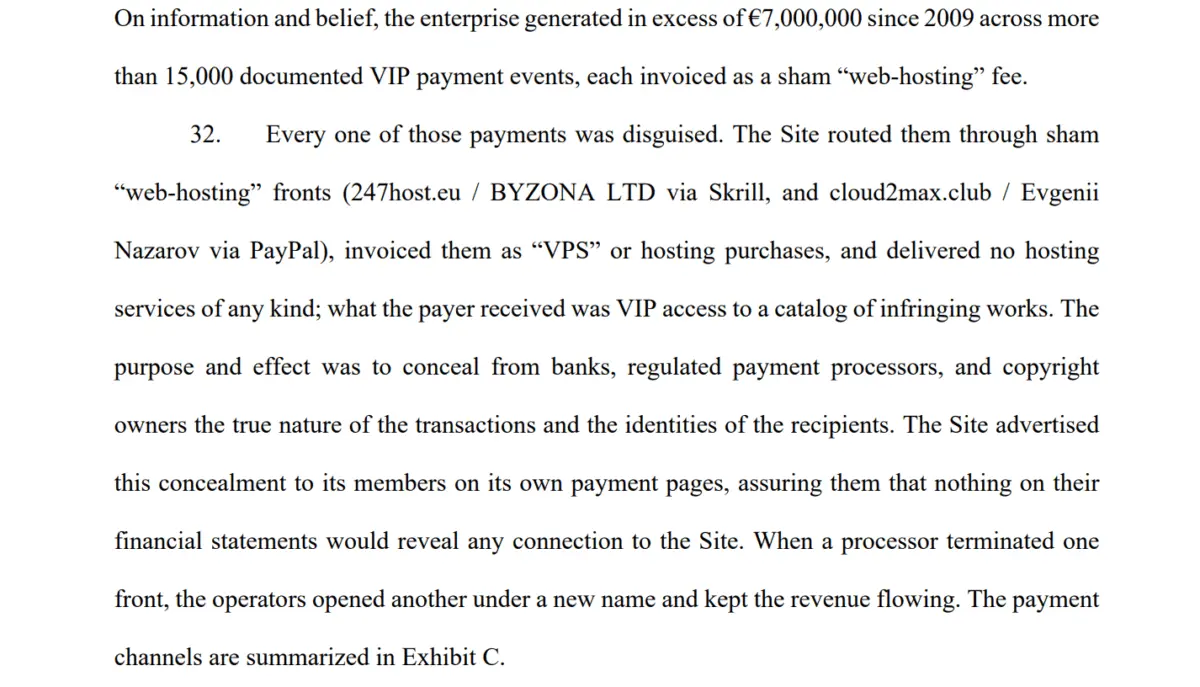
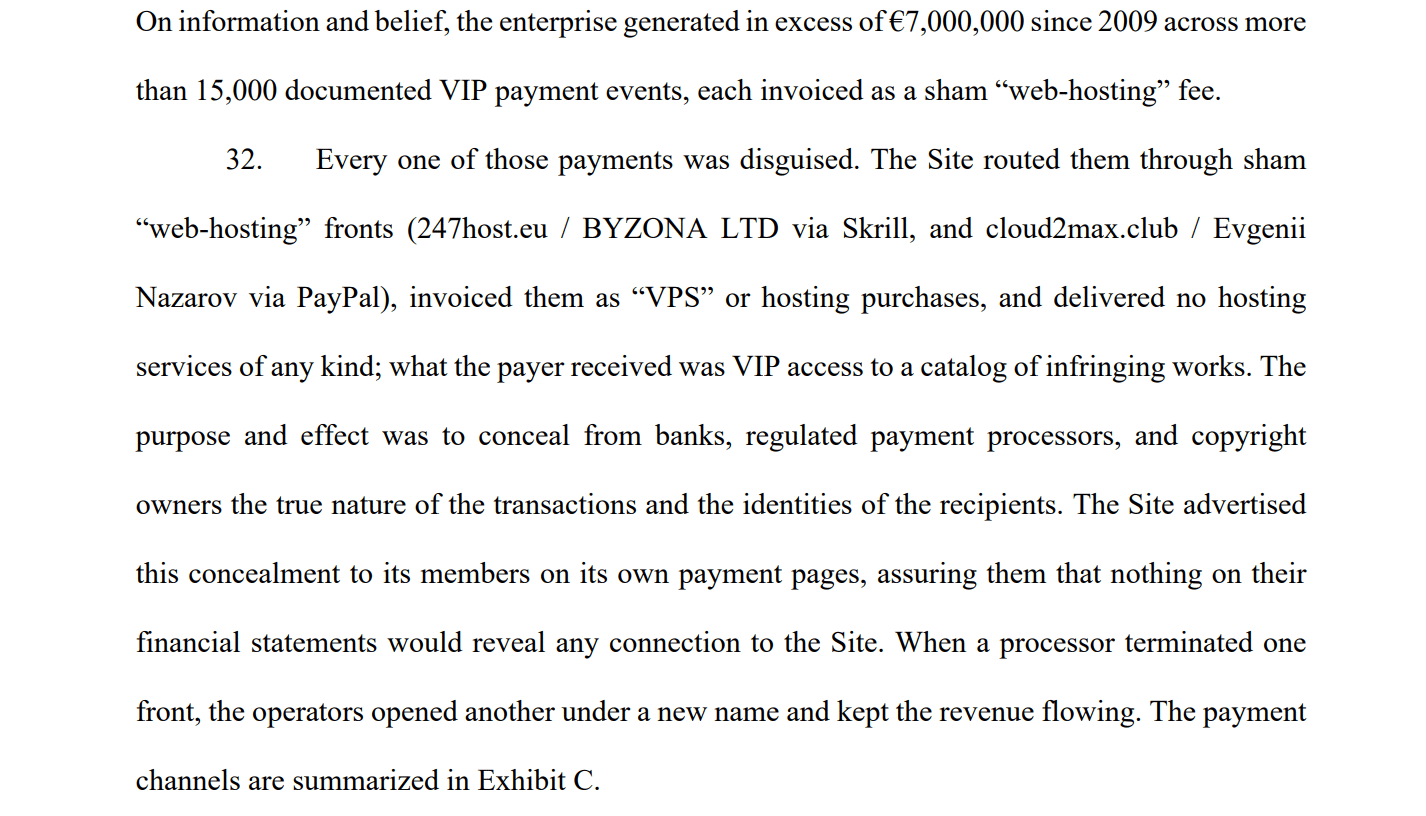
FlavaWorks alleges that these financial transactions were intentionally obfuscated. Rather than paying directly for adult content or tracker access, members were directed to sham web-hosting fronts where they purchased "Virtual Private Server (VPS) plans" that did not actually exist. This elaborate shell game was allegedly designed to mask the true nature of the transactions from commercial banks, credit card companies, and major payment processors.
The €7 Million Financial Footprint
Through forensic accounting and internal metrics, FlavaWorks estimates that the enterprise generated in excess of €7,000,000 since 2009 across more than 15,000 documented VIP payment events—each meticulously invoiced as a sham web-hosting fee. This multimillion-euro figure was initially cited in earlier attempts to secure asset-freezing injunctions against platforms like PayPal and Skrill, and it now serves as the financial baseline for the enterprise damages claimed under the RICO framework.
The Forensic Watermarking Trail
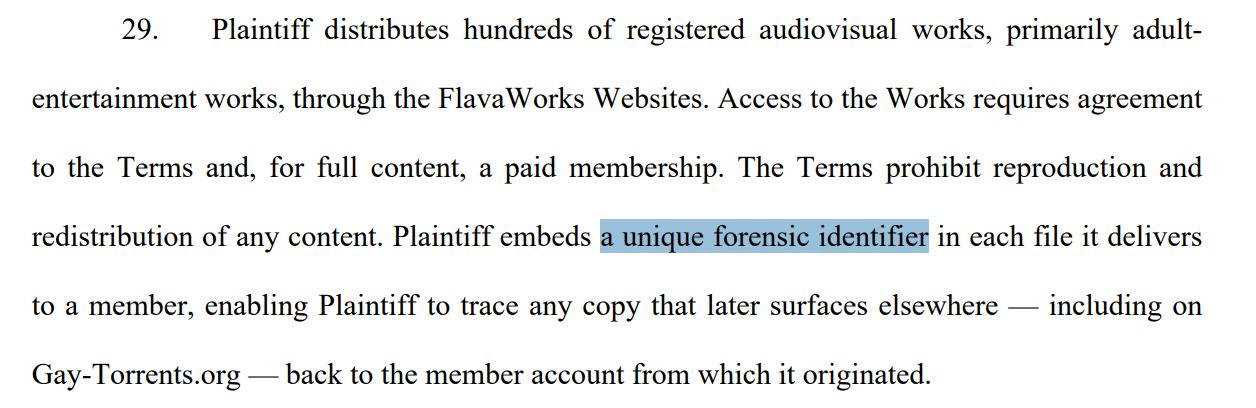
The cornerstone of the individual evidence trail rests on FlavaWorks’ proprietary forensic watermarking technology. Every video file distributed to legitimate subscribers contains a unique, invisible identifier embedded into the media data.
The sole named defendant in the current complaint—Jason A. S., a Virginia resident—was a paying subscriber to FlavaWorks’ legal platforms between March 2020 and July 2021. During that window, he allegedly downloaded more than 200 copyrighted works. When those exact files, stamped with his unique forensic identifier, surfaced on Gay-Torrents.org, FlavaWorks’ automated tracking systems flagged the breach.
Despite receiving a formal cease-and-desist letter in 2022, Jason A. S. allegedly continued his participation on the private tracker up until 2025. Because he allegedly both downloaded/uploaded content and paid for a VIP membership, he functions under the complaint as the critical "anchor defendant." His connection to Illinois establishes the jurisdictional hook required to drag dozens of out-of-state John Doe defendants into the same courtroom.
Legal Mechanics: Why RICO Changes the Game
The decision by FlavaWorks to invoke the Racketeer Influenced and Corrupt Organizations Act represents a masterclass in aggressive litigation strategy, fundamentally altering the rules of engagement in intellectual property disputes.
| Feature | Standard Copyright Lawsuit | RICO-Based Lawsuit |
|---|---|---|
| Jurisdictional Reach | Limited by state lines; requires separate filings in each defendant’s home state. | Nationwide Service of Process: One "anchor defendant" in Illinois brings all U.S.-based co-conspirators into the same court. |
| Liability Scope | Defendants are only liable for the specific files they personally uploaded or downloaded. | Conspiracy Liability: A member who only paid VIP fees can be held liable for all copyright infringements committed by the enterprise. |
| Damages Multiplier | Statutory damages (up to $150,000 per work) or actual damages. | Treble Damages: Potential to triple the final damage awards, alongside compounding penalties. |
| Evidentiary Burden | Proof of direct or contributory copyright infringement. | High burden requiring proof of a "pattern of racketeering activity," enterprise structure, and wire fraud details. |
Overcoming Jurisdictional Hurdles
In typical copyright cases against decentralized online communities, plaintiffs run aground when trying to sue defendants living across different federal districts. Under normal circumstances, an Illinois court lacks personal jurisdiction over a file-sharer living in California or Texas.
RICO completely upends this limitation. By establishing nationwide service of process, a plaintiff only needs to anchor one defendant to the forum state (in this case, Jason A. S. in Virginia and the enterprise’s historic roots in Illinois). Once that anchor is secured, every co-conspirator residing within the United States can be summoned to the same judicial district.
Conspiracy Liability and Wire Fraud
Furthermore, the inclusion of wire fraud allegations significantly broadens the scope of culpability. Under RICO conspiracy doctrines, even a passive user who never uploaded a single byte of data but financially supported the site via sham web-hosting fees can be held legally responsible for the entire scope of the enterprise’s copyright violations.
However, this aggressive legal positioning is not without its risks. The evidentiary bar for RICO is exceptionally high. FlavaWorks must meticulously document the "who, what, when, and where" of every alleged wire fraud transaction and convincingly demonstrate a continuous pattern of racketeering activity. Proving these complex elements at trial is exponentially more difficult and expensive than securing default judgments in standard copyright infringement actions.
Official Statements and Industry Implications
While formal statements from the defendants remain sparse given the anonymity of the John Doe designations, legal analysts and industry watchers have not minced words regarding the far-reaching implications of FlavaWorks’ strategy.
Legal experts note that while FlavaWorks has already achieved its primary strategic objective—forcing the permanent shutdown of Gay-Torrents.org—the pursuit of individual users serves as a chilling deterrent across the broader private tracker ecosystem.
"By weaponizing RICO against file-sharing communities, copyright holders are attempting to rewrite the playbook for digital enforcement," notes one digital rights attorney tracking the case. "If this strategy survives judicial scrutiny and motion-to-dismiss phases, private trackers will no longer just worry about losing their domains; their users will face the existential threat of federal racketeering charges and financial ruin."
The transition from targeting site operators to aggressively prosecuting low-level participants and financial contributors sends an unmistakable message to the underground sharing community: anonymity behind pseudonyms, user IDs, and pseudo-anonymous payment processors is increasingly porous when confronted with sophisticated forensic watermarking and aggressive corporate legal teams.
Future Outlook: What Lies Ahead for the 74 John Does?
As the litigation unfolds in the U.S. District Court for the Northern District of Illinois, several critical milestones will determine the ultimate outcome of the case:
- The Subpoena Phase: FlavaWorks will almost certainly expand its use of third-party subpoenas, targeting internet service providers (ISPs), email hosts, and payment gateways (including PayPal and Skrill records harvested from the initial lawsuit) to unmask the real-world identities behind the 74 John Doe usernames.
- Motions to Dismiss: Defense counsel representing the named defendant—and any John Does who choose to retain legal representation after being unmasked—are expected to challenge the application of RICO to a file-sharing community, arguing that sharing media files does not constitute a "racketeering enterprise" in the traditional sense intended by Congress.
- Settlement Pressure vs. Trial: Given the astronomical financial exposure associated with statutory damages and treble RICO penalties, many unmasked users may opt for private financial settlements rather than risking a devastating federal trial.
Ultimately, whether FlavaWorks pushes these specific claims all the way to a jury verdict remains to be seen. But regardless of how the courtroom battle concludes, the shadow cast by this RICO complaint has already permanently altered the risk calculus for participants across private torrent networks worldwide.