







Executive Overview
For the past six months, the administrative heart of SaaStr—one of the global tech industry’s most prominent media and community hubs—has operated in total isolation from the traditional user interface of its primary customer relationship management (CRM) platform.
The underlying data remains intact. Subscription fees continue to be paid, and platform dependencies are fiercely maintained. Yet, the human-facing dashboards, click-heavy forms, and traditional navigational menus of Salesforce have been systematically bypassed. For SaaStr leadership, the CRM user interface (UI) is no longer the primary gateway to operational data.
This architectural shift is not merely an eccentric tech experiment; it represents a profound structural evolution in how modern organizations operate. Driven by a lean team operating alongside more than twenty autonomous AI agents—and enjoying a striking 47% year-over-year revenue rebound following a previous 19% contraction—SaaStr has redefined the relationship between enterprise software and human labor.
When an organization scales its digital workforce faster than its human headcount, traditional UI constraints dissolve. The operational bottleneck shifts from whether a software interface is intuitive to whether autonomous agents can seamlessly access, manipulate, and synthesize underlying data across disparate systems. By taking Salesforce "headless" and building an orchestration layer powered by Claude—affectionately dubbed "Claudeforce" and anchored by an agent named "10K"—SaaStr has effectively previewed the post-SaaS enterprise.
This investigative report examines SaaStr’s transition, detailing the six core lessons learned from six months of headless CRM operations, the implications for enterprise software vendors, and the broader macro trends reshaping corporate IT consumption models.
Detailed Chronology: The Journey to Headless Operations
To understand how SaaStr arrived at a headless CRM model, one must examine the operational pressures facing modern lean enterprises. Operating with a tightly knit human core and an army of over twenty production AI agents, the company faced a stark reality: human bandwidth was too precious to spend navigating rigid database schemas and multi-step web forms.
The Breaking Point of Human-Centric Software
For decades, enterprise software design has adhered to a singular dogma: build a unified, human-navigable interface where employees spend their working hours logging calls, updating pipeline stages, and generating reports. This paradigm assumes that human labor is the primary engine of data entry and retrieval.
However, as generative artificial intelligence matured through 2024 and 2025, SaaStr’s operational philosophy pivoted. The leadership team recognized that humans should not be acting as manual data-entry bridges between disconnected software silos. Instead, software should act as a fluid substrate managed by automated intelligence, with humans intervening solely for high-level strategy, relationship building, and edge-case exception handling.
The Technical Implementation: Enter "Claudeforce"
The technical execution of the pivot was straightforward, eschewing complex proprietary middleware in favor of native API integration. SaaStr leveraged the robust developer APIs provided by Salesforce to strip away the front-end interface, transforming the platform into a pure system of record.
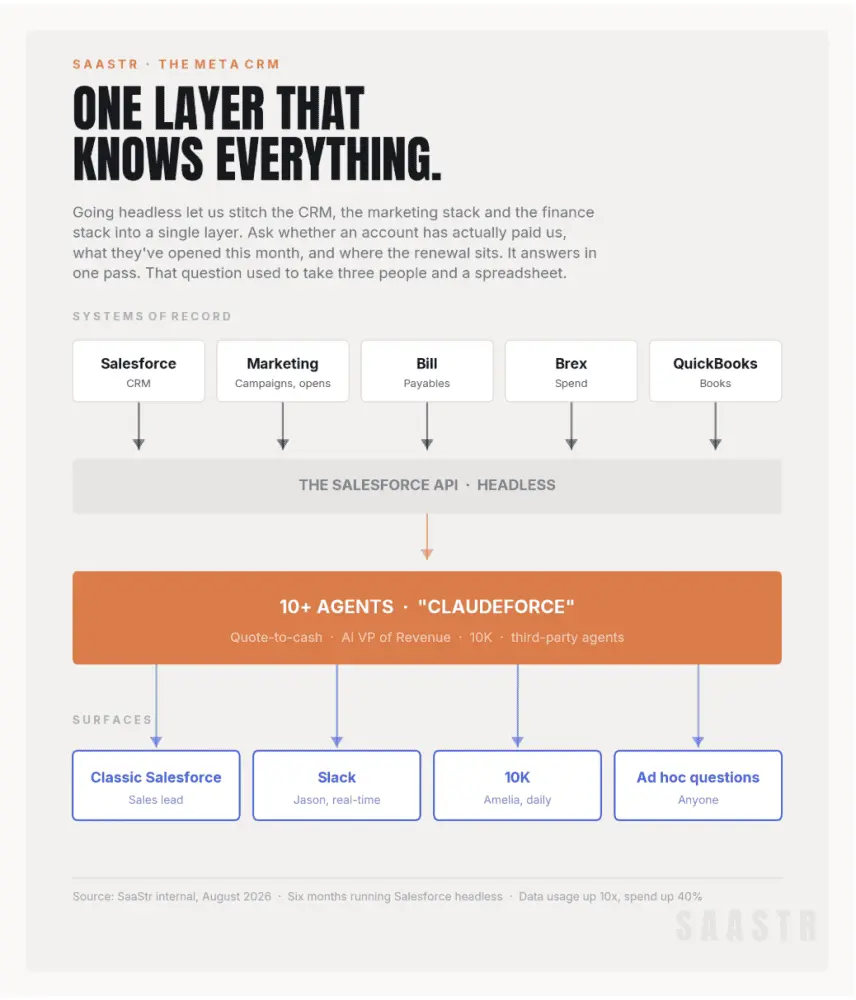
Atop this headless infrastructure, the team deployed an advanced orchestration agent built on Anthropic’s Claude architecture. Internally designated as Claudeforce, the core administrative agent—famously referred to as 10K—was granted real-time programmatic access not only to the CRM, but to more than twenty other production APIs spanning marketing automation, financial ledgers, and communication suites.
Rather than forcing employees to adapt their workflows to a vendor’s preconceived notions of record layout and screen real estate, SaaStr inverted the model. The CRM became a headless database, and the user interface became whatever custom surface best suited the specific human or artificial agent interacting with the data at any given moment.
Supporting Context & Metrics: Six Lessons from the Headless Frontier
Six months into full-scale headless operations, SaaStr has documented a series of profound operational shifts. These findings challenge foundational assumptions held by enterprise software buyers and SaaS vendors alike.
+-----------------------------------------------------------------------+
|                      SaaStr's Headless Metrics                        |
+------------------------+----------------------------------------------+
| Revenue Growth         | +47% Year-Over-Year (Post-Turnaround)        |
| AI Agent Workforce     | 20+ Production Agents (10+ touching CRM)     |
| Data Consumption       | 10x Increase vs. Traditional Human Usage     |
| Salesforce API Bill    | +40% Increase in Platform Costs              |
| Human UI Login Rate    | ~2 times per month (Leadership)              |
+------------------------+----------------------------------------------+
1. The Point of No Return: "We Would Never Go Back"
According to internal leadership accounts, the operational improvement is absolute. The prospect of returning to a world where employees must click through rigid, opinionated screen layouts to manage customer data is viewed as obsolete.
Executive leadership—including CEO Jason Lemkin and co-leaders—report logging into the classic Salesforce web interface roughly twice a month, and even then, primarily to audit obscure database anomalies or trigger isolated marketing workflows. Meanwhile, sales personnel are gradually ceding repetitive pipeline updates to autonomous agents. Far from creating friction, this dual-track evolution has allowed human talent to focus exclusively on high-touch enterprise relationships.
2. Scaling the Agentic Workforce at Zero Marginal Cost
More than half of SaaStr’s active AI agents (10 out of 20+) now interact directly with the headless CRM layer. This pool includes a mix of proprietary agents developed in-house and third-party commercial agents configured to interface with the same open API endpoints.
Once a core system of record goes headless, onboarding a new artificial intelligence agent ceases to be a complex engineering project. It transitions into a routine configuration change. Organizations no longer need to negotiate for UI screen real estate, wait for software vendors to release native integrations, or pay exorbitant per-seat licensing fees for automated workers. Pointing an agent at an open API endpoint yields immediate operational utility, with the marginal cost of deploying the eleventh agent approaching zero.
3. Constructing the "Meta CRM" Across Disparate Stacks
Historically, the greatest friction in enterprise data management has not been data capture, but data fragmentation. Customer records resided in the CRM, marketing engagement metrics lived in separate email platforms, and financial realities were locked away in disconnected accounting suites such as Bill, Brex, and QuickBooks.
By decoupling the database interface, SaaStr successfully stitched these disparate silos into a unified "meta-layer." Unlike traditional executive dashboards that rely on scheduled data synchronization and delayed refresh cycles, this agentic layer features live, concurrent API access to the entire corporate stack.
When leadership queries the system regarding a specific client—asking simultaneously whether an account has settled its invoices, what content collateral they have engaged with over the past thirty days, and what stage their contract renewal occupies—the meta-layer synthesizes the answer instantly. Complex multi-departmental audits that previously required hours of administrative coordination and spreadsheet consolidation are now executed in a single conversational pass.
4. Automated Quote-to-Cash Workflows
Among the most tangible operational triumphs of the headless architecture is the deployment of an end-to-end agentic quote-to-cash workflow.
For over a decade, quote-to-cash automation has been an industry buzzword, yet in practice, it has frequently relied on human operators manually transferring figures between quoting tools, CRM deal records, and invoicing software. By operating on top of a headless Salesforce instance integrated directly with financial tooling, SaaStr eliminated these manual handoffs. The orchestration agent autonomously generates legally binding contracts upon deal closure, routes them for digital signature, and actively tracks payment collections without human intervention.
5. Real-Time Operational Pulses via Slack
The traditional rhythm of executive management involved managers compiling weekly reports and leaders reviewing lagging metrics days after the fact. SaaStr replaced this latency with real-time, agent-driven broadcasting.
The company’s designated "AI VP of Revenue" actively monitors pipeline fluctuations, closed-won contracts, stalled deals, and revenue velocity, pushing real-time updates directly into Slack channels where leadership already collaborates. Business intelligence has transformed from a pull-based reporting task into a push-based operational stream.
6. The Consumption Economics: Data Usage Surges 10x
Perhaps the most critical empirical finding from SaaStr’s experiment centers on platform economics. As human interaction with the UI plummeted, programmatic data consumption skyrocketed.
- Data Usage: Increased by approximately 10x, with projections heading toward a 100x multiplier as agentic workflows expand.
- Platform Costs: API consumption and platform bills increased by 40%.
For enterprise software vendors, this metric shatters conventional SaaS pricing logic. Traditional software businesses rely heavily on per-seat licensing models. However, AI agents do not check CRM records twice a day like human sales representatives; they query databases constantly, driven by zero fatigue and an insatiable appetite for real-time context.
SaaStr’s experience validates market observations from enterprise indices: account growth metrics are becoming a lagging proxy for enterprise AI adoption. True enterprise value is migrating toward consumption volume. Vendors that attempt to throttle API access or penalize high-frequency consumption with punitive pricing models risk driving their customers to build alternative data substrates entirely.
Official Statements & Industry Implications
The pivot executed by SaaStr highlights a widening philosophical chasm between traditional SaaS giants and forward-thinking enterprise buyers.
The Death of the Monolithic Interface
Reflecting on six months of headless operations, SaaStr leadership emphasizes that the fundamental assumption of enterprise software—that a software vendor can design a single, canonical interface that satisfies every user across an organization—is officially dead.
In a mature AI-native enterprise, different stakeholders demand radically different surfaces to interact with the exact same underlying data:
- The Sales Lead relies on traditional record views because deep-dive deal management requires granular visual interfaces.
- Executive Leadership prefers passive, push-based updates delivered directly into communication channels like Slack.
- Strategic Operators engage in open-ended, conversational dialogues with AI agents like 10K to brainstorm pipeline strategies and analyze market trends.
Four distinct roles require four distinct surfaces, all drawing from a single, unified database. The software vendor’s core competency is no longer interface design; it is data integrity, workflow logic, and robust API architecture.
Warning to Enterprise Vendors
The ultimate takeaway for the broader software ecosystem is clear: Support every surface, or become obsolete.
Vendors that attempt to lock customers into proprietary user interfaces, restrict API access, or artificially throttle consumption to protect legacy business models will find themselves circumvented. If a platform makes headless operations difficult, sophisticated enterprises will simply construct their own meta-layers on open substrates, eventually hollowing out the underlying CRM until it is easily replaced.
As SaaStr’s six-month milestone proves, companies that embrace open, API-first architectures will reap exponential rewards in efficiency, unlocking higher data consumption, deeper automation, and unprecedented business agility.
Future Outlook
As the enterprise software landscape moves deeper into the agentic era, SaaStr’s trajectory offers a compelling blueprint for modern scaling.
Looking forward, the boundary between human-designed applications and autonomous agent ecosystems will continue to blur. We are rapidly approaching an economic reality where enterprise software spend is dictated not by human headcount and seat licenses, but by computational throughput and API transaction volume.
For SaaS providers, the mandate for survival is unambiguous: open the APIs, embrace headless flexibility, and prepare infrastructure for an era where machines—not humans—are your primary power users. For enterprise buyers, the path forward has been decisively charted: strip away the interface friction, unleash the agents, and let the data flow freely.