









Executive Overview
The digital retail landscape is undergoing a structural paradigm shift. As artificial intelligence transitions from conversational novelties into autonomous enterprise execution, the infrastructure supporting global ecommerce is adapting in real time. This week’s roundup of merchant services highlights a defining trend: the convergence of automated agentic workflows, multi-channel ad attribution, cross-border logistics orchestration, and embedded financial services.
Major logistics heavyweights, cloud infrastructure giants, and commerce platforms are rapidly deploying tools designed to strip friction from discovery, conversion, and fulfillment. From Maersk’s strategic integration with ShippyPro to empower carrier choice, to Shoppable and ESW embedding universal checkouts directly within generative AI ecosystems like ChatGPT and Microsoft Copilot, merchants are no longer waiting for customers to visit traditional web stores. Instead, checkout is decentralizing, moving directly to where consumers discover products.
Concurrently, B2B marketplaces are modernizing their payment rails—exemplified by Amazon Business introducing Affirm as its premier buy-now, pay-later (BNPL) checkout option—while enterprise tools from Algolia, Miva, and Lightspeed Commerce empower retailers with predictive search dynamics and closed-loop in-store advertising attribution. This report provides an exhaustive, chronologically structured analysis of the latest product releases, strategic partnerships, and platform updates shaping the future of digital and physical commerce.
Detailed Chronology of New Merchant Tools and Platform Updates
Logistics, Fulfillment, and Supply Chain Infrastructure
1. Maersk Expands Global Capabilities Through ShippyPro Partnership
Global integrated logistics leader Maersk has announced a strategic partnership with global shipping management platform ShippyPro. Designed to alleviate the operational bottlenecks faced by scaling digital brands, this collaboration merges ShippyPro’s multi-carrier management capabilities with Maersk’s sprawling physical logistics network. The integration gives merchant customers unprecedented flexibility and automated carrier choice, allowing them to dynamically route shipments, optimize delivery costs, and scale operations seamlessly across international borders without getting locked into rigid carrier contracts.

2. Flowspace Launches $50,000 Fulfillment Freedom Fund
Fulfillment technology provider Flowspace has introduced the "Fulfillment Freedom Fund," allocating up to $50,000 in volume-based transition support for qualifying ecommerce brands. The fund is specifically engineered to offset the financial and operational friction associated with legacy platform exits and onboarding hurdles. Alongside financial relief, participating merchants gain immediate access to Flowspace’s distributed network across the United States and Canada, orchestrated via an AI-powered software dashboard that automates inventory placement and intelligent order routing.
3. Basic 3PL Debuts "GO" on Shopline
Nationwide logistics provider Basic 3PL has launched GO, a self-service onboarding solution built for native integration with Shopline, an omnichannel commerce platform serving over 700,000 merchants. Through this integration, Shopline users can complete required verification workflows during their standard platform setup. Once verified, merchants are automatically provisioned into Basic 3PL’s nationwide fulfillment network, driven by the Soapbox order management system, to optimize transit speeds and inventory geographic proximity.
Agentic Commerce and AI-Driven Discovery
4. Shoppable Integrates Universal Checkout Plugin in ChatGPT
Commerce infrastructure provider Shoppable has launched its Universal Checkout plugin within the ChatGPT plugin directory. Built upon the universal checkout Model Context Protocol (MCP) server released earlier this year, Shoppable’s tool brings multi-retailer product discovery, cart consolidation, and transaction handling directly to U.S.-based ChatGPT users. This integration provides brands with a unified connection point to a backend capable of handling cross-retailer cart building and payment processing entirely within a conversational UI.
5. Fastly Joins Experian Agent Trust Ecosystem for AI Security
Cloud computing and content delivery network Fastly has partnered with credit data and analytics provider Experian to join the Agent Trust ecosystem. As autonomous AI agents increasingly execute transactions on behalf of human consumers, verifying agent authenticity has become a critical security priority. Fastly’s programmable edge platform extends Experian’s framework, allowing enterprises to evaluate AI agent identity, delegated authority, underlying intent, and payment credentials at the network edge before requests ever touch backend database systems.
6. ESW Launches "Agentic Commerce" with Microsoft Copilot
Global ecommerce engine ESW has rolled out Agentic Commerce, a new technology suite enabling brands to optimize product catalogs for AI discovery platforms and process secure checkouts natively within generative shopping experiences. Microsoft Copilot serves as the premier integration for the launch. By embedding checkout directly inside the Copilot interface, ESW aims to eliminate the historical drop-off points that occur when a consumer transitions from AI-driven product recommendations to a traditional web checkout funnel.
7. Novi Integrates with Syndigo to Accelerate AI Content Syndication
Novi, a platform that optimizes product content so AI search assistants like ChatGPT and Gemini can accurately find and recommend items, has announced a deep integration with product content syndication network Syndigo. The collaboration allows brands to flow Novi-optimized, AI-ready product content directly into Syndigo’s expansive retail network—which includes giants like Amazon, Walmart, and Target. This direct pipeline dramatically shortens the path from AI-driven product recommendation to multi-channel retail execution.
Payments, Financial Risk, and Post-Purchase Innovation
8. Cleo Updates AI-Powered Chargeback Prevention Solution
Supply chain orchestration and B2B integration platform Cleo has upgraded its Chargeback Prevention and supply chain suite for retail suppliers. Utilizing AI-powered pattern detection, the system automatically analyzes operational data streams to flag risks, surface demand signals, and prevent costly retail chargebacks. Furthermore, its Dynamic Insights feature introduces conversational intelligence for real-time reporting, while 3PL Order Intelligence extends visibility directly into outsourced warehousing and multi-enterprise order management workflows.
9. Amazon Business Adds Affirm as First BNPL Checkout Option
Amazon Business has selected Affirm as its inaugural pay-over-time payment option at checkout. The integration enables eligible B2B customers—particularly sole proprietors and small business owners—to split the cost of eligible equipment and supplies into manageable installments without incurring late or hidden fees. Amazon Business has confirmed that the capability will roll out across all eligible business accounts ahead of the Black Friday shopping surge.
10. Swap Launches "Checkout+" for Post-Purchase Revenue Generation
Ecommerce storefront and returns specialist Swap has introduced Checkout+, a modular add-on designed to transform standard post-purchase logistics into a revenue-generating channel. The tool bundles free return shipping and order protection into a single opt-in consumer experience at checkout. Brands earn a direct share of the opt-in revenue, while Swap covers return shipping through its integrated carrier network and resolves claims via an automated portal operating at an agreed-upon claim rate.
Advertising Attribution and Omnichannel Management
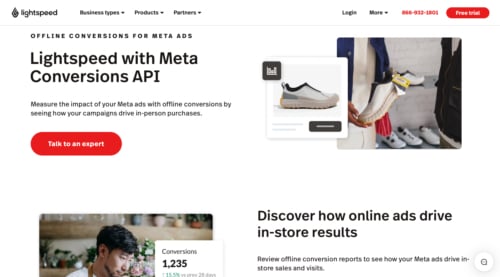
11. Lightspeed Commerce Integrates Meta Conversions API
Omnichannel platform Lightspeed Commerce has launched a native integration with the Meta Conversions API, bridging the traditional gap between digital advertising and brick-and-mortar retail revenue. By connecting Lightspeed point-of-sale systems directly to Meta, retailers can automatically sync in-store product catalogs and securely transmit physical transactions back to Meta. This unified data flow improves ad relevance, optimizes campaign delivery, and allows merchants to accurately measure how digital ad spend drives physical, in-store foot traffic and sales.
12. Shopify Expands Shop Campaigns to the United Kingdom
Shopify has officially expanded its performance-based marketing program, Shop Campaigns, to the U.K. and select international markets. Previously limited to North America, Shop Campaigns allows merchants to promote products across the native Shop app and external channels including Meta, Google, X, Snap, and Pinterest within a single campaign structure. Uniquely, merchants operate on a cost-per-sale model, only paying platform fees when a promoted view results in a completed transaction.
Developer Tools, Site Search, and Marketplace Enhancements
13. Neon Secures $13 Million Series A to Expand In-Game Commerce
Commerce infrastructure startup Neon has successfully closed a $13 million Series A funding round led by Andreessen Horowitz and Renegade Partners, with strategic participation from major game developer Krafton. Neon provides robust direct-to-consumer infrastructure—such as branded web stores and loyalty programs—for video game publishers. The fresh capital will be deployed to scale engineering teams, expand market footprint, and enhance in-game purchasing capabilities, bringing Neon’s total venture funding to $27 million.
14. Whop Launches Command-Line Interface (CLI) for Developers and AI Agents
API-driven business launch platform Whop has released Whop CLI (Command-Line Interface), granting business operators and their autonomous AI agents direct, full-stack API access via a streamlined, language-based interface. The CLI allows technical merchants and automated multi-agent systems to manage inventory, digital assets, and transactions programmatically, building upon the company’s recent releases of Whop Cards and Whop Ads.
15. Algolia Introduces "Dynamic Facets" for Intelligent Site Search
AI site-search pioneer Algolia has announced Dynamic Facets, an intelligent search capability that automatically reorders and prioritizes product filters (such as size, color, brand, or technical specifications) in real time based on contextual search queries and live shopper behavior. By displaying only the most contextually relevant filters for any given query, Dynamic Facets minimizes search friction and accelerates conversion rates.
16. Meta Launches "Seller" App for Facebook Marketplace
Meta has released a standalone mobile application named Seller, specifically tailored for high-volume merchants and independent operators utilizing Facebook Marketplace. The app provides users with advanced AI-powered listing creation tools, a unified customer messaging inbox, centralized inventory management, and granular performance metrics (including impressions, clicks, and conversion threads). All listings and customer chats sync seamlessly between the mobile app and the main Facebook Marketplace ecosystem.
17. Miva Releases 26R2 Update for Mid-Market Merchants
Enterprise ecommerce platform Miva has announced the immediate availability of 26R2, its latest platform update focused on merchandising control and storefront acceleration. The release enhances Vexture merchandising, allowing merchants to dynamically build tailored product showcases using natural-language AI prompts, complex category rules, and real-time search queries. Additionally, 26R2 introduces optimized page caching architecture and expanded category facet accessibility to boost overall site performance.
Supporting Context & Metrics
The velocity of these product announcements underscores several critical macroeconomic and technological shifts in global commerce:
- The Rise of Autonomous Commerce: Industry estimates suggest that conversational AI search interfaces and autonomous agents will account for a double-digit percentage of all digital discovery pathways by the end of the decade. Tools from Shoppable, ESW, Fastly, and Novi indicate that infrastructure providers are heavily investing in trust frameworks and universal checkouts to secure these nascent revenue streams.
- Omnichannel Attribution Necessity: With privacy regulations tightening and cookie deprecation altering digital tracking, solutions like Lightspeed’s Meta Conversions API integration and Shopify’s international Shop Campaigns expansion represent a desperate need for brands to unify offline point-of-sale data with online marketing metrics.
- Logistics Agility as a Competitive Moat: Partnerships like Maersk and ShippyPro, alongside Flowspace’s financial transition fund and Basic 3PL’s Shopline integration, highlight that modern merchants demand plug-and-play logistics orchestration to hedge against supply chain volatility and escalating shipping costs.
Official Statements and Industry Perspectives
Commenting on the structural evolution of AI-driven transactions, industry leaders emphasized the transition from passive browsing to active execution.
"As autonomous commerce accelerates from experimental chat interfaces to fully realized agentic workflows, enterprises require absolute certainty regarding agent identity, intent, and payment authorization. Our integration with Experian’s Agent Trust ecosystem establishes the necessary security guardrails at the network edge to ensure safe, scalable AI-driven trade."
— Representative, Fastly
Similarly, regarding the convergence of logistics and carrier choice, supply chain analysts note that flexibility is no longer a luxury for digital merchants.
"By combining ShippyPro’s sophisticated shipping management architecture with Maersk’s global physical footprint, we are delivering the exact modularity that modern merchants require to navigate complex international markets without operational friction."
— Spokesperson, Maersk
Future Outlook: What to Watch in the Months Ahead
As we look toward the remainder of the year and into 2027, several key trajectories are poised to dominate the ecommerce technology sector:
- Standardization of Agentic Protocols: As more platforms adopt Model Context Protocol (MCP) servers and universal checkout APIs (exemplified by Shoppable and ESW), expect broader industry standardization around how AI agents authenticate with retail backends. Security frameworks like Fastly and Experian’s Agent Trust will likely become table stakes for enterprise brands engaging in automated commerce.
- The Blurring of B2B and B2C Checkout Experiences: The integration of Affirm into Amazon Business signals a broader trend: business buyers increasingly expect the flexible, consumer-grade financing options that have long dominated direct-to-consumer retail. B2B platforms will face mounting pressure to modernize their payment rails.
- Hyper-Personalized Merchandising via Generative AI: With Miva’s 26R2 AI prompt merchandising and Algolia’s Dynamic Facets hitting the market, static category pages are rapidly becoming obsolete. The future storefront will dynamically assemble itself in milliseconds based on the nuanced intent of each individual visitor, whether human or algorithmic.
Merchants and technology leaders must evaluate their current tech stacks against these emerging capabilities to ensure they remain competitive in an increasingly automated, omnichannel marketplace.