Executive Overview
In a landmark transaction that underscores the shifting paradigm of modern defense procurement, Castelion—a high-flying missile technology startup founded by veterans of the commercial space industry—has officially closed a staggering $1 billion Series C funding round. The financing values the Torrance, California-based enterprise at an imposing $13 billion.
The funding round was co-led by a powerhouse consortium comprising venture capital titan Andreessen Horowitz (a16z), private equity giant The Carlyle Group, and financial services colossus JPMorgan Chase. The transaction structure comprises $800 million in equity alongside a $250 million revolving credit facility, bringing the company’s total war chest to unprecedented levels for a venture-backed defense hardware firm. The round also saw enthusiastic participation from existing high-profile investors, including Lightspeed Venture Partners, General Catalyst, and Altimeter Capital.
Founded in 2022 by former executives of aerospace pioneer SpaceX, Castelion was established with a singular, disruptive mission: to bypass the bureaucratic inertia, exorbitant costs, and glacial timelines of traditional defense "prime" contractors. By applying commercial aerospace iteration speeds, advanced manufacturing techniques, and vertical integration to the defense sector, Castelion aims to mass-produce hypersonic weapon systems—missiles capable of traveling at speeds exceeding Mach 5—at a fraction of the traditional cost and time.
This massive influx of capital arrives at a critical juncture for U.S. national security. For years, the Pentagon has expressed mounting concern over a widening strategic gap between the United States and foreign adversaries, most notably China, in the development, testing, and stockpiling of operational hypersonic capabilities. Castelion’s rapid rise—marked by more than $500 million in cumulative U.S. military contracts secured since its inception—positions the startup as a vanguard in the ongoing effort to rebuild America’s advanced tactical deterrent infrastructure through commercial agility.
Detailed Chronology: From Garage Concept to Defense Heavyweight
The 2022 Genesis: Challenging the Defense Industrial Complex
The genesis of Castelion traces back to 2022, a watershed year for venture-backed defense technology (often termed "deftech"). Frustrated by the protracted development cycles and entrenched monopolies of legacy defense contractors—such as Lockheed Martin, Raytheon, and Northrop Grumman—a cohort of engineering and operations veterans from SpaceX decided to apply commercial "NewSpace" principles to tactical missiles.
Traditional defense procurement has long been characterized by decades-long research and development phases, rigid cost-plus contracting models, and production lines that operate at artisan speeds. Castelion’s founders recognized that modern great-power competition requires an entirely different operational cadence: fast iteration, commercial-off-the-shelf (COTS) supply chain integration, and iterative hardware testing modeled after commercial rocket development.
Operating out of Southern California—a historic hub for aerospace innovation—the company quickly garnered attention from forward-leaning venture capital firms. By late 2023, Castelion had emerged from stealth mode, securing early-stage backing from Andreessen Horowitz and signaling its intent to aggressively challenge the status quo of military hardware manufacturing.
Rapid Scaling and Contract Accumulation (2024–2025)
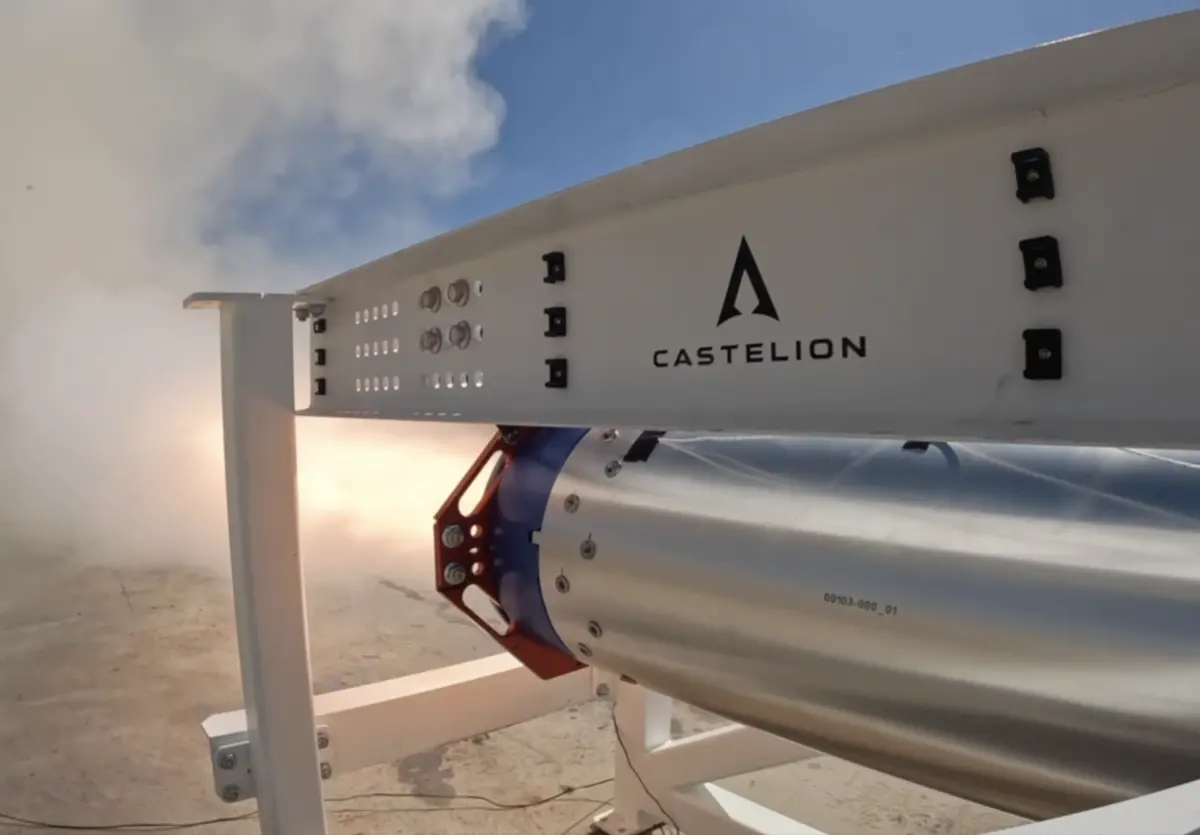
Unlike many software-centric defense startups that spend years pitching conceptual models to the Department of Defense (DoD), Castelion immediately prioritized physical hardware and rapid flight testing. The company invested heavily in test infrastructure, focusing on the engineering challenges associated with hypersonic flight: extreme thermal management, guidance systems capable of surviving plasma sheaths, and propulsion efficiency.
This rapid-fire testing schedule paid off swiftly. Over the subsequent two years, Castelion secured a succession of critical U.S. military contracts totaling more than $500 million. These awards were not merely exploratory research grants; they involved tangible milestones, rapid prototyping initiatives, and direct integration studies with various branches of the armed forces.
The company’s momentum culminated in July 2025, when Castelion announced a heavily subscribed $350 million Series B funding round. That capital injection allowed the company to transition from a pure R&D shop into a low-rate initial production (LRIP) entity, setting the stage for its current, monumental Series C capitalization.
The $1 Billion Milestone (August 2026)
The announcement of the $1 billion Series C round on August 20, 2026, marks a historic milestone in the venture capital financing of hardware-heavy defense tech. Crossing a $13 billion valuation threshold places Castelion in an elite tier of private defense companies, rubbing shoulders with autonomous systems leaders like Anduril Industries.
The inclusion of financial behemoths such as JPMorgan Chase alongside traditional venture capital and private equity underscores a broader macroeconomic shift: Wall Street and institutional capital markets are increasingly viewing national security tech not as a niche, morally complex asset class, but as a vital, high-growth sector essential to global stability and technological supremacy.
Supporting Context & Metrics: Closing the Hypersonic Gap
The Strategic Imperative: Mach 5 and Beyond
To understand the underlying market demand driving Castelion’s astronomical valuation, one must examine the current geopolitical and strategic landscape of modern missile warfare. Hypersonic weapons—defined as systems that travel at speeds of Mach 5 (five times the speed of sound) or faster while executing complex aerodynamic maneuvers within the atmosphere—represent the bleeding edge of modern military capability.
Unlike traditional ballistic missiles, which follow a predictable, parabolic arc, hypersonic glide vehicles (HGV) and hypersonic cruise missiles can maneuver unpredictably at low-to-mid altitudes. This combination of extreme speed and evasive maneuverability renders legacy missile defense radar and interceptor networks largely obsolete, creating a profound strategic vulnerability for any nation lacking a robust counter-stockpile or offensive capability.
The U.S. vs. China Hypersonic Disparity
For much of the past decade, defense analysts and Congressional panels have warned that the United States has fallen significantly behind its primary geopolitical rivals in the operational deployment of hypersonic systems. While the People’s Republic of China and the Russian Federation have successfully tested and fielded multiple operational hypersonic platforms, the U.S. military’s programs have faced persistent technical setbacks, budgetary hurdles, and flight-test failures.
The core of the American challenge has not been a lack of fundamental scientific brilliance, but rather a structural bottleneck in manufacturing capacity and testing cadence. Legacy prime contractors, bound by bureaucratic oversight and complex subcontracting chains, have historically struggled to build these systems at scale.

Castelion’s entire business model is engineered to solve this specific bottleneck. By controlling the manufacturing pipeline end-to-end and utilizing commercial manufacturing techniques, the startup aims to deliver high volumes of hypersonic munitions at a fraction of the cost per unit historically demanded by traditional primes.
Inside the Arsenal: The "Blackbeard" Missile Program
At the core of Castelion’s manufacturing push is its flagship weapon system: the Blackbeard missile. Named after the legendary English pirate, the Blackbeard program is designed to deliver tactical hypersonic strike capabilities from standard deployment platforms.
While specific technical performance metrics remain classified, public disclosures indicate that the Blackbeard system is engineered for rapid deployment, high reliability, and cost-effective mass production. The new $1 billion capital injection will directly fund the expansion of Castelion’s manufacturing footprint to support full-scale production of the Blackbeard line, transforming it from a developmental prototype into a readily available shelf-item for the U.S. armed forces.
Official Statements & Industry Perspectives
The announcement of the $13 billion valuation drew significant commentary from the leaders of Castelion, its co-lead investors, and the broader defense technology ecosystem.
Investor Confidence and Strategic Alignment
Representing the co-lead investors, representatives from Andreessen Horowitz, Carlyle, and JPMorgan Chase emphasized the existential necessity of scaling defense industrial capacity.
"The security of democratic nations depends on our ability to out-innovate and out-produce our adversaries," noted a spokesperson closely associated with the investment syndicate. "Castelion has proven that commercial agility can be successfully applied to the most demanding domains of national security hardware. We are not just investing in a company; we are investing in the revitalization of the American defense industrial base."
Carlyle, with its deep roots in aerospace and defense private equity, brings invaluable expertise in navigating government regulatory frameworks, facility security clearances, and large-scale manufacturing logistics. Meanwhile, JPMorgan Chase’s participation—facilitating both equity and a substantial revolving credit facility—signals a sophisticated blending of venture capital risk tolerance with institutional debt structures capable of supporting heavy industrial scaling.
Leadership Vision
Castelion’s leadership team, composed of seasoned engineers who cut their teeth managing complex aerospace programs at SpaceX, has consistently maintained a hyper-pragmatic approach to defense technology. Their operational philosophy is built on the premise that quantity has a quality of its own, and that expensive, exquisite weapons systems are of little use if they cannot be manufactured in sufficient numbers during a prolonged conflict.
While company executives have maintained strict operational security regarding precise manufacturing output targets and classified contract details, previous statements from co-founders underscore their core mission:
"We set out to bridge the gap between what the Department of Defense needs and what the traditional industrial base has been able to deliver," leadership noted during previous program rollouts. "Hypersonic deterrence is not just about a successful physics demonstration in a laboratory; it is about industrial repeatability, supply chain resilience, and the ability to put reliable hardware into the hands of warfighters at scale."
Future Outlook: Scaling Production and the Road Ahead
Expanding New Mexico’s Defense Footprint
With $1 billion in fresh capital secured, Castelion’s immediate operational focus turns to physical expansion. Headquartered in Torrance, California—where much of the advanced research, avionics development, and preliminary engineering takes place—the company is rapidly scaling its manufacturing and testing infrastructure.
A primary beneficiary of the Series C funding will be Castelion’s growing production facility in New Mexico. The state has long been a vital hub for American aerospace, missile testing, and defense research, hosting major installations such as White Sands Missile Range and Air Force Research Laboratory facilities. By establishing a robust manufacturing footprint in New Mexico, Castelion gains immediate geographic proximity to world-class testing corridors, enabling shorter feedback loops between assembly and flight-testing.
The Evolution of the Defense Tech Ecosystem
Castelion’s blockbuster funding round is emblematic of a broader, irreversible shift in venture capital and national security strategy. Over the past five years, the venture capital ecosystem has poured tens of billions of dollars into dual-use and defense-focused startups, challenging the decades-old oligopoly of traditional defense primes.
Companies specializing in autonomous drones, counter-UAS (unmanned aerial systems) tech, artificial intelligence for command and control, and advanced hypersonic propulsion are redefining how the Pentagon procures technology. However, among this cohort, Castelion stands apart due to the extreme physical and engineering complexity of its chosen domain: hypersonics.
Challenges on the Horizon
Despite its meteoric rise and massive valuation, Castelion will face significant headwinds as it transitions from a high-growth startup into an established defense supplier.
- Supply Chain Resilience: Procuring exotic materials capable of withstanding extreme thermal and mechanical stresses at Mach 5 remains a notoriously difficult supply chain challenge.
- Regulatory & Political Scrutiny: As a major recipient of taxpayer-funded defense contracts, Castelion will face intense scrutiny regarding cost accountability, manufacturing timelines, and program performance.
- Talent Acquisition: Competing with tech giants and commercial space leaders for top-tier propulsion engineers, metallurgists, and software architects remains fiercely competitive.
Conclusion
Castelion’s $1 billion Series C round at a $13 billion valuation is more than just a massive financial transaction—it is a clear signal that the U.S. defense apparatus is embracing commercial innovation to meet the urgent security challenges of the 21st century. By marrying the speed and risk-tolerance of Silicon Valley venture capital with the rigorous demands of military hardware manufacturing, Castelion is positioning itself to fundamentally alter the balance of power in hypersonic technology. As the company breaks ground on expanded production in New Mexico and accelerates the rollout of the Blackbeard missile system, the world will be watching to see if commercial agility can successfully reforge America’s strategic deterrent.