CHESAPEAKE, Virginia — As speculative land banking reaches a fever pitch across the mid-Atlantic, the Praetorian Fund’s pending acquisition of a sprawling, approximately 4,000-acre industrial site in Chesapeake, Virginia, has ignited a complex debate over local zoning, digital infrastructure capacity, and the future of regional growth.
While the transaction positions the massive parcel—known as the Coastal Virginia Commerce Park—for high-impact commercial use, neither the developer nor city officials have publicly identified a specific end-user, tenant, or data center project for the property. This absence of a confirmed customer has created a regulatory and utility paradox: a site equipped with a clear legal path for data center development and a multi-year history of heavy-industrial planning, yet operating completely devoid of a locked-in power commitment or a publicly disclosed blueprint.
The unfolding situation in Chesapeake highlights the high-stakes balancing act municipalities face as they court hyperscale data center developers and advanced manufacturing operations. With local authorities simultaneously trying to tighten citywide zoning restrictions on digital infrastructure, the Praetorian Fund transaction serves as a bellwether for how large-scale land banking, power grid bottlenecks, and community opposition intersect in the modern era of artificial intelligence and cloud computing.
Executive Overview
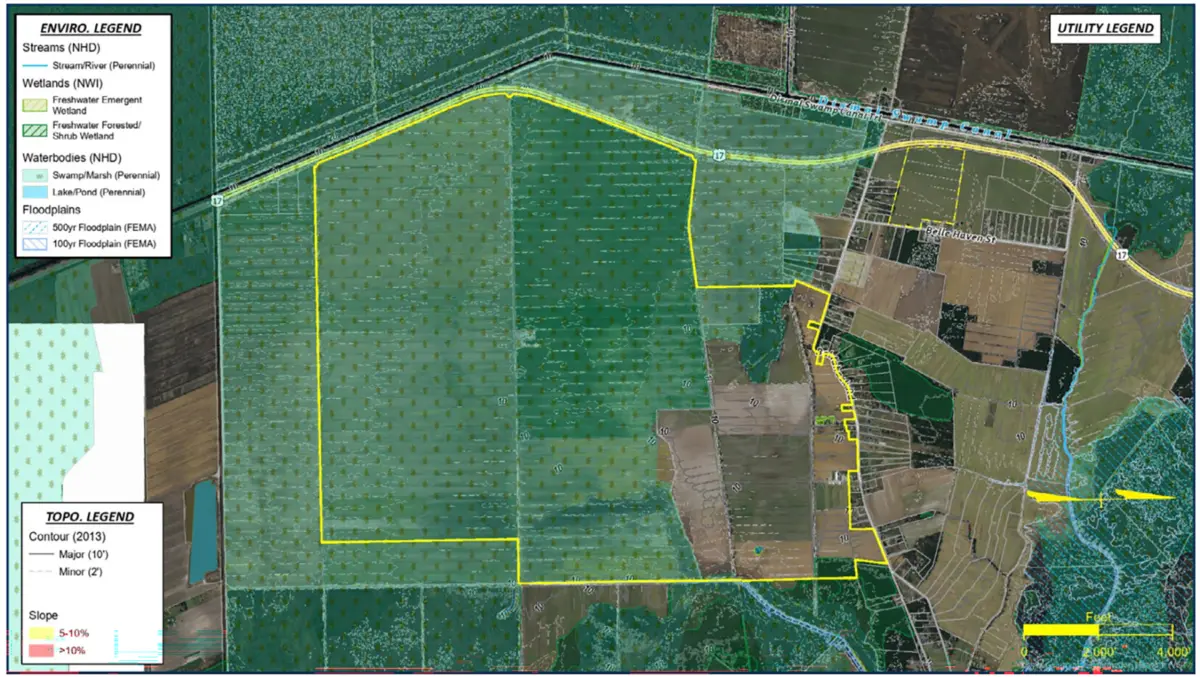
The planned acquisition by the Praetorian Fund centers on roughly 4,000 acres of prime industrial land situated along US Route 17, immediately proximate to the North Carolina border. Originally conceptualized by Chesapeake leaders as a premier "megasite" to attract heavy advanced manufacturing—ranging from automotive assembly lines to electric vehicle battery plants—the property has evolved into a blank canvas for potential digital infrastructure.
Through its specialized arm, Praetorian Data Solutions (PDS), the developer has cultivated a reputation focused on hyperscale data campuses, edge facilities, and the complex digital infrastructure required to support next-generation computing workloads. Yet, despite the developer’s digital pedigree, local elected officials remain largely in the dark. City leadership confirms that no formal project proposals, electric load projections, or transmission collaboration requests with utility provider Dominion Energy have been presented to the Chesapeake City Council.
This lack of transparency arrives at a critical juncture. The Chesapeake City Council is actively reviewing a sweeping overhaul of its data center ordinances, aiming to introduce stricter conditional-use rules and comprehensive infrastructure impact reviews. However, because the Coastal Virginia Commerce Park operates under an existing, pre-approved Planned Unit Development (PUD) framework established in 2022, data centers remain a permitted use on portions of the property. This regulatory friction between existing entitlements and newly proposed municipal restrictions has put the city, the developer, and local conservationists on a collision course.
Detailed Chronology of the Coastal Virginia Commerce Park
To understand the current uncertainty surrounding the Praetorian Fund acquisition, one must examine the multi-decade evolution of the property and Chesapeake’s aggressive economic development strategy.
The Origins of a Megasite Vision
Chesapeake’s ambition for the property dates back to the early 2020s. Around 2021, municipal economic development officials identified the site as a top-tier contender in competitive bids for major advanced manufacturing projects. During this phase, city planners collaborated closely with utility stakeholders—including Dominion Energy, Columbia Gas, and the municipal utility department—to evaluate whether core infrastructure could be extended to support massive industrial loads.
When those initial manufacturing bids ultimately went to competing states, Chesapeake did not abandon the land. Instead, city leaders continued speculative infrastructure planning, conducting preliminary evaluations of water, wastewater, and electrical capacities to ensure the site remained turnkey-ready for future mega-projects.
Municipal Acquisition Efforts Stymie
The city’s pursuit of the property was not always limited to facilitation. According to Vice Mayor S.Z. “Debbie” Ritter, Chesapeake previously attempted to acquire the acreage directly to bring the entire footprint under municipal control.
However, preliminary financial assessments revealed that acquiring the land and provisioning the necessary utility extensions would exceed $150 million. Unwilling to burden local taxpayers with such an immense financial obligation without guaranteed financial backstopping from the Commonwealth of Virginia, the city ultimately abandoned its acquisition efforts. This paved the way for private-equity-backed entities like the Praetorian Fund to step in and secure control of the massive land bank.
The Praetorian Fund Enters the Picture
With Praetorian’s acquisition announcement, the property’s trajectory shifted. While city officials knew that Praetorian had been engaged in acquisition talks with the prior landowner, no direct dialogue regarding specific end-uses has taken place between the city and the buyer. According to Stephen Wright, Chesapeake’s economic development director, Praetorian has not requested municipal assistance, zoning modifications, or infrastructure interventions thus far, keeping its precise commercial strategy tightly under wraps.
Supporting Context, Regulatory Frameworks, and Metrics
The intersection of a 4,000-acre land acquisition and the explosive demand for data center real estate brings several critical municipal, legal, and operational factors to the forefront.
Zoning Realities and the 2022 PUD Guidelines
The Coastal Virginia Commerce Park is governed by a Planned Unit Development (PUD) framework codified in 2022. Under these existing guidelines, data centers are explicitly listed as an allowable use across designated parcels within the roughly 1,420 acres of the park that have already undergone rezoning.
Stephen Wright noted that the city has routinely provided these development guidelines to corporate entities expressing interest in the site. This historical allowance creates an intriguing legal dynamic, as it insulates the property from some of the stricter administrative hurdles currently being erected by municipal policy-makers.
Tightening Citywide Rules
The contrast between the commerce park’s pre-approved status and Chesapeake’s broader municipal policy is striking. In January, the Chesapeake City Council initiated a comprehensive zoning amendment targeting data centers across the city. The proposed changes would reclassify data centers from permitted uses to conditional uses within specified industrial districts and the sensitive Fentress Airfield Overlay District.
Furthermore, a draft data center policy released in June mandates rigorous reviews encompassing:
- Power consumption and electrical grid impacts.
- Water and wastewater demands for operational cooling.
- Acoustic profiles and noise mitigation strategies.
- Infrastructure proximity, prioritizing sites located within 0.5 miles of existing high-voltage transmission corridors to prevent the proliferation of unsightly and costly new transmission lines.
The Chesapeake City Council is scheduled to review and deliberate on these proposed zoning amendments, adding a layer of urgency and regulatory scrutiny to large-scale industrial planning within city limits.
Infrastructure Versus Customer Commitment
Industry analysts emphasize the vital distinction between land-banking for infrastructural potential and securing an actual, executable customer. Neil Osnato, founder of Persistence Analytics Group, highlights this dynamic:
"The most important distinction is between designing a megasite capable of receiving extraordinary load and having an executable large-load customer already committed to it."
While Chesapeake’s historical utility planning proves the site can handle substantial industrial activity, the lack of a named tenant or a committed power load leaves open questions about the true scale of future development. Stephen Wright noted that while various prospective manufacturing users have inquired about power loads over the years, none have requested utility commitments scaling into the 100-megawatt (MW) tier typically associated with hyperscale data center campuses. Whether Praetorian intends to attract a user of that magnitude remains unverified.
Official Statements and Stakeholder Perspectives
As the community braces for the City Council’s upcoming policy decisions, key stakeholders have articulated vastly different views on the acquisition and its potential ramifications for the region.
Praetorian Fund’s Stance
In communications with Data Center Knowledge, representatives for the Praetorian Fund maintained a guarded posture while expressing confidence in the region’s long-term commercial appeal. The organization emphasized that the property possesses "multiple potential uses" and noted that the high volume of inbound market interest validates the acute demand for a contiguous development site of this magnitude in Coastal Virginia.
"Our goal is to bring a world-class development that will attract new business, jobs, tourism and economic development to Chesapeake and the Commonwealth of Virginia as a whole," Praetorian stated, adding that additional details will be publicly shared as the project progresses through its nascent development phases.
Local Government Caution
City leadership is maintaining a watchful stance. Vice Mayor S.Z. “Debbie” Ritter confirmed that local elected officials have received zero briefings regarding Praetorian’s internal development roadmap, intended utility loads, or preliminary conversations with Dominion Energy regarding the construction of dedicated electrical substations.
Stephen Wright reiterated that the city’s past infrastructural inquiries with Dominion were speculative exercises designed to test general site capacity rather than responses to a specific tenant’s demands. As discussions continue, the utility infrastructure required to support high-draw tenants will necessitate substantial capital investment from whichever entity ultimately develops the land.
Community Opposition and Environmental Concerns
Not all local stakeholders view the megasite project with optimism. Environmental groups and long-standing community coalitions that opposed Chesapeake’s original industrial megasite push remain steadfast in their resistance.
Jeff Staples, a representative for the anti-industrial advocacy group Save the Dismal, which has opposed the development of the area since 2015, voiced deep skepticism regarding the Praetorian acquisition.
"We still oppose the construction of a megasite or anything industrial there," Staples stated, noting that the group was caught off-guard by the transaction announcement.
Staples pointed out that while data centers were not a primary community concern during the initial phases of the megasite push nearly a decade ago, the modern threat of massive digital infrastructure compounds existing fears regarding the expansion of public utilities, natural gas infrastructure, and environmental degradation near protected ecological zones.
Future Outlook: What Lies Ahead for Chesapeake
The Praetorian Fund’s acquisition of the Coastal Virginia Commerce Park represents a critical inflection point for municipal planning and digital infrastructure deployment in the mid-Atlantic.
Over the coming weeks and months, several key milestones will shape the property’s trajectory:
- City Council Zoning Decisions: The August 18 consideration of the proposed data center zoning amendments will signal whether Chesapeake intends to clamp down on unvetted digital infrastructure or carve out exceptions for pre-entitled megasites like the commerce park.
- Utility Load Transparency: As Praetorian advances its internal master planning, formal engagement with Dominion Energy regarding high-voltage transmission lines and substation placements will ultimately reveal whether the site is destined for heavy manufacturing, a massive hyperscale data center campus, or a hybrid commercial development.
- Community Resistance: Environmental advocates and local residents are expected to ramp up pressure on local legislators, ensuring that any future infrastructure build-out faces intense public scrutiny.
Ultimately, the 4,000-acre Chesapeake megasite stands as a monument to modern economic development strategy—a vast expanse of potential caught between the immense economic allure of the digital age and the very real physical, infrastructural, and environmental limits of the communities that host them.